Tag: gas shortfall

  • Shaukat Tarin denies what he said on national television

    Shaukat Tarin denies what he said on national television

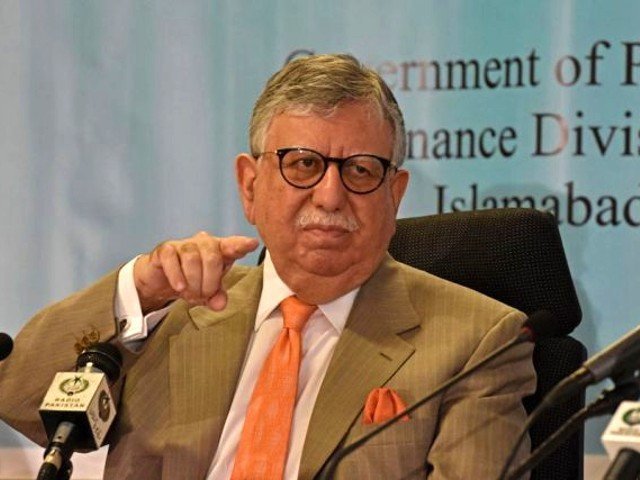
    Advisor to the Prime Minister on Finance Shaukat Tarin admitted to the present gas crisis in the country on Samaa News. However, a day later, Tarin denied his own words and issued a clarification.

    After the show was aired and various news media outlets covered the story,  Energy Minister Hammad Azhar took to Twitter and blamed Geo for manipulating Tarin’s words.

    Hammad tweeted, “What Tarin actually said: -intl prices high due to global shortage. -Noone can predict intl price. – some time ago (July) they had refused a tender (July) but that was for a limited time & wouldn’t have changed things now.”

    “Geo: Gas crises due to not purchasing LNG on time, Fin Min,” added Hammad.

    Shaukat Tarin, after admitting to the gas crisis, took to Twitter and shared his clarification.

    https://twitter.com/shaukat_tarin/status/1463427014711468036

    “News item published in Daily The News titled ‘Govt couldn’t purchase gas Cargoes in time, admits Tarin’ is completely misleading & out of the context,” read the statement.

    “When anchor (Nadeem Malik) asked about the gas shortfall situation in the country, he stated the reasons including the ongoing global LNG shortages which have created fiasco, and it was not in control of anybody.”

    “Government has been buying the gas as required, despite higher international prices. However, he has mentioned there was one tender scrapped in July, but this has nothing to do with winter gas. The Adviser Finance has not mentioned at any point that winter gas shortfalls are due to non-procurement of LNG on time.”

    On November 23, Shaukat Tarin appeared on Samaa News’ programme, ‘Nadeem Malik Live’, and said the very words being denied now.

    “We [government] should have bought the gas cargoes on time as the purchasing time for it was over,” said Tarin.

    Tarin further said nobody knew about the international prices, which he stated were quite high, and that the government should have bought some cargoes earlier.

  • ‘Government should have bought gas cargoes earlier’: Shaukat Tarin admits to gas crisis

    ‘Government should have bought gas cargoes earlier’: Shaukat Tarin admits to gas crisis

    Advisor to the Prime Minister on Finance Shaukat Tarin admitted to the present gas crisis in the country.

    While speaking on Samaa News’ programme, ‘Nadeem Malik Live’, Shaukat Tarin said, “We [government] should have bought the gas cargoes on time as the purchasing time for it was over.”

    Tarin further said nobody knew about the international prices, which he stated were quite high and that the government should have bought some cargoes earlier.

    Tarin said the country’s imports of petroleum and gas touched almost $20 billion per year, which had been at $12 to $13 billion per year and now it had to pay $7-8 billion more in that regard.

    Shaukat Tarin said that as per the market pundits, the prices would come down during December and January when the intensity of the Covid-19 pandemic would start declining.

    Speaking on the gas crisis, Tarin said Pakistani companies were supplying gas to consumers. He added that a couple of gas discoveries were made in Lakki Marwat, however, money was needed for the extraction process.

    Last week, Energy Minister Hammad Azhar took to Twitter to challenge journalist Shahzeb Khanzada to a debate on Liquefied Natural Gas (LNG) and gas.

    Shahzeb Khanzada, a year ago, had warned that the gas crisis was impending, kept reiterating that the crisis needs immense attention, otherwise the consequences shall be huge.

    Azhar took to Twitter and proposed a challenge.

    “I would like to challenge Shahzeb Khanzada to debate LNG and Gas issues with me moderated by a neutral anchor and with Independent experts. Let the ppl [people] see the facts without persistent interrupting, volume controls, teleprompters etc,” tweeted Azhar.

  • Shahzeb Khanzada warns of December crisis, Hammad Azhar ignores question in heated debate

    Shahzeb Khanzada warns of December crisis, Hammad Azhar ignores question in heated debate

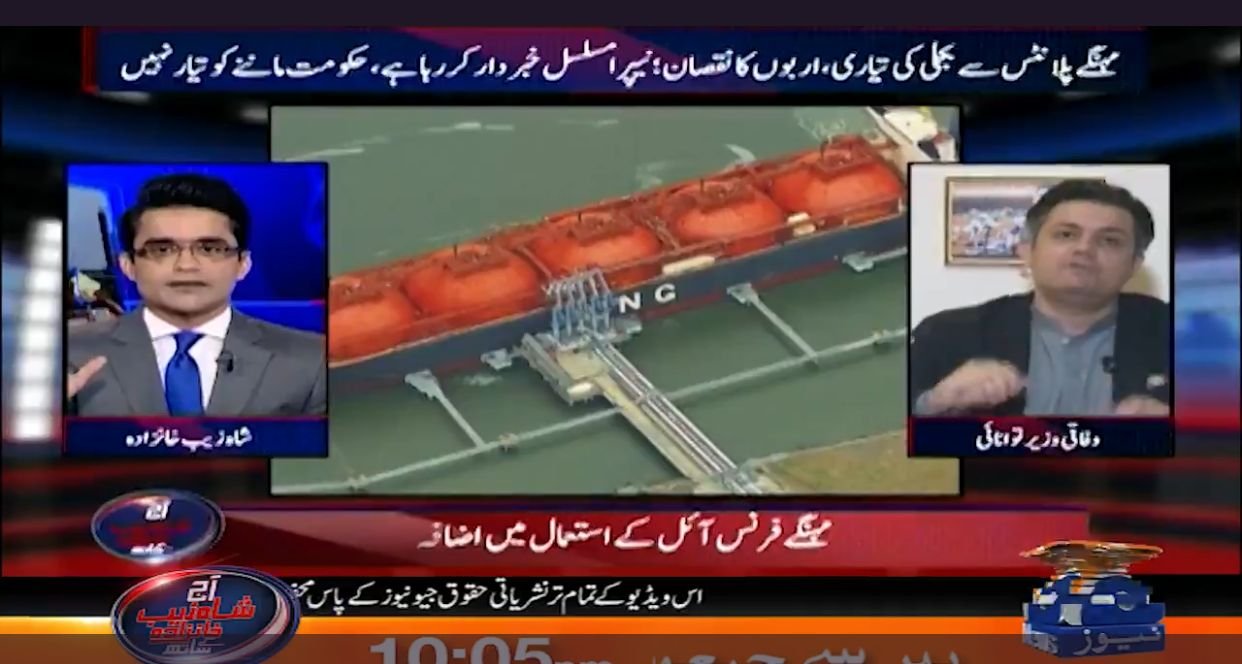
    Energy Minister Hammad Azhar appeared in Geo News’ programme Aaj Shahzeb Khanzada Kay Sath on Monday, during which the minister indulged in a heated debate with the host of the programme, Shahzeb Khanzada.

    During the show, Khanzada asked Azhar about the expected shortfall of gas in the winter season but the minister refused to answer the question. The minister kept refusing to answer the question about an expected gas crisis in December saying that he will appear again to talk about it.

    The federal minister said that he has only come to talk about the facts presented on Friday’s episode of the programme. The host mentioned that in Friday’s programme, he did talk about the expected shortfall of gas in the winter.

    The show on Friday, October 15, shared data from a report, compiled by Nepra, on the performance of the Ministry of Energy and asked the question: why is the ministry delaying the purchase of liquefied natural gas (LNG), which is costing the public dearly.

    Khanzada claimed earlier that he had invited the minister on his show 27 times, but the minister refused to come.

    Earlier in Friday’s show, Khanzada warned of the expected gas shortage during the winter season as Pakistan will not have the required number of LNG cargoes. He explained that during the winter season the government will only have 10 LNG cargoes. The government has the capacity to have 14 LNG cargoes but in the winter, the demand for LNG is more than 14 cargoes.

  • Naya Pakistan: ‘Gas shortage to double’

    Naya Pakistan: ‘Gas shortage to double’

    With a projected shortfall of 477 million cubic feet per day (mmcfd) and amid lack of new explorations, the shortage of gas is likely to be doubled next year, Cabinet Committee on Energy (CCoE) has been informed.

    According to Profit, a meeting of the CCoE, chaired by Adviser to Prime Minister on Finance and Revenue Dr Abdul Hafeez Shaikh, was informed on Wednesday that the demand of gas had risen by 5 per cent per annum during the past seven years.

    The heavy gas shortfall recorded last month (December 2019) was nearly 270 mmcfd.

    “One of the major reasons for this upsurge was the consumption of gas in the winter season by the domestic sector, which prefers to use heavily-subsidised gas as compared to other energy sources,” officials of the Ministry of Energy informed the CCoE.

    The committee was further told that work on adding 70 mmcfd gas in the Sui Southern Gas Company’s system and taking LNG supplies for Sui Northern Gas Pipeline up to 1,300 mmcfd had already started but its implementation was hampered by issues pertaining to the grant of ‘Right of Ways’ from the Sindh government, which had granted only one RoW so far while two more were still awaited since last summer.

    “With these measures, nearly 70 mmcfd gas is likely to be added to SSGC by the end of January.”

    According to the energy ministry, in view of 2020-21 projections showing a shortfall of 477 mmcfd, the government has decided to build additional terminals; five new private terminals were awarded in Nov 2019, while process for a dedicated pipeline of 1.2BCFD+, required to carry imported LNG from these terminals to north, would also begin soon.

    The CCoE noted that there was a need to work on contingency plans for 2020-21 to overcome the gas shortage. It stressed using energy produced through gas and electricity as a whole to provide more options to energy consumers and to bring efficiency in the system.

    Earlier, the Ministry of Energy briefed the CCoE on the current demand-supply situation of gas/RLNG, natural gas allocation and management, average gas supplies, winter load management, indigenous gas production, supplies and consumption in different regions, and LNG requirement by the SNGPL/SSGC.

    The CCoE asked the ministry to brief in the next meeting the current situation in the power sector so that the problems in both gas and power sectors could be properly analyzed and contextualized uniformly and a realistic and more efficient solution to bridge the demand and supply gap could be chalked out.