Tag: Gaza

  • US says new sanctions on Iran coming soon

    US says new sanctions on Iran coming soon

    The United States said Tuesday it would soon impose new sanctions on Iran’s missile and drone program after its retaliatory attack on Israel, and that it expects its allies and partners to follow with parallel measures.

    US National Security Advisor Jake Sullivan’s announcement came after Treasury Secretary Janet Yellen indicated punitive measures were in the works, and European Union foreign policy chief Josep Borrell said his office was working on it.

    Iran sent more than 300 missiles, drones and rockets at Israel over the weekend, in what it said was retaliation for a deadly strike on Tehran’s consulate in Damascus. Nearly all of the projectiles were intercepted, and there was little damage.

    “In the coming days, the United States will impose new sanctions targeting Iran, including its missile and drone program” as well as the Revolutionary Guards and the Iranian defense ministry, Sullivan said in a statement.

    “We anticipate that our allies and partners will soon be following with their own sanctions,” he added.

    “These new sanctions and other measures will continue a steady drumbeat of pressure to contain and degrade Iran’s military capacity and effectiveness and confront the full range of its problematic behaviors.”

    US authorities have been using economic tools to counter Iran’s activities, taking aim at its drone and missile programs, as well as its financing of groups like Hamas, which launched its own attack on Israel on October 7.

    Earlier, Yellen previewed the sanctions, telling reporters: “Iran’s actions threaten the region’s stability and could cause economic spillovers.”

    The Treasury will not hesitate to work with US allies to “use our sanctions authority to continue disrupting the Iranian regime’s malign and destabilizing activity,” she said.

    She added that “all options to disrupt terrorist financing” will be on the table.

    ‘More that we could do’

    Months of Israeli genocide in Gaza have triggered violence in the region involving Iranian proxies and allies who say they are acting in support of Palestinians in the Gaza Strip.

    But tensions have soared even higher with Tehran’s first direct assault on Israel, which has prompted appeals for de-escalation by world leaders fearing wider conflict.

    Yellen did not offer specifics on the possible measures to be taken, but said Washington has been working to diminish Iran’s ability to export oil, adding there might be “more that we could do.”

    The United States is also looking to work with G7 partners and countries including China to constrain Iran’s ability to access goods needed to build weapons, a senior Treasury official told reporters.

    “We’re going to have conversations with all major suppliers around the world,” the official said.

    In Brussels, Borrell said after an emergency meeting of EU foreign ministers that some member states had proposed “the adoption of expanded restrictive measures against Iran” and that his office would begin preparatory work.

    “We have to move away from the edge of the abyss,” Borrell said.

    Sullivan said that Washington had sanctioned more than 600 Iran-linked individuals and entities “connected to terrorism, terrorist financing and other forms of illicit trade, horrific human rights abuses, and support for proxy terrorist groups.”

    “The pressure will continue,” he warned.

    “We will not hesitate to continue to take action, in coordination with allies and partners around the world, and with Congress, to hold the Iranian government accountable for its malicious and destabilizing actions.”

    bys-sst/nro

    © Agence France-Presse
  • UN agency finds unexploded 1,000-pound bombs in Gaza schools

    UN agency finds unexploded 1,000-pound bombs in Gaza schools

    The UN agency for Palestinian refugees said Tuesday it had found unexploded 1,000-pound bombs inside schools after Israel pulled troops out of southern Gaza’s main city Khan Yunis.

    The Israeli army has carried out relentless air strikes and bombardments in Gaza since October 7 attacks.

    UN agencies led an “assessment mission” in Khan Yunis after Israeli forces withdrew from the embattled city last week, UNRWA said.

    It found “significant challenges in operating safely due to the presence of unexploded ordnance (UXOs), including 1,000-pound bombs inside schools and on roads”.

    “Thousands of internally displaced persons (IDPs) require a range of lifesaving assistance, including health, water and sanitation, and food,” it said.

    Earlier this month, the United Nations said it would take “millions of dollars and many years to decontaminate the (Gaza) Strip from unexploded munitions”.

    “We work off the rule of thumb that 10 percent of ordnance doesn’t function as designed,” UN Mine Action Service chief Charles Birch said in a statement earlier this month.

    “We estimate that, to begin the clearance of Gaza, we need around $45 million.”

    Israeli genocide in Gaza since October 7 has killed at least 33,843 people in the besieged strip, mostly women and children, according to the health ministry.

    lcm/jd/kir

    © Agence France-Presse

  • Five Palestinians sue Germany over weapons for Israel

    Five Palestinians sue Germany over weapons for Israel

    Five Palestinians living in the Gaza Strip have filed a legal complaint in Berlin against the German government over its delivery of weapons to Israel, an NGO representing them said Friday.

    The complaint seeks to “revoke the export licences issued by the German government for arms deliveries to Israel”, the European Center for Constitutional and Human Rights (ECCHR) said in a statement.

    A spokeswoman for the administrative court in Berlin confirmed it received the complaint late Thursday. The five plaintiffs live in different parts of the Gaza Strip, including Rafah, the official added.

    The Palestinians are “challenging the authorisation already granted for the delivery of anti-tank weapons” and seeking to stop deliveries that have not yet been authorised, the spokeswoman said.

    The complaint is directed against the economy ministry, which now has two weeks to respond.

    The five Palestinians have all had family members killed in Israeli missile attacks since Hamas attacks on Israel on October 7, according to the ECCHR.

    The plaintiffs say Berlin is failing to fulfil its obligations under international law, including the 1948 United Nations Genocide Convention.

    “Germany cannot remain true to its values if it exports weapons to a war in which serious violations of international humanitarian law are evident,” said Wolfgang Kaleck, general secretary of the ECCHR.

    Germany is the second biggest arms exporter to Israel after the US, accounting for 30 percent of imports between 2019 and 2023, according to the Stockholm International Peace Research Institute (SIPRI).

    Berlin is facing a case in the International Court of Justice in which Nicaragua says it is in breach of the UN Genocide Convention, set up after the Holocaust.

    On Tuesday, Berlin’s representatives insisted that Germany supplied arms only “on the basis of detailed scrutiny… that far exceeds the requirements of international law”.

    Israeli genocide in Gaza Strip has killed more than 33,000 people since October 7, according to the Gaza health ministry.

  • Will work with Iran: Zardari urges Iranian President to mutually share security intelligence

    Will work with Iran: Zardari urges Iranian President to mutually share security intelligence

    President Asif Ali Zardari, and the President of Iran Ebrahim Raisi, talked on the phone and greeted each other for Eid-ul-Fitr.
    President Asif Ali Zardari expressed his sincere condolences and sympathy to the Iranian leadership and the families who lost loved ones in the Israeli attack on the Iranian embassy in Damascus during the conversation.

    Zardari voiced his worry about the humanitarian crisis and the genocide happening because of Israeli forces. He demanded an instant ceasefire in Gaza.

    President Asif Ali Zardari assured his Iranian counterpart that Pakistan would continue to work with Iran in all areas of mutual interest to further boost bilateral cooperation.

    He emphasized the importance of improving how information is shared to tackle the security issues both countries are dealing with.

  • How humanitarian aid reaches war-torn Gaza

    How humanitarian aid reaches war-torn Gaza

    Most aid bound for war-ravaged Gaza arrives overland from neighbouring Egypt but Israel and UN agencies clash on how much actually makes it inside the Palestinian territory.

    The volume of aid entering Gaza by road each day through the Rafah crossing from Egypt is insufficient, aid workers say, blaming rigorous Israeli inspections at least in part.

    With no truce in sight to pause the Israel-Hamas war, here is a look at how aid currently reaches Gaza and what alternatives are being weighed to alleviate the crisis in the besieged Palestinian territory.

    First stop: Egypt

    Most Gaza-bound goods arrive by sea in the Egyptian ports of Port Said or El-Arish.

    El-Arish is closer to Gaza but also smaller, and was quickly overwhelmed by the volume of shipments arriving, aid groups say.

    Israeli authorities, who have blockaded Gaza since Hamas took sole control of the Palestinian territory in 2007, require that all aid entering Gaza be inspected by them.

    The main inspection area for goods is Kerem Shalom in southern Israel, not far from the Rafah crossing.

    Another inspection area exists in Nitzana, on the Israeli-Egyptian border about 40 kilometres (25 miles) to the southeast.

    Long wait for trucks

    Before reaching the inspection areas, many aid trucks wait for days at the Egyptian side of the Rafah checkpoint.

    Once inspected, goods that are cleared to enter by Israel are unloaded from the mostly Egyptian trucks in the zone between Egypt and Gaza.

    The supplies are then loaded onto separate vehicles, driven by Gazans working for aid groups, for distribution inside the Palestinian territory.

    Cumbersome screenings are a major reason shortages are so glaring, aid workers say.

    Israel blames a lack of sufficient capacity on the Palestinian side to distribute the aid once it gets in.

    In recent days, Israel took issue with UN figures on the number of trucks entering Gaza, accusing UN Palestinian refugee agency UNRWA of counting only trucks it had processed, not those processed by Israel.

    Heading north

    For months, aid groups and foreign governments including top ally the United States have urged Israel to reopen border crossings into the north of Gaza, where the humanitarian crisis is most severe.

    Israel announced that six World Food Programme (WFP) aid trucks entered the north directly from its territory in early March, in what it described as a “pilot project”.

    The trial was not extended, however, and aid convoys bound for northern Gaza must travel the length of the territory negotiating battlegrounds, Israeli bombardments and mobs of desperate civilians.

    In March, the WFP said one of its convoys had been blocked by Israeli forces inside Gaza before it could reach the north.

    After turning back, the agency said the convoy was looted by a “crowd of desperate people”.

    According to Israeli authorities, 28 trucks reached northern Gaza on Wednesday.

    They were among 298 trucks that Israel said entered Gaza on Wednesday, still far below the number aid groups say is needed to sustain the territory’s 2.4 million people.

    Under pressure from the international community, Israel announced on April 5 that it would open a new crossing directly into northern Gaza, without specifying its exact location or when it would open.

    By air and by sea

    In a bid to get round the logjam, several Arab and European governments, later joined by Washington, began carrying out aid airdrops over Gaza, particularly the north.

    But the airdrops have proved controversial, with multiple deaths among civilians on the ground who were crushed by aid crates when parachutes failed to open, or drowned trying to reach others accidentally dropped in the sea.

    There has also been an attempt to establish a maritime aid corridor from the Mediterranean island of Cyprus but it has largely fizzled out after seven aid workers were killed by Israeli fire on April 1 as they unloaded food from the second flotilla to make the crossing.

    Even though the Cypriot government insists it has not given up on the aid corridor, no further crossings are currently planned after the US and Spanish charities behind the first two suspended their operations in the region.

    UN agencies have in any case said repeatedly that road convoys are the only practical way of meeting Gaza’s needs.

  • Israel on alert after Iranian threat as genocide in Gaza grinds on

    Palestinian Territories – Israel was on alert Thursday after Iran threatened reprisals over a strike in Syria this month that killed two Iranian generals, and as genocide in Gaza continues.

    Days after Israel strengthened its air defences and paused leave for combat units, the United States also warned of the risk of an attack by Iran or its allied groups at a time Middle East tensions have soared.

    Iran is “threatening to launch a significant attack on Israel,” US President Joe Biden said Wednesday, pledging “ironclad” support for its top regional ally despite diplomatic tensions over Israel’s military conduct in Gaza.

    Israel was widely blamed for an April 1 attack that destroyed Iran’s consulate building in Damascus and killed seven Revolutionary Guards, including two generals.

    Iran’s supreme leader, Ayatollah Ali Khamenei, warned Wednesday that Israel “must be punished and will be punished”, days after one of his advisers said Israeli embassies are “no longer safe”.

    Israeli Foreign Minister Israel Katz swiftly replied on social media site X that “if Iran attacks from its territory, Israel will respond and attack Iran”.

    Biden said he had told Israeli Prime Minister Netanyahu that “our commitment to Israel’s security against these threats from Iran and its proxies is ironclad”.

    US Central Command chief Michael Kurilla was in Israel on Thursday to discuss the situation with Defence Minister Yoav Gallant, the Pentagon said.

    “We warned Iran,” Press Secretary Karine Jean-Pierre told a briefing without elaborating.

    During a visit to an airbase in central Israel, Netanyahu spoke of “challenging times” on multiple fronts.

    “We are in the middle of the war in Gaza which continues in full force… but we are also preparing for scenarios of challenges from other arenas,” he said in comments released by his office.

    Moscow called on both Iran and Israel to exercise restraint.

    German Foreign Minister Annalena Baerbock urged “maximum restraint”, and Lufthansa said it had extended a temporary suspension of Iran flights until Saturday.

    Iranian Foreign Minister Hossein Amir-Abdollahian said he had received phone calls Thursday from Baerbock as well as her British and Australian counterparts.

    In a post on X, he said he had told them that “when the Zionist regime breaches the immunity of diplomatic persons and places” and the UN Security Council fails to condemn it, “legitimate defence… is a necessity”.

    Israel and the United States have long faced off against Iran and its so-called “Axis of Resistance” allies based in Lebanon, Iraq, Syria and Yemen.

    ‘Panic among children’

    Regional tensions have been stoked following October 7 attack in Israel left.

    Israeli genocide in Gaza has killed at least 33,545 people, mostly women and children, according to the Hamas-run territory’s health ministry.

    Hamas said 20 people were killed in Israeli bombardments on Thursday. It said two schools and two mosques were among the buildings hit and an imam was among the dead.

    In the Nuseirat area, which took the brunt of the bombing, Imad Abu Shawish, 39, said “the situation is dire and still getting worse. Bombardment hasn’t stopped and is still happening now.”

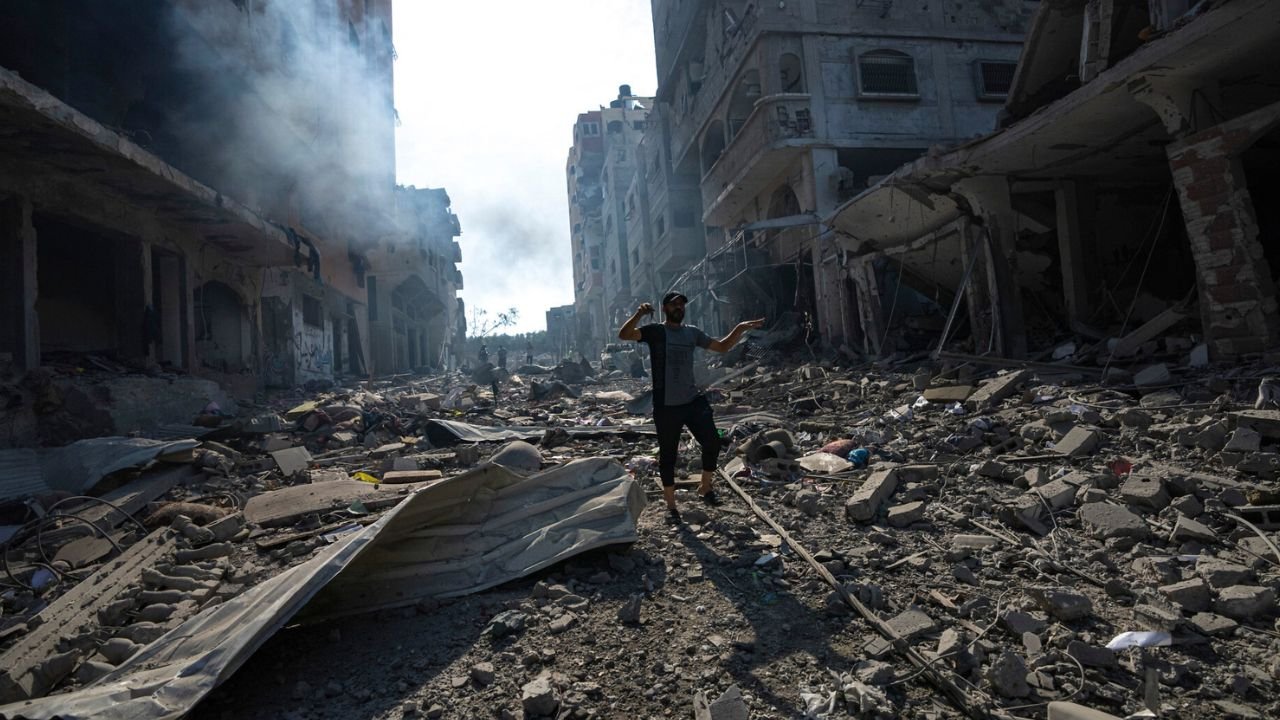
    Much of Gaza has been reduced to a bomb-cratered wasteland, with yet more bodies feared under the rubble.

    An Israeli siege has deprived Gaza’s 2.4 million people of most food, water, fuel and medicines, the dire shortages only alleviated by sporadic aid deliveries.

    Israeli war cabinet member Benny Gantz said Wednesday “Hamas is defeated” militarily but pledged to keep fighting “what remains of it” in the years to come.

    An Israeli air strike on Wednesday killed three sons of Hamas’s Qatar-based leader Ismail Haniyeh.

    Haniyeh insisted their deaths would not influence Hamas’s position in ongoing talks in Cairo for a truce and hostage release deal.

    Those talks, which started Sunday, have brought no breakthrough on a plan presented by US, Qatari and Egyptian mediators, which Hamas said it was studying.

    The framework plan would halt fighting for six weeks and see the exchange of about 40 hostages for hundreds of Palestinian prisoners, as well as more aid deliveries.

    Biden said that “it’s now up to Hamas, they need to move on the proposal that’s been made”.

    Israel accused Hamas Thursday of “walking away” from what government spokesman David Mencer called “a very reasonable offer on the table”.

    Hamas official Bassem Naim said only a ceasefire could provide “enough time and safety” to locate Israeli hostages held across the territory and ascertain their fate because they are held by different groups.

    ‘Destabilising Middle East’

    Washington has ramped up pressure on Netanyahu to agree to a truce, increase aid flows and abandon plans to send troops into Gaza’s far-southern city of Rafah where about 1.5 million civilians are sheltering.

    Rafah is the last Gazan city yet to face a ground incursion.

    Gallant promised Israel would “flood Gaza with aid”, using an Israeli crossing point, streamlined checks and two new routes organised with Jordan.

    He said they expected to reach 500 aid trucks a day, the pre-war average.

    However, a UN Security Council statement Thursday said “more should be done to bring the required relief given the scale of needs in Gaza”.

    Israel has faced a chorus of international criticism over its handling of the war.

    Spain is among several Western nations, including Ireland and Australia, to have suggested they would recognise a Palestinian state as a starting point for wider peace talks.

    Spanish Prime Minister Pedro Sanchez warned that Israel’s “disproportionate response” in Gaza risked “destabilising the Middle East and, as a consequence, the entire world”.

    burs-jd/srm/kir

    © Agence France-Presse

  • Gazans mark ‘saddest’ Eid with little to celebrate or eat

    Gazans mark ‘saddest’ Eid with little to celebrate or eat

    Gazans did their best to celebrate the end of Ramadan in the driving rain on Wednesday, as the genocide ravaged on with 14 killed, including children, in a strike on their home, the health ministry said.

    The Israeli military said it struck several targets on the first day of the Eid al-Fitr holiday, with a jet hitting a rocket launch site and troops killing a “terrorist cell” in close quarters fighting.

    An AFP photographer witnessed the aftermath of the the bombing of the home in Nuseirat refugee camp in central Gaza. Family members clutched the bodies of dead children at the Al-Aqsa Martyrs Hospital in nearby Deir el-Balah.

    There was no immediate comment from the Israeli army.

    Israel said 468 aid trucks — a record since the October 7 — were allowed into Gaza on the eve of the holiday which marks the end of the Muslim fasting month and is traditionally celebrated with family gatherings.

    But with the United Nations warning the besieged territory is on the verge of famine, there was little to feast on for the 2.4 million residents of Gaza, up to 1.5 million of whom are crammed into camps around the far-southern city of Rafah.

    The faithful gathered at dawn outside the city’s flattened Al-Farooq Mosque, where worshipper Khairi Abu Singer complained that Israel’s relentless bombardment had even “deprived Palestinians from praying inside their mosques”.

    Father-of-four Ahmed Qishta, 33, told AFP there was little to celebrate at what should be a joyous time.

    “We prepared sweets and biscuits from the aid we got from the UN and now we are giving it to the children. We try to be happy but it is difficult.”

    He said they went to pray at the graves of family members killed in the war before going to the Ibn Taymiyyah mosque for Eid prayers.

    There has never been “such an Eid — all sadness, fear, destruction and a grinding war”, he said.

    Abir Sakik, 40, who fled her home in Gaza City with her family and is now living in a tent in Rafah, said she had no “ingredients for the cakes and sweets” she would usually make.

    Instead she made cakes from crushed dates. “We want to rejoice despite all the blood, death and shelling,” she told AFP.

    ‘Enough of war’

    Sakik said that despite it being a religious holiday, the Israeli military “committed a massacre and killed women and children” in the camp.

    “We are tired and weary — enough, enough of war and destruction,” she said, adding that Gazans were desperate for a truce.

    “We try to bring joy to the children. Before all this, there was a great atmosphere at Eid with the children’s toys, the Eid cakes, the food, the chocolates in every house — everything was sweet and beautiful.

    “But they destroyed all of Gaza,” she said.

    Nihaya Atallah, 49, from Jabalia camp in northern Gaza, also celebrated the festival in a tent in Rafah. “Our spirits are broken, our homes destroyed,” she told AFP.

    “There’s no Eid, no joy, only war and loss.”

    Rafah resident Moaz Abu Moussa said that “despite the pain and massacres, we will show our happiness in these difficult circumstances”.

    “We don’t care about the war, we will live Eid like other Muslims and show our happiness to the displaced people and families of martyrs and detainees.”

    Meanwhile in Jerusalem tens of thousands of worshippers poured into the Al-Aqsa mosque compound, Islam’s third holiest site, for morning prayers.

    “It’s the saddest Eid ever,” said nurse Rawan Abd, 32, from Israeli-annexed east Jerusalem. “At the mosque you could see the sadness on people’s faces.”

    In the occupied West Bank, the atmosphere was even more sombre, with many Palestinians in the flashpoint northern city of Jenin visiting its cemetery to pray for those who have been killed since the Israeli genocide in Gaza began.

    Israeli offensive has killed at least 33,482 people in Gaza, mostly women and children, according to the health ministry.

    bur-fg/hkb

    © Agence France-Presse

  • Israel bombs Gaza during Eid despite US rebuke

    Israel bombs Gaza during Eid despite US rebuke

    GAZA STRIP: Israeli strikes hit Gaza on Wednesday as Muslims marked the end of the holy fasting month of Ramzan and after US President Joe Biden labelled Israel’s approach to the war a “mistake”.

    Palestinians gathered for morning prayers on the first day of the Eid al-Fitr holiday amid the ruins of Gaza, which has been devastated by more than six months of war since October 7.

    Tens of thousands also flocked to Israeli-annexed east Jerusalem’s Al-Aqsa mosque compound where one worshipper, nurse Rawan Abd, said: “It’s the saddest Eid ever… you could see the sadness on people’s faces.

    “Usually we come to Al-Aqsa to celebrate, this year we came just to support each other,” the 32-year-old said at Islam’s third holiest site, which is also revered by Jews as the Temple Mount.

    Israeli forces kept up combat operations and air strikes on Gaza a day after Prime Minister Benjamin Netanyahu vowed no let-up in the campaign to destroy Hamas and bring home the hostages.

    Netanyahu insisted on that “no force in the world” would stop Israeli troops from entering Gaza’s far-southern city of Rafah which is packed with displaced Palestinians.

    His threat came amid ongoing talks in Cairo involving US, Egyptian and Qatari mediators for a truce and hostage release deal.

    Biden, voicing his growing frustration with hawkish Netanyahu, issued some of his sternest criticism yet of the war, which has brought mass civilian casualties and widespread suffering.

    “I think what he’s doing is a mistake,” Biden told Spanish-language TV network Univision in an interview that aired Tuesday night after being recorded last week. “I don’t agree with his approach.”

    He urged Netanyahu to “just call for a ceasefire, allow for the next six, eight weeks, total access to all food and medicine going into the country.”

    ‘Famine-like conditions’

    The war broke out with October 7 against Israel, which resulted in the deaths of 1,170 people, mostly civilians, according to Israeli figures.

    Palestinian also took about 250 hostages, 129 of whom remain in Gaza, including 34 the Israeli army says are dead.

    Israel’s retaliatory offensive has killed at least 33,360 people in Gaza, mostly women and children, according to Gaza’s health ministry.

    Another 14 people were killed – including small children – in a strike on a home in Nuseirat camp in central Gaza, the health ministry said.

    The army said Wednesday that “Israeli troops are continuing to operate in the central Gaza Strip and killed a number of terrorists over the past day”.

    It added that aircraft had “struck dozens of terror targets in the Gaza Strip, including military sites, launchers, tunnel shafts and infrastructure.”

    Israel has imposed a siege that has deprived Gaza’s people of most food, water, fuel, medicines, and other essential goods.

    Humanitarian groups have accused Israel of using starvation as a weapon of war in Gaza, where UN experts say half the population is facing “catastrophic” food insecurity.

    Washington’s recent tougher line with Israel, its main ally in the region, has brought some results, according to the US Agency for International Development.

    Recent days had seen a “sea change” in aid deliveries, said USAID administrator Samantha Power, with Israel reporting 468 trucks entering from Egypt on Tuesday.

    However, Power stressed that Israel needs to do more, saying that “we have famine-like conditions in Gaza, and supermarkets filled with food within a few kilometres away” in southern Israel.

    Washington has also resumed funding to the UN agency for Palestinian refugees after cutting it weeks ago after Israel claimed that some UNRWA staff took part in the October 7.

    ‘It will be punished’

    Hamas has said it is studying the latest proposal for a truce. A framework being circulated would halt fighting for six weeks and see the exchange of about 40 hostages for hundreds of Palestinian prisoners.

    However, Hamas has so far also publicly insisted on a full withdrawal of Israeli ground forces and a permanent ceasefire – demands Israel has rejected outright.

    US National Security Advisor Jake Sullivan said Tuesday that Israel had to “take some steps forward” while Hamas’s public statements had been “less than encouraging”.

    The US State Department has however also warned Israel that “a full-scale military invasion of Rafah would have an enormously harmful effect” on civilians and “would ultimately hurt Israel’s security”.

    US Secretary of State Antony Blinken said Tuesday he had no indication of an “imminent” assault on the city, where around 1.5 million Palestinians are sheltering.

    Blinken also said he doubted Israel would attack Rafah before a delegation is set to visit Washington next week.

    Regional tensions have surged amid the Gaza war, and Israel was widely blamed for an April 1 strike on arch foe Iran’s consulate in Damascus that killed seven Revolutionary Guards.

    Iran’s supreme leader Ayatollah Ali Khamenei warned Israel that “the evil regime made a mistake in this regard. It must be punished and will be punished.”

    Israeli Foreign Minister Israel Katz swiftly replied with a Persian-language post warning that “if Iran attacks from its territory, Israel will respond and attack Iran.”

  • Israel’s Netanyahu says ‘there is a date’ for Rafah invasion

    Israel’s Netanyahu says ‘there is a date’ for Rafah invasion

    Israeli Prime Minister Benjamin Netanyahu said Monday that a date has been set for a ground offensive in Rafah, which Israel says is one of the last Hamas strongholds in Gaza.

    Around 1.5 million Gazans are sheltering in the city, which has so far not experienced a large-scale Israeli ground assault.

    Netanyahu did not say when the invasion would occur but reiterated that victory over Hamas militants “requires entry into Rafah and the elimination of the terrorist battalions there.

    “It will happen — there is a date,” he said in a video statement.

    He was speaking as talks in Cairo over a Gaza ceasefire and hostage deal appeared to be gathering momentum.

    Netanyahu is under pressure at home from his far-right coalition partners who are angry at talk of a truce as well as Israel pulling its troops out of southern Gaza on Sunday.

    “Today I received a detailed report on the talks in Cairo,” Netanyahu said.

    “We are working all the time to achieve our goals, primarily the release of all our hostages and achieving a complete victory over Hamas.”

    The White House said on Monday that negotiators in the Egyptian capital had presented Hamas with a proposal for a ceasefire in the Gaza Strip and a hostage deal.

    “Now it’s going to be up to Hamas to come through,” it said, describing the talks as “serious”.

    Israeli genocide in Gaza has killed at least 33,207 people, mostly women and children, according to the health ministry.

  • Palestinian Muslims mark sad and tense ‘holiest Ramadan night’ in Jerusalem

    Palestinian Muslims marked a tense and sombre last Friday of Ramadan in Jerusalem as Israeli police controlling the entrance to the Al-Aqsa mosque – the third holiest site in Islam – attacked worshippers.

    Some 120,000 people descended on the shrine, which dominates the Old City, officials said, with grand mufti Muhammad Ahmad Hussein urging the faithful to brave the heavy police presence because of the war in Gaza.

    Adli al-Agha, 53, from Jerusalem, told AFP that many people “had to flee dawn prayers” after Israeli police deployed a mini-drone spraying tear gas to disperse people chanting “Glory to God”.

    “In our soul and our blood, we sacrifice for you Al-Aqsa,” worshippers declared, according to Agha.

    Police said they arrested eight people for inciting terrorism.

    Yasser Basha, from Tulkarem in the Israeli-occupied West Bank, said police were restricting entrance to the mosque to the old and the very young. Only men over 55 and women over 50 were being allowed inside, he said.

    “If it wasn’t for the war, things would have been much easier,” he added.

    Friday also marks Laylat al-Qadr (“The Night of Destiny”), the spiritual climax of the Muslim holy month, which commemorates the moment the archangel Gabriel first appeared to Prophet Mohammed and began revealing the Koran.

    It is the night when Muslims believe their prayers are most likely to be granted, a festive moment while children stay up late and shops stay open till the small hours.

    But many Palestinians are not in the mood to celebrate and are praying for an end to the war in Gaza after almost six months of bloodshed.

    Sameeha Al Qadi, 55, who had come from near Bethlehem, said Jerusalem “is sad and has lost its light — we all feel what is going on in Gaza. We can’t escape it for a minute.”

    This year there are few Ramadan decorations or lights in the Holy City, with Palestinians instead having a bitter coffee and a date — traditionally to mark mourning — on Tuesdays and Wednesdays, when feasts are usually held.

    “There is sweet nothing about the feast this year. People are not celebrating,” said Sabah, 54, some of whose relatives have been killed in Gaza.

    “Everything is bitter in my mouth. It is so painful at this time which is all about family.”

    Easter was similarly subdued last weekend for Palestinian Christians.

    Adnan Jafar, 60, a sweet maker in the Old City, said usually in Ramadan his shop is at its busiest.

    “But I have never had a Ramadan like this. And we all know why. (Gaza) is not just affecting us, it is affecting the whole world.”

    Israeli genocide in Gaza has killed at least 33,091 people since October 7, mostly women and children, according to the territory’s health ministry.