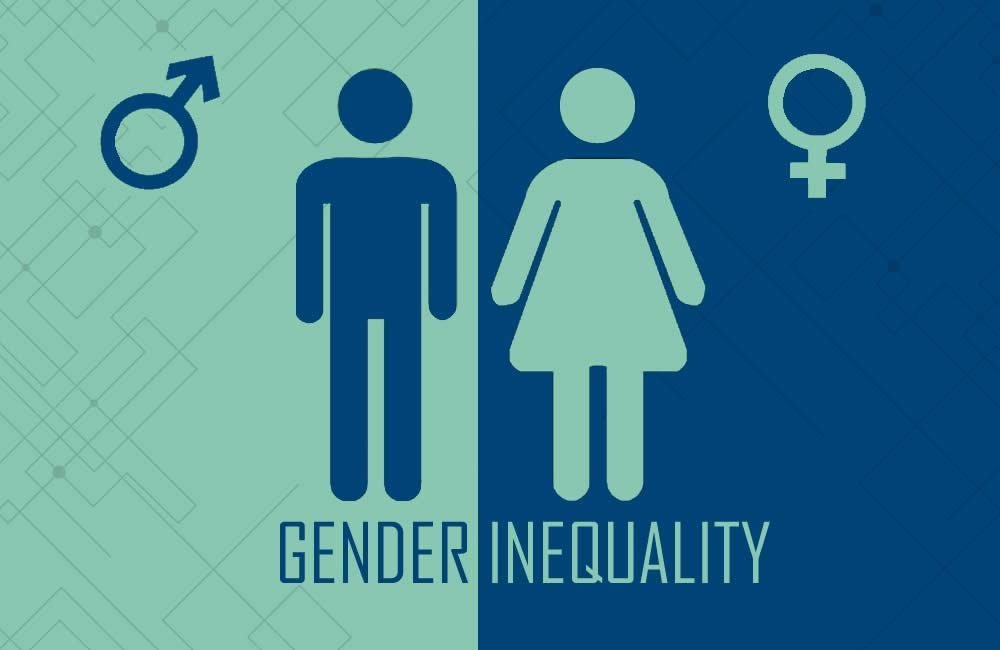
Tag: gender equality

  • BTS sing and dance their way through the UN headquarters

    BTS sing and dance their way through the UN headquarters

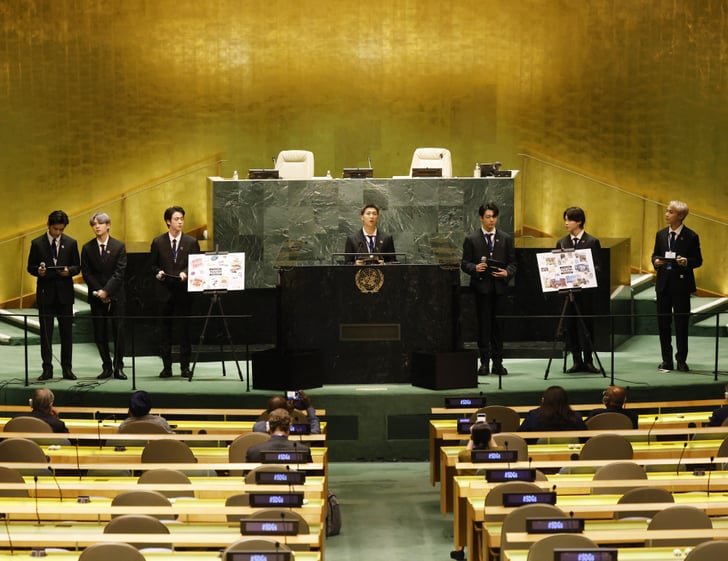
    South Korean band BTS performed at the 76th United Nations (UN) session on Monday, ahead of the annual gathering of world leaders.

    While promoting UN goals for 2030 including ending extreme poverty, preserving the planet and achieving gender equality. The band’s leader rap monster said, “Every choice we make is the beginning of change, not the end.” The artists took turns on stage during their seven-minute speech, reports AFP.

    The pop stars said that they had been vaccinated against Covid and urged the young people around the world to share perspectives on being the “Covid lost generation”.

    Apart from this, the seven-member boy band also unveiled a new music video ‘Permission to Dance’, which was filmed at the UN Headquarters in New York.

    Earlier, the pop group was appointed as special presidential envoys. They previously addressed the UN General Assembly in 2018.

    Prime Minister Imran Khan will address the UN General Assembly on September 24 via video link.

  • Justice for us

    Justice for us

    Every week, nay every day, we hear of incidents of violence against women. A couple of weeks ago, the viral video of Usman Mirza harassing and subjecting a couple to sexual assault made the headlines. Then we heard of a man who shot his wife, Saima, in front of his children in Peshawar just this month. On July 15, another man tortured and killed his wife, Quratulain, in Hyderabad; they had four children. After each news, we think about what could be worse. But this cycle never ends as we hear of another shocking incident one after another. 

    This week, Noor Mukadam was murdered in Islamabad by Zahir Zakir Jaffer. A son of an influential businessman, Zahir is a dual national. According to the police, Zahir held Noor captive for a couple of days in his house before beheading her. She tried to escape once but was captured again by her tormentor. Noor’s gruesome death has left every woman wondering what it means to be a woman in a patriarchal society where no woman is safe just because of her gender. 

    Noor’s murder has sent shockwaves across the country. People are protesting and asking for justice. Details of this case leave one feeling completely helpless. We cannot even fathom the plight of her parents, her family. We didn’t know Noor personally but her murder feels so personal. Just reading how her mother kept saying that she leaves it in Allah’s hands (Allah ke hawaalay, Allah ke hawaalay) makes us cry in anger and agony. Why do women have to keep suffering? These incidents are not in isolation. It has everything to do with the fact how we treat our women in general, how misogyny is prevalent in our society, how toxic masculinity is present in almost every household, and how there is so much inequality between genders.

    Pakistan ranks 153 in the Global Gender Gap Report 2021 out of 156 countries. We have slipped two spots since last year as Pakistan’s gender gap had widened by 0.7 percentage points.  Have we ever wondered why? There are at least 1,000 honour killings each year as per reports. Women are killed, maimed, beaten up, raped, sexually assaulted, kidnapped, and much more. Whenever such incidents make headlines, there are always those who say this will tarnish our country’s image instead of saying that we need to change and reform our society. Fingers are almost always pointed at women, never at men who are the perpetrators of violent crimes against women. When we blame the victims and survivors, we — in essence — end up justifying the crime and giving impunity to the criminal. This must stop. Our justice system also needs to deliver. Conviction rates in most cases of violence against women are low. It makes women feel even more insecure. 

    Let’s make our women safe. Let’s teach our children about gender equality. Let’s call out each and everyone who blames the victims. Let’s call out patriarchy and misogyny for what it is instead of making up excuses for violent crimes. Let women live. 

  • ‘A man is incomplete without a woman and vice versa’: Mathira reacts to Zara Noor’s statement

    Mathira has expressed her opinion on a recent statement given by Zara Noor Abbas, by leaving a comment under The Current’s Instagram post. In a Q&A session with her followers on Instagram, Zara said that men and women are not equal as women can give birth to a human but men can’t do that.

    The Blind Love actress commented, “A man is incomplete without a woman and a woman is incomplete without a man, both are made different for each other’s betterment, not to compete and take brownie points”.

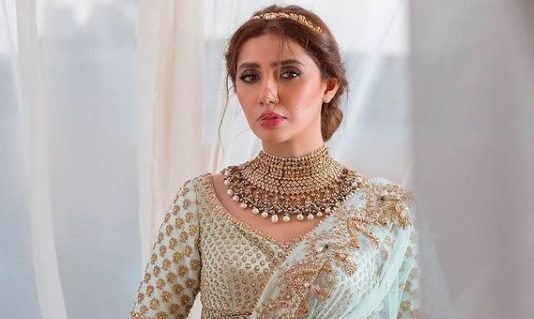
  • ‘Mera Jism Meri Marzi’ doesn’t mean I want to rip off my clothes, says Mahira Khan

    ‘Mera Jism Meri Marzi’ doesn’t mean I want to rip off my clothes, says Mahira Khan

    Mahira Khan, in a recent interview, opened up and revealed why she attends the Aurat March every year and what are the three things she finds attractive in a man.

    Read more – We can’t show a woman being assaulted and falling in love with the same man, says Mahira Khan

    “I think it is necessary for me [to go to Aurat March] because I think when I do something, no matter how small it is, it leaves an impact,” said the actor. “So when I go to Aurat March, what I’m actually trying to say is ‘Look, if you like me and if you think what I say means something if you think I that I’m on the right side of history, or whatever you think of me, this is also what I believe in, this is why I’m here.’”

    Honestly, mere Aurat March jaane se itna ziada kuch nae hota siwaye iske ke it creates an impact,” added Mahira.

    Mahira also shared her thoughts on the Mera Jism Meri Marzi slogan saying: “It [the slogan] doesn’t mean that I want to rip off my clothes. It means that I’m a whole person. This is my body, and if you are looking at me and I’m not feeling comfortable about it, I have the right to say that don’t look at me. Or if you are trying to touch me I can report you, because yeh mera jism hai, aur yeh meri marzi hai [it’s my body, and I have complete right over it].”

    During the interview, Mahira also shared that while growing up her parents gave her the freedom to make her own judgments.

    Meanwhile, answering a question about three things she finds attractive in a man, Mahira said: “I find both men and women attractive when they are at complete peace with themselves.”

    “Secondly, I love sense of humour”, shared Mahira. “I like someone who makes me laugh and if someone is not making me laugh then I make them laugh.”

    “Thirdly I like it when a man truly respects a woman,” added the actor.

    Though Mahira keeps her personal life tightly under wraps, designer Hassan Sheheryar Yasin, in a quarantine live session accidentally revealed the name of Mahira’s beau and cajoled her into opening up about him.

    When HSY asked Mahira how she feels when she looks into his eyes, Mahira said: “There’s a line in Humsafar, which I thought was beautiful, where Ashar says to Khirad, ‘Pata nahi tum mujhe kis naiki kay badlay main milli ho.’ I think the same about him. I must have done something good in my life.”

    Meanwhile, Mahira has recently ventured into production with a web series titled Baarwan Khiladi. The actor has set up a production house Soulfry Films with her friend and producer Nina Kashif. Baarwan Khiladi will be their first project together.

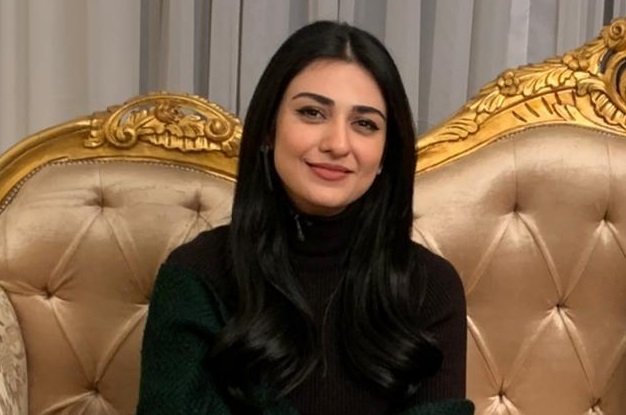
  • ‘Don’t teach your daughters to go to Aurat March, educate your sons,’ says Sarah Khan

    ‘Don’t teach your daughters to go to Aurat March, educate your sons,’ says Sarah Khan

    Sarah Khan has said that Allah has made men and women as equals and that people shouldn’t try to distinguish them as superior or inferior.

    In an exclusive interview with The Current, Sarah said: “I believe in gender equality. I do not say that women should be superior, they should be treated as equals. The status Allah has given to them, we should follow that. Do not try to make it a competition.”

    “Women are already strong, then why do we have to say that the women are strong as well or they should be given equal salaries as men,” remarked the actor further.

    “I think, instead of fight for the rights, we should educate our sons. Don’t teach your daughters to go to ‘Aurat March’, educate your sons and teach them that their mother is also a woman,” she continued. “[A] woman is the one who runs the house, does the house chores and supports the man. If your wife is not helpful, then how will you be happy? Allah has already granted status to the woman, but I think men should be given the same rights. They deserve the same, not only women.”

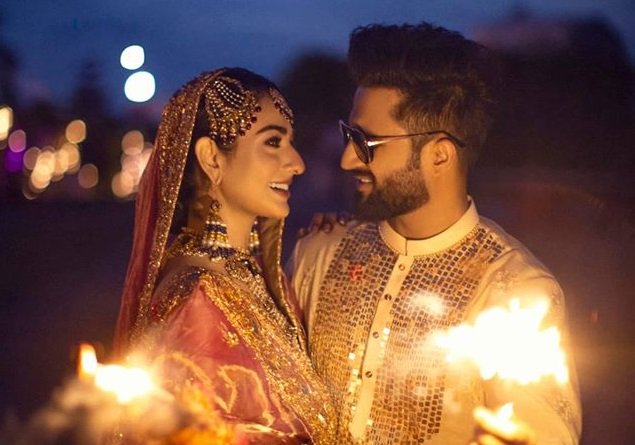
    Sarah, who is married to renowned singer Falak Shabir, also opened up about her marriage saying that it gave it more freedom. Sarah and Falak tied the knot in July 2020.

    “To be honest, I am now [after marriage] doing my work much more freely and with a lot more passion. It wasn’t like this before. One of the reasons was that I used to be at home occupied with so many things, with my siblings etc,” said the actor.

    “Now after marriage, it’s just me and my husband. He gives me so much freedom and encourages me to pursue my passion and wants me to succeed in my work. I enjoy working even more now and I want Allah to give every girl a husband like him,” added Sarah.

    Read more – Imran Ashraf, Sarah Khan shine in ‘Raqs-e-Bismil’

    Besides her marriage and thoughts on gender equality, Sarah also discussed her sister’s Noor Zafar Khan’s career, her ongoing drama Raqs e Bismil and what she would have been if she wasn’t an actor in the interview. Check it out below:

  • ‘Women participation in economic activities on the rise in Pakistan,’ says IMF

    IMF’s new report “Women in the Labour force: The role of fiscal policies” highlights an average of 2pc rise of the female workforce in Pakistan and 1pc decrease in India, DAWN reported.

    According to the IMF’s staff report, women in most countries do not have the same opportunities to participate in economic activities as men have. This gender inequality has reduced to a good extent, but the average of female labour participation is below the male rate.

    Globally, about on-quarter of countries experienced a decline in female force participation. Countries such as India and Sri Lanka facing an average annual decrease of one per cent between 1990 and 2018, whereas Pakistan, Peru and Spain experienced an average annual increase of 2pc.

    READ: Want to know how much money the PSL winning team will take home?

    The report also says “Many countries have adopted fiscal policy measures to promote gender equality since the mid-1980s. Countries use tax and expenditure policies to address gender inequality and the advancement of women in areas such as education and economic empowerment. Fruthermore, in 2018, at least 80 countries have used gender-responsive fiscal policy interventions to reduce gender inequality.

    READ: Kaala Jadu: Jemima shares poster of herself, PM Imran and Bushra Bibi

    Women’s economic empowerment is the key to growth and productivity. Greater participation of women in the labour force also brings greater diversity that can foster new ideas for production and management, boosting aggregate productivity.

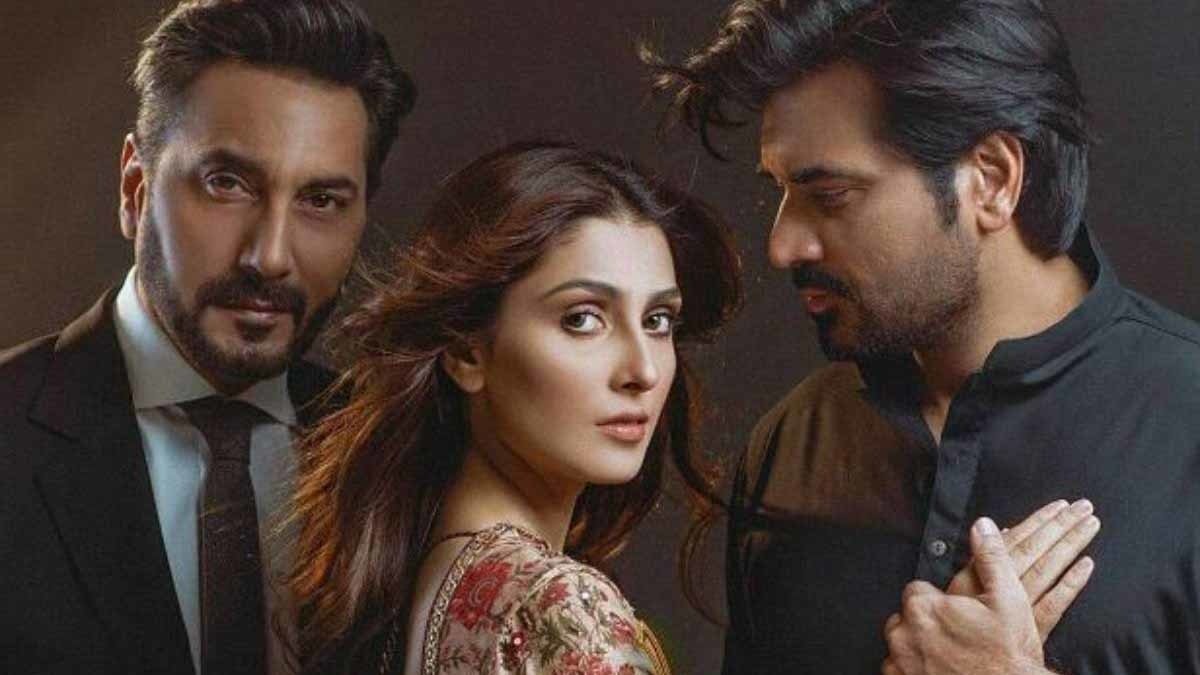
  • Mere Paas Tum Ho: A male lens into infidelity

    Mere Paas Tum Ho: A male lens into infidelity

    In a story as old as time itself, a male author has, through Mere Paas Tum Ho, tapped into archaic notions of what constitutes a moral vs an immoral woman, in a topic as complex as infidelity.

    Today marks an almost historic day in Pakistani television history as “Mere Pass Tum Ho” (MPTH), which has become one of the most successful dramas in our history, is all set to end with its mega finale.

    This has become such an anticipated ending that in an unprecedented move, cinema houses have decided to showcase the entire episode, and it is expected that we will witness packed houses. However beneficial this may be for our television industry’s commercial growth, MPTH has uncovered the deeply sexist faultiness within our onscreen depiction of women, as well its widespread acceptance within society.

    More so than the actors, the drama’s writer, Khalilur Rehman Qamar, who has written hits like “Pyare Afzal’ and “Sadqay Tumhare”, has been in the limelight for the past few months due to his shockingly misogynistic views. And he has rejected, shunned and castigated his haters in a way that only someone possessing extreme male privilege would be able to do.

    There have been a few key issues in the debate surrounding MPTH — the first, and perhaps most significant, has been whether and to what degree do the on-screen portrayal of women and men, as well as the dynamics between the genders, impact the mindsets of viewers. Is the media merely a depiction of what actually happens in society, or can it be an engine that drives social change?

    This debate has been around for decades. An argument can clearly be made that media is not monolithic, and can have both a representative, as well as a progressive role. The problem, however, seems to be that the Pakistani television industry has almost one-sidedly been playing a regressive role in its portrayal of problematic cultural and social norms, where formulaic and one-dimensional characterisations of social issues are carefully depicted as a means of appeasing the audience and driving commercial success.

    Very few channels have been bold enough to tackle topics that may receive criticism or force the viewers to think outside their preconceived notions. In a country that ranks third lowest in the world on gender parity, a more responsible role by the media industry should be expected.

    In a similar vein, and in a story as old as time itself, a male author has, through MPTH, tapped into archaic notions of what constitutes a moral vs an immoral woman, in a topic as complex as infidelity. Qamar’s personal views come through very clearly via his writing, where a one-dimensionally “evil” Mahwish, is pitted against an equally one dimensional “pure” Danish. The fundamental problem lies not as much in the motivations behind infidelity, but in the consequences, which seem to be drastically different for men and for women.

    There have been countless dramas in which the male protagonist has been unfaithful to his wife, but he has received forgiveness from her, and this has satiated our audience’s desire for maintaining a warped gender dynamic especially on the issue of infidelity. In the case of MPTH, which is also perhaps one of the first-ever portrayals of a female protagonist cheating on her husband, this issue has been handled through an exclusively male lens. Mahwish’s character has been reduced to being a “2 takay ki aurat“, whereas Adnan Siddiqui has been accepted, albeit reluctantly, by his first wife.

    This issue has been made worse by the drama writer’s own personal views on gender and infidelity, where he has unabashedly stated that a woman who cheats loses her very essence and he considers her to be a “non-woman”. Unfortunately, Qamar’s opinions are not rare, and we live in a society where gender disparity is so entrenched that men have even earned the right to cheat without glaring consequences.

    The pain of infidelity has been experienced by countless individuals, but it’s the woman who is constantly expected to think of her home, her children’s future, and society’s expectations. Surely, one of the biggest indicators of gender equality should be equal punishment for the same crime. What has made this experience even more unbearable has been Qamar’s constant presence on television, where he has been outdoing himself with his own misogyny. His lack of knowledge and facts on society’s deep-rooted prejudices becomes more apparent with each interview.

    The case of MPTH depicts how badly our television writers and their characters need a touch of complexity and diversity. The tired, black and white portrayals of morality need a dash of empathy and realism. The constant parade of similar narratives written by privileged men with regressive views needs a major refreshment and a modern touch. But more so than anything, our television industry needs daring writers — those whose vision goes beyond commercial success, or what the audience will blindly accept, to actually exploring unique topics, deeper human emotions and contemporary realities. In 2020, we need a braver lot.
  • Pakistan ranked 151 out of 153 in gender equality index: WEF

    Pakistan ranked 151 out of 153 in gender equality index: WEF

    According to the Gender Equality Index report of the World Economic Forum, Pakistan stood 151 out of 153. The only two countries below Pakistan are Iraq and Yemen.

    Though grand claims have been made about improving educational opportunities for youth, empowerment of democracy and the betterment of health facilities in the country, all have been shattered after the INGO placed Pakistan at number 150 in the list of economic participation and opportunities, 143rd in education attainment, 149th in health and survival and 93 in political empowerment globally.

    While Pakistan stood 112th in 2006, the standing has drastically slipped to 151 in the the last 14 years.

    The report highlights that there is a huge gap of 32.7 percent between men and women in the context of economic opportunities. The gap has also widened to 94.6pc – which means that women do not have the same facilities in comparison to men.

    On the contrary, Bangladesh ranked 50, followed by Nepal 101, Sri Lanka 102, India 112, Maldives 123 and Bhutan 131.