Tag: General Qamar Javed Bajwa

  • ‘Tum apnay janazay ka bandobast karo’: Retired general gives life threats to journalist for asking a question

    ‘Tum apnay janazay ka bandobast karo’: Retired general gives life threats to journalist for asking a question

    Veterans of Pakistan, an organisation of former military officers, held a press conference in Islamabad yesterday (June 6). A video from the conference went viral where retired Lieutenant General Asif Yasin Malik threatened journalist Azaz Syed for asking a question.

    Azaz asked, “General Saab, do you think that generals should give back the land given to them because of the present economic conditions of the country?”

    Tum apnay janazay ka bandobast karo,” said General Malik to Azaz Syed. [Translation: You should prepare for your funeral].

    “Stop it,” General Malik shouted.

    Azaz interjected and said, ” Sir I am asking you a question, this is a matter of the country, you just did a press conference.”

    It is being reported that during the press conference, Brig (R) Mian Mehmood claimed that when the situation in Pakistan started to deteriorate, their team led by General Ali Quli went to meet the Chief of Army Staff (COAS) General Qamar Javed Bajwa.

    “General Bajwa very clearly promised that he would hold elections in 90 days to make the situation in Pakistan better. Today we ask Gen Bajwa: where did his promises go?”

    A denial has been issued by military sources to BBC Urdu that no such promise [polls in 90 days] was made by the army chief. The military sources also told BBC Urdu that nobody can use the army for politics by using the name of ‘veterans’.

  • Khan stopped me from meeting ‘boss’, says Sheikh Rasheed

    Khan stopped me from meeting ‘boss’, says Sheikh Rasheed

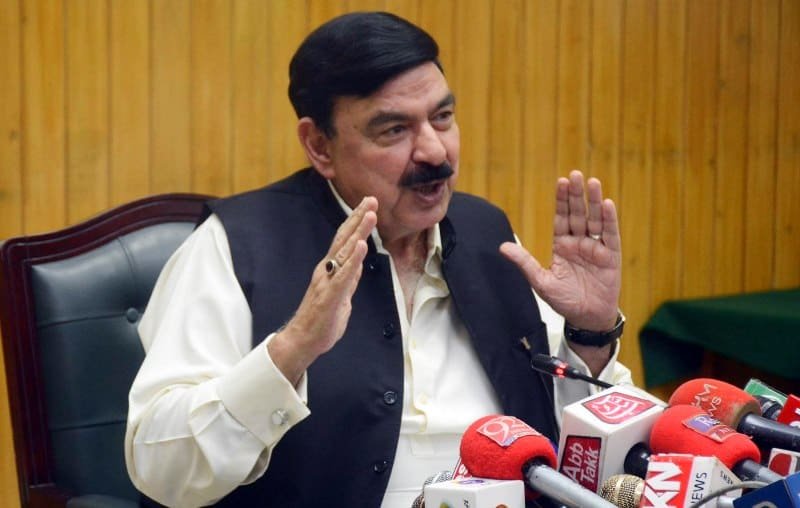
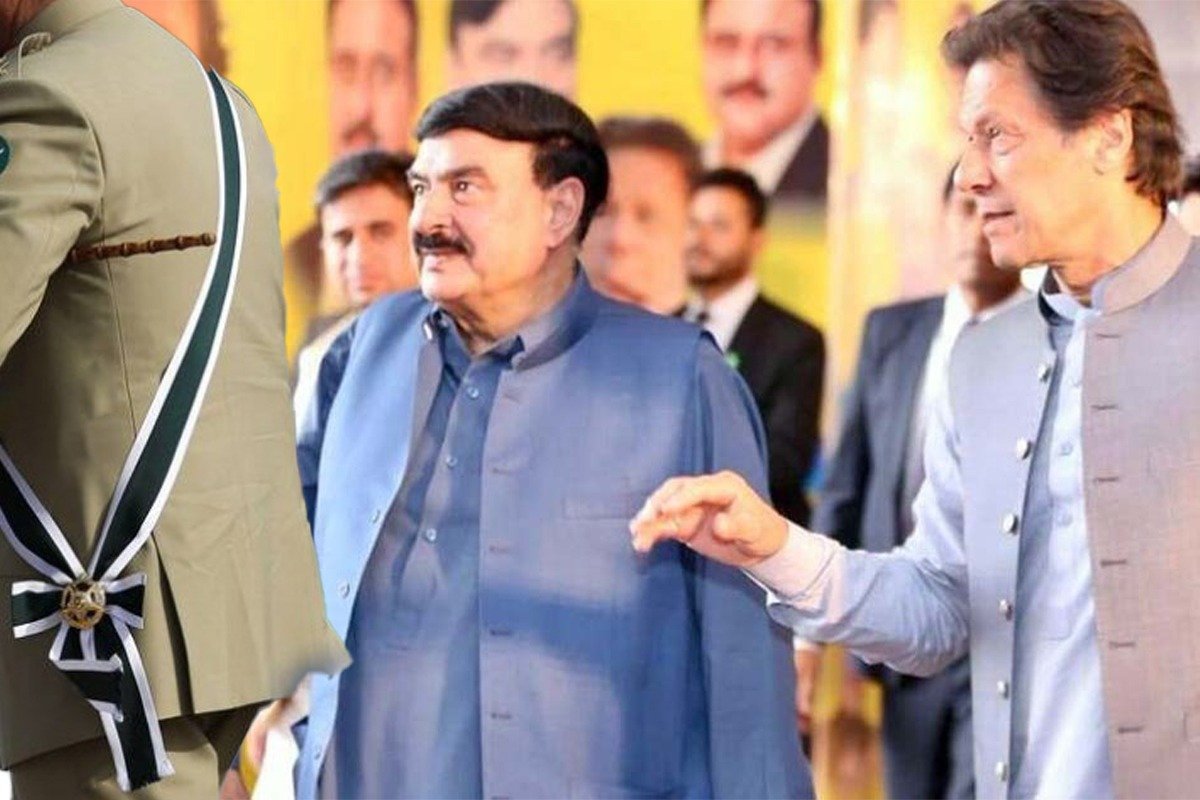
    Former Interior Minister Sheikh Rasheed has claimed that former Prime Minister Imran Khan stopped him from going to meet “boss”. Rasheed was alluding to Chief of Army Staff (COAS) General Qamar Javed Bajwa.

    Speaking on Geo News programme ‘Aaj Shahzeb Khanzada Kay Sath’, Rasheed said, “I will complain to boss about the Rangers. It was not the responsibility of the Rangers to use tear gas at protesters. Police could have done it but the Rangers doing it was wrong. They have a name and status. They should not ruin their reputation like this.”

    Rasheed was referring to the May 25 face-off between the police, Rangers and Pakistan Tehreek-e-Insaf (PTI) supporters during the Imran Khan-led ‘Azadi March’.

    Anchorperson Shahzeb Khanzada asked if he [Rasheed] had called “boss” to complain and whether his number was blocked or not.

    “My number is open,” said Rasheed, adding that his number was open for all.

    When asked if he had contacted the boss, Rasheed responded, “Khan asked me not to go to meet boss. He stopped me. So I didn’t go. I can go to his house anytime but Imran Khan specially asked me not to go to his house.”

    “I do not want to disregard someone’s trust [in me]. Khan told me twice that Sheikh Rasheed, there are people involved in talks so you don’t go and meet him. I know everything. Where, when and what the negotiations were. I am telling you, I am still the most well-informed person of all. And this is the very reason I am telling the present government your days are numbered,” said Rasheed.

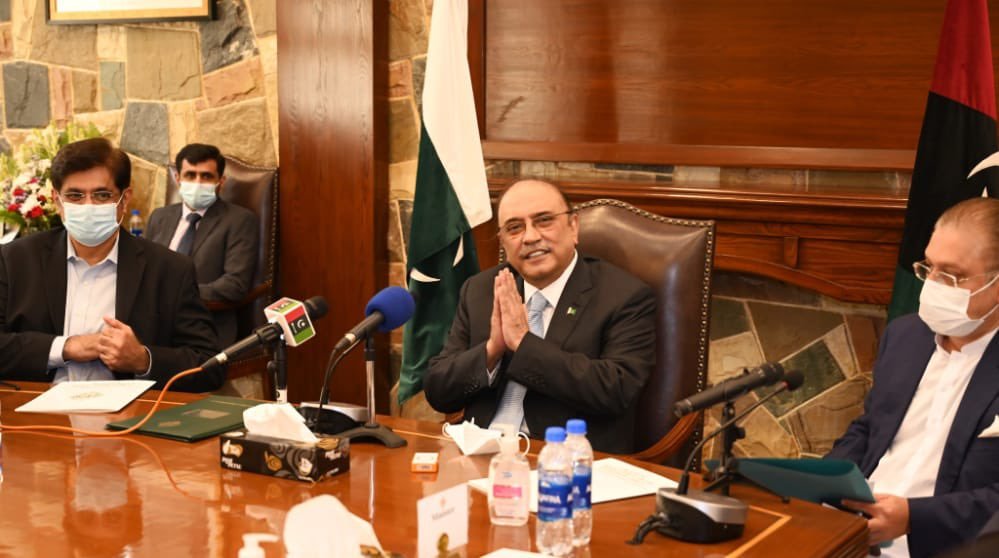
  • ‘Gen Bajwa should be saluted or should he be criticised?’ Zardari

    ‘Gen Bajwa should be saluted or should he be criticised?’ Zardari

    Pakistan Peoples Party (PPP) co-chair Asif Ali Zardari said on Wednesday said that the army was “apolitical” for the first time, asking whether the situation warranted saluting Chief of Army Staff (COAS) General Qamar Javed Bajwa or “fighting” with him.

    “Should Chief of the Army Staff (COAS) General Qamar Javed Bajwa be saluted for [keeping] the army apolitical or shall he be criticised?” asked Zardari, adding that the government will try to make sure “they” remain apolitical and neutral in the future.

    Faiz Hameed has been khuddi laen (sidelined)

    When asked whether he would salute former Inter-Services Intelligence (ISI) chief Lt Gen Faiz Hameed, Zardari replied, “he has been khuddi laen (sidelined).”

    Talking about the judiciary, which has been criticised by Pakistan Tehreek-e-Insaf (PTI) Chairman Imran Khan, Zardari said he had never run a campaign against them.

    “[Former military ruler] Pervez Musharraf kept me in jail for five years but we did not attack his house and I have said internationally, I want to see Musharraf alive.”

    “I think we should let the institution do its work and help them.”

    General elections only after the government introduces electoral reforms

    Asif Ali Zardari said that Pakistan would move towards general elections only after the government introduces electoral reforms.

    “Electoral and NAB (National Accountability Bureau) reforms are included in our game plan,” the ex-president said during a a meeting with journalists, noting that if polls are held before reforms, then any government that comes into power will face the issues that the past and present regimes are facing.

    “We have to change laws and improve them and then go to elections. Whether it takes three or four months, we have to work on implementation of policies and improving the electoral process,” Zardari said at a press conference in Karachi.

    He said he had consulted Pakistan Muslim League-Nawaz (PML-N) Mian Nawaz Sharif and “made him understand that as soon as our reforms and low-hanging fruit targets are complete [we can go to polls]”.

    When will the new army chief be appointed?

    Defence Minister Khawaja Asif in a recent interview said that there was a possibility of holding elections before November. In response, Zardari said the PML-N leader had his own thoughts and was bound to listen to his party’s directives.

    “The PML-N decided with me that until electoral reforms were brought, there would be no [talk] about the new army chief’s appointment.” Once the electoral reforms had been introduced and the economic situation had improved and the parliament believes it is time to go for elections, polls can then be held, he added.

    ‘Out of box solutions to fix economy’

    Speaking on the economy, Zardari said, “We did not take any votes from the PTI’s dissident lawmakers,” he said, adding that he has come to power to know the prices of “aaloo, tamatar, unlike Khan.”

    Zardari also called for “out of the box” solutions to fix Pakistan’s economy as the country faces an uphill task on the fiscal front.

    He maintained that the new government will take some time to control the situation. Asif Zardari said that the nation will have to face problems until the International Monetary Fund (IMF) programme is finalised.

    He said he had a lot of “out-of-the-box thought processes”, including about the State Life Insurance Corporation. “It is an investment of more than Rs100 billion. Give 26 per cent of it to a business house with a good track record and float 26pc [of its shares] in the market. You will get at least Rs8 to 10bn.”

     There is no such thing. He (Imran) has created a political myth:

    Zardari, while responding to a question, said he had not read the cable that Imran claimed contained proof of a “foreign conspiracy” to oust him.

    “I do not believe any [US] State Department official is irresponsible enough to [say] what you have read out to me. There is no such thing. He (Imran) has created a political myth. What need does the US have [to interfere]?”

    The former president said Pakistan needs to correct its policies and portray itself as a safe haven so the international community would consider it as a partner.

    He slammed Imran for labelling his opponents as Mir Jafars and Mir Sadiqs. “If anyone can run the country, it is us, not him. His own friends left him because they (PTI) could not fulfil their political commitments.”
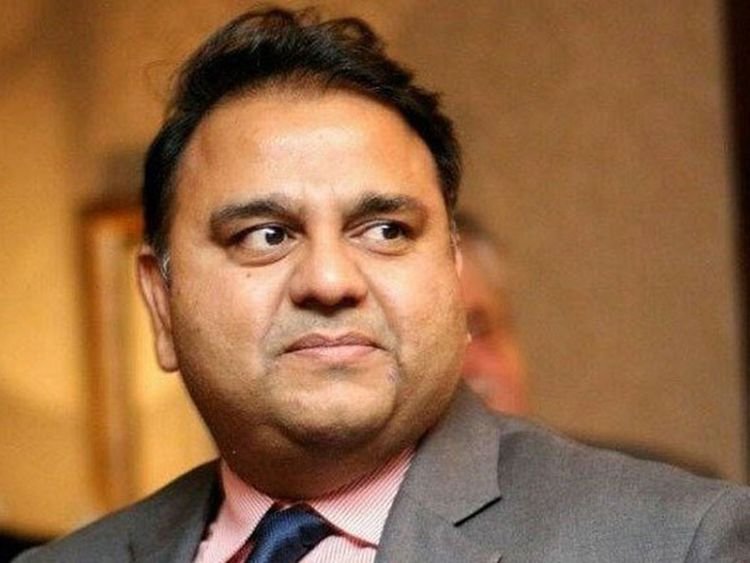
  • Shehbaz govt has no right to appoint new army chief’, Fawad Chaudhry

    Shehbaz govt has no right to appoint new army chief’, Fawad Chaudhry

    Former federal Law Minister Fawad Chaudhry has said that the constitution gives the right to the elected Prime Minister to appoint the Army Chief. He said that such important appointments will create anarchy in the country if done by an imported government, which is just temporary and not permanent. “The present government has no right to make such important appointments.”

    Fawad’s tweet came after Prime Minister Shehbaz Sharif in a meeting with journalists said that appointment of Army chief will be done constitutionally at the right time.

    PPP Senator Mustafa Nawaz Khokhar while responding to Fawad’s tweet wrote, “Making the appointment of a new Army Chief controversial is an irresponsible attempt by your party to push this country towards anarchy. This statement of yours in the lust for power is a conspiracy to create divisions in the army.”

    Khokhar added: “We have the examples of Iraq and Libya in front of us. Disagree with the military, of course, but it is a national institution.”

    General Qamar Javed Bajwa is due to retire as Chief of Army Staff on November 29, 2022 after a three-year extension. He was appointed as the army chief by the then prime minister, Nawaz Sharif, in 2016.

  • FIA picks up 24 over social media campaign against Pak Army

    FIA picks up 24 over social media campaign against Pak Army

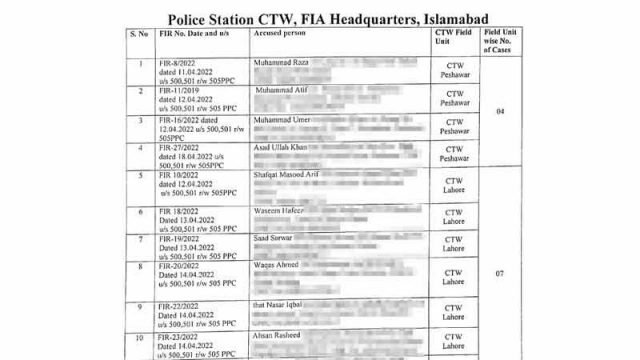
    The Federal Investigation Agency (FIA) has arrested more 24 persons on charges of launching a smear campaign on social media against the Pakistan Army. According to officials, the arrests were made during raids conducted in 11 cities.

    According to the FIA officers, the arrested people have been accused of initiating a “hate trend” against Pakistan Army on Twitter. Until now, 19 people have been charged under various sections of the Pakistan Penal Code (PPC) and Pakistan Electronic Crime Prevention Act  (PECA) for unleashing a smear campaign against the Army on social media.

    On Monday, the FIA carried out raids in various cities including Karachi, Lahore, and Islamabad to arrest people who were behind targetting Chief of Army Staff (COAS) General Qamar Javed Bajwa and the Army.

    According to media reports, the cases will be heard by the authority concerned under the anti-terrorism laws. All cases have been shifted from the cyber crime wing to the anti-terrorism wing.

    The Counter-Terrorism Wing Director Humayun Sindhu is leading the investigation process under anti-terrorism laws.

    On April 12, FIA arrested six people under similar charges to propagate a propaganda campaign against COAS and Army across the social media.

  • ‘Martial law or elections – your choice’: Khan threatened to impose martial law, states report

    ‘Martial law or elections – your choice’: Khan threatened to impose martial law, states report

    Imran Khan, who was ousted as Pakistan’s prime minister (PM) on Saturday, April 9, had threatened to impose martial law rather than facing the no-trust motion and handing over the power to the Opposition, reports The Guardian.

    The news outlet writes, “On Friday, a senior minister from his ruling government sent a message to an Opposition leader that read: “Martial law or elections – your choice.”

    “It appeared to threaten the Opposition with the ultimatum that they should agree to Khan’s demand for fresh elections or he would bring in Pakistan’s powerful military to take control, as has happened repeatedly in the country’s history,” writes The Guardian.

    “Imran Khan believed it should be him or no one,” says the news report, attributing, to one figure from the Opposition who said he had refused the demand.

    The news report also states that the premier had attempted to sack Chief of the Army Staff (COAS) General Qamar Javed Bajwa in order to provoke the military into taking control and imposing martial law.

    “Imran Khan wanted to sack the army chief, but the forces received information about it and they thwarted his plan after they came to know about it,” said a security official on condition of anonymity. “Khan wanted to create a huge crisis to remain in power,” writes The Guardian.

    There were also reports that the COAS and the former PM had 45 minutes meeting in Prime Minister House. The Inter-Services Public Relations (ISPR)  has dismissed BBC Urdu’s story that claims that Khan was pushing for the removal of COAS.

    The Opposition’s no-confidence motion against former Prime Minister Imran Khan succeeded on Sunday with 174 members voted in favour of the motion. The magic number to oust Khan was ‘172’. The National Assembly debated on the matter for more than 12 hours and the political situation in the country took a critical turn.

    Later, PM Khan was voted out as Prime Minister of Pakistan a little after midnight with 174 votes.

  • ‘Ready to move forward on Kashmir if India agrees’: General Bajwa

    ‘Ready to move forward on Kashmir if India agrees’: General Bajwa

    Chief of Army Staff (COAS) General Qamar Javed Bajwa on Saturday said that Pakistan continues to believe in using dialogue and diplomacy to resolve all outstanding issues, including the Kashmir dispute.

    “Pakistan is ready to move forward on this front if India also agrees to do so,” the COAS said.

    “I believe it is time for the political leadership of the region to rise above their emotional and perceptional biases and break the shackles of history to bring peace and prosperity to almost three billion people of the region.”

    Khanewal Indian Missile incident

    Gen Bajwa termed India’s “accidental” launching of a supersonic missile into Pakistan on March 9 a matter of “serious concern”.

    “We expect India to provide evidence to assure Pakistan and the world that their weapons are safe and secure.”

    “Unlike other incidents involving strategic weapons systems, this is the first time in history that a supersonic cruise missile from one nuclear-armed nation has landed in another,” he said.

    Relationship with the US

    “Pakistan does not believe in camp politics and our bilateral relations with our partners are not at the expense of our relationships with other countries.”

    He said that Pakistan sought to broaden and expand relations with both China and the US “without impacting our relations with [either]”.

    In addition, relations with the European Union, the United Kingdom, Gulf countries, South East Asia and Japan were also important for Pakistan’s progress, the COAS said.

    Pakistan enjoyed a close strategic relationship with China, which was demonstrated by the country’s commitment towards the China Pakistan Economic Corridor (CPEC), he said, adding, “Equally, we share a long and excellent strategic relationship with the US, which remains our largest export market.”

    Afghanistan situation

    “Pakistan recognises that it is the regions and not countries that grow. This is why we believe that peace and stability in our wider region are prerequisites for achieving shared regional prosperity and development. In this regard, our doors are open for all our neighbours,” the COAS said.

    The army chief cautioned that an inability to address the issues would “not only lead to a refugee crisis but will again make Afghanistan an epicentre of terrorism where [the Islamic State] with its global agenda flourishes [and] may result in more than one 9/11”.

    Gen Bajwa stressed the need for the international community to support the Afghan government. “The performance of present Afghan government is not satisfactory, to say the least, but we have to be patient and accommodative.”

    “While Pakistan shares some of the concerns of the international community, we believe disengagement with Afghanistan is not an option,” he stressed.

  • ‘Gen Bajwa wanted concessions from India,’ British High Commissioner to Pakistan tells New Delhi

    ‘Gen Bajwa wanted concessions from India,’ British High Commissioner to Pakistan tells New Delhi

    British High Commissioner to Pakistan Christian Turner said that Chief of Army Staff (COAS) General Qamar Javed Bajwa was looking for concessions—among them, the restoration of the Article 35A of India’s Constitution, which gave the state of Occupied Jammu and Kashmir the right to designate “permanent residents” entitled to purchase land, writes Praveen Swami for The Print. The British High Commissioner was speaking at a gathering in New Delhi.

    The news report further states that the Pakistan army chief believes he has helped New Delhi by controlling jihadists and thus ensuring violence in Kashmir remains at historically low levels.

    “The General, in his telling of events to British interlocutors, has resisted pressure from hawks to escalate in Kashmir—among them, Prime Minister Imran Khan,” writes the news outlet.

    In a report published in Dawn on April 25, 2021, it was revealed that India appro­ached Pakistan in December 2020 with an offer to reduce tension and offered backchannel talks on all outstanding issues, including Jammu and Kashmir, and Pakistan reciprocated favourably.

  • ‘I want to state this on oath, I don’t know what the agreement with TLP is’: Sheikh Rasheed

    ‘I want to state this on oath, I don’t know what the agreement with TLP is’: Sheikh Rasheed

    Interior Minister Sheikh Rasheed on Thursday while talking to the media said, “I want to state this on oath, I don’t know what the agreement with Tehreek-i-Labbaik Pakistan (TLP) is.”

    The minister when questioned about the “secretive agreement” of the government with TLP, responded that thankfully he has been able to escape problems and said, “I am not a part of this problem.”

    Earlier, the government decided to disclose the details of the agreement with the TLP in the next 10 days. The military leadership had advised against the use of force against the protesters after Prime Minister (PM) Imran Khan had authorised it.

    “The army chief [General Qamar Javed Bajwa ] said if the decision-makers were ready to pay the price for using force against the TLP, then the military would do as ordered. However, mention was made of the previous instances where the government had used force against citizens – Lal Masjid and the Model Town incident – and participants of the meeting were reminded of the consequences of both episodes.”

    The government, on November 7, revoked the ban on TLP.

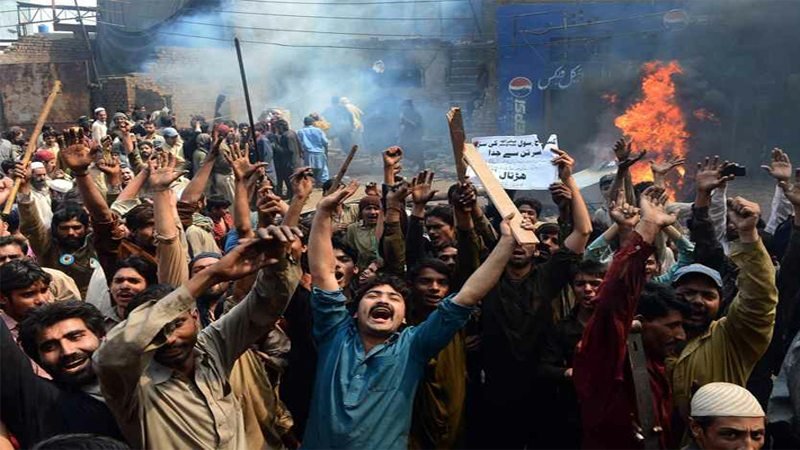
  • ‘Avoid bloodshed’: Military opposed use of force against TLP protestors

    ‘Avoid bloodshed’: Military opposed use of force against TLP protestors

    The government has decided to disclose the details of the agreement with the Tehreek-i-Labbaik Pakistan (TLP) in the next 10 days. The military leadership had advised against the use of force against the protesters after Prime Minister (PM) Imran Khan had authorised it, writes Fahd Husain for Dawn.

    On Monday, a meeting of the Parliamentary Committee on National Security (PNSC) comprising members of the National Assembly (NA) and Senate took place in Islamabad. The parliamentarians were taken into confidence by the military leadership over a secretive deal between the government and the TLP.

    The government has fundamentally decided to make public the agreement it signed with the TLP but the secrecy of the details shall be kept intact until its implementation.

    Sources privy to the matter revealed that the premier had authorised the use of force against the TLP marchers. Chief of Army Staff (COAS) General Qamar Javed Bajwa presented all the gains and losses of using force against TLP workers.

    “The army chief said if the decision-makers were ready to pay the price for using force against the TLP, then the military would do as ordered. However, mention was made of the previous instances where the government had used force against citizens – Lal Masjid and the Model Town incident – and participants of the meeting were reminded of the consequences of both episodes.”

    “The military leadership, however, advised against the use of force arguing that it was not a solution. It was then decided to opt for a negotiated settlement in order to, as one source put it, ‘avoid bloodshed’. This is when Mufti Muneeb-ur-Rehman was identified as someone who could mediate an agreement given his standing as a senior Barelvi cleric.”

    The TLP protest turned violent, killing seven police officers and hundreds more wounded during clashes with TLP demonstrators marching up towards the capital. November