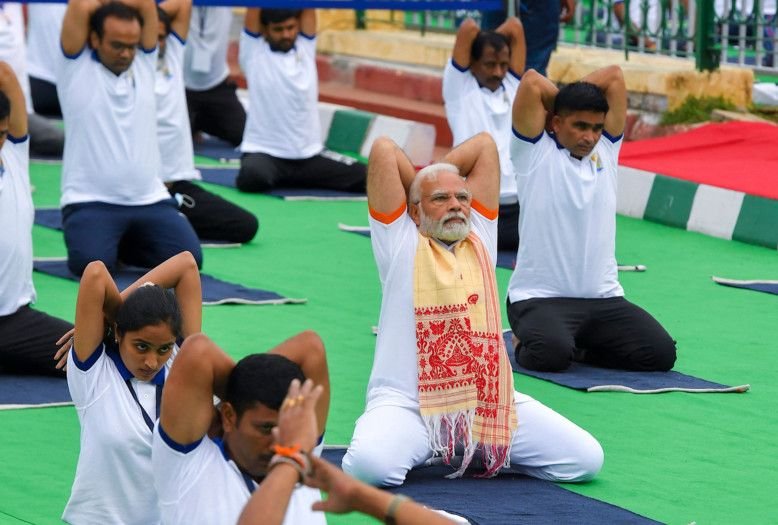
In celebration of the ninth annual observance of International Day of Yoga, Indian prime minister Narendra Modi will be leading a yoga session on the north lawn of the UN headquarters in New York on Wednesday morning.
Modi, a practicing Hindu, often presents himself as devoutly religious. Considering yoga has its origins in ancient Hindu religious practices, the exercise seems a fitting ode to both his faith and culture.
But there are other, more important concerns surrounding his crucial visit to Washington.
Congresswoman boycotts speech
Earlier today, United States’ Congresswoman Ilhan Omar published a tweet ahead of Indian prime minister Narendra Modi’s speech to Congress. She stated she will not be attending the address, holding a briefing with human rights groups instead to discuss ‘Modi’s record of repression and violence.’
She accused his government of repression of religious minorities, emboldening Hindu nationalist groups, and targeting journalists/human rights advocates ‘with impunity’.
At the beginning of June, top lawmakers in the U.S. had invited Modi to address Congress on the 22nd of June, during his visit to Washington, DC. Addressing Congress is a rare opportunity that is granted only to the country’s closest allies.
Biden asked to raise concerns
A letter was sent to U.S. President Joe Biden on the eve of Modi’s visit to Washington, asking him to raise concerns around democratic norms and human rights in India with its prime minister.
A total of 75 American Senators and Representatives have signed the letter. The U.S. lawmakers that drafted it said they were concerned about religious intolerance, press freedoms, internet access and the targeting of civil society groups.
They cited “a series of independent, credible reports” reflecting “troubling signs” in India, as reported by Reuters.
“We do not endorse any particular Indian leader or political party — that is the decision of the people of India — but we do stand in support of the important principles that should be a core part of American foreign policy,” said the letter.
A strategic ceremony
According to BBC, the discussions between the two states not only have potential to infuse new energy into India-U.S. relations, but also have an impact on the global order.
As China’s influence continues to grow in the Indo-Pacific, the U.S. needs India’s influence more than ever, viewing it as a counterbalance to China’s. While India is reluctant to claim this tag, China is one of the main catalysts driving India-U.S. relations.
Human rights advocates worry that geopolitics might overshadow humanitarian issues. U.S. rights groups have planned protests against Modi’s state visit to Washington, citing India’s deteriorating human rights record, as reported by Reuters.