Tag: global pandemic

  • Another deadly Covid variant identified in Pakistan

    Another deadly Covid variant identified in Pakistan

    The health authorities announced that another variant of the deadly Covid virus has reached Pakistan, reports Dawn.

    Talking to the media outlet, Member Scientific Task Force on Covid-19 Dr Javed Akram said a fatal variant of the virus called ‘Epsilon’ had been detected in the country.

    He confirmed that around 40 patients had contracted the variant so far, however, the figure is not accurate.

    “This variant had originated in California, which was why it was called the California strain or B.1.429,” Dr Akram added.

    “We need to understand that the virus has been controlled but not eradicated, therefore, there are chances of it bouncing back,” said Dr Akram.

    Talking about the vaccines’ efficiency, Dr Akram, who is also the vice-chancellor of the University of Health Sciences (UHS), stated, “The positive side is that all vaccines are effective against Epsilon, therefore people should get immunised and adhere to the standard operating procedures.”

    The Japanese government provided equipment worth 6.59 million dollars to Islamabad through the United Nations Children’s Fund (UNICEF) for enhancing Pakistan’s capacity for Covid vaccine storage.

    According to the statistics shared by the National Command and Operation Centre (NCOC), 662 covid cases were recorded in the last 24 hours and the current positivity rate is 1.40 per cent.

  • Eid ul Azha: Only vaccinated individuals to be allowed to visit tourist resorts

    Special Assistant to Prime Minister on Health Services, Dr Faisal Sultan, on Monday said that only vaccinated people will be allowed to visit tourist resorts during the Eid holidays from July 20 till July 22.

    People can travel once they are fully vaccinated. Dr Sultan stressed that it is necessary to have a vaccination certificate to travel during the Eid holidays.

    While talking to the media, he appealed to all citizens to follow Standard Operating Procedures (SOPs) and to get vaccinated.

    Dr Sultan said that in the last few days, the positivity rate of Pakistan’s Covid-19 cases has jumped from two percent to four percent. The main cause of this surge is violation of SOPs, and the Delta Variant.

    Dr Sultan also said that the government may seek help from the army to implement SOPs, as per sources.

    According to the latest statistics by the National Command and Operation Center (NCOC), 47,015 tests for coronavirus were conducted across the country in the last 24 hours, of which 1,808 people tested positive.

  • India struggles to breathe

    India struggles to breathe

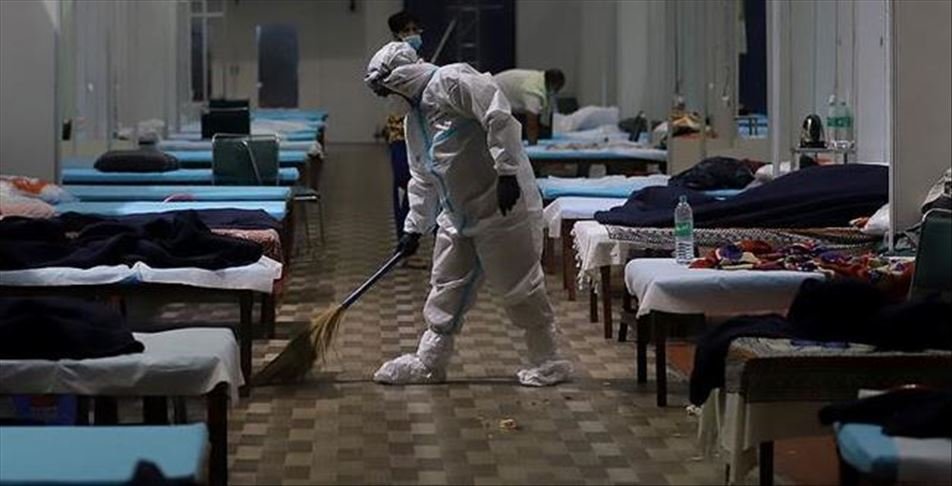
    A video has been making rounds on social media, where a person can be seen begging and crying for an oxygen cylinder. Like him, millions of Indians are struggling to find oxygen for their loved ones amid a devastating second wave of coronavirus.

    According to report, the second-largest populated country in the world has had 3,498 deaths reported in the last 24 hours.

    The BBC has documented the breaking points of Indian hospitals and crematorium, which has left hospitals in India overwhelmed. Donations have been pouring in to India from all over the world and in different cities, the Indian Army is setting up temporary hospitals and making its medical staff available to fight the deadly Covid 19.

    While talking to CNN, Narendra Taneja, a spokesman for the ruling Indian Party Bharatiya Janata Party (BJP) said that, “We are in power, we are the government in India so of course responsibility is first and foremost ours, good or bad, whatever it is. It is our responsibility and we’re trying our very level best.” The BJP came under fire when despite the several warnings, large mass rallies held between March and April ahead of state elections.

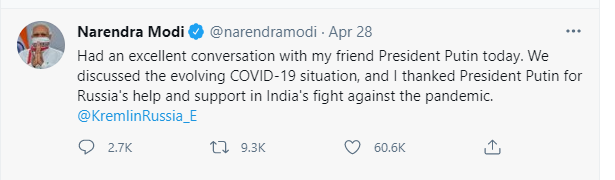
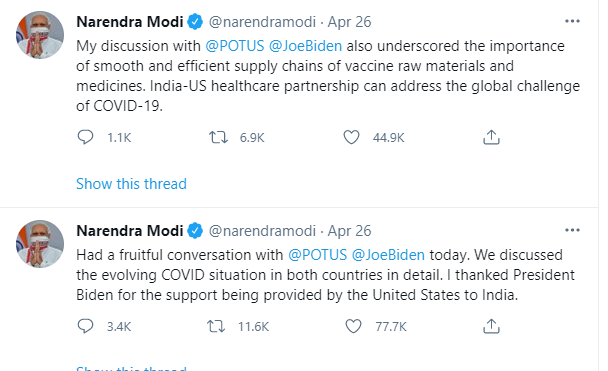
    Earlier this week, Indian Prime Minister Narendra Modi thanked US President Joe Biden and President of Russia, Vladimir Putin, for their help and support.

    From Pakistan, in a letter to Indian PM Modi, Managing Trustee of Edhi Foundation Faisal Edhi offered to arrange all the necessary supplies. He stated,” As a neighboring friend, we sympathize with you greatly and during this strenuous time, we would like to extends our help in the form of a fleet of 50 ambulances along with our services to assist you in addressing, and further circumventing the health conditions.”

    The Indian government has advised all its citizens to get vaccinated as soon as possible. According to experts, a double mutant variant is adding fuel to India’s crisis as there are 243 cases every minute.

  • ‘A Year To Remember’: Adnan Siddiqui on why he ‘admires 2020’

    ‘A Year To Remember’: Adnan Siddiqui on why he ‘admires 2020’

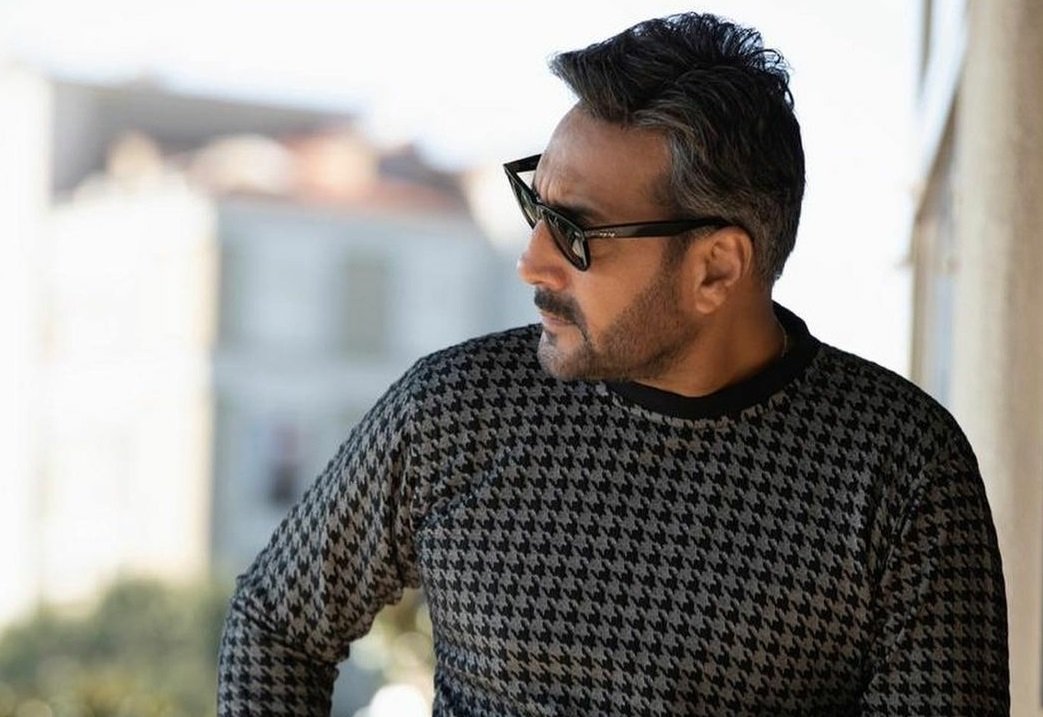
    2020 has been quite the year, for all of us and none of us would like to relive it. But Adnan Siddiqui, who had a great year as far as his acting projects are concerned (Meray Paas Tum Ho, Ye Dil Mera) says that he admires 2020, calling it ‘A Year To Remember’.

    “In three weeks from now, 2020 will be behind us,” wrote the actor on Instagram. “A most extraordinary year. When we rang it in, I don’t think anyone had even a vague idea that three months into it and our lives, as we knew it, would come to a halt. A thriving world came to an abrupt standstill and we are still waiting for normalcy to return. No wonder, our most common refrain since March 2020 is, ‘when will life be back to old normal’.”

    He then went on to share why he admires 2020 so much.

    “I often get asked why I admire 2020 so much when it caused a life-altering crisis across the globe. I have always felt that in every adversity lies an opportunity. We only need to discover that. The amount of free time I had on my hands, thanks to the lockdown, was God sent. I loved the languid pace at which life was moving all those months. And as Mac Davis crooned, I stopped and smelled the roses,” the actor added.

    Sharing about time spent with his kids, Adnan wrote: “My kids were the happiest to have me around 24 hours and I would like to imagine myself as a more patient and wiser parent while dealing with the millennials. I finished a book that was mocking me for years for having left it in between. Caught up on sleep, wrote poetry.”

    Read more – Quarantine turns Adnan Siddiqui into Wolverine

    “But most of all, 2020 enlightened me to a new perspective of life–to accept it in a larger scheme of things. I learnt that man, even if he fancies himself as omnipotent, can never conquer nature.”

    “2020 also taught me to slow down a bit, to hold my loved ones closer, to pray a little longer, and never to take life for granted,” concluded Adnan.

  • Students protest outside HEC Islamabad demanding to waive of semester fees

    Students protest outside HEC Islamabad demanding to waive of semester fees

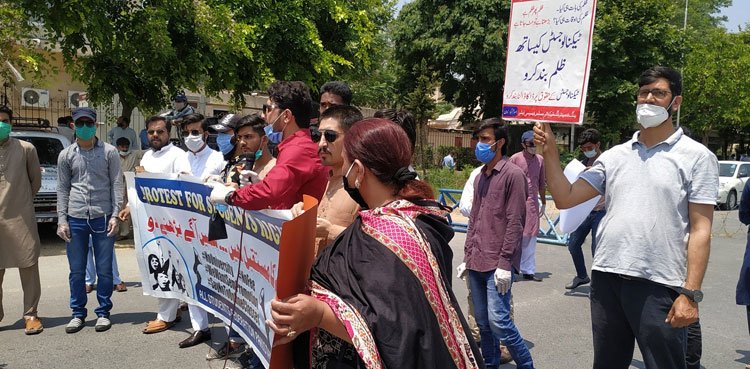
    Several university students from across the country protested outside the Higher Education Commission (HEC) office in Islamabad demanding the board to waive their full semester fee, suspended online classes and promote all students to the next semester without examinations.

    Blocking Islamabad’s Service Road, the students had placards in their hands and raised slogans against the HEC.

    They called out universities for charging full semester fees despite the coronavirus pandemic.

    Many students also took to social media to voice their concerns.

    Earlier, on May 12, Chairman Higher Education Commission (HEC) Dr Tariq Banuri had chaired a meeting with university vice-chancellors and discussed possible ways to conduct annual examinations.

    Suggestions were given to conduct examinations based on an open book, multiple-choice questions, assignments and viva-voce methods. The vice-chancellors put forth complaints made by students regarding internet connectivity issues and asked HEC to help in this regard.

    .

  • Dubai set to open drive-in cinema

    Dubai set to open drive-in cinema

    After the World Health Organisation (WHO) warned that coronavirus may never go away and we will have to learn to live with it, Dubai came up with a solution to entertain people amid the pandemic crisis. People in Dubai will soon be able to watch films on the big screen but only from their own cars at a new drive-in cinema created on the roof of one of the world’s largest shopping malls.

    With social distancing essential in the United Arab Emirates to control the spread of the virus, VOX Cinemas says that only two viewers per car will be allowed at the open-air venue, which opens on Sunday and can accommodate up to 75 cars at a time. Tickets cost 180 dirhams ($50) per vehicle inclusive of popcorn, snacks and drinks.

    Dubai, the UAE’s business and tourism hub, has been easing coronavirus restrictions since the Ramzan began three weeks ago, allowing malls and dine-in restaurants to reopen at limited capacity.

    However, children aged 3-12 and people over 60 are still barred from such venues, including the outdoor cinema, which sits on the roof of Majid Al Futtaim’s Mall of the Emirates. The screen stands under the peak of the mall’s indoor ski slope.

    Dubai, a major shopping and entertainment destination, has been hit hard by the coronavirus pandemic due to travel troubles and closures to curb the spread of the disease.

    The UAE has so far recorded 20,386 coronavirus infections and 206 deaths.

  • Rethinking a post-COVID-19 future

    Rethinking a post-COVID-19 future

    “We should not go back to the old ways.”

    We are living through a global pandemic and life as we knew it will perhaps never be the same again, That’s the hope anyway. Because there are a lot of things about the way life was before that need rethinking — and COVID-19 has given us an opportunity to do this.

    In the 21st century, there was life before the virus, there is now lockdown and life during the virus and, at some point, there will be life after the virus — but will the latter be the same as our old way of living? There is much discussion now of ‘getting the economy going’ again, of getting things back to ‘normal’ again but is our plan just to restore the same economic model and the same old systems?

    Or is now the time to rethink the way we live?

    Several falsehoods about our lives have been exposed by the lockdown. Key among these is the myth that the old way of working and studying was the only way: fixed hours of attendance at sites you had to physically travel to. It turns out that this ‘hazri’ culture is not actually essential, and many of these ways of working were just constructs whose aim was to strengthen a type of corporate or darbari culture. Not allowing people to work from home stemmed perhaps from a reluctance to lose control of staff. The institutions that would hire expensive consultants to help them ‘save money’ and work efficiently told us that it was too expensive to have individual desks for staff and subjected them to the horrors of hotdesking. This apparently ‘saved’ some money yet these same organisations would be reluctant to allow staff to work from home routinely even though that would have saved even more money. The permission for ‘working from home’ was given not as the norm, but as some kind of great favour or concession which involved HR, applications and a degree of workplace politics.

    Well now nearly everybody’s working from home and we realise this has actually been possible for many, many years and that perhaps the workplace would have caught up with technology long ago if there weren’t so many dubious management practices and vested interests involved. Apart from the workplace, there is the question of the classroom and what it is — is it a physical reality or an intellectual one? In Britain, university education was once state-funded and all about education rather than businesses.

    “We’ll have to rethink education completely — especially university education.”

    But in the last decade universities have been turned into businesses which are less about education and more about profits. The students are called ‘clients’ and since university fees are now more than three times what they were ten years ago, they are saddled with crippling student debt (student loans are given by a private profit-seeking company). Students invest so much that they are afraid to challenge intellectual views of question anything professors say because they know that they need to get good grades because of their investment. Instead of concentrating on the wellbeing of their students, universities seem to have become more focused on marketing their brand in order to attract a maximum number of ‘customers’ or ‘clients’. But even when the riches poured in, it never seemed to be the academic staff who’d benefit but rather the ‘managers.’

    We’ll have to rethink education completely — especially university education. In Argentina, most young people get their first degree while working full time. Work by day and take evening classes. It might take longer but it definitely seems to be a more productive way to live. Oh, and state universities are free.  Of course, education can not all be virtually based but perhaps a large part of it does need to be.

    Then there’s the question of how society values work. Of how bankers are more highly paid and valued than ‘unskilled’ workers. How financial managers are much better paid than medical professionals. Now we realise who are the professionals that society really needs when in times of trouble: they are the medical professionals, the cleaners, the garbage collectors, the bus drivers, the police, the fire brigade, the people who run food shops and stack shelves. These are essential, these are the people we should value, these are the jobs we need to pay people well to do.

    We need to think of new businesses too. Instead of having an endless number of restaurants and coffee shops to ‘provide employment’ perhaps we should have more businesses whose goal is to contribute to community welfare employing people. We need more cooperative models of working and more localised businesses. Instead of manufacturing fast fashion and throwaway clothes which encourage frivolous spending and whose plastic fibres are clogging up the oceans and rivers, we perhaps should concentrate on businesses that produce food.

    “And guess who governments need to fund now? Not bigshot entrepreneurs and investment bankers, they need to support medical professionals, health workers and research scientists.”

    The virus and subsequent lockdown exposed a number of vulnerabilities in life as we were living it, and one of these was the matter of food production and supply. Perhaps now we need to have a national policy of localised production: local dairy farming, local livestock, locally grown fruit and vegetables. Apart from the fact that this will avoid the issue of complicated supply chains, many people in the health, economic and development sectors have long argued that this is a healthier and more sustainable way to live. This way food production would be organic and fresh – not shipped from the other side of the world. And in terms of food, we need to unlearn the mantra that endless choice is good. The illusion that the more choice you have in choosing, for example, a brand of chocolate shows how ‘free’ you are as people needs to be dispelled. And we need to move back to the idea of quality not quantity in the way we live.

    And new initiatives need to be set up to care for the environment. The enforced detox brought on by the lockdown has shown us bluer skies, clearer air and cleaner waters. We need to have a policy of setting up local initiatives to support this which are goal-oriented and not just motivated by a profit motive.

    And guess who governments need to fund now? Not bigshot entrepreneurs and investment bankers, they need to support medical professionals, health workers and research scientists. And they need to provide free broadband and digital access to all citizens because when push comes to shove this is something that will benefit the whole of society. We need more government spending, new frameworks and new initiatives based on a clear vision of what our priorities are now.

    People and governments need to come together and come up with a new way to live and a new model of economics, We can make a whole new sort of world; a world minus dodgy ‘outsourcing’, privatisation, unsound financial instruments, economic disparity and unbridled greed. But what’s needed is a lot of imaginative ideas and a bold new way of thinking. We need to be creative.
  • ‘China let coronavirus become a pandemic’

    ‘China let coronavirus become a pandemic’

    Top officials of the Chinese government by January 14 knew that the coronavirus outbreak in Wuhan could snowball into a pandemic, yet they kept the world in dark from the unfolding catastrophe for the next six days, The Associated Press (AP) has reported on the basis of retrospective infection data.

    The report cited Chinese media and claimed there was enough data to prove that COVID-19 was spreading person-to-person as people who had never been to Wuhan’s animal market contracted the disease as early as December, yet the Chinese government hid the fact from the public and the World Health Organisation (WHO).

    President Xi Jinping warned the public on the seventh day — January 20 — but by that time, more than 3,000 people had been infected during almost a week of public silence internal documents revealed.

    That delay from January 14 to January 20 was neither the first mistake made by Chinese officials at all levels in confronting the outbreak, nor the longest lag, as governments around the world have dragged their feet for weeks and even months in addressing the virus.

    But the delay by the first country to face the new coronavirus came at a critical time — the beginning of the outbreak. China’s attempt to walk a line between alerting the public and avoiding panic set the stage for a pandemic that has infected more than 2.1 million people and taken more than 147,000 lives.

    Zuo-Feng Zhang, an epidemiologist at the University of California, has said that had they taken action six days earlier, there would have been much fewer patients and medical facilities would have been sufficient. “We might have avoided the collapse of Wuhan’s medical system.”

    Moreover, the Chinese Center for Disease Control had stopped registering any cases from Wuhan’s local hospitals from January 5 to 17. However, thousands of patients were admitted to hospitals not just in Wuhan but all over China during that period.

    It is understood that doctors in local hospitals feared that they might receive the same punishment for rumor-mongering as the eight doctors, including Dr Li Wenliang, who tried to alert the public before any official authorities.

    It’s uncertain whether it was local officials who failed to report cases or national officials who failed to record them. It’s also not clear exactly what officials knew at the time in Wuhan, which only opened back up last week with restrictions after its quarantine.

    But what is clear, experts say, is that China’s rigid controls on information, bureaucratic hurdles and a reluctance to send bad news up the chain of command muffled early warnings.

  • Italy gave China protective equipment to help with coronavirus, then China made them buy it back: report

    Italy gave China protective equipment to help with coronavirus, then China made them buy it back: report

    At the peak of the COVID-19 outbreak in China, Italy had donated personal protection equipment (PPE) to Beijing and now when Rome is in dire need of the same, China is making them buy it back, a report in The Spectator has claimed.

    According to reports, after the new coronavirus made its way to Italy, decimating the country’s significant elderly population, China told the world it would donate PPE to help Italy stop its spread.

    Reports later indicated that China had actually sold, not donated, the PPE to Italy. A senior Trump administration official told The Spectator that it was much worse than that as “Beijing forced Italy to buy back the supply that it gave to China during the initial outbreak”.

    “Before the virus hit Europe, Italy sent tons of PPE to China to help China protect its own population,” the administration official explained.

    “China then has sent Italian PPE back to Italy — some of it, not even all of it… and charged them for it,” he added.

    Unfortunately, China’s diplomacy in the wake of the pandemic outbreak has been slippery.

    Much of the supplies and testing kits that China sold to other countries have turned out to be defective.

    Spain had to return 50,000 quick-testing kits to China after discovering that they were faulty.

    In some cases, instead of apologising or fixing the issue, China has blamed others for the defective equipment. It reportedly told the Netherlands to “double-check the instructions” on its masks, after the country had complained that half of the masks did not meet safety standards.

    “China has a special responsibility to help because they are the ones who began the spread of the coronavirus and did not give the information required to the rest of the world to plan accordingly,” the official said, adding that China’s “disinformation campaign” of lying to the world about the seriousness of its COVID-19 outbreak further delayed the response by other countries.

  • Deepika Padukone’s quarantine playlist features a Pakistani song

    Deepika Padukone’s quarantine playlist features a Pakistani song

    As we all self-isolate, everyone is taking to social media to share their favourites including recipes, seasons, movies and songs. Deepika Padukone also shared a list of songs which are currently on her quarantine playlist and we were surprised to see a Pakistani song on it.

    Turns out Abida Parveen and Rahat Fateh Ali Khan’s Chaap Tilaak is on her list. Have to say Deepika has got a great taste in music.

    Chaap Tilak featured in Season 7 of Coke Studio. It was produced by Strings.

    Other songs on her playlist included Arjit Singh’s Tujhe Kitna Chahanay Laga Hoon (Kabir Singh), Kabira (Yeh Jawaani Hai Deewani), Laal Ishq (Ram Leela), Channa Mereya (Ae Dil Hai Mushkil) and Agar Tum Saath Ho (Tamasha) among others.