Tag: Google trends

  • What are Google trends saying about your search history of popular party leaders?

    What are Google trends saying about your search history of popular party leaders?

    Google Trends offer an insight into the popularity and curiosity political leaders enjoy among the masses. As the elections are drawing near, we took a peak into the data Google Trends have recorded over the last 30 days.

    The highest and ever-increasing line graph is Imran Khan’s. The highest peak was shown on January 30 with Khan hitting the record 100 score whereas his contemporaries, Nawaz stood on 15, Maryam Nawaz at eight, Bilawal-Bhutto Zardari at three, and Hamza Shehbaz being the lowest: less than one.
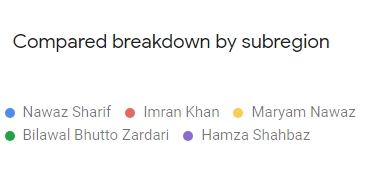
    However, it is important to note that Imran’s progressively increasing arc starts dropping successively in the days after Jan 30.
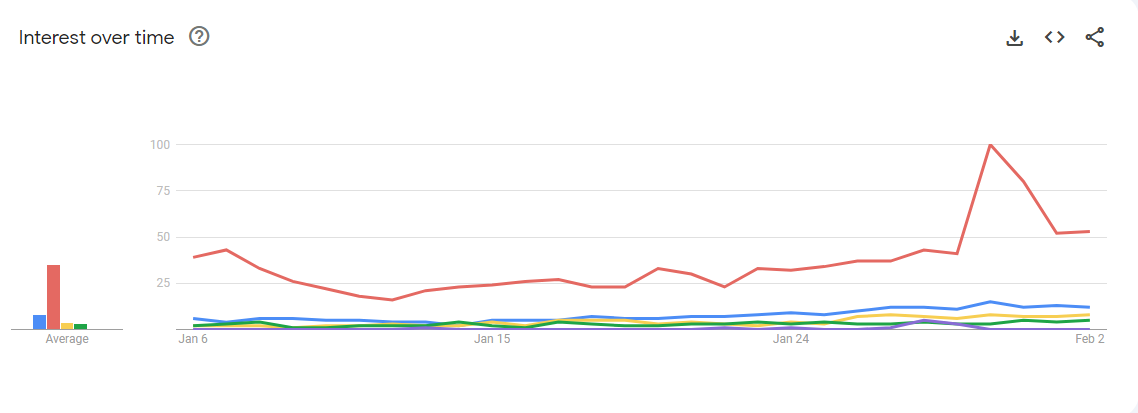
    On the other hand, except for Hamza Shehbaz, the other three is slowly on an upward trend.

    Breakdown of regions

    PTI founder and jailed leader Imran Khan is most popular all over Pakistan according to Google Trends.

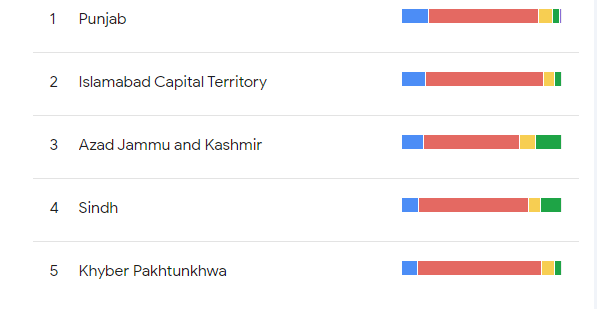
    Punjab

    In Punjab, the most popular choices for Chief Ministership, Hamza Shehbaz, and Maryam Nawaz contrary to popular perception, are not being searched so much. After Khan winning with more than 69 percent of searches, Nawaz Sharif is at 17 percent while Maryam is at nine percent. It appears that people in Punjab are comparatively more interested in Bilawal than Hamza who has 1 percent searches from all over the province.

    However, it is important to note that out of all the provinces, Punjab has shown more interest in PML-N leader Nawaz Sharif. Sindh has shown the most interest after Punjab, which is 11 percent, 10 percent in Khyber Pakhtunkhwa, nine percent in Balochistan, and seven percent in former FATA.

    Sindh

    After Imran Khan (69 percent) former Foreign Minister and Chairman of Pakistan People’s Party, Bilawal Bhutto Zardari is unsurprisingly most popular in Sindh with 13 percent of Google searches. Second in line is Punjab and third is Balochistan. After him is Nawaz (11 percent) followed by Maryam (7 percent).

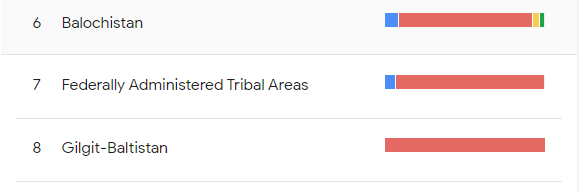
    Balochistan

    Imran Khan leading the slot here with 84 percent followed by Nawaz (9 percent), Maryam (4 percent), and Biawal Bhutto (3 percent). Hamza does not invoke public curiosity even the slightest.

    Gilgit Baltistan

    Imran Khan has a 100 percent popularity rate in Gilgit Baltistan, where it seems no other party leader stands a chance, implying that there were minor searches of them in GB.

    Former FATA

    Interestingly, in the former federally administered tribal areas, only Imran Khan and Nawaz Sharif were searched for, Khan at 93 per cent of searches and Nawaz at seven percent.
    Though Google search and Google trends are not the ultimate parameter of a party leader’s popularity, they certainly are proof of what netizens are most interested in and the social media footing of a politician.

  • What election-related matters are Pakistanis searching on Google?

    What election-related matters are Pakistanis searching on Google?

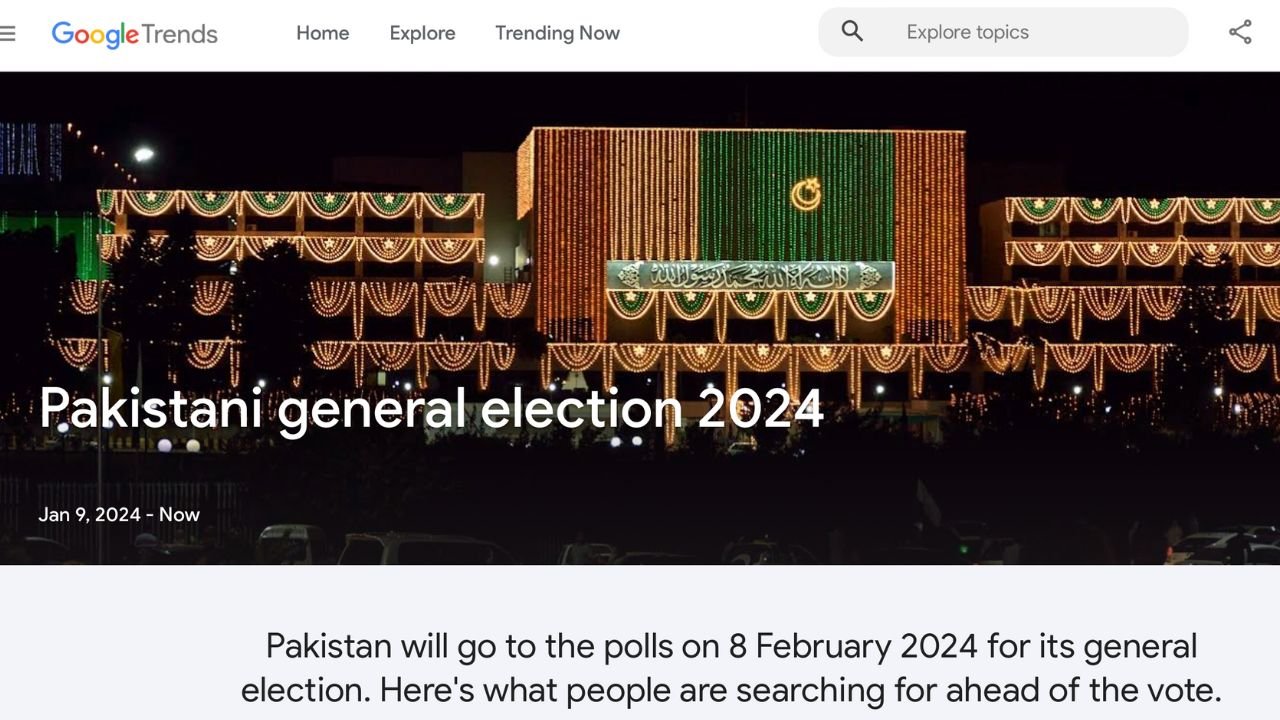
    As the much-anticipated general elections in 2024 draw near, Google has taken a noteworthy step to provide insight into the search pattern of Pakistanis.

    In preparation for the polls scheduled for February 8, 2024, the technology giant has unveiled the “Google Trends Pakistan General Election” page.

    Search interest of people in Pakistan in the last 14 days indicate that 77 per cent searched for Pakistan Tehreek-e-Insaf, 14 per cent searched for Pakistan Muslim League-Nawaz and only 3 per cent searches were related to Pakistan Peoples Party.

    The innovative platform aims to offer valuable insights into the questions actively being searched by people in Pakistan concerning political parties, election topics, and general interests.

    The most searched questions include, what is the date of the election in Pakistan, will the caretaker minister be changed, and how to get into politics.

    The dedicated trends page not only highlights the top election-related topics but also categorizes them based on regions, providing a comprehensive view of concerns and interests prevalent across the country.

    It is important to note that Google emphasizes that the trends page is not a survey or a reflection of voting behavior. Instead, it serves as a dynamic tool showcasing evolving interests and search queries.

    “While it is a valuable resource for understanding what people are searching for, it’s crucial to clarify that a spike in a particular search query does not indicate the popularity or success of a political party. It is not a measure of voting intentions but rather a reflection of the evolving search interests of the public,” stated Google in its official announcement.

  • Google to launch its Android Earthquake Alerts System in Pakistan

    Google to launch its Android Earthquake Alerts System in Pakistan

    Google has announced the launch of its “Android Earthquake Alerts System” in Pakistan, which will send automatic early warning alerts that help people be prepared for an emergency.

    “Android Earthquake Alerts System is a no-cost, helpful android feature that detects earthquakes around the world and alerts people. It uses sensors in Android smartphones,” said Google in a statement.

    “When people look up ‘earthquake’ or ‘earthquake near me’, they will find relevant results, along with helpful resources on what to do after an earthquake,” the statement further added.

    “Pakistan has experienced several earthquakes in the past, especially in the northern and western parts of the country. With the expansion of this earthquake alerts system, android users in Pakistan may receive automatic early warning alerts that help them be prepared for an emergency.”

    “One feature titled ‘Be Aware’ alerts people when earthquakes with a magnitude of 4.5 occur, or an intensity level of 3 or 4 on the MMI scale. The notification is sent along with the distance of the earthquake’s epicentre. The alert uses the phone’s current volume, vibration, and Do Not Disturb settings.”

    The Android Earthquake Alerts System was initially launched in New Zealand and Greece.

  • Google reveals what Pakistanis are searching for

    Google reveals what Pakistanis are searching for

    Google’s maiden “What is Pakistan searching for?” report has revealed what Pakistanis are looking for online.

    According to the report, Pakistanis are looking for ways to connect with new communities, searching for high-quality products and how they can improve their lives and environment. 

    The data can be very useful for seasoned marketeers who’re trying to build businesses, or entrepreneurs looking for ways to engage with potential consumers.

    In the past three years, Pakistan’s digital population has surged by 68 per cent, with over 78 million (seven crores and eight lakhs) users. Understanding the needs and expectations of this growing number of digital consumers is important for brands to remain agile and relevant, especially during these unprecedented times. 

    “Pakistanis and their smartphones are inseparable — always on the lookout for the best experiences and deals within their vicinity and at the same time seeking authoritative information during these trying times,” said Google Asia Pacific Industry Head for South Asia Faraz Azhar. 

    Google has highlighted five key areas that are shaping how Pakistani’s carry out an online search.

    1. Increasingly sophisticated consumers

    Consumers expect search engines to understand the intent behind what they need and deliver the best. They want high-quality products that are available with a convenient digital experience.

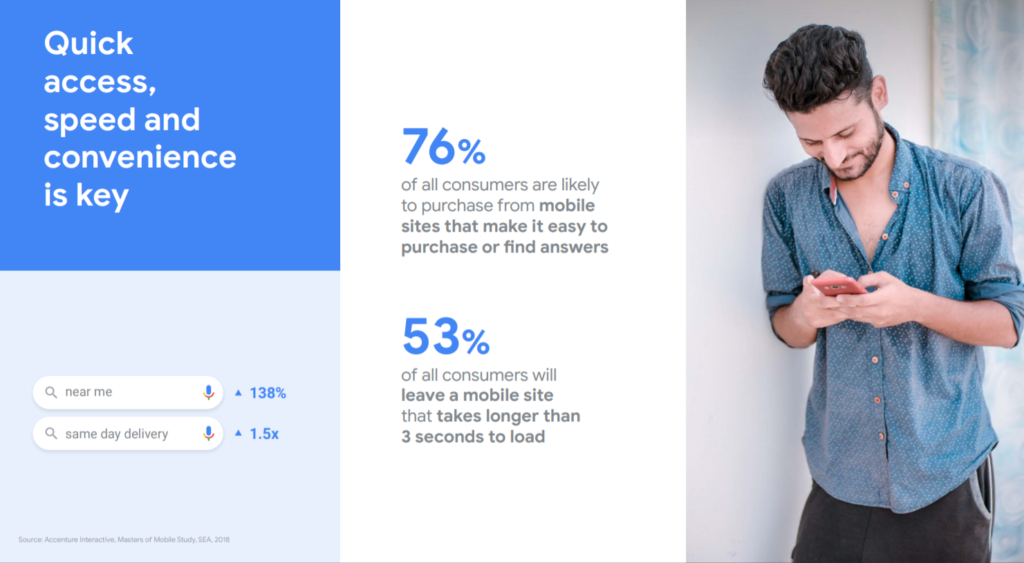
    Four of five Pakistani consumers research products online before a purchase, and they switch between online search and video. They also want quick access to products and services. 

    As per the report, 138 per cent growth in “near me” searches and 1.5 per cent increase in “same-day delivery” queries was reported between the year 2018 to 2019. “Fast delivery” searches increased by a whopping 1300% and online grocery delivery searches increased by 300% since the coronavirus pandemic began.

    2. Towards sustainability and conscious consumption 

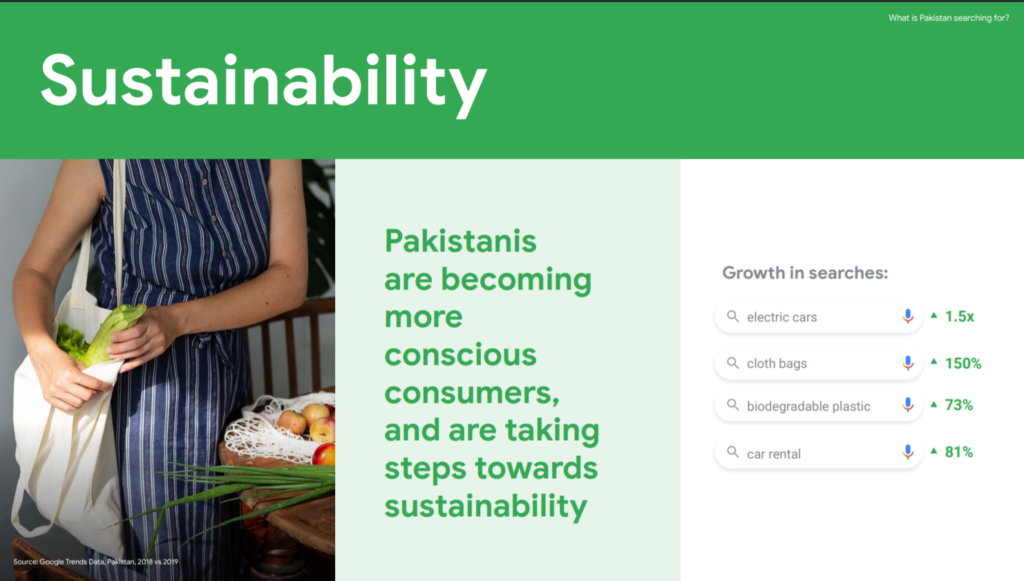
    A combination of the state of the world and an overall rise in awareness has seen the rise of environmentally-conscious consumers. Over the past year, these searches have risen sharply across Pakistan: “climate change” by 1.5x, “electric cars” by 1.5x and “reusable” by 1.3x. 

    Users were also curious about the visible impact on air quality and pollution levels, with searches such as “clear skies” increasing by 300 per cent, “clean air” by 225 per cent and “clear water” by 217 per cent.

    3. Digital video continues to boom

    Video streaming and sharing platforms where Pakistanis get their fix of information, entertainment, news and sports. The primary drivers are a combination of affordable data combined with the proliferation of devices and new platforms. 

    Every seven in 10 Pakistanis use YouTube every month, with searches related to “with me” increasing by 150 per cent, “Teeli” by 108 per cent and “village food secrets” by 168%.

    4. Healthy lifestyle choice

    While Pakistan has a rich and diverse culinary tradition, there has been a rise in searches for alternate diets and meal plans predicated around well-being. 

    Searches for “daily exercise” are up by 1.6x. Searches for “vegetarian cuisine”, “healthy supplements” and “intermittent fasting” have risen by 1.5x. Meanwhile, searches for “superfood” are up by a whopping 767 per cent and “high-intensity interval training (HIIT) workout” by 600 per cent.

    5. COVID-19 implications

    With COVID-19 restricting the movement of people outdoors, Pakistanis have started looking for ways to start (or continue) their usual physical routines indoors with “HIIT workout” YouTube search growing by 600 per cent, “gym at home” by 125 per cent and “home workouts” by 80 per cent. With more people confined indoors, interest in mental health and well-being has also become an important factor for Pakistanis, with a surge in searches for “meditation” (+56%) in March this year.

    The information was gathered from a web conference organization by Syntax Communications with Google Asia Pacific team.

  • PM Imran second most searched leader at UN General Assembly

    Prime Minister (PM) Imran Khan has become the second most searched personality among the leaders currently in the United States (US) for the 74th session of the United Nations General Assembly (UNGA).

    According to Google Trends, PM Imran has secured the second slot in the list of most searched UNGA leaders on Google, while Indian PM Narendra Modi stands fifth and United States (US) President Donald Trump has topped the list.

    Among other most searched UNGA leaders are British PM Boris Johnson at the third place and Brazilian President Jair Bolsonaro on the fourth. The Brazilian president had recently made headlines after severe criticism over his lack of efforts to protect the Amazon rainforest.