Former United States (US) President, Donald Trump has announced that he has no intention to rejoin Twitter following the agreement with Elon Musk to buy the social media platform.
While talking to Fox News on Monday, Trump revealed that he is satisfied with his own platform, Truth Social which was launched earlier this year.
He said, “I am not going on Twitter. I am going to stay on Truth,” Trump was quoted telling the network. “I hope Elon buys Twitter because he’ll make improvements to it and he is a good man, but I am going to be staying on Truth.”
Trump’s account was suspended after he incited violence on January 6, 2021, US Capitol attack through the social media platform. He had about 89 million followers on Twitter at that time.
Trump has sued Twitter, Facebook, and Google’s YouTube against censoring his posts while posts by conservative commentators are widely shared on social media.
In an interview, he said that he welcomed Elon Musk’s decision to buy Twitter, but he want to focus on his own platform. He did not see Twitter as his competitor.
He said, “Truth Social will be a voice for me,” he said. “And that’s something nobody else can get.”
Elon Musk is the world’s richest person and advocates free speech on all platforms. He had said before that he wanted to purchase Twitter and privatize it to allow free speech on the platform. He proposed some changes to the platform, including relaxing restrictions on content. Yesterday, he closed the purchase agreement for $44billion with the company.
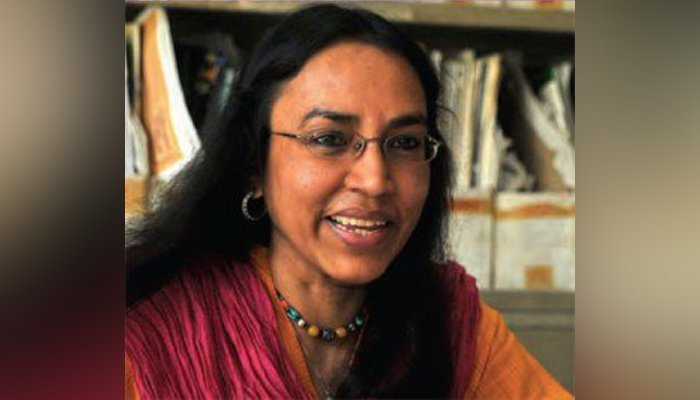
Today’s Google Doodle was dedicated to murdered Karachi activist Perween Rahman. She did her postgraduate diploma in housing, building and urban planning from the Institute of Housing Studies in Rotterdam, Netherlands. She was the director of a NGO based in Karachi, Orangi Pilot Project.
She was born in born in Dhaka in 1957. Pervween did part of her schooling in former East Pakistan and migrated to Karachi after the fall of Dhaka.
She received a bachelors in engineering and architecture from Karachi’s Dawood College of Engineering and Technology in 1981 and joined a private architect’s firm. She later joined, Orangi Pilot Project, a NGO based in Karachi.
She also did postgraduate diploma in housing, building and urban planning from the Institute of Housing Studies in Rotterdam, Netherlands.
Perween Rahman was an outspoken critic of the land mafias in Karachi. Perween has received numerous awards from the government, including the Sitara-e-Shujaat for her efforts.
Rahman was killed on March 13, 2013, when four gunmen opened fire on her vehicle near Pirabad police station in Orangi Town. She was rushed to Abbasi Shaheed Hospital where she was pronounced dead. The bullets fired that day ended her 28-year-long career for advocating for land and basic services rights for the underprivileged.
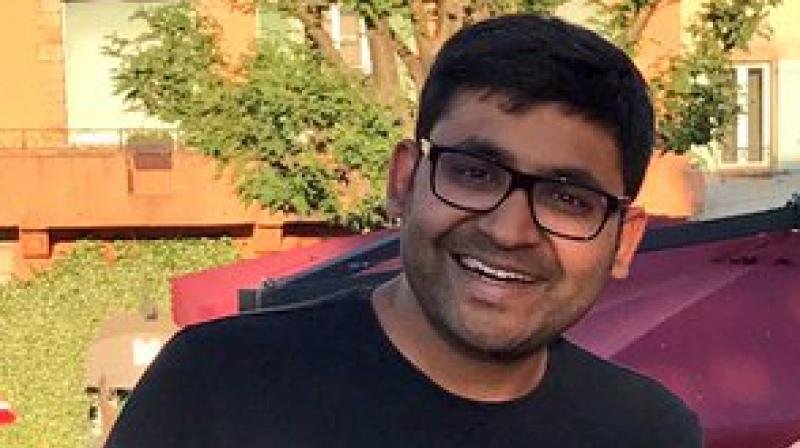
Indian born Parag Agrawal has been named as the Chief Executive Officer (CEO) of Twitter after co-founder Jack Dorsey’s resignation.
The news is making headlines in India. This is not the first time that an Indian has been appointed as a CEO of a well-known organisation. Sundar Pichai is the CEO of Alphabet, the umbrella network of Google. Similarly, Shantanu Narayen is Adobe’s and Satya Nadella is Microsoft’s.
Since Agrawal’s appointment, Pakistanis have been tweeting about the Indian CEOs who have taken over the Information Technology (IT) world.
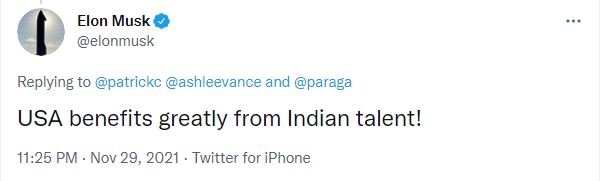
Billionaire Elon Musk, Chief Executive Officer (CEO) of Tesla Motors, took to Twitter to share his admiration for the Indian talent that contributed to America’s economy as Jack Dorsey (CEO) of Twitter stepped down and announced his successor, Indian Parag Agrawal.
Last night, Dorsey announced his resignation on Twitter and confirmed that his replacement was Indian-born Parag Agrawal. Dorsey will remain a member of the board until his term expires in May 2022 and assist Parag with the transition.
A 37-year-old immigrant from India, Agrawal joined Twitter in 2011 as a Software Engineer and was later promoted to Chief Technical Officer (CTO) in 2017. While working as CTO, he worked as in-charge of strategy involving Artificial Intelligence, reports CNBC.
A colleague of Agrawal, Chklovski, who worked with him from 2012 to 2014 said, “Parag is phenomenal, understands the problems, stays up late to get it done, mentors others — he’s the whole package.”
Yoel Roth who is Twitter’s head of site integrity, tweeted, “Parag was one of the first engineers I worked with when I started at Twitter (when we were first working on timeline ranking). The rigor he brings to every decision was clear then, and I’m delighted to see it recognized today.”
Social media platform Facebook has reportedly planned to rebrand itself with a new name to reflect its focus on building the metaverse, a virtual-reality space in which users can interact with a computer-generated environment and other users, reported The Verge.
The announcement is likely to take place at the company’s annual Connect conference on October 28th.
“The metaverse is going to be a big focus, and I think that this is just going to be a big part of the next chapter for the way that the internet evolves after the mobile internet,” Facebook Chief Executive Officer (CEO) Mark Zuckerberg told The Verge.
The Verge stated a possible name for the company could have something to do with Horizon. Recently, Facebook renamed its in-development Virtual Reality (VR) gaming platform named “Horizon” to “Horizon Worlds”.
Since July, Zuckerberg has been talking about the metaverse.
Earlier this week, the social media company also announced plans to create 10,000 jobs in Europe over the next five years to help build this metaverse.
Facebook isn’t the first tech company to change its company name as in 2015 Google entirely reorganized under a holding company called Alphabet.
Google has released a doodle artwork of medieval Derawar Fort located in the Cholistan Desert of Punjab to mark Pakistan’s 75th Independence Day.
“Seventy-four years ago today, Pakistan achieved independence. Today’s doodle celebrates Pakistan Independence Day, a public holiday commemorating the day on which the nation became a sovereign republic.
“Pakistanis across the subcontinent join to celebrate their freedom and honour the centuries of history that comprise its cultural foundation,” read a statement by Google accompanying the doodle.
Huawei has been sued in California federal court for creating a “backdoor” that allowed it to collect sensitive data “important to Pakistan’s national security”, reports Reuters.
Business Efficiency Solutions (BES), a California-based IT consultant company, filed a complaint against the China-based tech giant on Wednesday, August 11.
According to the complaint, Huawei subcontracted with BES in 2016 for its $150 million bid to develop software for a Pakistani government programme providing new technology for police and law enforcement in Lahore. BES said it created software for the project that collects data from government agencies, controls access to buildings, monitors social media and manages drones, among other things.
Huawei officials allegedly demanded that BES send this information to the company in China for testing, and BES said it agreed to the demand but terminated its authorisation to use the technology after Huawei revoked its access to the testing laboratory.
The complaint said Huawei has yet to return any of the confidential software design tools or uninstall the software, as BES said it had agreed to.
BES said Huawei later demanded it install its data-aggregation software – used by Pakistani law enforcement to collect and analyse “sensitive data from different sources and government agencies” – in its Chinese lab, “this time not merely for testing purposes but with full access to data at the Lahore Safe City project.” BES said it agreed, under threat of termination and withheld payments, after Huawei said it had approval from the Pakistani government.
Huawei has yet to respond to the lawsuit filed by BES through its legal team. BES also did not share any more information beyond the case that it filed in the federal court.
The IT consulting firm also accused Huawei of stealing the “trade secrets, and other intellectual properties in its possessions after officials of the China tech company demanded it for testing.”
Up until now, the lawsuit alleged that Huawei has not returned the software design tools to BES.
Moreover, BES said that it only allowed Huawei to use the software with full access as the latter threatened that they will not be paid, which the Chinese giant has yet to do for some of the software in the project.
Huawei is a Chinese firm that has been banned in the United States (US) after it was accused of being a security risk. Thus, Google forcibly removed its services from the devices of the Chinese phone maker.
However, Huawei recently decided to live without Google by debuting its own operating system across all of its devices.
For the longest time, our country’s private sector has dealt with obstacles that don’t fully allow small companies to flourish. These obstacles combined with lack of opportunities cause a lot of frustration and reduce the ability to move forward.
In some respects, startups are not too different. After all, they also take birth in the same corporate culture. So naturally one wonders if regulations, opportunities, efficiency, and the business environment were more conducive, would our entrepreneurs be able to do things differently?
Could there be an area where progressive rules were introduced and one could monitor the changes and see if that made a major difference to the mechanics of the industry?
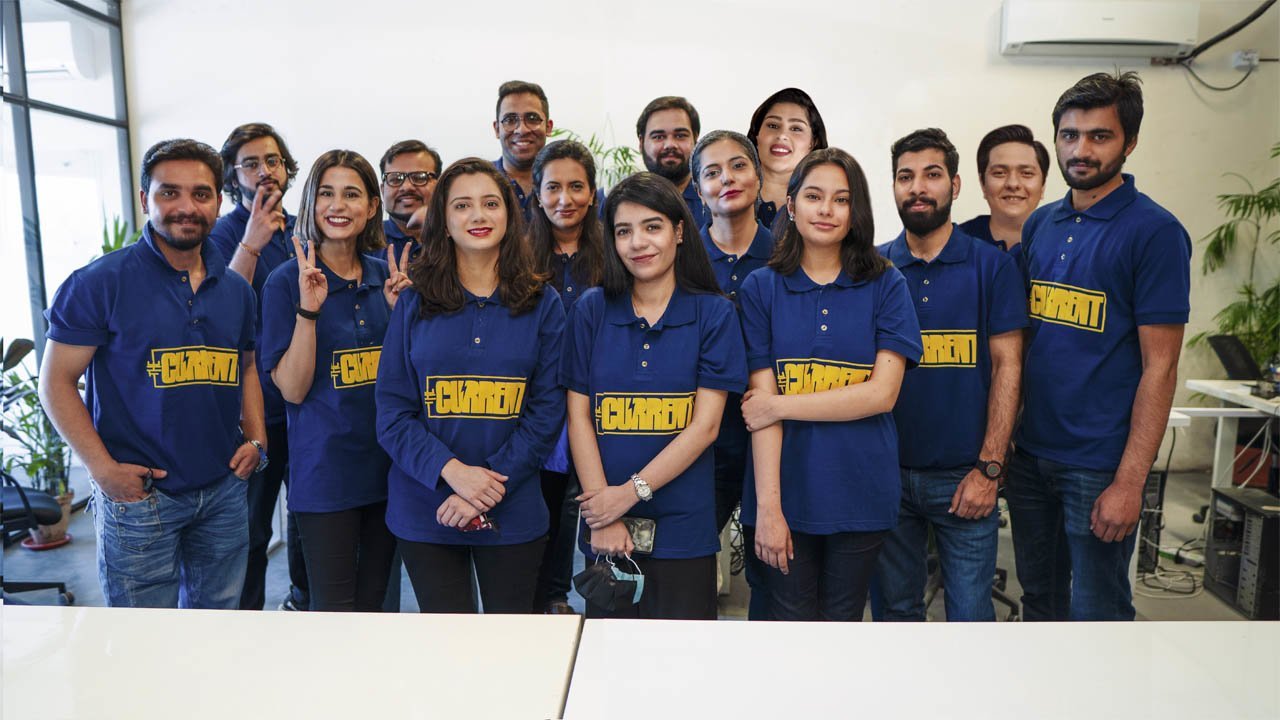
The Current, Pakistan’s first digital news-lifestyle platform that simplifies news for Pakistani millennials, is a startup. After winning the Google News Innovation Challenge in 2020, we faced immense challenges. When Google was sending over the first half of our grant, we were unable to meet the requirements to open a US Dollar bank account. We reached out to six different banks and were refused every time. Frustrated, we kept at it, until one bank took a chance and allowed us to open the account, granted we provide details that the money was indeed coming in from Google. We did and waited for our money to come in. When it did, the bank sent it back, citing that, according to State Bank regulations, getting the money into the country would be tough. Desperate, we appealed to the then Science and Technology Minister, Fawad Chaudhry, as well as contacting State Bank’s President Reza Baqir. Chaudhry was receptive and got us in touch with the right people to help us get our grant across. We were lucky that tech giant Google was in the picture. We finally got our money through and now, will be launching Pakistan’s first membership program.
The Current now comes around bearing good news for all startups. After we became the catalyst that pushed the State Bank of Pakistan (SBP) to understand the issues being faced by tech startups, the SBP introduced a new policy to facilitate startups and provide them a way to get their money home.
“You won the Google grant and there were issues bringing the money to Pakistan. Since I was the Science and Technology Minister at the time, I discussed the issue with Reza Baqir (President State Bank of Pakistan). Since the State Bank is in very capable hands, they made a new policy to facilitate startups,” says Fawad.
Chaudhry further added, “The credit goes to State Bank President, his team and to The Current, the reason why this issue was highlighted in the first place.”
SBP officially removed a major obstacle that has been subsequently thwarting the growth of the startup companies by allowing them to avail foreign loans as convertible debt.
Startup firms face funding issues due to the unavailability of collateral or security. Foreign investors, including equity funds and angel investors, show interest in startups but they try to cover the risk through alternative means like high return on loan, reports Dawn.
A company may raise funds from abroad in the form of convertible debt, i.e. the lender shall have the option to convert the loan into the equity of the borrowing company.
“It is expected that this initiative will help in attracting more foreign investment as it will provide another option to the international investors to invest in startup companies operating in Pakistan,” said the SBP.
We at The Current are immensely happy that we have helped carve a way and provide an easier path for Pakistani startups.
Google has fired the co-head of the ethical Artificial Intelligence (AI) team Margaret Mitchell for violating the security policies stated by the company.
The previous AI ethics researcher Timmit Gebru, a widely respected leader in AI ethics research, was also fired over similar accusations.
Mitchell is known for co-authoring a groundbreaking paper that showed facial recognition to be less accurate at identifying women and people of colour. The system can end up discriminating against them.
Mitchell also used automated scripts to look through her email to find evidence of discrimination against her co-workers.
Her views were directed at Google AI’s head Jeff Dean and CEO of Google Sundar Pichai; resulting in losing her corporate email access. Her activities were investigated, which led to the termination of Mitchell as well.
According to Axios, Google said in a statement regarding Mitchell’s firing: “After conducting a review of this manager’s conduct, we confirmed that there were multiple violations of our code of conduct, as well as of our security policies, which included the exfiltration of confidential business-sensitive documents and private data of other employees.”
These recent terminations have stirred a lot of heat for Google regarding diversity. As of now, Marian Croak, a Vice President in the engineering organisation is leading a new centre of expertise on responsible AI within Google.