Tag: government borrowing

  • SBP data reveals govt borrowed Rs8.3 trillion from banks in FY24

    SBP data reveals govt borrowed Rs8.3 trillion from banks in FY24

    The Pakistani government significantly increased its domestic borrowing in the fiscal year 2023-24, according to the latest data from the State Bank of Pakistan (SBP). This period saw the government borrowing Rs8.3 trillion from scheduled banks, a substantial rise from Rs3.6 trillion in FY23 and Rs3.3 trillion in FY22.

    The Federal Government accounted for the bulk of this borrowing, taking Rs8.56 trillion, while the Provincial Government retired Rs261.27 billion. The two primary sources of budgetary support financing are the SBP and scheduled banks.

    In FY24, the government repaid a net amount of Rs694.85 billion to the central bank, bringing the net borrowing figure to Rs7.49 trillion. Government sector borrowings are categorized into three main areas: budgetary support, commodity operations, and others.

    For FY24, the net borrowing for budgetary support stood at Rs7.61 trillion. In contrast, there was a net retirement of Rs107.59 billion for commodity operations and Rs6.18 billion for other categories.

    This notable increase in domestic debt highlights the government’s reliance on internal sources to manage its fiscal requirements amid challenging economic conditions.

  • Pakistani rupee ends 2023 with marginal gain versus US dollar

    Pakistani rupee ends 2023 with marginal gain versus US dollar

    Pakistani rupee demonstrated a slight appreciation against the US dollar for the 13th consecutive session, marking a gain of 0.02 per cent in the inter-bank market on Friday.

    According to the State Bank of Pakistan (SBP), the day concluded with the rupee settling at Rs281.86, reflecting an increase of Rs0.07.

    Remarkably, this signifies a closure of 2023 with the rupee undergoing a depreciation of 19.7 per cent, originating from its starting point at Rs226.43 against the US dollar in the inter-bank market at the beginning of the year. 

    Notably, on the preceding Thursday, the rupee experienced a marginal upturn, settling at Rs281.93 against the US dollar.

    A significant development unfolded as the foreign exchange reserves held by the State Bank of Pakistan observed a substantial weekly upswing, surging by $852 million to reach $7.75 billion as of December 22, according to data released on Thursday. 

    The overall liquid foreign reserves for the country tallied at $12.85 billion, with commercial banks holding net foreign reserves amounting to $5.1 billion. The SBP attributed this surge in reserves to official government inflows.

    On the global stage, the US dollar appeared poised to conclude 2023 with a loss, reversing a two-year trend of gains. This shift was influenced by market expectations that the US Federal Reserve might initiate rate easing as early as March of the following year. 

    The greenback remained generally subdued on the last trading day of the year, hovering near a five-month low against a basket of currencies, falling 0.02 per cent to 101.18, following a recent dip to 100.61. 

    This trend underscored the impact of the Federal Reserve’s aggressive rate-hike cycle initiated in early 2022 on the dollar’s trajectory over the past two years.

  • Pakistani rupee gains ground against US dollar for 11th consecutive session

    Pakistani rupee gains ground against US dollar for 11th consecutive session

    The Pakistani rupee sustained its upward trajectory against the US dollar for the 11th consecutive session, exhibiting a 0.06 per cent appreciation in the interbank market on Wednesday. 

    According to the State Bank of Pakistan (SBP), the rupee concluded at Rs282.20, reflecting an increment of Re0.17.

    In the preceding session on Tuesday, the rupee had achieved a marginal gain, settling at Rs282.37 in relation to the US dollar. 

    Concurrently, there has been a notable surge of 200 per cent in the cumulative borrowing by the federal and provincial governments for budgetary support from the domestic banking system in the current fiscal year (FY24).

    Internationally, the US dollar encountered continued pressure on Wednesday, while the euro flirted with a four-month pinnacle. 

    This trend emerged as market expectations of an imminent interest rate cut by the Federal Reserve gained traction. The restrained week, marked by global holiday absences until the New Year, is anticipated to witness subdued trading volumes.

    The dollar index, gauging the US currency against six counterparts, stood at 101.54, just below the five-month low of 101.42 recorded last week. 

    The index is poised for a 1.9 per cent decline in 2023, following two consecutive years of robust gains driven by the Fed’s rate hikes to combat inflation. 

    The recent weakening of the dollar is attributed to market anticipation of forthcoming rate cuts by the Fed in the coming year, diminishing the allure of the greenback.

  • PKR records eighth consecutive gain, closes at Rs282.79 vs dollar

    PKR records eighth consecutive gain, closes at Rs282.79 vs dollar

    In a notable financial trend, the Pakistani rupee (PKR) sustained its positive trajectory against the US dollar (USD) for the eighth consecutive session, witnessing a 0.04 per cent appreciation in the interbank market on Thursday.

    According to the State Bank of Pakistan (SBP), the rupee concluded at Rs282.79 after experiencing a rise of Re0.11.

    The preceding day saw a slight uptick in the PKR’s value, settling at Rs282.9 against the US dollar. 

    A significant development unfolded as the government successfully secured a historic amount of Rs397 billion ($1.4 billion) in Wednesday’s local currency bond auction. 

    This achievement surpassed expectations, marking the highest borrowing in years within a single auction, showcasing sustained market interest even as December draws to a close.

    The substantial participation of investors underscores their confidence in long-term bonds, fueled by the anticipation of an early 2024 rate cut. 

    The government strategically opted for long-term borrowing in response, effectively mitigating rollover risks and minimisingreliance on short-term funding in the future.

    On the global front, the US dollar regained strength on Thursday, prompted by a sudden end to a robust rally for US stocks, compelling investors to seek safety. 

    In the final hour of equities trade on Wall Street, heavy selling induced a ripple of risk aversion through markets, lifting the previously under-pressure greenback from lows.

    As of early Asia trade on Thursday, the dollar index, which is down 1 per cent for the year so far, remained steady at 102.37. 

    In a comparison with major currencies, the Pakistani currency strengthened by 69.15 paisa against the Euro, concluding at Rs309.57 as opposed to the previous rate of Rs310.26. 

    The British Pound saw a reduction in value of 79.58 paisa, settling at Rs357.41 in comparison to the previous day’s Rs358.21.

    However, PKR experienced a slight decline of 0.38 paisa against the Japanese yen, closing at Rs1.974 as compared to the previous day’s rate of Rs1.97. 

    The Saudi Riyal concluded at Rs75.38, registering a decrease of 1.15 paisa from its value of Rs75.39 a day ago. 

    Similarly, the UAE Dirham witnessed a decrease in value of 2.81 paisa, shifting from Rs77.027 the previous day to Rs76.999.

    Meanwhile, oil prices, a crucial indicator of currency parity, experienced a decline on Thursday due to concerns over low demand following an unexpected US crude inventory build, outweighing apprehensions about global trade disruptions linked to tensions in the Middle East. 

    Brent crude futures dropped by 3 cents to $79.67 a barrel, while US West Texas Intermediate crude stood at $74.16 a barrel, reflecting a 6-cent decrease.
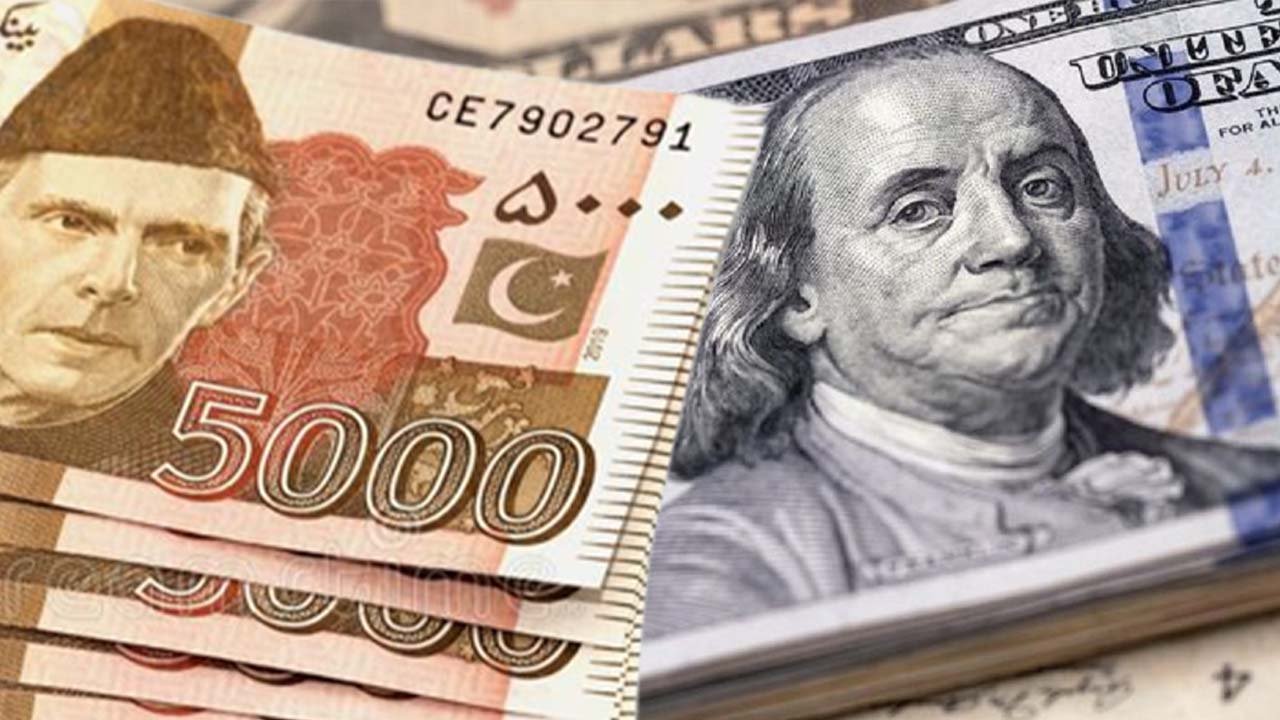
  • Govt’s borrowing soars to over Rs1.6 trillion in three months, marking a fivefold increase from last year

    Govt’s borrowing soars to over Rs1.6 trillion in three months, marking a fivefold increase from last year

    In the current fiscal year, FY24, the federal government’s net borrowing to meet its financial obligations for governing the nation amounted to Rs1.6 trillion.

    According to official data released by the State Bank of Pakistan (SBP), the government secured loans exceeding Rs1.6 trillion in cash from the domestic banking sector during the first quarter, up significantly from the Rs261 billion borrowed during the same period in the previous year.

    During this period, the government obtained a net loan of Rs98 billion from SBP. It’s worth noting that the government is obligated to adhere to International Monetary Fund regulations, which prohibit direct borrowing from the central bank.

    Additionally, the government raised Rs1.5 trillion from scheduled banks in the first quarter of FY24 (up to September 8) to address the budget deficit.

    The net borrowing by the government for budgetary support in FY23 totaled Rs3.74 trillion, marking an increase from Rs3.13 trillion in FY22.

  • Rising debt levels: Pakistan’s national debt surpasses Rs61 trillion

    Rising debt levels: Pakistan’s national debt surpasses Rs61 trillion

    The federal government has witnessed a substantial increase in its total debt, which has surged to nearly Rs62 trillion. This significant escalation is primarily attributed to the government’s strategic borrowing from both domestic and foreign sources, a measure aimed at covering the fiscal deficit.

    According to The News, data from the State Bank of Pakistan (SBP) reveals that as of July 2023, the total debt of the government stands at Rs61.75 trillion. This figure reflects a substantial year-on-year increase of 22.11 per cent, compared to Rs50.57 trillion recorded in July 2022. Furthermore, on a month-on-month basis, the government’s debt exhibited a 1.49 per cent increase from Rs60.84 trillion in June 2023.

    The surge in the debt burden can be predominantly attributed to the government’s reliance on domestic and foreign borrowing mechanisms to address fiscal deficits.

    Breaking down the composition of the debt, data from the central bank highlights that a significant portion of Rs39.02 trillion is domestically sourced, representing a notable year-on-year growth of 24.08 per cent. This domestic debt comprises Rs29.59 trillion in long-term debt and Rs9.29 trillion in short-term debt. The remaining Rs22.73 trillion is external in nature.

    By the close of July 2023, the government’s long-term debt had escalated by 24.44 per cent year-on-year to Rs29.59 trillion when compared to the figure of Rs23.78 trillion recorded in the same period a year earlier. In parallel, short-term debt exhibited a substantial year-on-year increase of 27.14 per cent as opposed to Rs7.31 trillion in July 2022.