Tag: green energy

  • BYD says half of total vehicles sold in Pakistan will be electric by 2030

    BYD says half of total vehicles sold in Pakistan will be electric by 2030

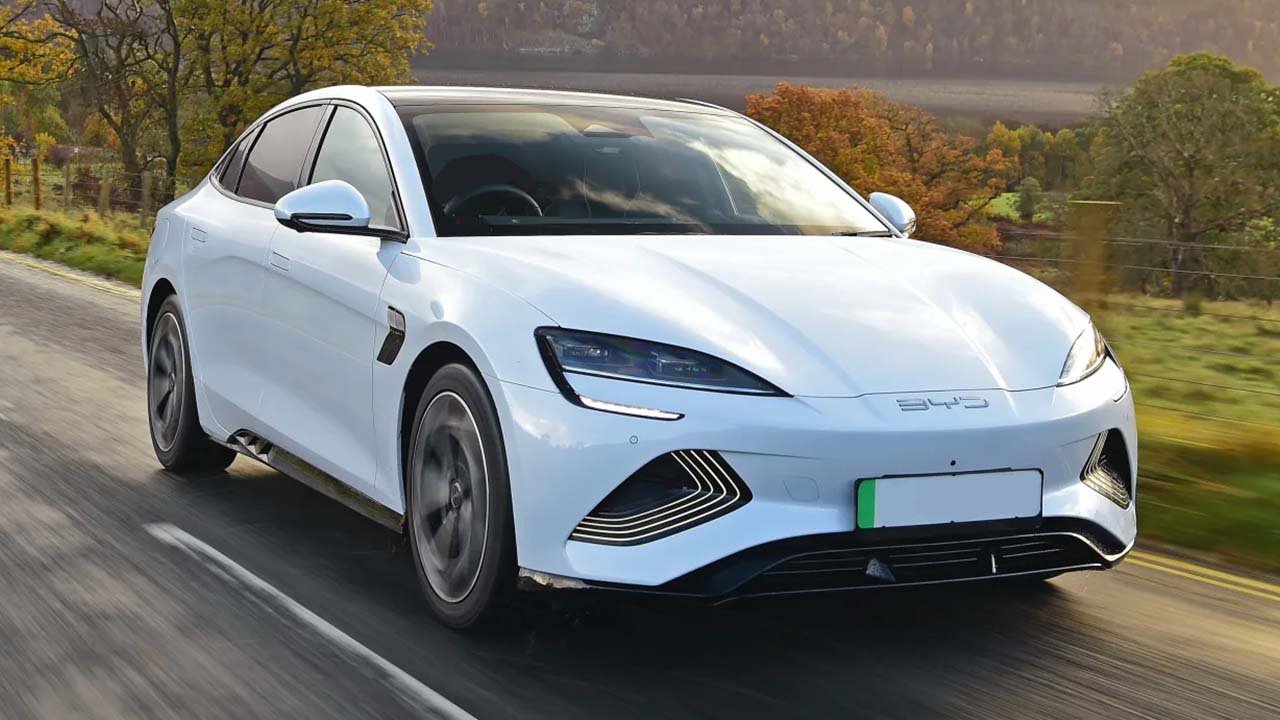
    Up to half of all vehicles sold in Pakistan by 2030 could be electric, according to BYD Pakistan, a joint venture between China’s BYD and Pakistan’s Mega Motors. This target aligns with global goals for reducing emissions.

    BYD, a Chinese electric vehicle (EV) giant backed by Warren Buffett, recently announced its entry into Pakistan, which has a population of around 250 million.

    In a partnership with Mega Motors, the company plans to build an assembly plant by early 2026. However, they will begin selling cars later this year, following the launch of three models in August.

    According to Reuters, Kamran Kamal, BYD Pakistan’s spokesperson, mentioned in an interview that the company expects up to 50 per cent of all vehicles in the country to be powered by new energy sources, such as electric or hybrid technology, by 2030.

    Kamal, who also leads Hub Power, the parent company of Mega Motors, acknowledged this is a bold target given Pakistan’s auto market, which has traditionally been dominated by Japanese brands like Toyota, Honda, and Suzuki. In fact, vehicle sales recently hit a multi-year low as of June 2024.

    While some new players, such as South Korea’s KIA and China’s Changan and MG, have entered the market offering hybrid vehicles, BYD is the first major company focused entirely on new energy vehicles in Pakistan. Hybrid vehicle sales in the country have already doubled in the past year.

    However, experts like Muhammad Abrar Polani, an auto analyst at Arif Habib Limited, believe that while a 30 per cent adoption rate for electric vehicles is achievable by 2030, reaching 50 per cent may be more difficult due to challenges with charging infrastructure.

    Kamal confirmed that the Pakistani government plans to support the development of this infrastructure by offering incentives, and standards for EV charging stations have already been drafted. The government is also considering providing these stations with cheaper electricity.

    BYD Pakistan is working with two oil marketing companies to build a network of charging stations, aiming to set up 20 to 30 stations during the initial rollout of its vehicles. Initially, the company will sell fully assembled cars, which are subject to high import taxes, but Kamal stressed that their primary goal is to start assembling vehicles locally as soon as possible.

    The size of the new assembly plant is still being decided, with more details about the investment and collaboration with power company HUBCO expected later.

  • Markets nationwide to close at 8 pm to save energy

    Markets nationwide to close at 8 pm to save energy

    The National Economic Council has decided to close shops across the country at 8 pm.

    The meeting was held under the chairmanship of Prime Minister Shehbaz Sharif, with the participation of the Chief Ministers of Sindh, Punjab, and KP.

    The Balochistan Minister of Planning also participated in the meeting. During the meeting, it was decided to close shops across the country at 8 pm.

    In a press conference held after the meeting, Federal Minister for Planning Ahsan Iqbal stated that the decision to close shops at 8 pm was made to save energy.

    He further mentioned that commercial areas will be closed at eight o’clock, green energy will be promoted, and LED bulbs will be installed.

  • Pakistan buys Russian oil amid chronic energy shortages

    Pakistan, which is facing a severe economic crisis and chronic energy shortages, has turned to Russia for oil imports. However, Pakistan’s petroleum minister, Musadik Malik, believes that the future of energy lies in diversification, particularly towards green energy sources.

    During his visit to the United States, Malik confirmed that Pakistan had placed an initial order for Russian oil, which will arrive within a month, and based on the results, the country will assess how much to import in the future.

    Pakistan, which imports 84 per cent of its petroleum products, mainly from Gulf Arab allies Saudi Arabia and the United Arab Emirates, has been transparent about its dealings with Russia. Malik stated that their initial dealings with Moscow were far less than those of other countries, particularly China and India, whose enthusiastic buying of Russian oil has cast a shadow over India’s warming relationship with Washington.

    Malik spoke with US companies during his visit about buying shale liquified natural gas, upgrading Pakistani refineries and storage facilities, exploring offshore oil and gas and starting horizontal drilling, a method that Pakistan has not yet used.

    However, he emphasized that his talks with the United States also included support for green energy sources, in line with Pakistan’s goal of generating 30 per cent of its electricity from renewables by 2030, including a plan for widespread solar power on rooftops.

    Pakistan is one of the nations most vulnerable to climate change, with floods last year submerging one-third of the country. Geoffrey Pyatt, the assistant secretary of state for energy resources, has promised US backing for Pakistan’s renewable goals during his visit to the country.

    According to France24, Malik also believes that the future of energy security lies in green energy sources. Although Pakistan’s share of Russian oil imports is small, it helps, and the country is open to cheaper sources of energy.

  • Google reveals what Pakistanis are searching for

    Google reveals what Pakistanis are searching for

    Google’s maiden “What is Pakistan searching for?” report has revealed what Pakistanis are looking for online.

    According to the report, Pakistanis are looking for ways to connect with new communities, searching for high-quality products and how they can improve their lives and environment. 

    The data can be very useful for seasoned marketeers who’re trying to build businesses, or entrepreneurs looking for ways to engage with potential consumers.

    In the past three years, Pakistan’s digital population has surged by 68 per cent, with over 78 million (seven crores and eight lakhs) users. Understanding the needs and expectations of this growing number of digital consumers is important for brands to remain agile and relevant, especially during these unprecedented times. 

    “Pakistanis and their smartphones are inseparable — always on the lookout for the best experiences and deals within their vicinity and at the same time seeking authoritative information during these trying times,” said Google Asia Pacific Industry Head for South Asia Faraz Azhar. 

    Google has highlighted five key areas that are shaping how Pakistani’s carry out an online search.

    1. Increasingly sophisticated consumers

    Consumers expect search engines to understand the intent behind what they need and deliver the best. They want high-quality products that are available with a convenient digital experience.

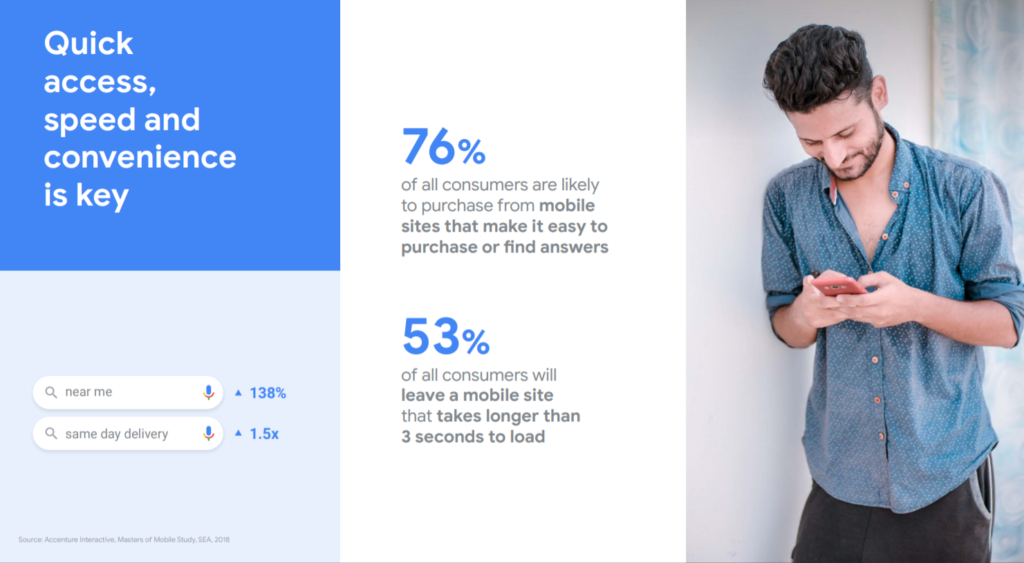
    Four of five Pakistani consumers research products online before a purchase, and they switch between online search and video. They also want quick access to products and services. 

    As per the report, 138 per cent growth in “near me” searches and 1.5 per cent increase in “same-day delivery” queries was reported between the year 2018 to 2019. “Fast delivery” searches increased by a whopping 1300% and online grocery delivery searches increased by 300% since the coronavirus pandemic began.

    2. Towards sustainability and conscious consumption 

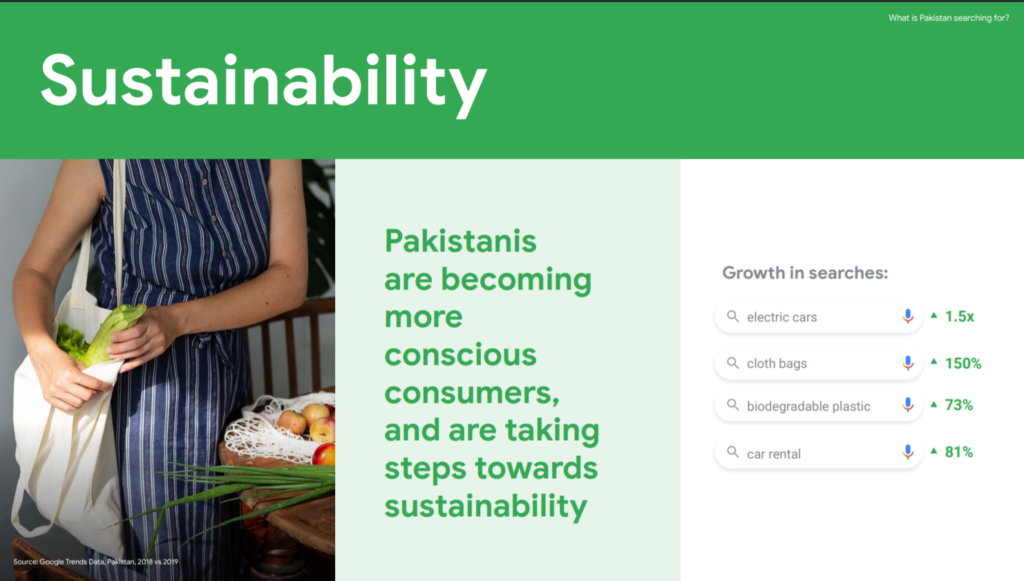
    A combination of the state of the world and an overall rise in awareness has seen the rise of environmentally-conscious consumers. Over the past year, these searches have risen sharply across Pakistan: “climate change” by 1.5x, “electric cars” by 1.5x and “reusable” by 1.3x. 

    Users were also curious about the visible impact on air quality and pollution levels, with searches such as “clear skies” increasing by 300 per cent, “clean air” by 225 per cent and “clear water” by 217 per cent.

    3. Digital video continues to boom

    Video streaming and sharing platforms where Pakistanis get their fix of information, entertainment, news and sports. The primary drivers are a combination of affordable data combined with the proliferation of devices and new platforms. 

    Every seven in 10 Pakistanis use YouTube every month, with searches related to “with me” increasing by 150 per cent, “Teeli” by 108 per cent and “village food secrets” by 168%.

    4. Healthy lifestyle choice

    While Pakistan has a rich and diverse culinary tradition, there has been a rise in searches for alternate diets and meal plans predicated around well-being. 

    Searches for “daily exercise” are up by 1.6x. Searches for “vegetarian cuisine”, “healthy supplements” and “intermittent fasting” have risen by 1.5x. Meanwhile, searches for “superfood” are up by a whopping 767 per cent and “high-intensity interval training (HIIT) workout” by 600 per cent.

    5. COVID-19 implications

    With COVID-19 restricting the movement of people outdoors, Pakistanis have started looking for ways to start (or continue) their usual physical routines indoors with “HIIT workout” YouTube search growing by 600 per cent, “gym at home” by 125 per cent and “home workouts” by 80 per cent. With more people confined indoors, interest in mental health and well-being has also become an important factor for Pakistanis, with a surge in searches for “meditation” (+56%) in March this year.

    The information was gathered from a web conference organization by Syntax Communications with Google Asia Pacific team.