Tag: hacking

  • Here are the celebrities who are hackers’ hot favourites

    Here are the celebrities who are hackers’ hot favourites

    A study by McAfee reveals a list of 10 celebrities which are used by hackers as bait while searching for them online may lead to malware and risky websites. The list includes celebrities spotted in deepfake and other AI driven content as well.

    ‘Barbenheimer’ fever is not over yet as the two movies were not just huge hits at the box office but for cybercriminals as well. Internet searches of the two films have got consumers in a rash of ticket scams, download scams and other attacks that were capitalising on these summer hits.

    Who made it to the list?

    In that context, our very own Ken, Ryan Gosling, is the hacker’s favourite celebrity, making it to number one. His co-star Margot Robbie and the titular character of the film Barbie makes it to number eight on the list.
    Emily Blunt, the leading lady of Oppenheimer, is at number two.
    Pop culture icon, actor, singer and producer Jennifer Lopez, known as JLO, is the third most malware attracting celebrity.
    Zendaya, famous for her portrayal of nerdy MJ in Spiderman, makes it to the fourth spot.
    Notoriously popular Elon Musk, owner of X (former Twitter) is unsurprisingly standing on number six.
    Among others are academy award winning actor Kevin Costner on number five, American weather presenter Al Roker on number seven, singer Bad Bunny on number nine and Barbie’s guide Gloria, played by America Ferrera, makes it to the tenth position.
    Football superstar Lionel Messi is also on the list, standing at number 18. Taylor Swift, singer with a huge fan following, made it to number 25.

    The plethora of crimes that can be committed and how?

    The hackers commit crimes with these searches as they pair celebrity names with terms like audiobook, lyrics, deepfake, free ringtone, free movie, free download, MP4, among others—which generate results that lead to shady sites. They carry out fraudulent activities with that because they understand people’s liking for the free celebrity content.

    The study finds out that between 25 to 135 deepfake URLs were celebrity searches. These could be malicious, recreational or cases of false advertising.

    A word of caution:

    Using trusted websites, sticking to legitimate streaming and downloading services and using antivirus softwares may help keep your devices protected and enable safe internet search. Searching about your favourite celebrities is not wrong because their names are used by hackers to attract more traffic. This just needs to be done with a sharp eye.

  • Teen hacker causes millions in damages to Uber, Revolut, and Grand Theft Auto maker

    Teen hacker causes millions in damages to Uber, Revolut, and Grand Theft Auto maker

    During proceedings at a London court, prosecutors disclosed that a member of the hacking group Lapsus$, who is a teenager, successfully breached the security systems of Uber and fintech company Revolut.

    The individual in question, identified as Arion Kurtaj, allegedly gained unauthorised access to the personal information of approximately 5,000 Revolut customers in September 2022, while also inflicting damages amounting to nearly $3 million on Uber.

    Furthermore, the prosecution claims that Kurtaj proceeded to target Rockstar Games shortly after, hacking into their systems. In a Slack message addressed to all Rockstar staff, he purportedly threatened to disclose the source code of the highly popular video game franchise, Grand Theft Auto, which was under development for a forthcoming installment.

    Additionally, Kurtaj stands accused, alongside an unnamed 17-year-old co-defendant, of engaging in a blackmail scheme against BT Group (BT.L), the largest broadband provider in Britain, and EE, a prominent mobile network operator. This illicit activity reportedly took place between July and November 2021, during which the accused demanded a ransom of $4 million.

    Prosecutors assert that the duo, considered “key players” within Lapsus$, conducted a cyberattack on chipmaker Nvidia Corp (NVDA.O) in February 2022. They allegedly sought payment from Nvidia to prevent the public release of the company’s data.

    During the trial, prosecutor Kevin Barry revealed that the 17-year-old defendant had breached the cloud storage of the City of London Police, mere weeks after being apprehended in connection with the BT and EE hacking incident.

    According to Barry, Kurtaj later embarked on a solo cybercrime spree, commencing with the targeting of Revolut and subsequently Uber, followed by the intrusion into Rockstar Games’ systems.

    Kurtaj’s mental fitness to stand trial has been assessed by psychiatrists and found inadequate. Consequently, the jury will evaluate whether he committed the alleged acts, rather than delivering a traditional guilty or not guilty verdict.

    The charges leveled against Kurtaj encompass a total of 12 offenses, including three counts of blackmail, two counts of fraud, and six charges under the Computer Misuse Act.

    Meanwhile, the 17-year-old defendant is currently being tried for two counts of blackmail, two counts of fraud, and three charges under the Computer Misuse Act related to the hacking of BT and Nvidia. The defendant denies these charges but has previously pleaded guilty to two offenses under the Computer Misuse Act and one count of fraud.

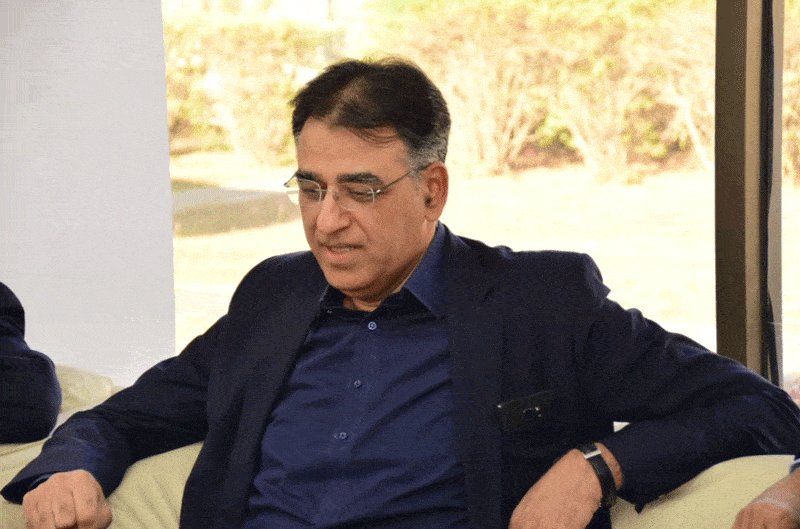
  • PTI’s Asad Umar’s Twitter account hacked

    PTI’s Asad Umar’s Twitter account hacked

    Pakistan Tehreek-e-Insaf (PTI) General Secretary and former federal minister Asad Umar’s Twitter account has been hacked, confirmed PTI’s official Twitter handle early Wednesday.

    “PTI Secretary General Asad Umar’s account has been hacked. Please report any uncharacteristic tweets to Twitter. We are working with Twitter to get access back,” tweeted PTI official.

    Earlier in May, PTI leader and former federal minister Hammad Azhar’s e-mail, Twitter, and Apple accounts were also hacked

  • Italian spyware hacks Apple and Android smartphones

    Italian spyware hacks Apple and Android smartphones

    A report released on Thursday by Alphabet Inc.’s Google revealed that a hacking tool created in Italy was used to spy on Apple Inc. and Android smartphone users in Kazakhstan and Italy.

    The report claimed that RCS lab, a Milan-based company whose website lists European law enforcement agencies as clients, created tools to spy on the private messages and contacts of the targeted devices.

    Regulators in Europe and America have been considering possible revisions to the laws governing the sale and import of spyware.

    “These vendors are enabling the proliferation of dangerous hacking tools and arming governments that would not be able to develop these capabilities in-house,” Google said.

    According to Billy Leonard, a senior researcher at Google, the hackers occasionally collaborated with the target’s ISP, which suggests that they had connections to the government.

    Requests for comment from the governments of Italy and Kazakhstan were not immediately returned. According to a spokesperson for Apple, the company has cancelled all known accounts and certificates linked to this hacking campaign.

    According to RCS lab, its goods and services are compliant with European regulations and support criminal investigations.

    Government spyware has become a growing global industry in recent years. More and more businesses are being accused of supporting governments that, in some cases, use these tools to repress civil and human rights.

    When it was discovered that numerous governments were using the Pegasus spyware from Israeli surveillance firm NSO to spy on journalists, activists, and dissidents, there was a widespread outcry against the industry.

  • Google to ban call recording apps in the next update

    Google to ban call recording apps in the next update

    From May 11, a new policy of the Google Play Store will prohibit third-party call recording applications from being downloaded.

    Modifications to the Google Play Policy mean that developers’ access to the Accessibility API will be restricted even more. This has been used as a workaround for remote call audio recording, however starting May 11, Google will no longer allow apps on the Play Store to use the Accessibility Service.

    In addition, Google clarified potential misunderstandings about the change in policy through a recent developer webcast.

    Numerous apps allow recording audio from a call without the other party knowing. As a result, this policy change only affects third-party apps on the Play Store. On some devices, several default dialer apps, such as Google Phone, Mi Dialer, and others, have a native call recording feature built-in. The update would not affect the default dialer apps on devices like Pixel and Xiaomi handsets.

    “Remote in this sense refers to call audio recording where the person on the other end is unaware that the recording is taking place,” said Moun Choi, Google content operations lead, during the special developer webinar.

    “Accessibility capability is not necessary to get access to the incoming audio stream if the app is the phone’s default dialer and also pre-loaded”. As a result, there would be no infringement. Because this is a clarification of an existing policy, the new language will take effect on May 11th for all apps”.

    Read more: Netflix loses 200,000 subscribers in Q1 2022, projects deeper losses in Q2

    In other words, you won’t lose functionality if you can record calls using your pre-installed dialer programme. Call recording may not be possible in the future if you use an app downloaded from the Google Play Store.

  • National awareness campaign launched to protect children against cybercrime

    National awareness campaign launched to protect children against cybercrime

    The Federal Ombudsman’s nationwide public awareness campaign aimed at educating the wider populace and relevant groups about the skills and methods needed to combat cybercrime against children is now in full swing.

    On Sunday, a representative for the Federal Ombudsman Office said that as part of the program, state-run broadcasting stations broadcast informational messages and programmes about the prevention and control of cyber-crime against children in Urdu and regional languages.

    The strategic goal of the awareness campaign, according to Commissioner for Children Syeda Viqar un Nisa Hashmi, is to raise public awareness about the effects of cyber-crime abuse and exploitation of minors, as well as to educate children so that they could protect themselves from such situations.

    He went on to say that politicians were encouraged to bring legal amendments to the issue as part of the protection drive. The FIA Cyber Crime Cell is also conducting operations to apprehend the remaining suspects. 

    Read more: Lahore Police arrested 648 dacoits, recovering more than Rs27 crore in three months

    Earlier, the Federal Investigation Agency’s Cyber Crime Cell also nabbed a gang in Lahore that was allegedly making money from the dark web through juvenile crime.

  • Man hacks airline’s website after he lost his baggage

    Nandan Kumar, a software engineer, hacked the website of an India airline — IndiGo — to search for his baggage after it was exchanged with some other passenger. He also tried to reach out to the airline’s customer service but they did not assist him properly.

    Nandan Kumar was travelling on a domestic flight from Patna to Banglore on March 27 when his baggage was exchanged with another passenger’s luggage.

    When his wife unpacked the luggage, he realised that his baggage was exchanged with another passenger.

    Kumar also narrated the full incident on Twitter in which he revealed that IndiGo’s customer service refused to give personal details of another passenger due to privacy concerns.

    According to Kumar, he was assured that they would contact him when they reach the other person. However, he did not receive any feedback from them.

    On March 28, he decided to resolve the issue by himself in order to get the contact details of that passenger by using his Passenger Name Record written on his bag’s tag. However, his attempt did not succeed. After several failed attempts, Nandan Kumar decided to hack IndiGo’s website and successfully got the contact details of that person.

    He contacted him and decided to meet at a certain location and there they exchanged their bags. He was also surprised by the whole incident. Later, Kumar also advised IndiGo to improve their security on the website to prevent hacking.

  • Twitter reacts to PM Modi’s hacked account news

    Twitter reacts to PM Modi’s hacked account news

    Indian Prime Minister (PM) Narendra Modi’s Twitter account was hacked late Saturday.

    A deleted tweet from Modi’s official handle declared India had adopted Bitcoin as legal tender and was distributing the cryptocurrency to citizens.

    Later, the Indian Prime Minister Office clarified that “The Twitter handle of PM was very briefly compromised. The matter was escalated to Twitter and the account has been immediately secured. In the brief period that the account was compromised, any Tweet shared must be ignored.”

    Soon the hashtag #ModiAccountHacked started making rounds on Twitter.

  • ‘PM Khan’s phone does not have messages of Gujarat massacre like Modi’: Fawad

    ‘PM Khan’s phone does not have messages of Gujarat massacre like Modi’: Fawad

    Federal Minister for Information and Broadcasting Fawad Chaudhry, while speaking on Geo News’ programme ‘Jirga’, said, “Two days prior to the story of Pegasus spyware being published, I received a letter from The Guardian revealing that there was a list of phone numbers that had been hacked. Three numbers previously used by Prime Minister Imran Khan were also in the list.”

    Fawad said that the letter further added that he needed to confirm whether the numbers included in the list belonged to PM Khan or not.

    Fawad said that a team was being put together by the government, who would do the forensics to verify whether the premier’s phone was hacked or not. Only then will the government be able to tell if the attempt to hack the phone was successful or not.

    “It is confirmed that an attempt to hack the phone was made,” said Fawad.

    On being asked by Saleem Safi that if the phone was indeed hacked and the Indians did get the data from the premier’s phone, what implications would it have for the country, Fawad replied, ” PM Khan’s phone did not have messages of Gujarat massacre like Indian Prime Minister Narendra Modi. His phone does not have any orders of murder in it.”

    Fawad condemned how Modi and his government had hacked the phones of Indian journalists, judges, his own government officials, and other world leaders and said that the United Nations must intervene in this regard.

    Fawad Chaudhry added that the Foreign Office has taken notice of India’s use of Israeli spyware, Pegasus, to hack Prime Minister Imran Khan’s phone and had already said: “We call on the relevant UN bodies to thoroughly investigate the matter, bring the facts to light, and hold the Indian perpetrators to account.”

    When questioned about the meeting between Imran Khan and Narendra Modi before he came into power and whether it was discussed with the then government, Fawad responded that PM Khan’s meeting was public and the media was present. Fawad criticised Nawaz Sharif’s meeting with Afghan National Security Adviser (NSA) Hamdullah Mohib in London and said this was news shared with the Afghan media.

    “I won’t call Nawaz Sharif a traitor but it was a very irresponsible act by him,” added Fawad.

    Earlier this week, Pakistan Muslim League-Nawaz (PML-N) leader Nawaz Sharif was met by Afghan National Security Adviser Hamdullah Mohib and State Minister for Peace Sayed Sadat Naderi.

    The National Security Council of Afghanistan (NSCA) gave an update about the meeting on Twitter Saturday, saying that the Afghan state minister for peace and NSA discussed “matters of mutual interest” with the former Pakistan prime minister.

    Nawaz Sharif’s meeting faced extreme criticism from the government.

  • Government blames Nawaz Sharif for PM Khan’s phone hacking

    Government blames Nawaz Sharif for PM Khan’s phone hacking

    Minister of State for Information and Broadcasting, Farrukh Habib, said that when Prime Minister Imran Khan’s phone was being hacked through Pegasus spyware, it was Nawaz Sharif’s government.

    Farrukh made this statement after The Guardian reported that the Indian government targeted Prime Minister Imran Khan’s phone for surveillance.

    Farrukh further added that while Indian Prime Minister Narendra Modi was busy hacking the phones of his Opposition, who knows, Nawaz Sharif might have sought Modi’s help for some other purposes as well.

    “We will not allow them [Nawaz Sharif and Narendra Modi] to remain silent on these issues,” added Farrukh.

    Special Assistant to Prime Minister Dr Shahbaz Gill tweeted, “Maryam Safdar kept speaking against Imran Khan. Today, the international media has once again exposed the nexus between her [Maryam Nawaz’s] father and Israel.”

    “He [Nawaz Sharif] was working with Israel to hack the phones of Imran Khan and other government officials,” added Gill.