Tag: health workers

  • Police baton-charges teachers and health workers in Lahore, Bahawalpur

    Police baton-charges teachers and health workers in Lahore, Bahawalpur

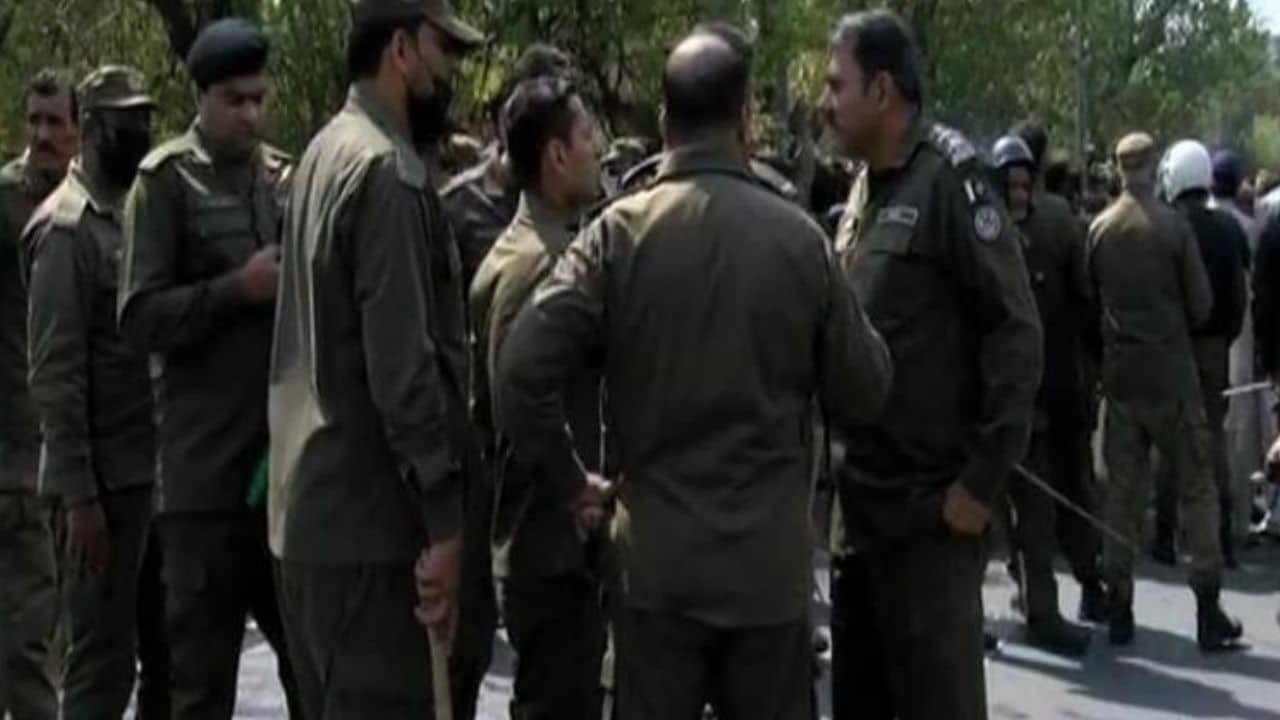
    In an attempt to deter protesting government employees, Lahore police subjected them to baton charging. The incident occurred on Thursday while protesters were holding a rally from the PMG chowk to Aiwan-i-Iqbal. There were more than a hundred government employees, both male and female teachers and health workers. As part of the crackdown they were shifted to different police stations of the city.

    The protest was held by All Government Employees Grand Alliance (AGEGA), a coalition of 34 organisations representing many departments including health, education and higher education. Their protest is especially targeteding the Punjab Government and the district administration over the arrest of more than 200 teachers.

    They have a range of demands which include the restoration of leave encashment, reversal of amendments to pension regulations and cancellation of privatisation plans for public schools. To get their protests registered, many teachers are boycotting classes in the schools and colleges throughout the province for the last one week.

    The office bearers of AGEGA have held Caretaker Chief Minister Mohsin Naqvi responsible for all their complaints but they also pledged not to give up on their demands or surrender in front of violence.

    In Bahawalpur, Police booked around 200 employees under 16-MPO for making provocative speeches against the Government and blocking the road. An FIR lodged by the police says that the demonstrators were asked to unblock the road, however, they kept it blocked until action by police became imperative.
  • Monkeypox outbreak primarily spreading through sex: WHO officials

    Monkeypox outbreak primarily spreading through sex: WHO officials

    Monkeypox, a potentially fatal disease that has seen an alarming surge in cases in North America and Europe over the last three weeks,  can be spread through close contact. According to the World Health Organization (WHO), the most recent surge in cases appears to have been spread among men who have sex with other men, emphasising that anyone can contract monkeypox.

    “While the virus itself is not a sexually transmitted infection, which are generally spread through semen and vaginal fluids, the most recent surge in cases appears to have been spread among men who have sex with other men,” said WHO officials.

    “Many diseases can be spread through sexual contact. You could get a cough or a cold through sexual contact, but it doesn’t mean that it’s a sexually transmitted disease,” said Andy Seale, a strategic advisor with WHO’s HIV, hepatitis and sexually transmitted infections programme.

    Read more- Monkeypox outbreak primarily spreading through sex: WHO officials

    According to the US Centers for Disease Control and Prevention, monkeypox is a disease caused by a virus that is related to smallpox but is less severe. According to findings in Africa, monkeypox can kill up to 1 in 10 people who develop the disease.

  • Khairpur health workers inject at least 150 police officers with expired vaccine

    Khairpur health workers inject at least 150 police officers with expired vaccine

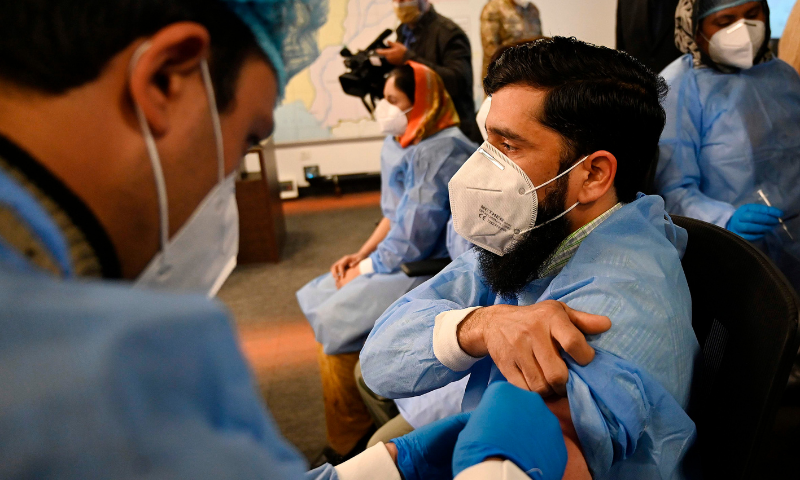
    At least 150 officers of the Khairpur police department were injected with expired Covid-19 vaccines, confirmed by the Police Training Centre, reports Geo News.

    After the incident, an inquiry report stated that the date of expiry for the vaccine was December 2021, while the vaccine was administered on January 24.

    Four police officers out of 170 got sick due after getting an expired booster dose. Five health workers, including Dr Amar Lal were found responsible for the act.

    The inquiry report states that the incident took place due to the negligence of a storekeeper, a technician, a male nurse, and a vaccinator in Sukkur, and that action should be taken against those responsible.

  • ‘There is no corona’: Mob attacks Karachi hospital as health workers remain at risk amid rising fatalities

    ‘There is no corona’: Mob attacks Karachi hospital as health workers remain at risk amid rising fatalities

    In yet another incident of a hospital being ransacked by survivors of a deceased coronavirus patient, a mob on Friday night attacked Civil Hospital Karachi while also harassing and attempting to assault the medical staff on duty.

    According to the hospital’s management, at least 70 people entered the hospital and took the body of the deceased from the emergency ward.

    The hospital’s medical superintendent, Dr Khadim Qureshi, reportedly confirmed the incident and said the police were asked to lodge an FIR [First Information Report] against those involved in the attack.

    No medical staffer were, however, injured in the attack.

    WATCH VIDEO:

    “Doctors are demanding security. It’s hard for them to work under this kind of situation,” Dr Qureshi said.

    Another doctor who was on duty at the time, said the incident took place at around 11 pm. He and other doctors on duty were also tortured and abused. “It’s the third time in a week, ” he claimed, alleging that the police deployed outside the hospital gate did not help the medical staff.

    While no arrests have been made as of yet and doctors have demanded deployment of Sindh Rangers for security, it is worth mentioning that it is not the first incident of its kind as hospitals across the country are being attacked every day amid the rising number of deaths due to COVID-19.

    Among other incidents being reported across the country, over a dozen people last week barged into and vandalised the isolation ward at Karachi’s Jinnah Postgraduate Medical Centre (JPMC) after a coronavirus patient being treated there died, officials said.

    Videos taken of the ward, where 37 coronavirus patients were being treated, after the attack showed pieces of glass, furniture and fans strewn on the floor. The glass windows of a counter were also shattered.

    Pakistan has so far reported 1,395 deaths due to the novel virus.

  • Young health workers who sacrificed their lives  fighting COVID-19

    Young health workers who sacrificed their lives fighting COVID-19

    Coronavirus cases in Pakistan are on the rise and according to the latest numbers, there are 64,028 cases of COVID-19 in the country. Healthcare workers, who are fighting on the frontlines, have been badly affected by the virus.

    As per reports, until May 28, 17 medical professionals had died of COVID-19 in Pakistan out of the total 1,904 who tested positive; this figure included 299 nurses, 570 others healthcare staff and 1,035 doctors.

    This is the total data of medical staff, as far as young doctors are reported, many of these were among them who sacrificed their lives fighting against coronavirus.

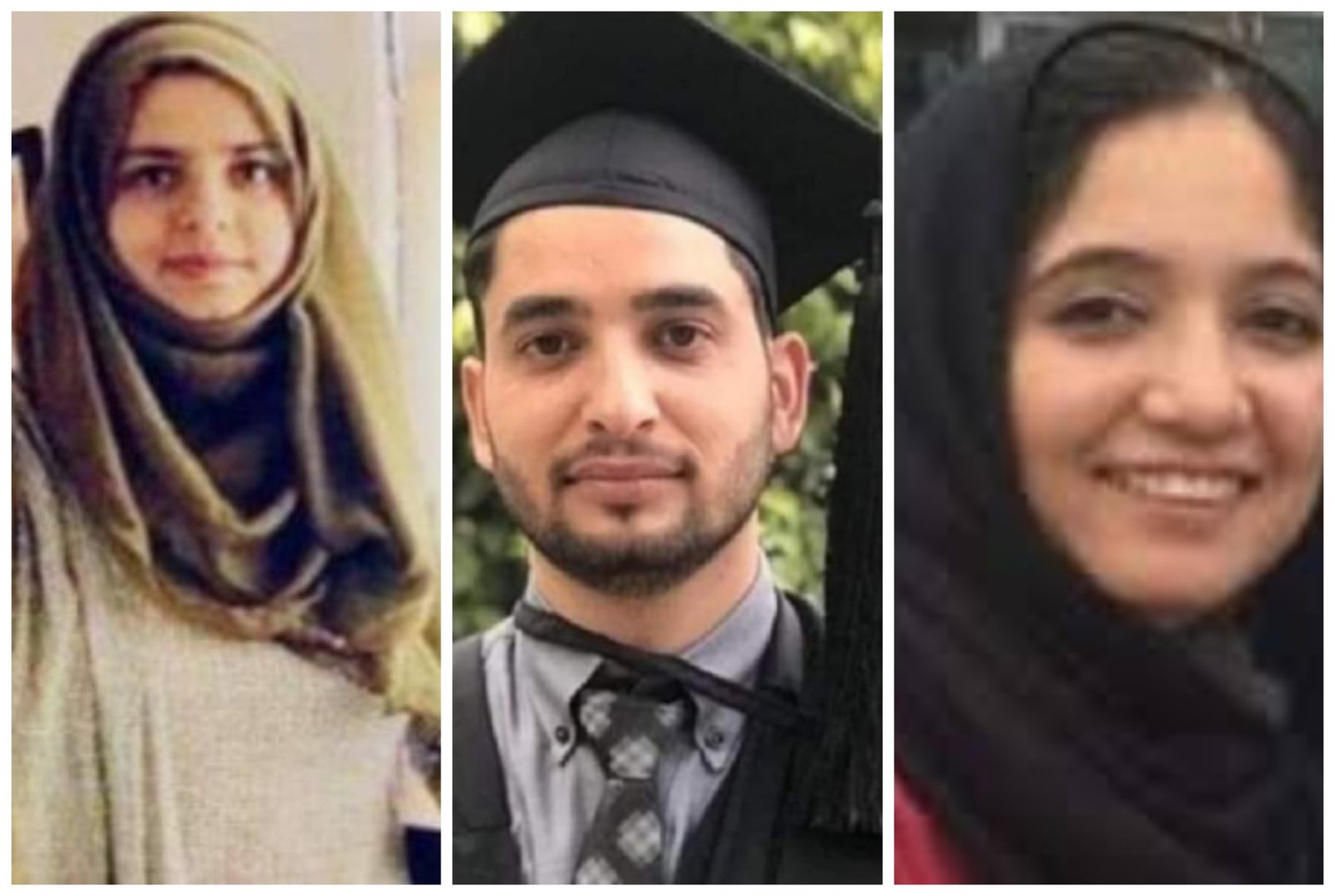
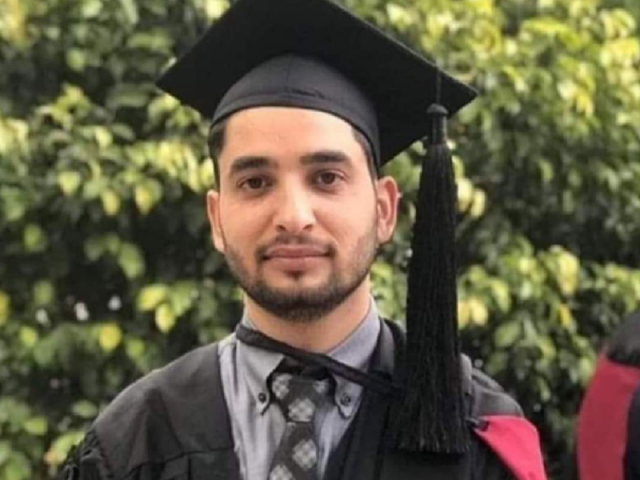
    Here are a few young doctors who lost their lives because of this pandemic.

    Dr Sana Fatima

    The doctor lost her life due to coronavirus on May 29. She was admitted to Lahore General Hospital after being tested positive for Covid-19 on May 20.

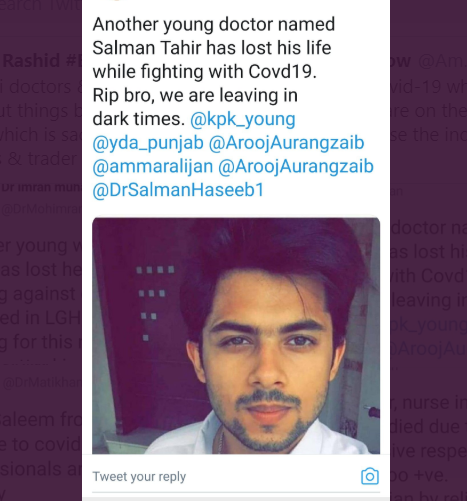
    Salman Tahir

    Salman Tahir, an MBBS fourth-year student of a private medical college in Lahore, was admitted due to high fever, but due to the high viral load of the virus, he died in the ICU of a private hospital within 24 hours. Dr. Salman Tahir’s father Prof. Tahir Saleem is in charge of the pediatric ward in a private hospital while his mother Dr. Shabana is a gynecologist in a private hospital.

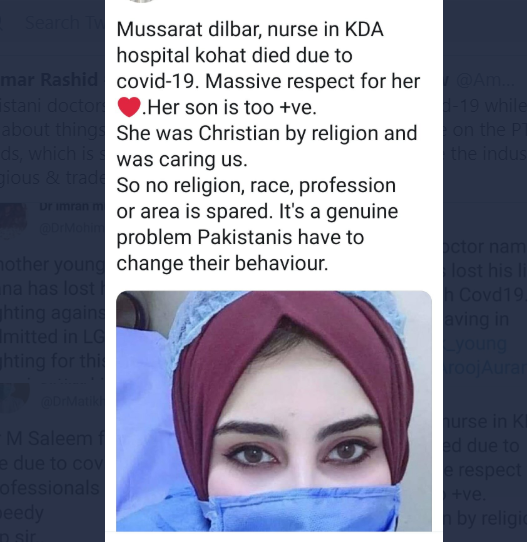
    Mussarat Dilbar

    Mussarat Dilbar, a nurse at the Kohat Development Authority (KDA) hospital, was tested positive for the virus a few days ago. She had been admitted to the facility but her health condition continued to worsen and on May 29, she succumbed to the virus.

    Dr Usama Riaz

    The 26-year-old was infected with the coronavirus while screening infected pilgrims who had returned from Iran and Iraq in Gilgit-Baltistan and lost his life to COVID-19 disease on March 22. He was among the first healthcare workers to succumb to the disease.

    Dr Rabia Tayyab

    26-year old Rabia Tayyab succumbed to coronavirus at Rawalpindi’s Holy Family Hospital after battling the infection for almost two weeks.

    The doctor, who hailed from Gujjar Khan, was the daughter of a renowned teacher Mohammad Tayyab. She graduated from the Quaid-e-Azam Medical College in Bahawalpur and was due to start her house job from May 1.

    Healthcare workers are risking their lives and fighting on the forefront to save us from COVID-19. We can play our part in controlling the spread of the virus by following the SOPs and precautionary measures issued by the government and the World Health Organisation (WHO). Here’s what you can do:

    • Avoid going out unnecessarily
    • Clean your hands often. Use soap and water, or an alcohol-based hand rub to disinfect them
    • Maintain a safe distance from anyone who is coughing or sneezing
    • Don’t touch your eyes, nose or mouth with dirty hands. Cover your nose and mouth with your bent elbow or a tissue when you cough or sneeze
    • Stay home if you feel unwell
    • If you have a fever, cough and difficulty breathing, seek medical attention as soon as possible
  • Coronavirus: Army takes over distribution of protective equipment to ensure transparency

    Coronavirus: Army takes over distribution of protective equipment to ensure transparency

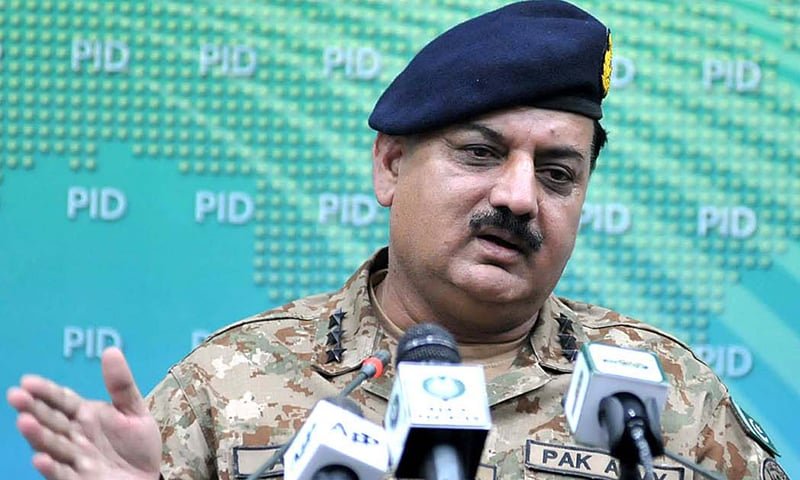
    National Disaster Management Authority (NDMA) chief Lieutenant General Muhammad Afzal has said that the army, amid doctors’ complaints regarding the nonavailability of personal protective equipment (PPE), has taken over the distribution of the same and the equipment is now being provided to hospitals with the help of respective corps headquarters.

    “As we had received complaints from some doctors that they were not getting PPE, I requested COAS [Chief of Army Staff Gen Qamar Javed Bajwa] after which it was decided that PPEs will directly be sent to the corps headquarters concerned rather than sharing them with the provincial governments,” Lt Gen Afzal said while addressing a press conference.

    According to Dawn, he added that the information regarding the dispatching of PPEs was, however, duly shared with the provincial governments. “Now the army is distributing the protective gear in the hospitals, and since then we have not received any complain.”

    The NDMA chairperson said the authority had adequate stocks of protective equipment which could cater to the needs of doctors and patients for the next month.

    He said initially Pakistan was dependent on foreign-made equipment but now except ventilators, everything else was being manufactured by local companies. “As a result of the local production of equipment, the cost of normal mask has dropped from Rs50 to Rs10 and N-95 mask is now available for Rs300 against its previous price of Rs2,000.”

    Lt Gen Afzal said so far five tranches of equipment had been sent to provinces and a universal helpline 111-157-157 set up to receive complaints regarding unavailability of PPE and other material being used against the virus.

    He said a quarantine centre established at Haji Camp in the capital was not being utilised as people of the area had demanded that such a centre should be away from populated areas.