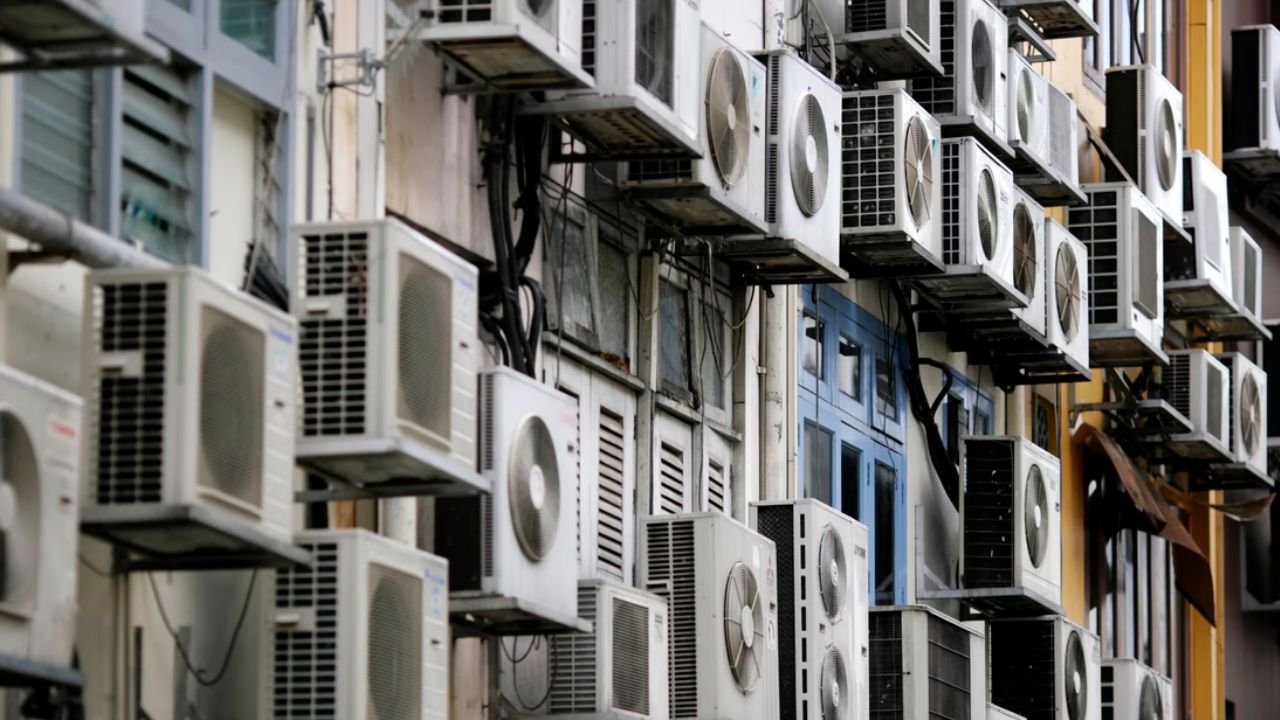
Experts warn that air conditioners, primarily used to beat the heat and cool rooms, are contributing to global warming by heating up the environment and increasing temperatures.
In cities where tree cover is decreasing, the number of air conditioners is rising.
Ecologists from the University of Agriculture explain that while ACs cool indoor spaces, they simultaneously heat the outdoor environment, leading to higher temperatures.
ACs can raise outdoor temperatures by as much as 60 to 80 degrees Celsius in extreme conditions and has reportedly caused temperatures to rise by half a degree Celsius over the past century.
Experts further warn that continued proliferation of air conditioners to cool environments could irreversibly damage natural ecosystems.
Instead of disregarding environmental warnings, experts urge increasing urban tree cover as a sustainable alternative to cooling the environment without exacerbating global warming.
Karachi Cattle Farms Association spokesperson Shabir Dar has reported that 150 animals have died in a span of three days as temperatures increase in the coastal city, Samaa news has reports.
Cattle farmers are facing financial losses as timely treatment remains elusive.
Shabir Dar emphasised that despite the challenges, including the absence of veterinary doctors from the livestock department, it is crucial for the department to ensure the supply of care and medicines.
Yesterday, following the mercury hitting 41 degrees Celsius in Karachi, concerns among residents escalated. Over the past four days, more than 70 people affected by extreme heat sought treatment at Civil and Jinnah Hospitals.
Dr. Nizam, AMS Civil Hospital, reported that 67 heat-affected individuals were admitted to the emergency room, predominantly elderly or those suffering from various illnesses.
Chief Meteorologist Sardar Sarfraz has forecast a partial heatwave in Karachi for the next two days, attributing the intensified heat to changing winds. Temperatures are expected to decrease after two days, with monsoon rains likely starting in the first week of July.
Global temperatures “smashed” heat records last year, as heatwaves stalked oceans and glaciers suffered record ice loss, the United Nations said Tuesday — warning 2024 was likely to be even hotter.
The annual State of the Climate report by the UN weather and climate agency confirmed preliminary data showing 2023 was by far the hottest year ever recorded.
And last year capped off “the warmest 10-year period on record”, the World Meteorological Organization said, with even hotter temperatures expected.
“There is a high probability that 2024 will again break the record of 2023”, WMO climate monitoring chief Omar Baddour told reporters.
Reacting to the report, UN chief Antonio Guterres said it showed “a planet on the brink”.
“Earth’s issuing a distress call,” he said in a video message, pointing out that “fossil fuel pollution is sending climate chaos off the charts”, and warning that “changes are speeding up”.
The WMO said that last year the average near-surface temperature was 1.45 degrees Celsius above pre-industrial levels — dangerously close to the critical 1.5-degree threshold that countries agreed to avoid passing in the 2015 Paris climate accords.
“I am now sounding the red alert about the state of the climate,” Saulo told reporters, lamenting that “2023 set new records for every single climate indicator”.
The organisation said many of the records were “smashed” and that the numbers “gave ominous new significance to the phrase ‘off the charts’.”
“What we witnessed in 2023, especially with the unprecedented ocean warmth, glacier retreat and Antarctic sea ice loss, is cause for particular concern,” Saulo said.
One especially worrying finding was that marine heatwaves gripped nearly a third of the global ocean on an average day last year.
And by the end of 2023, more than 90 percent of the ocean had experienced heatwave conditions at some point during the year, the WMO said.
As temperatures surge to unprecedented levels year after year, July 2023 is on track to become the hottest month ever recorded on Earth, surpassing previous records by a significant margin, CNN has reported.
Scientific reports from both the European Union’s Copernicus Climate Change Service and the World Meteorological Organization have confirmed that this month’s scorching heat is virtually certain to break global climate records.
Till the first 23 days of July, the average air temperature across the entire world reached a staggering 16.95 degrees Celsius (62.51 Fahrenheit), well above the previous record of 16.63 degrees Celsius (61.93 Fahrenheit) set in July 2019.
Scientists warn that these extreme temperatures are the hottest witnessed in human history, with estimates suggesting they are the warmest the planet has experienced in over 120,000 years
Despite a pleasant first week, this May is not being kind to Lahoris, with the temperature currently at 42°C which has left us without no option but to stay inside with ACs on 24/7.
But, this is not the case as per the weather App on our iPhones. According to the application, while all of us are burning in this garmi, a thunderstorm is happening. We have just one question. Where are the rainy clouds?
Social media users have also taken to Twitter to express their frustration.
According to a report, a searing heat wave that gripped parts of South Asia in April this year was made at least 30 times more likely by climate change.
The climate change-fueled heat caused deaths, widespread hospitalizations, damaged roads, sparked fires and led to school closures in the region.
Keeping in view the meteorological department’s prognosis of a heatwave for the coming week, the Punjab government issued an advisory on Friday, requesting that all relevant ministries in the province take steps to mitigate the effects of the heat.
The provincial and district crisis management agencies have been activated across the province to avert health-related occurrences, according to Punjab Chief Secretary Kamran Ali Afzal, who issued an advisory to several ministries.
Hospitals and the emergency service Rescue 1122 have also been placed on high alert, he said. For sensitive areas, temporary water-drinking sites and early reaction centers, according to the chief secretary, should be erected. He urged individuals to take all necessary precautions to protect themselves from the heatwave and to heed the health department’s advice.
The Provincial Disaster Management Authority (PDMA) has already issued a warning for severe heatwave conditions in upper, central, and southern Punjab during the next week.
From May 15, a high-pressure system is expected to hold the upper atmosphere, according to the Met Office.
Day temperatures are expected to rise to 7-9 degrees Celsius above normal owing to the high pressure in upper Punjab, and 6-8 degrees Celsius beyond average in the central and south Punjab, during the heatwave.
The Pakistan Meteorological Department (PMD) issued a warning on Monday for an extreme heatwave across the country this week, stating that day temperatures in most parts of the country, are likely to remain unusually high due to persistent high pressure in the upper atmosphere. The heatwave is supposed to take over most parts of the country except for Karachi.
As per the alert issued by PMD. “Day temperatures in Northern Balochistan, Upper Sindh, South Punjab, Kashmir and adjoining areas will remain 09-10°C above normal.”
“Day temperature in Islamabad, Upper & Central Punjab, Khyber Pakhtunkhwa, Gilgit-Baltistan, Lower Sindh and South Balochistan will remain 07-08°C above normal.”
As per a mobile weather application, the temperature in Lahore can rise up to 38 °C, 36 °C in Islamabad, and 33 °C in Peshawar.
According to the advisory, the country’s dry spell and hot temperatures may cause water stress for standing crops, vegetables, and orchards, and farmers should manage crop water properly.
“The general public is advised to avoid unnecessary exposure to direct sunlight. Gusty winds are also expected in North Balochistan, South Punjab and Upper Sindh during the period,” the alert read.
Jacobabad, the city with 200,000 citizens in the Sindh province has long been known for its severe heat but recent research has conferred an unwelcome scientific distinction.
The mixture of heat and humidity in the city has made it one of the hottest places on earth. The temperature there is hotter than the human body can handle.
The city’s temperature rises to 52 degrees Celsius forcing its residents to remain inside their homes. Few have air conditioners in their homes and loadshedding in the city worsens the situation. The hospital fills with heatstroke cases from those whose livelihoods demands them to step out.
Speaking to the telegraph, a resident, Zamir Alam said, “When it gets that hot, you can’t even stay on your feet.”
“It’s a very, very difficult time when it goes beyond 50°C. People do not come out of their houses and the streets are deserted,” Abdul Baqi, a shopkeeper, added.
Mr. Matthews, who is a lecturer in climate science at Loughborough University with his colleagues analysed global weather station data last year and found that Jacobabad and Ras al Khaimah, northeast of Dubai in the United Arab Emirates, have both temporarily crossed the deadly threshold. The milestone had been surpassed decades ahead of predictions from climate change models.
The researchers inspected what are called wet bulb temperatures. These are taken from a thermometer covered in a water-soaked cloth so they take into account both heat and humidity. Wet-bulb thermometer readings are significantly lower than the more familiar dry bulb readings, which do not take humidity into account.
Researchers say that at a wet-bulb (thermometer covered in a water-soaked cloth) reading of 35 degrees Celsius, the body can no longer cool itself by sweating and such a temperature can be fatal in a few hours, even to the fittest people.
According to reports, Jacobabad crossed the 35 degrees Celsius wet-bulb threshold in July 1987, then again in June 2005, June 2010 and July 2012. Each time the boundary may have been breached for only a few hours, but a three-day average maximum temperature has been recorded hovering around 34°C in June 2010, June 2001 and July 2012. The dry bulb temperature is often over 50 degrees Celcius in the summer.
As temperatures rise and rainfall patterns shift, difficulties with farming, irrigation, disease and labour are predicted by 2050 to badly hit people’s quality of living in parts of India, Pakistan and Bangladesh.