Tag: high treason

  • Unknown armed men break into residence of Musharraf’s ex-prosecutor, ‘warn him’

    Unknown armed men break into residence of Musharraf’s ex-prosecutor, ‘warn him’

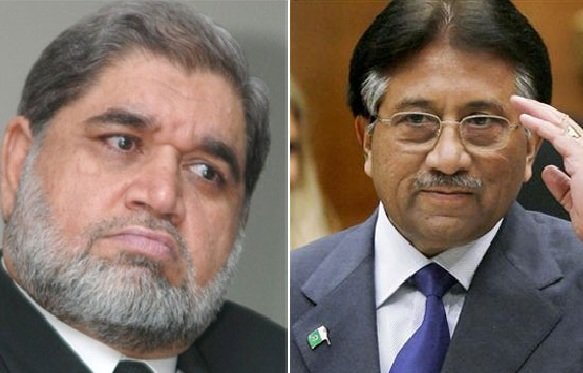
    An armed robbery has been reported at the farmhouse of Akram Sheikh, who previously headed the government’s prosecution team against Gen (r) Pervez Musharraf in the high treason case against the latter, SAMAA reported.

    According to reports, the armed men remained at the lawyer’s residence for around two hours while they held his family hostage, and finally left after looting items worth millions of rupees.

    Sheikh’s farmhouse is located in Islamabad’s Chak Shehzad area, police said and added that the lawyer’s family was locked in a room after their mobile phones were taken away by the intruders. “The house was then combed and looted.”

    While a case has not yet been lodged amid Sheikh’s silence, senior journalist and analyst Hamid Mir has claimed that the lawyer was also threatened by the armed men.

    Sheikh was appointed as the prosecutor by former prime minister (PM) Nawaz Sharif to fight the Musharraf treason case on behalf of the government. He fought the case till 2018 and resigned after the Pakistan Tehreek-e-Insaf (PTI) was elected to power.

    The former army chief and dictator was handed death sentence by a special court earlier this week.

  • Fawad Chaudhry expresses disappointment over Musharraf verdict

    Fawad Chaudhry expresses disappointment over Musharraf verdict

    Federal Minister for Science and Technology Fawad Chaudhry says that no one in Pakistan was happy with Musharraf verdict.

    A Special Court on Tuesday awarded death penalty to former dictator General (retd) Pervez Musharraf for high treason.

    Addressing a press conference in Jeddah, Fawad said that countries cannot function without the army.

    “GHQ has a vital role in formation of the country’s security policy,” said Chaudhry adding that all state institutions should respect each other and not tread into others’ jurisdiction.

    Earlier in the day, Fawad also expressed his displeasure over the verdict saying that what’s the point of verdicts like these which only serve to create further distances.

    It must be remembered that when Musharraf declared Emergency on November 3, 2007, Imran Khan said on Dr. Shahid Masood’s show that Musharraf must be tried for high treason and should get the death penalty.

    https://twitter.com/hyzaidi/status/1207003979596652544?s=20
  • Explainer: Musharraf’s crime, punishment as per law

    Former military ruler General (r) Pervez Musharraf on Tuesday was sentenced to death by a special court hearing the high treason case against him.

    The case was reigstered against the ex-dictator for imposing a state of emergency on November 3, 2007, by the Pakistan Muslim League-Nawaz (PML-N) government in 2013 under Article 6 of the counstitution.

    Here is what Article 6 says:

    “Any person who abrogates or subverts or suspends or holds in abeyance, or attempts or conspires to abrogate or subvert or suspend or hold in abeyance, the Constitution by use of force or show of force or by any other unconstitutional means shall be guilty of high treason.”

    The second clause of the article maintains that any person aiding, abetting or collaborating in the acts will also be considered guilty of high treason; while clause 2A states that an act of high treason cannot be validated by any court, including the Supreme Court (SC) and a high court.

    The last clause directs the parliament to provide for the punishment of persons found guilty of high treason, and according to the High Treason (Punishment) Act, 1973, the punishment is death or lifetime imprisonment.

    STATE OF EMERGENCY:

    On November 3, 2007, the then president and chief of army staff (COAS) Musharraf issued a proclamation of emergency, which held the constitution in a state of temporary suspension.

    While he later resigned as army chief 25 days into the emergency on November 28, the state of emergency and its responses are generally attributed to the controversies surrounding his re-election during the presidential election on October 6, 2007, including his holding of both offices of president and COAS at the time.

    Coming to power six years later, Nawaz Sharif had announced putting the former military ruler on trial for treason, saying the former president had committed treason by abrogating the constitution and should be tried under the law.

  • Imran govt steps up to support former military ruler in high treason case?

    Days after former dictator General (r) Pervez Musharraf petitioned the Lahore High Court (LHC) to challenge the reservation of a special court verdict in the high treason case against him, the Prime Minister (PM) Imran Khan-led government has also sought postponement of the same.

    According to media reports, the Interior Ministry on Monday also challenged the forthcoming November 28 verdict in a high court and said that Musharraf’s co-accused were not made part of the trial.

    In its petition, the ministry requested that the verdict in the high treason case be stopped until a new prosecution team was formed as the government had last month sacked the entire prosecution team formed by the previous Pakistan Muslim League-Nawaz (PML-N) government.

    On October 23, the Interior Ministry had denotified the prosecution and constitutional teams, as well as the research assistant working on the high treason case against Musharraf. The notification said that the step was taken under Section 4-A of the Central Law Officers Ordinance, 1970, which deals with appointments made by the president. It says that the services of the teams have been “disengaged”.

    “The prosecution team was denotified on October 23, but it pursued the case a day later on October 24 and submitted written arguments without any authority to do so,” the Interior Ministry, led by Brig (r) Ijaz Shah of the ruling Pakistan Tehreek-e-Insaf (PTI), reportedly said.

    Hearing Musharraf’s separate petition challenging the forthcoming verdict, the LHC, earlier in the day, directed the counsel of the former military dictator to present arguments on the maintainability of the petition seeking suspension of the ex-army chief’s high treason trial in a special court.

    Justice Sayyed Mazhar Ali Akbar Naqvi told Musharraf’s counsel to argue on the maintainability of the petition on Tuesday. “How can the LHC hear this petition when matters relating to Musharraf are pending in the country’s top court [Supreme Court of Pakistan]?” asked Justice Naqvi.

    “Also, how is the petition maintainable in LHC when the petitioner is a resident of Islamabad?”

    The ailing former military ruler had last week petitioned LHC to stay the proceedings of a special court trying him for “subverting the Constitution on November 3, 2007” until he recuperates and appears before the court in person.

    Citing the example of cases against former PM Nawaz Sharif, Musharraf’s counsel argued that the LHC had found Nawaz’s petition maintainable although his cases were also being heard in Islamabad.

    “Nawaz Sharif is a resident of Lahore while Musharraf is a resident of Islamabad,” replied Justice Naqvi.

    The counsel further contended that the treason case against Musharraf was filed without following due process. “The case was filed with only the approval of then-premier Nawaz. His cabinet’s approval was never sought,” said Musharraf’s lawyer.

    Justice Naqvi adjourned the proceedings till Tuesday and directed the former army chief’s counsel to explain why his petition should be heard by the LHC.

    On November 19, the three-judge special court, which has been hearing the high treason case against Musharraf since 2013, reserved its verdict after six years.

    The verdict is likely to be announced on November 28 in the absence of Musharraf, who went to the United Arab Emirates in May 2016 for ‘medical treatment’ and has not returned since to face the court. The high treason charge carries capital punishment in Pakistan.

    MUSHARRAF CASE:

    The PML-N government had filed the treason case against Musharraf over the president’s imposition of an extra-constitutional emergency in November 2007.

    Earlier this year, head of the prosecution, Mohammad Akram Sheikh, tendered his resignation. In his resignation letter sent to the interior secretary, Sheikh expressed his inability to proceed with the case after the imminent change of government at the centre.

    Sheikh was appointed as the head of the prosecution in the case in November 2013, by the then-PML-N led government.

    The former army chief was indicted in the case in March 2014 after he appeared before the court and rejected all charges.

    On March 18, 2016, the former president left Pakistan for Dubai for medical treatment after his name was removed from the Exit Control List on the orders of the Supreme Court.

    A few months later, the special court had declared him a proclaimed offender and ordered the confiscation of his property owing to his no-show. Later, on orders of the Supreme Court, Musharraf’s passport and identity card were also cancelled.