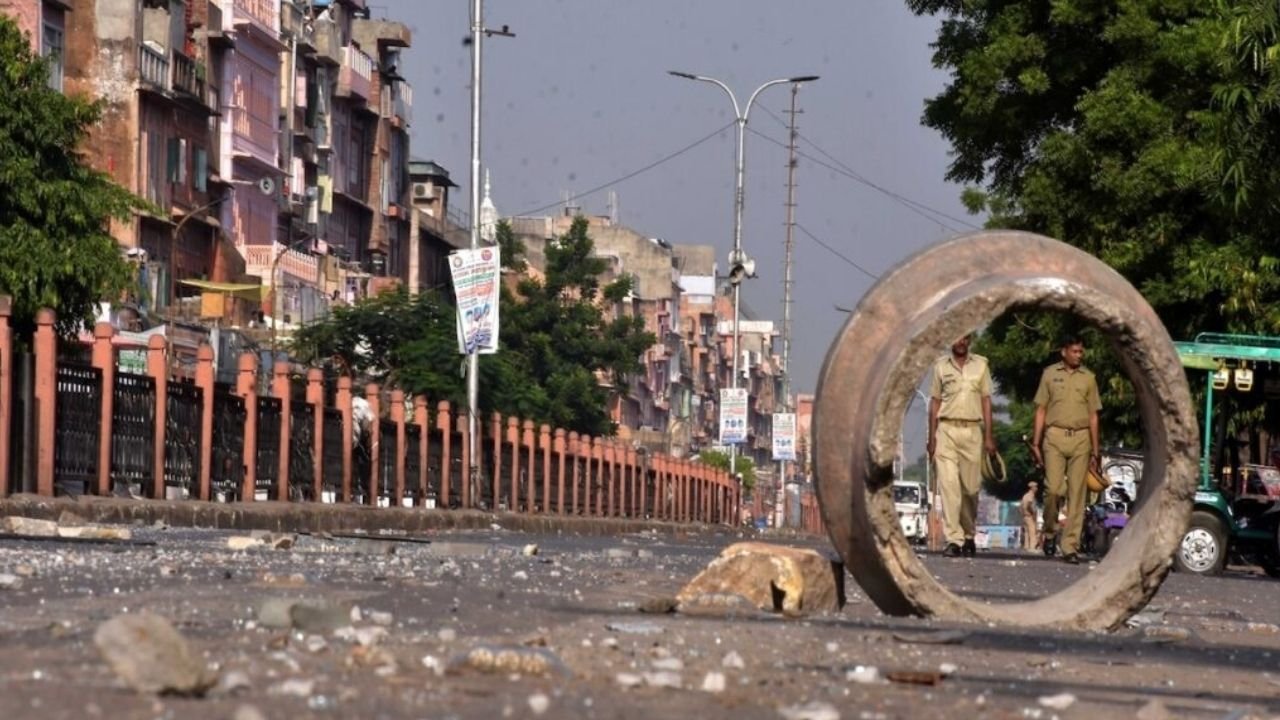
While violence against the Muslim community of India is no longer an internal secret of our neighbour, it would be nothing less than hypocrisy to turn a blind eye towards the quality of life of minorities in Pakistan where a majority of them is equally vulnerable due to intolerance rooted in religion or ethnicity.
When Saadat Hasan Manto finally decided to leave India amid growing communal violence back in the 40s, Indian actor Sunder Shyam Chadda wasn’t very happy with his friend’s decision.
“Are you going to Pakistan because you think you are a Muslim?” Shyam asked Manto as the former removed the bottle of alcohol from their table.
“I am a Muslim enough to get killed here,” Manto replied.
Seven decades later — in the year 2020 — the world’s most populous democracy, under fascist Narendra Modi’s Bharatiya Janata Party (BJP), witnesses similar circumstances as those belonging to India’s minority communities, flee their homes in order to save their lives.
The recent round of violence against Muslims in India by extremist Hindutva mobs has been the worst with over 40 innocent people losing their lives, mosques being set ablaze and properties of New Delhi’s Muslims being vandalised.
The situation persisting across Pakistan’s eastern boundaries can be best explained through a mention of suzerainty, under which a single ideology asserts and maintains paramountcy or supremacy over the rest. But the problem in India is further accentuated by the fact that the state’s monopoly over violence has silently been delivered to the goons of the ruling BJP with the promise of targeting Muslims regardless of if they are at home or at a mosque.
While violence against the Muslim community of India is no longer an internal secret of our neighbour, it would be nothing less than hypocrisy to turn a blind eye towards the quality of life of minorities in Pakistan where a majority of them is equally vulnerable due to intolerance rooted in religion or ethnicity.
Although analyses suggest the factors that have led to the current upheaval in India are manifold, our focus, for now, will remain on religion since outside India, its importance has been rightly overshadowed by unfolding the neo-liberal agenda New Delhi is trying to implement; for which Hindutva serves as the best medium, and that too in disguise.
It is nothing but Modi’s model from Gujarat, which is now expanding to Delhi and Ashoknagar.
Nonetheless, the role of religion in itself cannot be undermined especially in the Indian subcontinent as both in Pakistan and India, religion has remained closely intertwined with politics since even before the partition. And from world-acclaimed statesman Gandhi to today’s fascist Modi, the combination has proved to be lethal while resulting in violence almost every time.
The use of religion on state-level despite having a secular constitution is to achieve a purposive social order, which in other words is ‘national interest’ based on the exclusion of Muslims and inclusion of corporate and liberal values in society, surprisingly through the conservative ideology of RSS.
Regardless of the intention behind employing religion in politics, its implications have not been desirable for the general masses, which brings into question the basic understanding of religion. Apart from politics, when religion is examined alone, the underlying principle of religion generally is expounded as that of peace and prosperity.
Having said that, one inadvertently subscribes to the root word of religion as ‘lig’ and not ‘leg’ where the former means ‘to bind’ while the latter means ‘to gather.’
Contrary to the broader agreement of religion to be in the greater interest of mankind by making people dependent on each other, the current predominant form of Hinduism in India is that of a certain mindset of people – the Rashtriya Swayamsevak Sangh (RSS) — coming together to serve a ‘holy purpose’ which in this case has become a national interest of BJP’s India.
In this pretext, the use of religion on state-level despite having a secular constitution is to achieve a purposive social order, which in other words is ‘national interest’ based on the exclusion of Muslims and inclusion of corporate and liberal values in society, surprisingly through the conservative ideology of RSS, which ultimately benefits a handful of people in India by increasing their wealth and stay in power.
Therefore, while mentioning the Citizenship Amendment Act (CAA), one should always mention its far-reaching effects in the lives of minorities other than Muslims, including Hindus with a working-class background.