An unfortunate incident took place in Karachi when a fast-moving car ran over a sleeping family killing three siblings and injuring two other family members.
The family was sleeping on a footpath near Nagan Chowrangi in the small hours of Wednesday morning when the car ran over them. However, the car driver managed to escape in injured condition, leaving behind his vehicle which was impounded by the police.
The police said that two brothers and their sister were killed in the accident, reports Dawn. Bali Gopi Chand, 22, and Ashok Gopi Chand, 9, died on the spot. Later, Shri Ram Gopi, 15, died during treatment at the Jinnah Postgraduate Medical Centre. Sita Gopi, 14, and Lalay Gopi, 6 were injured and admitted for treatment.
“An FIR has been registered and police are working on the case,” said SSP Zeeshan Shafiq Siddiqi, adding that police will arrest the driver and whoever else was in the car. A case of manslaughter has been registered.
Area SHO Qamar Kiani said that the police had conducted raids at three places to nab the suspect but to no avail.
He also said that the case was registered on the complaint of a relative of the victims, who informed the police that he lived in the slum area of Sohrab Goth and sold vegetables on a pushcart. He was asleep in his home when at around 3 am someone informed him about the death of his relatives in a car accident.
Due the ongoing inflation crisis in Pakistan, food and petrol prices have risen astronomically, leading to many families finding it difficult to afford basic necessities like rice or flour. Writing for The Guardian, Zofeen T Ebrahim has covered the story of the street kitchen ‘Khana Ghar’ set up in Karachi’s poorest district by Parveen Saeed, who has been serving food to families for the past 22 years.
Opening up to The Guardian, Saeed said that the kitchen has become even more busy since Ramzan began, as more families have arrived to receive one-month food rations:
“But we can only give one bag to one family, and we need their ID cards to check that,” she said. “There are more and more mouths to feed than we can cope with.”
Saeed, who had received the Pride of Performance award in 2021, sells salan and roti to families for only Rs 3. Before the Covid-19 lockdown, the kitchen provided meals for 6,000 people, but afterwards it rose to 7000, and now currently stands at 8,200.
Saeed revealed that people stand in line for long hours in order to eat, because the ongoing political and economic instability has made it difficult for people to make a living:
“These people are not beggars, they have become destitute..where are the jobs?”
“Food prices have hit the sky. It is heartbreaking as they have waited for a couple of hours, only to leave empty-handed.”
The newspaper also spoke to some of the regulars who visit Khana Ghar. Former construction worker Mohammad Shakeel, a father of six, suffered a head injury and broken wrists after which finding work became incredibly hard. He said the food was a ‘Godsend’ because “with a kilo of flour costing 150 rupees, we would not be able to survive the jump in food prices.”
A widow who has been relying on Khana Ghar to feed her polio ridden daughter and toddler grandson said, “Had it not been for Parveen, we would have died from hunger.”
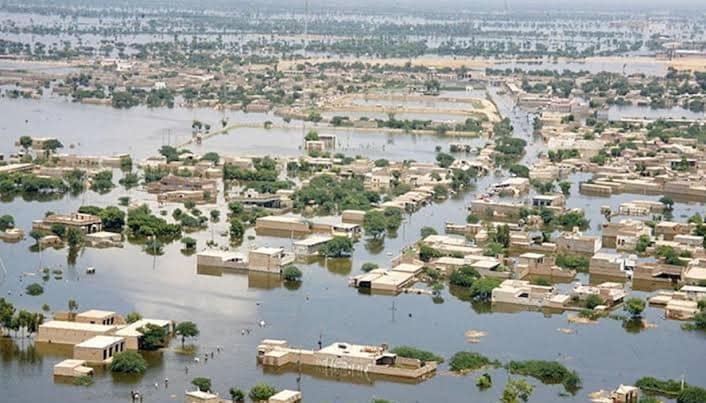
Federal Minister for Planning, Development and Reforms Ahsan Iqbal said that 55 lakh households were affected, while more than three crore people became homeless due to the devastating floods and rains across Pakistan.
“A safe analysis suggests that 55 lakh poor households have been affected, while more than three crore people have been displaced due to the floods. We need more than one million tents for these people,” said Iqbal while speaking on Dawn News programme, ‘Live with Adil Shahzeb’.
سیلاب سے 55لاکھ گھرانے متاثر جبکہ 3کروڑ افراد بے گھر ہوئے جن کے لئے 10 لاکھ سے زائد ٹینٹ کی ضرورت ہے. وفاقی وزیر منصوبہ بندی احسن اقبال
A report issued by the PDMA Balochistan said the death toll since June 1 in the rain-destructed province has reached 234. The deceased include 110 men, 55 women and 69 children.
Federal Minister for Climate Change, Sherry Rehman said that death toll in Pakistan has gone up to 903.
“Our death toll has gone up to 903 with thousands homeless without shelter & food. It is a serious humanitarian disaster. The cities aren’t geared for the type of climate resilience that is required for this consistent torrential downpour” Fed Minister @sherryrehmanpic.twitter.com/TRvNTekDR4
A Pakistani, Haroon Qureshi, who arrived in Japan as a student some 30 years ago, is reaching out to those living on the margins of society.
According to a report published in Mainichi, the national daily of Japan, Qureshi, a businessman from Pakistan, helps the homeless and those foreigners who have been detained by immigration authorities after failing to get refugee status.
He is also involved in the running of a mosque in Tokyo, Otsuka Masjid.
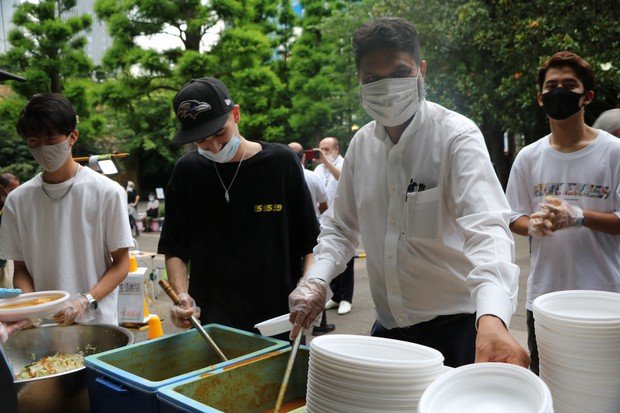
According to the Japanese daily, Qureshi’s efforts started just when he arrived in Tokyo to study computer programming in 1991. He began distributing food to the homeless in his neighbourhood in the capital’s Kita Ward.
“Now, three decades on, he has enlisted Japanese university students in his goodwill endeavours, seeing their involvement as a vital part of raising society’s awareness of the plight of the less fortunate,” it said.
The 55-year-old Qureishi said he believed there was a lack of understanding in Japan of why people ended up on the streets. He thinks the public’s attitude to the homeless is “cold.”
“The reality is that many times the homeless suffer from mental health issues and cannot fit into society,” the daily quoted him as saying.
So far, Qureshi had asked for students from Tokyo-based Keio and Tokyo universities to volunteer in his activities, which included serving meals to the needy.
In collaboration with Tenohasi in Tokyo’s Ikebukuro area, students and volunteers from the mosque recently helped in providing food to over 360 people.
“Today I witnessed a stark difference between normal people who were walking on the streets all dressed up, and those who had come to get food here,” the daily quoted Satoru Soejima, 18, who is studying Arabic at Keio University, as saying.
Qureshi, meanwhile, also leads another project called Food Bank to help the students themselves, some of whom have gone hungry after losing part-time work because of the coronavirus pandemic.
A soft-spoken man, he has also been helping those detained after their failed asylum bids since around 2000.
In one month, Qureshi received around 30 letters on average seeking help from detainees, mostly from countries in Africa or elsewhere in Asia.
“We may have different religions, colour or race. But I request everyone to try and feel the pain of other members of this huge (human) family, and do what they can,” he urged.
In recognition of his services the Pakistan Embassy in Japan awarded him with a letter of appreciation.
Ambassador Imtiaz Ahmad invited three extraordinary Pakistanis living in Japan for their social work that has also been highlighted in the Japanese media, including Qureshi.
According to the embassy, Qureshi was appreciated for his services that include providing food for the needy, financial help for the destitute and homeless, running an Islamic school and managing a graveyard for the Muslims.
The ambassador appreciated Qureshi’s work while stating that it has contributed positively to Pakistan and Pakistanis’ image living in Japan.
Qureshi thanked the Ambassador for the appreciation and vowed to continue and expand his humanitarian work, the embassy said.