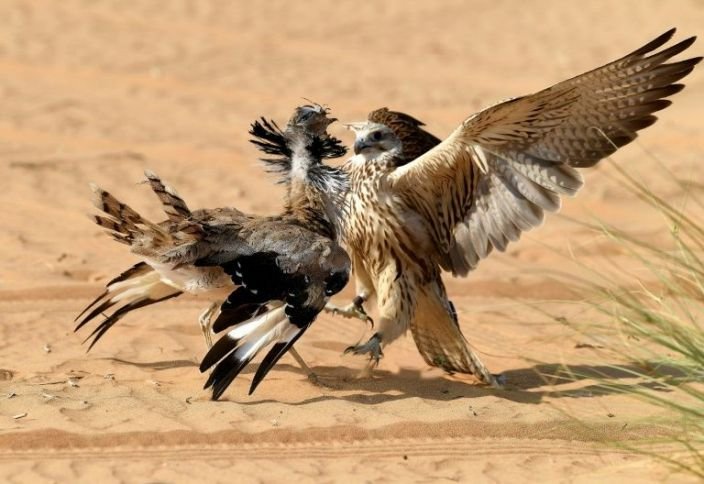
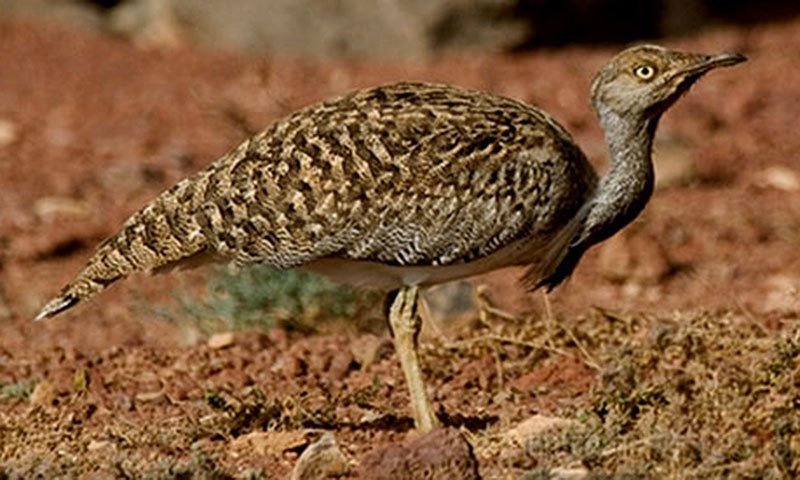
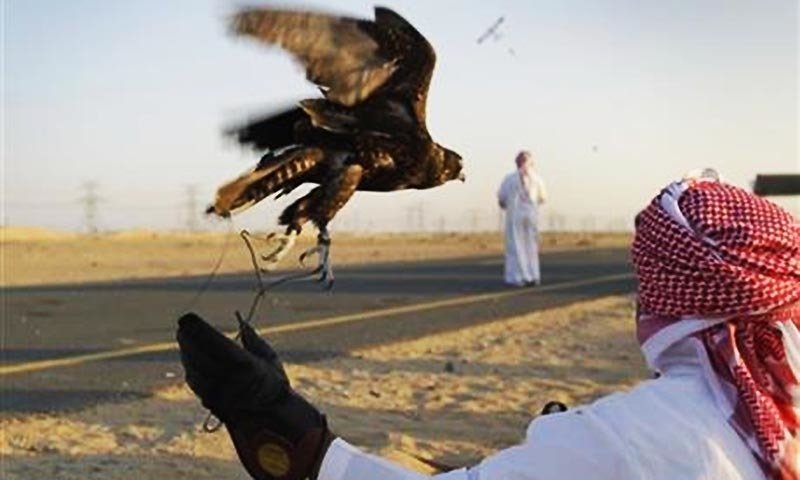
A man who recently posted a video of foreigners hunting Houbara bustard in Thatta district on social media was found dead in Karachi’s Malir district on Wednesday, reports The News.
A few days back, Nazim Jhokio had stopped a car with a foreign registration number plate and asked the people sitting inside the vehicle why they had blocked the road and what were they doing there. Jhokio filmed the entire episode, in which a passenger sitting next to the driving seat is seen stepping out of the car and snatching his phone.
In another video, Nazim said he had been tortured and threatened over the video he shot of the Arab guests of some influential persons.
قتل سے پہلے نوجوان کو دھمکیاں دی گئی جس پر نوجوان نے وڈیو رکارڈ کیا اور پولیس سے مدد طلب کی لیکن پولیس نے ان کی ایک بھی نہ سنیں، بعد میں نوجوان کو عرب کے دلال بااثر لوگوں نے اغوا کرکے قتل کردیا۔#JusticeForNazimJokhiopic.twitter.com/RRd8r7ITcU
On Wednesday, the police recovered Nazim Jhokio’s dead body from Memon Goth in Malir and got his postmortem conducted at a hospital.
The police have registered a murder case against Pakistan People’s Party (PPP) MPA Jam Awais, Niaz Salar, and others.
FIR against PPP MPA Jam Awais Jokhio for torturing to death Nazim Jokhio, father of four, for trying to prevent Arab hunters from illegal hunting pic.twitter.com/AzcJ1xhjy9
The government has reportedly issued special permits to seven-members of Dubai’s royal family to hunt the internationally protected Houbara bustard during the 2020-21 hunting season.
As per details, the permit has been issued to Dubai ruler Sheikh Mohammed bin Rashid Al-Maktoum and six other members of the ruling family including the crown prince, deputy ruler and finance and industries minister, deputy police chief, an army official, two other members of the royal family, and a businessman.
The hunting permits were reportedly issued by Prime Minister Imran Khan himself who earlier opposed the hunting of rare bird, while in opposition.
It is pertinent to add here that local citizens are not allowed to hunt the migratory bird wrongly prized as an aphrodisiac and classified as vulnerable by conservationists.
Talking about the hunting of the Houbara bustard Muhammad bin Naveed, an animal rights activist and member of Friends of Islamabad Zoo said: “Houbara bustards have become an unfortunate tool for so-called diplomacy with our Arab allies where again we are using animals and their lives to play politics.”
He further added: “No government in the past or now has stood up to the killing of Houbara bustards by Arab royal families simply because they pay a lot to be here and contribute to the local economy. I think we, as a nation, and our Arab allies need to think if such activities have any place in the 21st century and why we are using animals to propagate outdated traditions that are not even a part of our culture.”
Earlier in December 2020, it was reported that at least 18 Saudi and Qatari royals, including Saudi Crown Prince Muhammad Bin Salman, will visit Pakistan to hunt the rare houbara bustard after the confirmation of their special hunting licences.
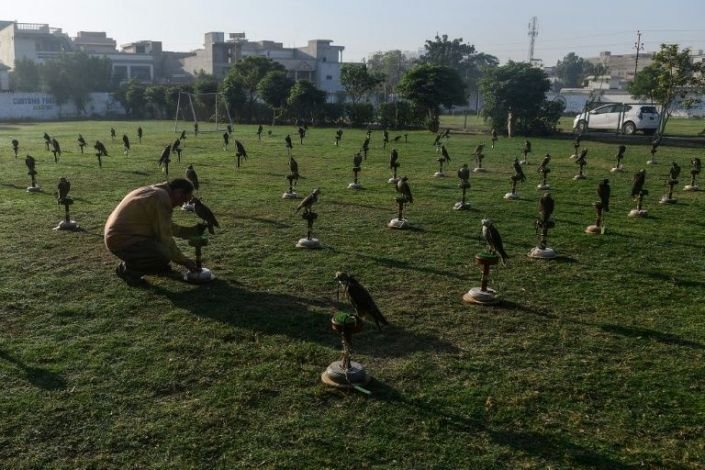
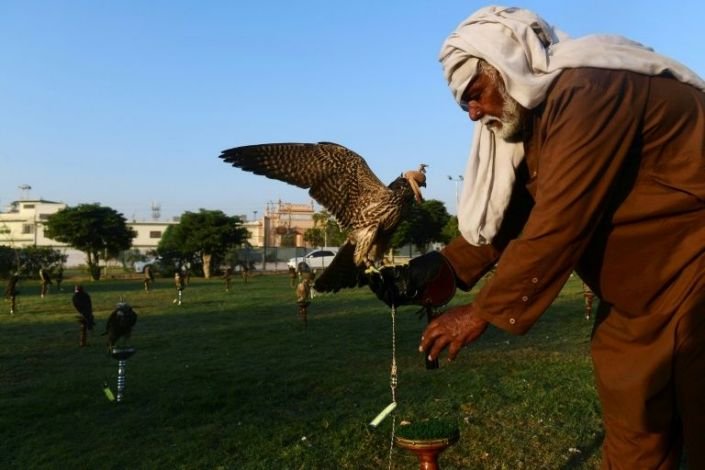
Since learning to capture birds as a teen, Muhammad Rafiq has amassed a small fortune in Pakistan trapping and trafficking falcons — including some endangered species — for wealthy Gulf Arabs.
A single falcon can fetch up to tens of thousands of dollars on the black market, which allowed Rafiq to renovate his family home.
“Every season, dealers come from Karachi and leave their contacts with us, and we call them back if we catch something,” said the 32-year-old, from a nearby coastal village.
He recently trapped a peregrine falcon on a one-week hunting mission.
“I desperately needed money,” he told AFP. “And God has listened to me.”
For years, Pakistan has stood at the nexus of the falcon trade, both as a source of the birds of prey, and then as a destination to hunt with them.
Falcon poaching is officially banned, but demand for the birds is rising, according to the World Wildlife Fund in Pakistan.
It estimates that up to 700 falcons were illegally smuggled out of the country last year alone, often by organised criminal networks.
Their destination is normally Gulf countries, where falconry is a treasured tradition.
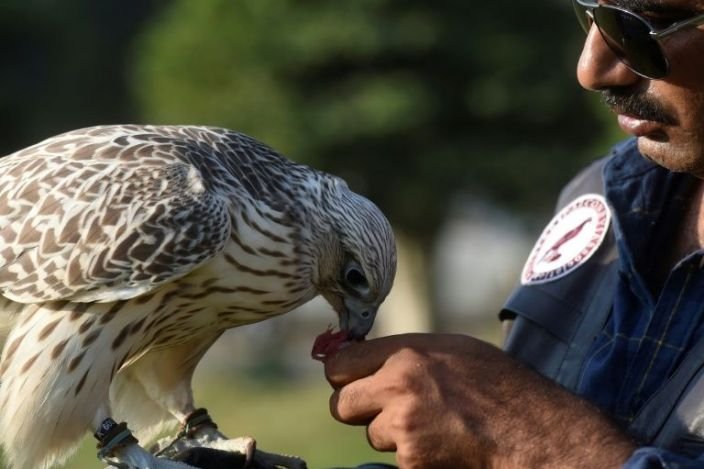
Owners treat the birds “like their own children”, said Margit Muller, the director of Abu Dhabi’s falcon hospital, which treats 11,000 falcons annually, a number that has more than doubled in the past 10 years.
One conservationist told AFP an Arab falconer usually owns around five to six hundred birds, most of which will be captured in the wild in Pakistan or Mongolia.
Wild birds are prized over those bred in captivity because they are believed to be better hunters, though there is no evidence to support those claims.
Every winter, lavish hunting parties from the Gulf flock to Pakistan’s sprawling deserts, where they are given permits to use their falcons to hunt the houbara bustards, a migratory bird wrongly prized as an aphrodisiac and classified as vulnerable by conservationists.
These excursions have cast a spotlight on the deep ties between Pakistan and its allies in the Gulf. For decades, the Gulf states have propped up Islamabad’s ramshackle finances with generous loans, with one of the expectations being that they can continue to use Pakistan as a hunting playground.
Saudi Crown Prince Mohammed bin Salman and two other royals were granted permission to catch bustards by Prime Minister Imran Khan’s government in December last year, a soft diplomacy tactic that Khan had openly disagreed with when he was in the opposition.
The government also presents falcons as gifts to world leaders.
“Our officials are working like pimps for the Arabs,” a government official requesting anonymity told AFP.
A brief ban on the bustard hunts was overturned in 2016 by the Supreme Court, but conservationists are now pushing for the export of falcons to be regulated in an ongoing case at the Islamabad High Court.
Every year, falcons escape the harsh Siberian winter and fly thousands of miles to warmer regions, including southern Pakistan.
During the migratory season, wildlife traffickers descend on villages along the Arabian Sea coastline, offering fishermen cash to briefly abandon their boats and try their hand at poaching.
“We pay them in advance, send food to their families and if they catch a bird that is precious, we happily give them motorbikes,” said one trafficker who spoke to AFP on the condition of anonymity.
A range of tactics can be employed — sticky liquids, net traps or, most commonly, using smaller birds as bait.
Poachers especially target the peregrine falcon, whose populations remain stable — but also the saker, which is endangered.
Bob Dalton, a veteran falcon conservationist, helped oversee the rehabilitation of dozens of falcons seized by Pakistani authorities in October, with officials estimating the cache to be worth well over $1 million.
“The illegal trade is growing, there is more money being spent, more pursuit from the Gulf,” he told AFP.
“With the exception of one or two species, most falcon populations are in decline or on the point of being unstable.”
With ongoing efforts to curtail rampant poaching failing, some officials in Pakistan have suggested regulating the falcon trapping market, inspired by a scheme involving another rare native species, the markhor — an elusive mountain goat with striking twisted horns found in Pakistan’s mountainous north.
Every year, foreigners shell out tens of thousands of dollars for a handful of trophy hunting permits, providing a financial incentive for communities to prevent poaching. Naeem Ashraf Raja, the director of the biodiversity at the ministry of climate change, said markhor numbers have rebounded as a result of this controversial conservation method.
With hunting parties set to descend on Pakistan again over the next few months, Kamran Khan Yousafzai, the president of Pakistan’s Falconry Association, said the country desperately needs to implement a sustainable wildlife programme.
“Arab falconers can’t resist coming to Pakistan. They have been coming to these hunting grounds for generations, and unless they face any real problems, they are not going to search for new destinations.”
At least 18 Saudi and Qatari royals, including Saudi Crown Prince Muhammad Bin Salman, will visit Pakistan to hunt rare houbara bustard after the confirmation of their special hunting licences.
The members of royal families have obtained permission to hunt houbara bustard in Balochistan in spite of the international and local bans on the hunt of the endangered species.
Media reports suggest that Saudi CP Muhammad Bin Salman will hunt the bird in Layyah and Bhakkar region, whereas another Saudi royal Prince Fahad Bin Sultan has been allotted Awaran and Chaghi areas of Balochistan for the hunting of the rare bird.
Qatari royal Muhammad Bin Khalifus Sani and Sheikh Jassim bin Hamadus Sani will be hunt the migratory bird in Loralai and Musakhel, respectively. Sheikh Muhammad bin Ali Sani was allotted Barkhan while Sheikh Sani Abdul Aziz was given Kalat and Surab.
In total 18 sheikhs from Saudi Arabia and Qatar succeeded in getting permission for hunting in Balochistan and other provinces. In return, the Balochistan government will receive Rs150 million for granting this permission.
The Dubai ruler had needed younger falcons to hunt houbara bustards, and permission in this regard was issued by the foreign ministry.
The permit issued on Sept 15 this year had read: “The Ministry of Foreign Affairs…has the honour to inform that the esteemed embassy may export one hundred and fifty (150) falcons from Pakistan to the United Arab Emirate (UAE) for the personal use of His Highness Sheikh Mohammad bin Rashed Al Maktoum, vice president of UAE and ruler of Dubai, from Karachi/Bahawalpur/Rahim Yar Khan/Islamabad/Quetta.”
In spite of a ban on the trade of falcons under wildlife protection laws, the federal government has granted permission to Sheikh Mohammad bin Rashed Al Maktoum, Vice President of the United Arab Emirates and ruler of Dubai, to export 150 falcons of rare species from Pakistan to the United Arab Emirates.
According to a report in Dawn, the Dubai ruler needed younger falcons to hunt houbara bustards, and a permission in this regard has been issued by the foreign ministry.
The permit issued on Sept 15 this year read: “The Ministry of Foreign Affairs…has the honour to inform that the esteemed embassy may export one hundred and fifty (150) falcons from Pakistan to the United Arab Emirate (UAE) for personal use of His Highness Sheikh Mohammad bin Rashed Al Maktoum, vice president of UAE and ruler of Dubai, from Karachi/Bahawalpur/Rahim Yar Khan/Islamabad/Quetta.”
“In this regard, the concerned authorities have been requested to accord facilitation for the export of one hundred and fifty (150) falcons from Pakistan to UAE,” the notification read.
The permission, however, will create challenges for Pakistan as it is a member of various wildlife conservation treaties. The newspaper reported that Pakistan is a signatory to treaties that ensure the protection of wildlife, such as the Switzerland-based Convention on International Trade in Endangered Species of Flora and Fauna (CITES).
Also, due to a ban on the trade of rare falcons, there are no markets in the country that would deal in the ‘legal trade’ of these species, which meant that the Arab exporter will have to seek these birds in the black market. By allowing this trade, the government and the exporter will be guilty of patronising this illegal wildlife trafficking, the news report added.
In addition, the export of these birds would also hurt Pakistan’s standing in the eyes of the European Union and the country may lose the Generalised System of Preferences (GSP) Plus for violating international conservation treaties, the newspaper quoted sources as saying.
The GSP+ status facilitates the easy access of Pakistani exports to the highly lucrative market of the European Union.
Special permits have been issued by the federal government to King of Bahrain Sheikh Hamad bin Isa bin Salman al Khalifa and five of his family members to hunt the internationally-protected houbara bustard during the 2019-20 hunting season. The permits were delivered to the Embassy of the Kingdom of Bahrain in the federal capital and had the names of hunters and the areas allocated to them.
According to a report in Dawn News, the king and his hunting party which includes his uncle, his country’s interior minister, adviser on defence, cousins, and other people have been granted special permission to hunt the endangered bird in different districts of Pakistan including Jamshoro district, Sujawal district, Naushahro Feroze district in Sindh, Jaffarabad district in Balochistan, Tando Mohammad Khan, Hyderabad and Malir (excluding Malir Cantonment and Dhabeji areas) districts.
Under a code of conduct issued by the foreign ministry, a hunter can hunt 100 houbara bustards in a 10-day hunting spree during the three-month-long hunting season between Nov 1, 2019 and Jan 31, 2020.
Though the houbara bustard belongs to the colder central Asian region, every winter it migrates southwards towards the relatively warm environment here.
Ruthless hunting by Arab hunters has resulted in a sharp decline in its population because of which it is protected under various international nature conservation conventions and a ban on its hunting has been imposed – Pakistanis are not allowed to hunt this bird.
Previously, Prime Minister Imran Khan had been very critical of Nawaz Sharif’s government for permitting the hunting of the rare bird.
1. PTI’s Rind joins locals protesting in Balochistan ag Houbara Bustard hunting permission given to Qatari royals on direct NS intervention
Seven Qatari nationals, including four royals, have been arrested for attempting to hunt the houbara bustard in Nushki district of Balochistan without permission of the Foreign Office, a private media outlet reported.
According to reports, the Qatari nationals were en route Nushki when they were intercepted and taken into custody on the Quetta-Nushki highway. Deputy Commissioner Abdul Razzaq Sasoli confirmed the arrest and stated that they were aiming to hunt without proper license.
He added that the Qataris had been handed over to the wildlife department.
The four royals have been identified as Sheikh Mohammad bin Mansoor Jasim, Sheikh Khalid bin Ali, Sheikh Abdullah bin Jasim and Sheikh Ahmed bin Ali Khalid.
A case has been registered against the foreigners who were in the country on a three-month visa. They had been informed before that they would not be allowed to hunt if they did not possess a proper hunting license.
According to the Wildlife Department, 100 houbara bustards can be hunted for a fee of $100,000.