Tag: HRW

  • IMF should protect low-income people in Pakistan’s economic crisis: Human Rights Watch

    IMF should protect low-income people in Pakistan’s economic crisis: Human Rights Watch

    International Monetary Fund (IMF) should collaborate with the government of Pakistan to protect the economically disadvantaged by expanding social protection systems and minimizing reforms that may have adverse effects on the most vulnerable population, according to Human Rights Watch.

    The country is currently grappling with pressing issues such as inflation, poverty, inadequate governance, limited reserves, and high unemployment. Pakistan initiated discussions with the IMF on February 1st to formulate a plan to revive the economy, including securing the ninth tranche of $1.1 billion in loans from the $6.5 billion bailout.

    “Millions of Pakistanis have been pushed into poverty and denied their fundamental social and economic rights,” said Patricia Gossman, associate Asia director at Human Rights Watch.

    In addition, she emphasized that the IMF and the Pakistani government have a duty to manage this crisis in a manner that prioritizes and safeguards the well-being of low-income individuals.

    According to data from the State Bank of Pakistan (SBP), foreign exchange reserves have reached their lowest level at $3.09 billion, a decrease of 16%, sufficient to cover less than three weeks of imports.

    Pakistan is currently experiencing its highest inflation rates since 1975, with the cost of perishable food items rising by over 60% in January. In response to IMF demands, the government of Pakistan recently raised prices of petrol and diesel by Rs35 and removed the cap on the dollar, as it was a crucial condition of the IMF and the dollar should be market-driven.

    The ongoing negotiations with the International Monetary Fund (IMF) are aimed at concluding the ninth review of the IMF’s Extended Fund Facility, designed to support countries facing balance-of-payments challenges.

    The completion of this review would provide the necessary clearance for the IMF’s bailout installment, which would alleviate the severe shortage of foreign exchange and enable access to additional funding sources, including from multilateral and bilateral donors.
  • ‘India should stop harassing journalists’: Human Rights Watch

    ‘India should stop harassing journalists’: Human Rights Watch

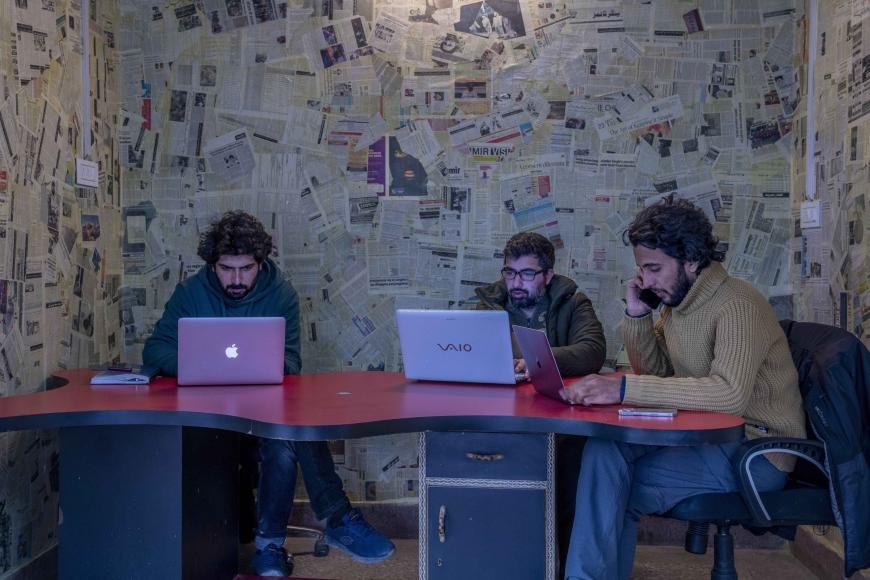
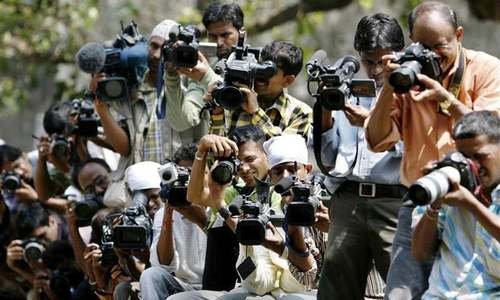
    Human Rights Watch (HRW) has released its report to address the unlawful arrest of journalists in Indian-Occupied Kashmir (IoK). According to the report, so far at least 35 journalists in IoK have faced police interrogation, raids, threats, physical assault, or fabricated criminal cases for their reporting.

    The recent arrest of Fahad Shah, an editor-in-chief of a leading Kashmir-based news site The Kashmir Walla, has led to condemnation from several journalism organisations including United States (US)-based Committee to Protect Journalists (CPJ).

    South Asia director at Human Rights Watch (HRW) said, “Instead of ensuring justice for security force violations in Kashmir, the [Indian] government is more interested in silencing those who bring these abuses to light.”

    Ganguly also demanded Indian authorities in Kashmir to release Shah and all journalists, activists, and critics jailed on “politically motivated charges” and stop harassing them with draconian laws.

    Furthermore, HRW has stated a number of journalist names who are behind bars on baseless grounds. Last month, the police arrested another journalist at the Kashmir Walla.

    In September, the police raided the homes of four Kashmiri journalists and confiscated their phones and laptops. Not only this, the Indian authorities give threats to journalists with jail if their work criticises them and pressured them to self-censor, says the HRW report.

    It states that India has placed over 40 people, including 22 journalists, on lists to stop them from travelling abroad.

  • PMDA: Why all the secrecy?

    PMDA: Why all the secrecy?

    The mystery shrouding the elusive proposed draft of the Pakistan Media Development Authority (PMDA) is quite intriguing. Some consultations have been held with journalists, civil society members, and parliamentarians but without a copy of the proposed draft. Members of the National Assembly (NA) Standing Committee on Information and Broadcasting on Thursday demanded that the draft be shared instead of verbal briefings by the Information Ministry. Chairman of the NA standing committee Mian Javed Latif then formed a sub-committee, which will be headed by Marriyum Aurangzeb with Nafisa Shah and Kanwal Shozab as its members. Let’s see if the proposed draft will now be shared with the sub-committee. 

    Last month, representatives of media organisations issued a joint statement that rejected the proposed media authority. They said that it was unconstitutional and deemed it as a draconian law. It seems that this is yet another tactic by the government to curb media freedom. Human Rights Watch (HRW) recently also issued a statement on the PMDA saying that the Pakistani government is “seeking broad new powers to control the media as part of its crackdown on freedom of expression. Journalists, human rights activists, and political leaders across that country have raised the alarm about proposed legislation that would bolster powers of the government to censor and restrict the media.” The government reacted to HRW’s statement by issuing a rejoinder through the Pakistan Embassy in the US challenging the human rights organisation’s assertions on PMDA. Patricia Gossman, HRW’s associate director for the Asia division, asked for a draft, which has so far not been shared with anyone. 

    It is quite worrying that in a country where media freedom is already quite curtailed, where interviews have been stopped from going on air or stopped mid-way, where anchors have been taken off-air, where there are now so many red lines that media organisations have to tread very carefully, where attacks on journalists have become frequent and culprits are still at large, where online trolling of journalists has become a norm, where the government issues reports of social media trends and hashtags it deems anti-state, where government officials keep on targeting journalists and media organisations without any shred of evidence, a new media authority with immense powers is being proposed without sharing the details of the proposed law and/or taking the main stakeholders on board.

    We hope that the government will share the proposed draft with all stakeholders so that the mystery shrouding this media authority ends once and for all. There is already a lot of mistrust between the government and the media. We hope the government will listen to the legitimate concerns of media organisations and not dismiss them. A free and independent media is essential for any democracy. Pakistan is a democracy and we hope the government will not undermine it in any way. 

  • “Human Rights Watch’s statement based on gossip”, Pakistan challenges report on media bill

    “Human Rights Watch’s statement based on gossip”, Pakistan challenges report on media bill

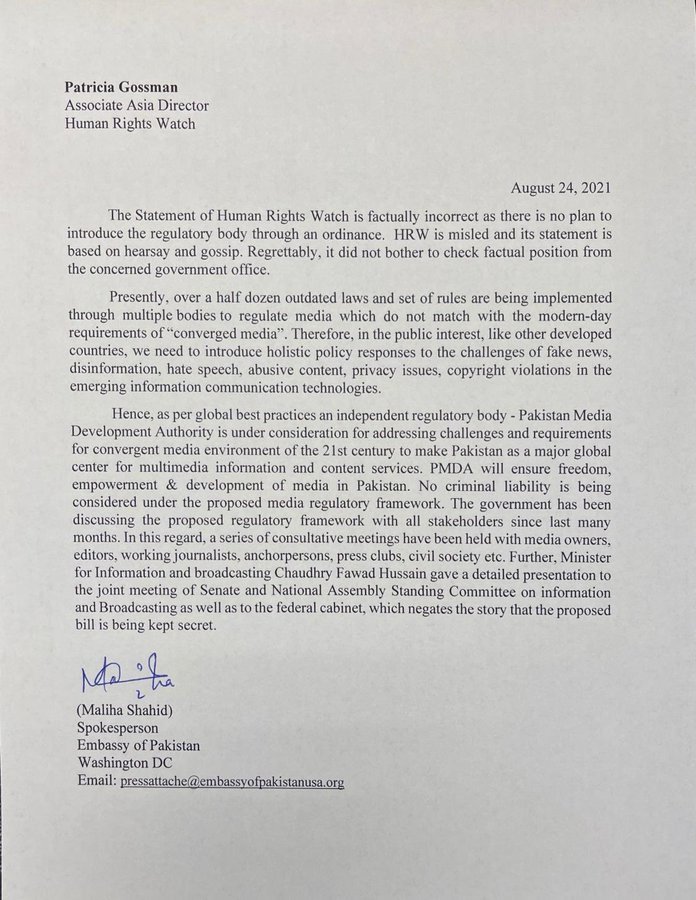
    Pakistan responded to a dispatch by the Human Rights Watch (HRW) Associate Asia Director, Patricia Gossman, on the proposed media bill. Pakistan condemned the claims of the organisation and termed the statement “factually incorrect”.

    “The statement of Human Rights Watch is factually incorrect as there is no plan to introduce the regulatory body through an ordinance,” read the letter from Pakistan’s Embassy in Washington DC.

    The letter further added, “HRW is misled and its statement is based on hearsay and gossip.”

    “In the public interest, like other developed countries, we need to introduce holistic policy responses to the challenges of fake news, disinformation, hate speech, abusive content, privacy issues, copyright violations on the emerging information communication technologies.”

    The letter further states, “Hence, as per global best practices and independent regulatory body – Pakistan Media Development Authority is under consideration for addressing challenges and requirements for convergent media of the 21st century to make Pakistan a major global center for multimedia information and content services.”

    Patricia Gossman took to Twitter and wrote, “Wow. You have identified no inaccuracies in our article and you have failed to provide a draft of the law. What are you hiding?”

    https://twitter.com/pagossman/status/1430426802049196036

    Meanwhile, in its statement, HRW said, “The government claims an ordinance setting up the Pakistan Media Development Authority (PMDA) would replace the ‘fractured’ regulatory environment and fragmented media regulations currently in place. The proposed PMDA would bring all media in Pakistan – print, television, radio, films, and digital media – under one regulator.”

    The proposed law would also increase government control by allowing government officials to be appointed to key positions.

    With journalists under relentless attack for doing their jobs, the Pakistan government needs to stop trying to control reporters and instead start protecting media freedom, added HRW.

  • Govt seeking new powers to control media by setting up PMDA:  Human Rights Watch

    Govt seeking new powers to control media by setting up PMDA: Human Rights Watch

    As part of its crackdown on freedom of expression, the government is seeking broad new powers in the garb of the proposed Pakistan Media Development Authority (PMDA), says Human Rights Watch (HRW).

    “The government claims an ordinance setting up the Pakistan Media Development Authority (PMDA) would replace the ‘fractured’ regulatory environment and fragmented media regulations currently in place. The proposed PMDA would bring all media in Pakistan – print, television, radio, films, and digital media – under one regulator,” HRW said in its statement.

    The PMDA law would grant new unchecked powers to the government-controlled regulator by setting up special “media tribunals” that will have the power to impose steep fines for media organisations and journalists who violate its code of conduct or publish content it deems to be “fake news”.

    The proposed law would also increase government control by allowing government officials to be appointed to key positions.

    With journalists under relentless attack for doing their jobs, the Pakistan government needs to stop trying to control reporters and instead start protecting media freedom, added HRW.

    Earlier this month, the representatives of media organisations rejected the proposed PMDA and termed the concept as an unconstitutional and draconian law against freedom of press and expression and a step toward imposing state control to regulate all segments of media under over-centralised body.

    The major stakeholders believe that the proposed PMDA is an attempt to tighten the government’s control over the media from one platform and ignores the fact that print, electronic and social media are separate entities, each with their own defined features.