Tag: Human Rights Watch

  • ‘Army chief agrees fake news, disinformation a threat to national security’: Fawad

    ‘Army chief agrees fake news, disinformation a threat to national security’: Fawad

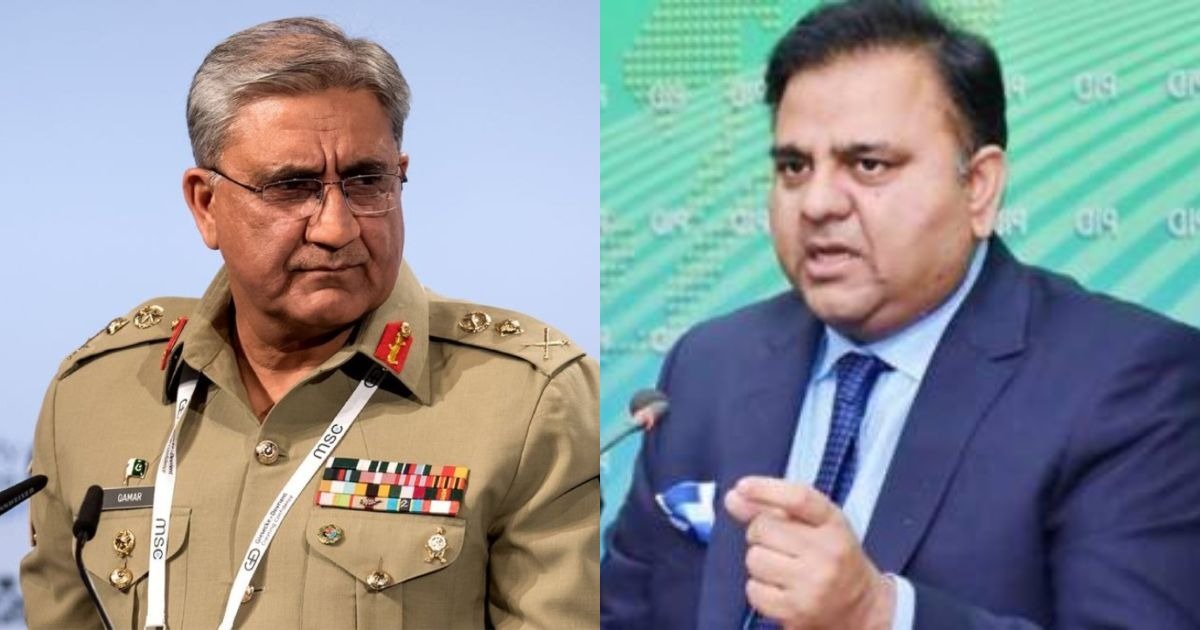
    Federal Minister for information and Broadcasting, Fawad Chaudhry took to Twitter and said, “Chief of Army Staff (COAS) General Qamar Javed Bajwa, while addressing the Defence Day function, said fake news and disinformation were a threat to national security.”

    Fawad wrote, “This analysis is based on the truth, and therefore the Pakistan Media Development Authority (PMDA) is being brought to deal with these threats, as yellow journalism happens to be the biggest threat to freedom of media.”

    Representatives of media organisations rejected the proposed PMDA and termed the concept as an unconstitutional and draconian law against the freedom of press and expression and a step toward imposing state control to regulate all segments of media under over-centralised body.

    The Human Rights Watch (HRW) in a statement said that as part of its crackdown on freedom of expression, the government of Pakistan is seeking broad new powers in the garb of the proposed PMDA.

    Information Minister faced a hard time as members of the National Assembly Standing Committee on Information and Broadcasting demanded to see the draft law of PMDA.

    Spokesperson of Pakistan Muslim League-Nawaz (PML-N), Marriyum Aurangzeb, demanded that the draft of the law should be presented for the establishment of the authority instead of a verbal briefing by the minister.

    Adding to her point, Aurangzeb said, “The attitude of the information minister was dictatorial.”

    However, Fawad Chaudhry said that some people did not want to have any regulations in the media industry, adding that Pakistan cannot turn a blind eye to conspiracies being formulated against it.

  • PMDA: Why all the secrecy?

    PMDA: Why all the secrecy?

    The mystery shrouding the elusive proposed draft of the Pakistan Media Development Authority (PMDA) is quite intriguing. Some consultations have been held with journalists, civil society members, and parliamentarians but without a copy of the proposed draft. Members of the National Assembly (NA) Standing Committee on Information and Broadcasting on Thursday demanded that the draft be shared instead of verbal briefings by the Information Ministry. Chairman of the NA standing committee Mian Javed Latif then formed a sub-committee, which will be headed by Marriyum Aurangzeb with Nafisa Shah and Kanwal Shozab as its members. Let’s see if the proposed draft will now be shared with the sub-committee. 

    Last month, representatives of media organisations issued a joint statement that rejected the proposed media authority. They said that it was unconstitutional and deemed it as a draconian law. It seems that this is yet another tactic by the government to curb media freedom. Human Rights Watch (HRW) recently also issued a statement on the PMDA saying that the Pakistani government is “seeking broad new powers to control the media as part of its crackdown on freedom of expression. Journalists, human rights activists, and political leaders across that country have raised the alarm about proposed legislation that would bolster powers of the government to censor and restrict the media.” The government reacted to HRW’s statement by issuing a rejoinder through the Pakistan Embassy in the US challenging the human rights organisation’s assertions on PMDA. Patricia Gossman, HRW’s associate director for the Asia division, asked for a draft, which has so far not been shared with anyone. 

    It is quite worrying that in a country where media freedom is already quite curtailed, where interviews have been stopped from going on air or stopped mid-way, where anchors have been taken off-air, where there are now so many red lines that media organisations have to tread very carefully, where attacks on journalists have become frequent and culprits are still at large, where online trolling of journalists has become a norm, where the government issues reports of social media trends and hashtags it deems anti-state, where government officials keep on targeting journalists and media organisations without any shred of evidence, a new media authority with immense powers is being proposed without sharing the details of the proposed law and/or taking the main stakeholders on board.

    We hope that the government will share the proposed draft with all stakeholders so that the mystery shrouding this media authority ends once and for all. There is already a lot of mistrust between the government and the media. We hope the government will listen to the legitimate concerns of media organisations and not dismiss them. A free and independent media is essential for any democracy. Pakistan is a democracy and we hope the government will not undermine it in any way. 

  • Fawad blasts Opposition for criticising the new media authority bill without reading it

    Fawad blasts Opposition for criticising the new media authority bill without reading it

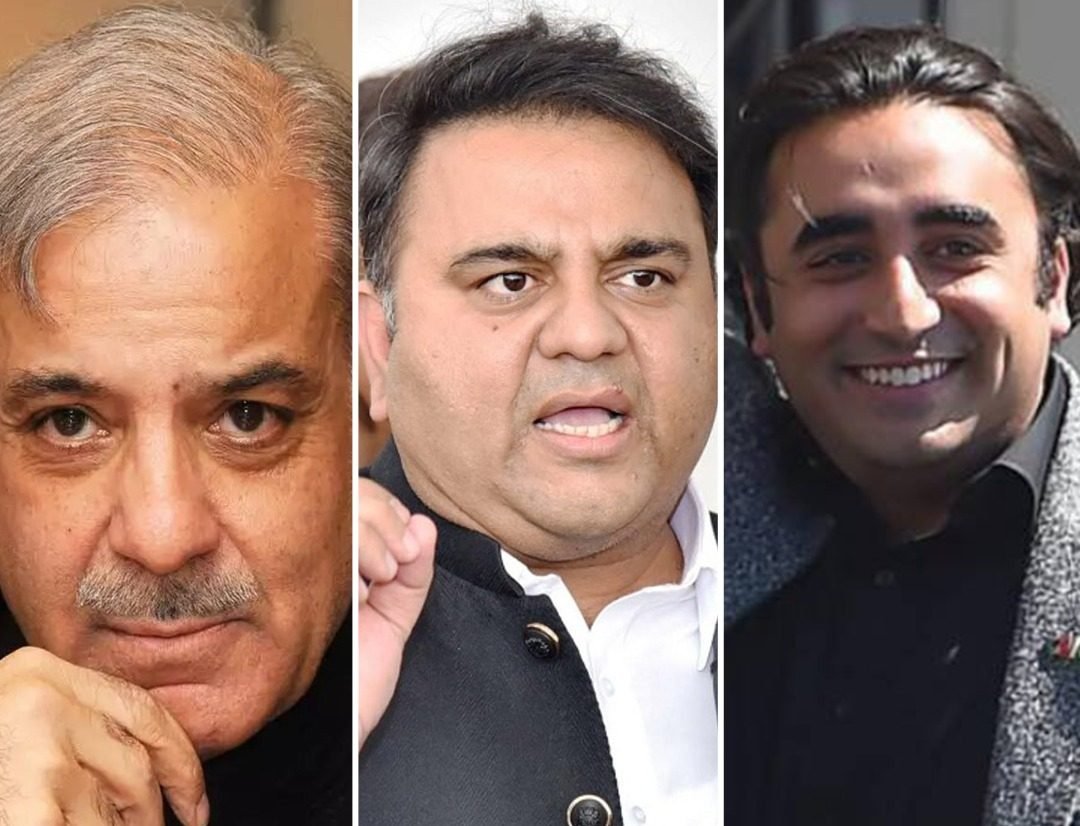
    Federal Minister for Information and Broadcasting Fawad Chaudhry took to Twitter to lash out at the Opposition stating that President Pakistan Muslim League-Nawaz (PML-N) Shehbaz Sharif and Chairperson Pakistan People’s Party (PPP) Bilawal Bhutto “have not read a word of election reform and Pakistan Media Development Authority (PMDA) nor do they know what the proposals are.”

    “Our Opposition has only one role, to unite with the anti-government satan,” added Fawad.

     Shehbaz Sharif on Monday vowed to go against any government efforts to pass legislation related to the media.

    Shehbaz Sharif said no party in parliament will support this “black law” except for the government.

    “We will join forces with all political parties […] and take Opposition into confidence against this black law,” Shehbaz said, adding: “This is a matter of life and death for independent journalism, democracy, and constitutional freedom.”

    “If any other government had imposed such restrictions, it would have been overthrown,” said Shehbaz.

    Bilawal Bhutto also criticised the government for the proposed bill. He said, “We like it when Human Rights Watch (HRW) writes about injustice in Indian occupied Kashmir but go silent when it’s about Pakistan.”

    Taking a jibe at the government for its double standards, Bilawal added, “Human Rights Watch statement on PMDA legislation to silence Pakistan media must be read and this black law should be rejected as its against the freedom of speech in the country.”

  • “Human Rights Watch’s statement based on gossip”, Pakistan challenges report on media bill

    “Human Rights Watch’s statement based on gossip”, Pakistan challenges report on media bill

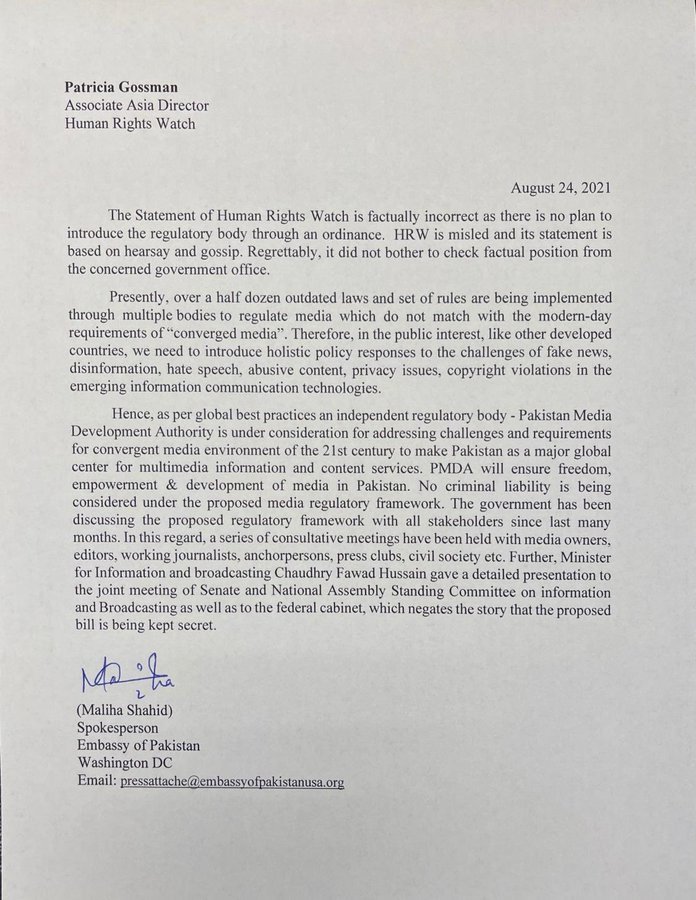
    Pakistan responded to a dispatch by the Human Rights Watch (HRW) Associate Asia Director, Patricia Gossman, on the proposed media bill. Pakistan condemned the claims of the organisation and termed the statement “factually incorrect”.

    “The statement of Human Rights Watch is factually incorrect as there is no plan to introduce the regulatory body through an ordinance,” read the letter from Pakistan’s Embassy in Washington DC.

    The letter further added, “HRW is misled and its statement is based on hearsay and gossip.”

    “In the public interest, like other developed countries, we need to introduce holistic policy responses to the challenges of fake news, disinformation, hate speech, abusive content, privacy issues, copyright violations on the emerging information communication technologies.”

    The letter further states, “Hence, as per global best practices and independent regulatory body – Pakistan Media Development Authority is under consideration for addressing challenges and requirements for convergent media of the 21st century to make Pakistan a major global center for multimedia information and content services.”

    Patricia Gossman took to Twitter and wrote, “Wow. You have identified no inaccuracies in our article and you have failed to provide a draft of the law. What are you hiding?”

    https://twitter.com/pagossman/status/1430426802049196036

    Meanwhile, in its statement, HRW said, “The government claims an ordinance setting up the Pakistan Media Development Authority (PMDA) would replace the ‘fractured’ regulatory environment and fragmented media regulations currently in place. The proposed PMDA would bring all media in Pakistan – print, television, radio, films, and digital media – under one regulator.”

    The proposed law would also increase government control by allowing government officials to be appointed to key positions.

    With journalists under relentless attack for doing their jobs, the Pakistan government needs to stop trying to control reporters and instead start protecting media freedom, added HRW.

  • Govt seeking new powers to control media by setting up PMDA:  Human Rights Watch

    Govt seeking new powers to control media by setting up PMDA: Human Rights Watch

    As part of its crackdown on freedom of expression, the government is seeking broad new powers in the garb of the proposed Pakistan Media Development Authority (PMDA), says Human Rights Watch (HRW).

    “The government claims an ordinance setting up the Pakistan Media Development Authority (PMDA) would replace the ‘fractured’ regulatory environment and fragmented media regulations currently in place. The proposed PMDA would bring all media in Pakistan – print, television, radio, films, and digital media – under one regulator,” HRW said in its statement.

    The PMDA law would grant new unchecked powers to the government-controlled regulator by setting up special “media tribunals” that will have the power to impose steep fines for media organisations and journalists who violate its code of conduct or publish content it deems to be “fake news”.

    The proposed law would also increase government control by allowing government officials to be appointed to key positions.

    With journalists under relentless attack for doing their jobs, the Pakistan government needs to stop trying to control reporters and instead start protecting media freedom, added HRW.

    Earlier this month, the representatives of media organisations rejected the proposed PMDA and termed the concept as an unconstitutional and draconian law against freedom of press and expression and a step toward imposing state control to regulate all segments of media under over-centralised body.

    The major stakeholders believe that the proposed PMDA is an attempt to tighten the government’s control over the media from one platform and ignores the fact that print, electronic and social media are separate entities, each with their own defined features.

  • Saudi Arabia allows women to live alone without male consent

    Saudi Arabia allows women to live alone without male consent

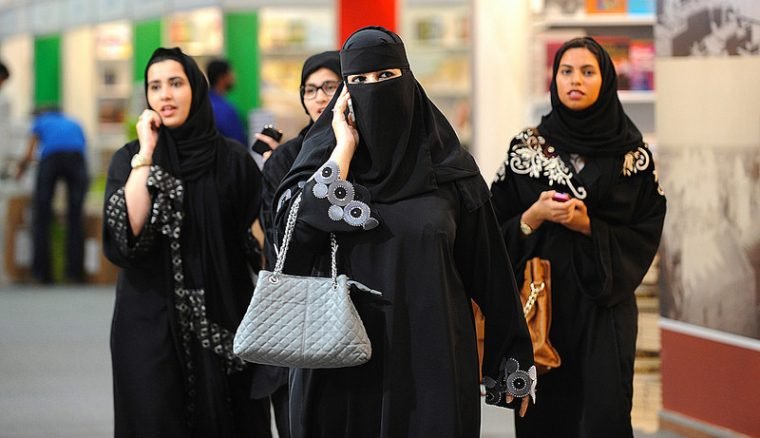
    Saudi Arabia has announced that Saudi women can now live on their own without the approval of their male guardians.

    Saudi Judicial authorities have revoked Paragraph B under article No. 169 of the “Law of Procedure before Sharia Courts”, reported Gulf News which has been replaced now. It states “An adult woman has the right to choose where to live.”. It is also included, under the law if a woman is imprisoned, she will not be handed over to her guardian after the expiry of her sentence.

    While speaking to a local newspaper, Saudi Attorney Naif Al-Mansi said, “Families can no longer file lawsuits against their daughters who choose to live alone.” Prior to this, under the old  “absenteeism” law, families were able to file a report with the police against the woman in case she disappears or choose to live independently.

    Read More- In a first, Saudi Arabia appoints women security guards at Grand Mosque.

    Under this law, last year, a Saudi woman Mariam Al Otaibi was detained because her family sued her for traveling alone. However, she won a historic ruling after the Saudi court passed a remarkable ruling that she had “the right to choose where to live”.

    This new amendment made after the passing of a law that allowed Saudi Arabia women over the age of 18 to change names on their ID cards without guardian approval. Moreover, in 2017, the Kingdom’s Head of State granted permission to women to drive putting an end to an old traditional practice.

    These developments are actually a part of Saudi Crown Prince Mohammed Bin Salman’s Vision 2030, formed five years ago to focus more on public sectors.

  • Human Rights Watch accuses India of targeting minorities

    Human Rights Watch accuses India of targeting minorities

    Human Rights Watch (HRW) on Friday accused the Indian government of adopting laws and policies that “systematically discriminate against Muslims and stigmatise critics of the government.”

    HRW’s report came days ahead Feb 23, which marks the first anniversary of the violence in New Delhi, where 53 people were killed, 40 of them were Muslims. The violence came after protests started against India’s Citizenship Amendment Act (CAA) passed in 2019 that excludes Muslims.

    The law granted citizenship to at least six minorities from Afghanistan, Bangladesh, and Pakistan who immigrated to India until Dec. 31, 2014.

    “Instead of conducting a credible and impartial investigation, including into allegations that [ruling Bharatiya Janata Party] BJP leaders incited violence and police officials were complicit in attacks, the authorities have targeted activists and protest organisers,” the report said.

    “The authorities have lately responded to another mass protest, this time by farmers, by vilifying minority Sikh protesters and opening investigations into their alleged affiliation with separatist groups,” it added.

    When Anadolu Agency contacted BJP spokesperson Syed Shahnawaz Hussain to comment on the HRW Report 2021, he declined to respond by saying, “I have not seen the report.”

    Prime Minister Narendra Modi’s BJP “has not only failed to protect Muslims and other minorities from attacks but is providing political patronage and cover for bigotry,” said HRW South Asia Director Meenakshi Ganguly.

    Although violence in New Delhi followed peaceful protests by Indians of all faiths, BJP leaders “attempted to discredit protesters, particularly Muslims, by accusing them of conspiring against national interests.”

    Also mentioning the protests of farmers against new farm laws in November, HRW accused the BJP leaders, their supporters on social media, and the pro-government media, of blaming the Sikhs, another religious minority.

    “Following violent clashes on January 26 between the police and protesting farmers who broke through police barricades to enter Delhi, the authorities filed baseless criminal cases against journalists, ordered the internet to be shut down at multiple sites, and ordered Twitter to block nearly 1,200 accounts, including of journalists and news organisations, some of which Twitter later restored,” it said.

    Since Modi came to power in 2014, various legislative and other actions have been taken, legitimizing discrimination against religious minorities and enabling violent Hindu nationalism, HRW said.

    “These actions violate domestic law and India’s obligations under international human rights law that prohibits discrimination based on race, ethnicity, or religion, and require the governments to provide residents with equal protection of the law,” HRW said.

    “The Indian government is also obligated to protect religious and other minority populations, and to fully and fairly prosecute those responsible for discrimination and violence against them,” it added.

    RIGHTS GROUPS ENDORSE REPORT:

    Kavita Krishnan, an activist, and secretary of the All India Progressive Women’s Association said in response to the HRW Report, “It is an acknowledgment of what is happening in India. I have no doubt that the government is targeting minorities and speaking the language of bigotry every day.”

    “There are a number of such cases that we see on a daily basis where Muslims, Sikhs, and Christians are targeted,” she said, blaming Modi’s BJP government.

    “In the last six years, it has increased exponentially under Modi government. It is very much state-sponsored and the latest one is the interfaith marriage which has made a marriage of Hindu woman with Muslim and Christian very difficult,” she said.