Tag: humanitarian aid

  • UN needs $46.4 billion for aid in ‘bleak’ 2024

    UN needs $46.4 billion for aid in ‘bleak’ 2024

    Geneva, Switzerland – The United Nations said Monday that it needed $46.4 billion next year to bring life-saving help to around 180 million people in desperate circumstances around the world.

    The UN said the global humanitarian outlook for 2024 was “bleak”, with conflicts, climate emergencies and collapsing economies “wreaking havoc” on the most vulnerable.

    While global attention focuses on the conflict raging in the Gaza Strip, the UN said the wider Middle East, Sudan and Afghanistan were among the hotspots that also needed major international aid operations.

    But the size of the annual appeal and the number of people it aims to reach were scaled back compared to 2023, following a decrease in donations.

    “Humanitarians are saving lives, fighting hunger, protecting children, pushing back epidemics, and providing shelter and sanitation in many of the world’s most inhumane contexts,” UN aid chief Martin Griffiths said in a statement.

    “But the necessary support from the international community is not keeping pace with the needs,” he said.

    The 2023 appeal was for $56.7 billion but received just 35 percent of that amount, one of the worst funding shortfall in years. It allowed UN agencies to deliver assistance and protection to 128 million people.

    With a few weeks left to go, 2023 is likely to be the first year since 2010 when humanitarian donations declined compared to the previous year.

    The UN therefore scaled down its appeal to $46.4 billion this time around, and will focus on those in the gravest need.

    72 countries

    Launching the 2024 Global Humanitarian Overview, Griffiths said the sum was nonetheless a “massive ask” and would be tough to raise, with many donor countries facing their own cost of living crises.

    “Without adequate funding, we cannot provide life-saving assistance. And if we cannot provide that assistance, people will pay with their lives,” he said.

    The appeal covers aid for 72 countries: 26 states in crisis and 46 neighbouring nations dealing with the knock-on effects, such as an influx of refugees.

    The five largest single-country appeals are for Syria ($4.4 billion), Ukraine ($3.1 billion), Afghanistan ($3 billion), Ethiopia ($2.9 billion) and Yemen ($2.8 billion).

    Griffiths said there would be 300 million people in need around the world next year — a figure down from 363 million last year.

    But the UN aims to reach only 180.5 million of those, with NGOs and aid agencies targeting the remainder — not to mention front-line countries and communities themselves who provide the first help.

    Climate impact

    The Middle East and North Africa require $13.9 billion, the largest total for any region in 2024.

    Beyond Syria, the Palestinian territories and Yemen, Griffiths also pointed to Sudan and its neighbours, and to Ukraine, Afghanistan, Venezuela and Myanmar as hotspots that needed sustained global attention.

    Ukraine is going through a “desperate winter” with the prospect of more warfare on the other side, he said.

    With the Gaza war between Israel and Hamas, plus Russia’s war in Ukraine, Griffiths said it was hard for the Sudan crisis to get the attention it deserved in foreign capitals.

    More broadly, Griffiths said climate change would increasingly impact the work of humanitarian aid workers, who would have to learn how to better use climate data to focus aid resources.

    “There is no doubt about the climate confronting and competing with conflict as the driver of need,” he said.

    “Climate displaces more children now than conflict. It was never thus before,” he said.
  • History will judge us all, warns UN Secretary-General

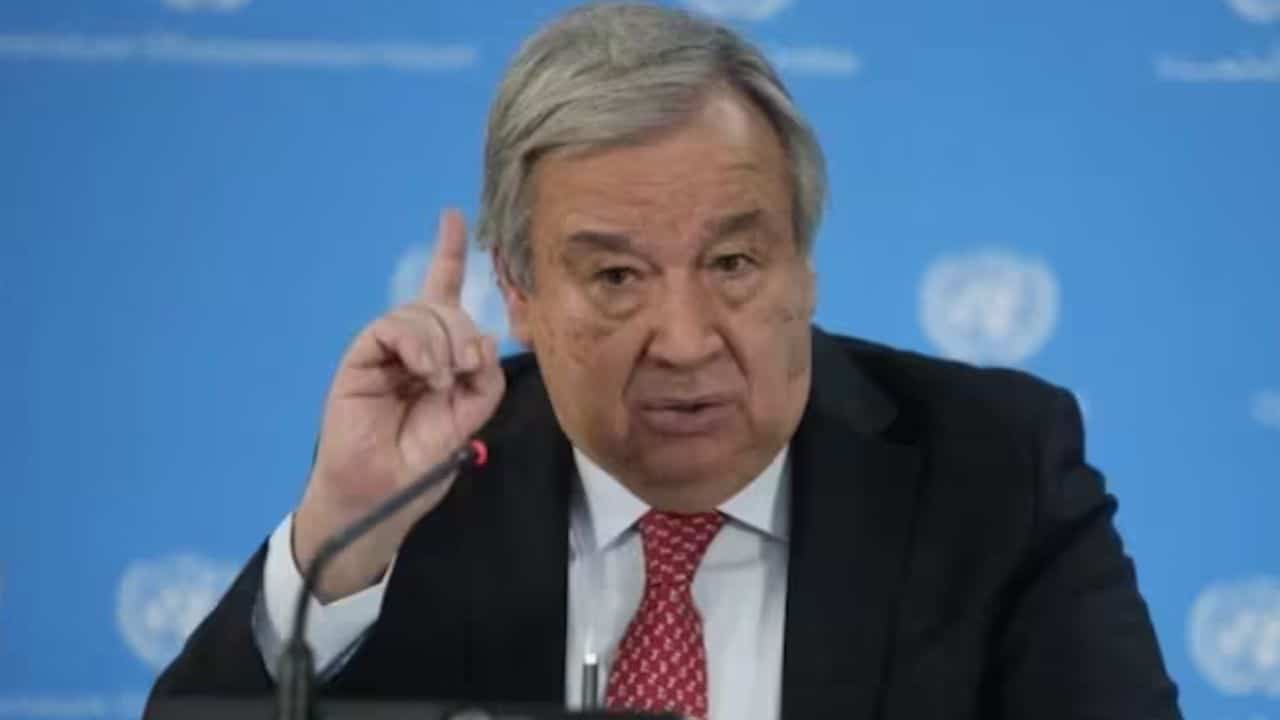
    History will judge us all, warns UN Secretary-General

    The Secretary-General UN Antonio Guterres has said “Everyone must assume their responsibilities. This is the moment of truth. History will judge us all,” as Israel imposed a total blockade of the internet on the Gaza Strip before the heaviest bombardment of the area has ever seen.

    He reasserted his call for a humanitarian ceasefire in the war-torn Middle East, the release of hostages, and that aid be delivered at the scale needed.

    Earlier on Friday, the UN voted for a humanitarian truce in Gaza and adopted a non-binding resolution where 120 countries voted in favor, 14 were against and 45 abstained. The Palestinian Ambassador Riyad Mansour emphasized, “Enough is enough, the carnage against our people needs to stop and humanitarian assistance should begin to enter the Gaza Strip.”

    It is important to note that Gaza has now no communication access and there is a complete blackout in the besieged area while the Israeli Ambassador in the UN has demanded the resignation of the Secretary-General. Gilad Erdan believes, “understanding for the campaign of mass murder of children, women, and the elderly, is not fit to lead the UN.”

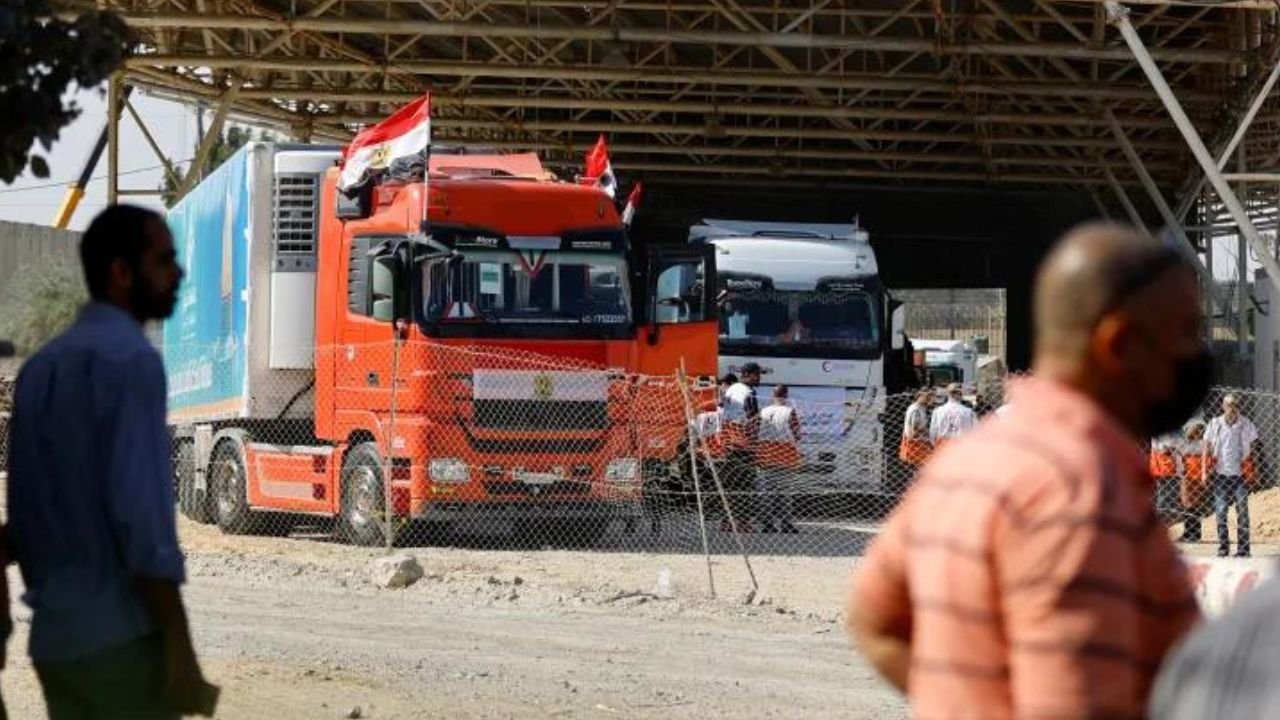
  • Only 20 trucks of aid allowed into Gaza

    Only 20 trucks of aid allowed into Gaza

    The Rafah border between Egypt and Gaza has finally been opened for aid trucks into Gaza on Saturday.

    Al Jazeera reports that Hamas’s media office confirmed that “The relief aid convoy that is supposed to enter today includes 20 trucks that carry medicine, medical supplies, and a limited amount of food supplies [canned goods],”

    The World Health Organization took to X to highlight that its trucks consists of trauma supplies for 1,200 people, portable trauma bags for on-the-spot stabilisation for 235 people, medication for chronic diseases for 1,500 people, essential health supplies for 300,000 people for three months.

    It is, however, important to note that the besieged Gaza Strip has a population of 2.3 million people.

    Humanitarian workers have been saying that 20 trucks are not enough for the catastrophe caused by Israeli attacks on the Gaza strip. So far, more than 4,000 people have been killed while more than 12,000 are injured.

    The UN reported that there is a severe dearth of food and drinking water while sanitation facilities, water wells, reservoirs, and pumping stations have been destroyed due to air raids.

    Hamas’s media office has also stated that this aid “will not change the catastrophic medical conditions in Gaza”.

    Previously, US President Joe Biden visited Israel and announced the agreement to allow 20 trucks in Gaza through Egypt.

  • Number of flood affectees may cross 33 million, warns Climate Change Minister

    Number of flood affectees may cross 33 million, warns Climate Change Minister

    Federal Minister of Climate Change Sherry Rehman warned on Sunday (August 28) that the number of those affected by the floods may cross 33 million as the devastating floods continue.

    She said that the government, supported by the United Nations (UN) and other humanitarian agencies, is leading the humanitarian action.

    “Kabul River is still at very high flood level at Nowshera as more than 300,000 cusecs of water was crossing the river,” she said, adding that with 500,000 cusecs, water levels in River Indus at Taunsa, Sukkur and Chashma are at “high flood level”.

    Calling the floods “a perfect storm”, Sherry Rehman added that as relentless rains had battered the southern parts of the country, the floods in the Indus River devastated the northern areas.

    Updating on the relief efforts, she said that as rain has subsided in some areas, the National Disaster Management Authority (NDMA) and Pakistan Army have amped up rescue efforts.