Tag: humanitarian crises

  • Palestinians feel ‘no joy’ as Israel bombs Gaza on Christmas

    Palestinians feel ‘no joy’ as Israel bombs Gaza on Christmas

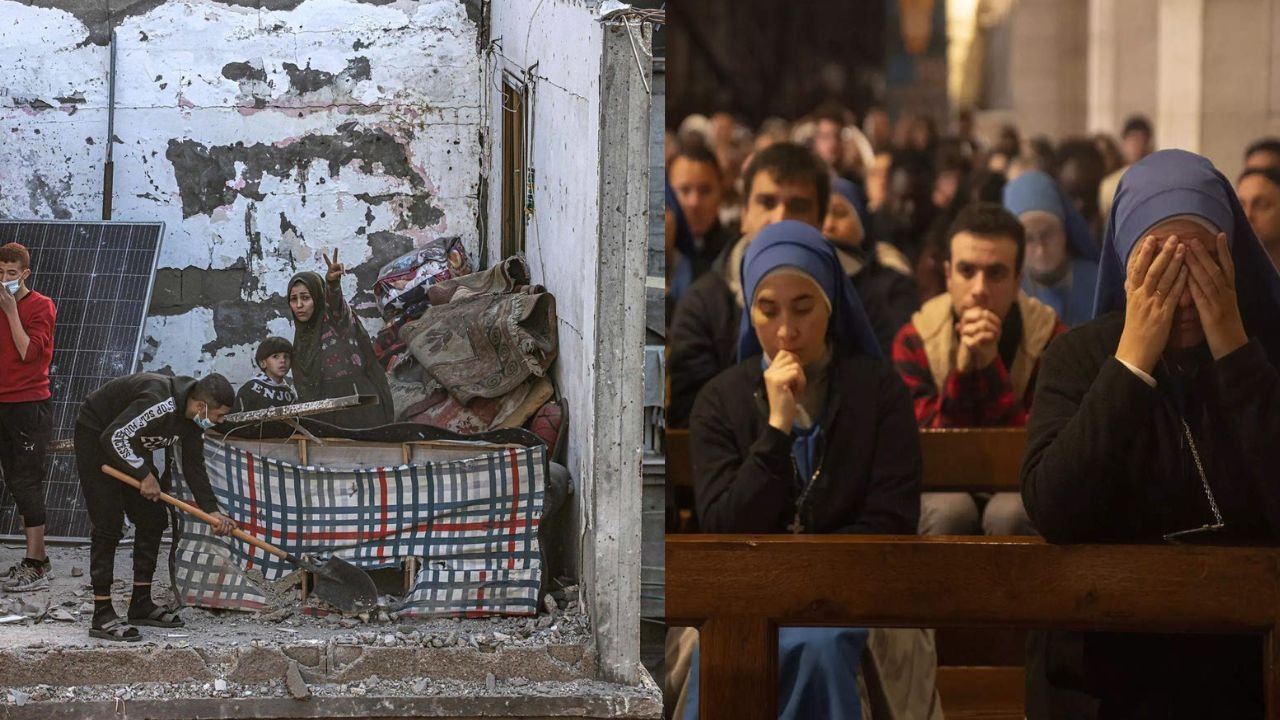
    Palestinians said they felt “no joy” this Christmas as Israel bombed Gaza on Monday, with no end in sight to the war that Hamas says has claimed more than 20,000 lives.

    Festivities were effectively scrapped in the occupied West Bank city of Bethlehem, revered as the birthplace of Jesus Christ, with few worshippers or tourists on the usually packed streets.

    In the besieged Gaza Strip, the Hamas-run ministry of health said early Monday Israeli strikes had killed at least 18 people in the southern city of Khan Yunis, the centre of recent fighting.

    At a hospital in the city, Fadi Sayegh — whose family has previously received permits to travel to Bethlehem for celebrations — said he would not be celebrating Christmas this year.

    “There is no joy. No Christmas tree, no decorations, no family dinner, no celebrations,” he said while undergoing dialysis. “I pray for this war to be over soon.”

    Sister Nabila Salah from the Catholic Holy Church in Gaza — where two Christian women were killed by an Israeli sniper earlier this month according to the Latin Patriarchate of Jerusalem — struck a sombre tone.

    “All Christmas celebrations have been cancelled,” she told AFP. “How do we celebrate when we are… hearing the sound of tanks and bombardment instead of the ringing of bells?”

    The war broke out when Hamas fighters attacked southern Israel on October 7 and killed about 1,140 people, mostly civilians, and seized 250 hostages, according to an AFP tally based on Israeli figures.

    Israel has vowed to eliminate Hamas in response and its military campaign, which has included massive aerial bombardment. The campaign has killed 20,424 people, mostly women and children, according to Gaza’s health ministry.

    Pope Francis kicked off global Christmas celebrations on Sunday with a call for peace.

    “Our heart goes to Gaza, to all people in Gaza but a special attention to our Christian community in Gaza who is suffering,” the Catholic leader said.

    Christmas eve strike

    Just ahead of Christmas, the Hamas-run health ministry said at least 70 people were killed in an Israeli air strike on Sunday at the Al-Maghazi refugee camp in central Gaza.

    Health ministry spokesman Ashraf al-Qudra said the “toll is likely to rise” as many families were thought to be in the area at the time of the strike.

    In a separate incident, the ministry said 10 members of one family were killed in an Israeli strike on their house in the Jabalia camp in northern Gaza.

    AFP was unable to independently verify either toll.

    Vast areas of Gaza lie in ruins and its 2.4 million people have endured dire shortages of water, food, fuel and medicine due to an Israeli siege, alleviated only by the limited arrival of aid trucks.

    Eighty percent of Gazans have been displaced, according to the UN, many fleeing south and now shielding against the winter cold in makeshift tents.

    The head of the UN refugee agency, Filippo Grandi, called for an end to the suffering.

    “A humanitarian ceasefire in Gaza is the only way forward,” he wrote on X, formerly Twitter. “War defies logic and humanity, and prepares a future of more hatred and less peace.”

    World Health Organization chief Tedros Adhanom Ghebreyesus also renewed calls for a ceasefire, saying: “The decimation of the Gaza health system is a tragedy.”

    ‘No choice’

    Israeli Prime Minister Benjamin Netanyahu said Sunday the war was exacting a “very heavy price”, as the death toll of soldiers killed in the conflict continued to mount.

    “But we have no choice but to keep fighting,” he said, adding: “This will be a long war.”

    The army said Monday two more soldiers had been killed, taking to 17 the number of troops killed since Friday and 156 since Israel’s ground assault began on October 27.

    Israeli military spokesman Jonathan Conricus indicated that forces were close to gaining control in northern Gaza and that now “we focus our efforts against Hamas in southern Gaza”.

    Two freed detainees and a medic said Sunday that Palestinians held by the Israeli army in the Gaza Strip had suffered torture, a charged denied by the military.

    The two men were among hundreds detained by Israeli forces over alleged links with Hamas during Israel’s ground offensive.

    About 20 men released from Israeli custody “have bruises and marks of blows on their bodies”, Marwan al-Hams, hospital director in the southern city of Rafah, told AFP.
  • Israel intentionally starving civilians in Gaza: HRW

    Israel intentionally starving civilians in Gaza: HRW

    The group Human Rights Watch on Monday accused the Israeli government of intentionally starving civilians in Gaza as part of its offensive in the besieged Palestinian territory. 

    “The Israeli government is using starvation of civilians as a method of warfare in the occupied Gaza Strip, which is a war crime,” the New York-based group charged in a report.

    “Israeli forces are deliberately blocking the delivery of water, food and fuel, while wilfully impeding humanitarian assistance, apparently razing agricultural areas, and depriving the civilian population of objects indispensable to their survival,” it added.

    The Israeli government hit back at HRW, accusing it of being an “anti-Semitic and anti-Israeli organisation”.

    “Human Rights Watch … did not condemn the attack on Israeli citizens and the massacre of October 7 and has no moral basis to talk about what’s going on in Gaza if they turn a blind eye to the suffering and the human rights of Israelis,” foreign ministry spokesman Lior Haiat told AFP.

    The deadliest ever Gaza war began with the unprecedented attack by Hamas on October 7, when the group killed 1,139 people, mostly civilians, and abducted around 250, according to updated Israeli figures.

    The health ministry in the Hamas-run territory says more than 18,800 people, mostly women and children, have died in Israel’s campaign in Gaza.

    Following months of fierce bombardment and fighting, most of Gaza’s population has been displaced and people are grappling with shortages of food, water, fuel and medicine.

    Israel on Friday approved the “temporary” delivery of much-needed aid to Gaza via its Kerem Shalom crossing.

    A humanitarian aid convoy entered Gaza through the crossing on Sunday, the first since Israel approved the move, an Egyptian Red Crescent official said.

    A total of “79 trucks began entering today,” the official, who is not authorised to speak to the media, said on condition of anonymity.

  • World treats crises affecting blacks, whites unequally, regrets WHO chief

    The WHO chief said on Wednesday that the world was treating humanitarian crises affecting black and white lives unequally, with only a “fraction” of the attention on Ukraine given elsewhere.

    According to the AFP, World Health Organisation’s director-general Tedros Adhanom Ghebreyesus said the emergencies happening in other parts of the world were not being taken as seriously and hoped the international community “comes back to its senses”.

    “I don’t know if the world really gives equal attention to black and white lives,” Tedros told a news conference. “The whole attention to Ukraine is very important of course, because it impacts the whole world.

    “But even a fraction of it is not being given to Tigray, Yemen, Afghanistan and Syria and the rest. A fraction.

    “I need to be blunt and honest that the world is not treating the human race the same way. Some are more equal than others. And when I say this, it pains me. Because I see it. Very difficult to accept but it’s happening.”

    Tedros, who is himself from Tigray, said the United Nations had determined that 100 trucks per day of life-saving humanitarian supplies needed to be going into the besieged northern region of Ethiopia.

    The country’s former health and foreign minister said that since a truce was declared, at least 2,000 trucks should have gone in, but only 20 have done so thus far.

    Tedros said he was worried that the 20 trucks going in could be just a “diplomatic manoeuvre” on the part of the government in Addis Ababa.

    “In effect, the siege by the Ethiopian and Eritrean forces continues,” he said.

    “To avert the humanitarian calamity and hundreds of thousands more people from dying, we need unfettered humanitarian access from those reinforcing the siege.” But Tedros said global attention was simply not being placed on such humanitarian crises.

    “I hope the world comes back to its senses and treats all human life equally,” he said.

    “What is happening in Ethiopia is a tragic situation. People are being burned alive… because of their ethnicity…. Without any crime. “So we need to balance. We need to take every life seriously because every life is precious.”

    The UN says hundreds of thousands of people are at risk of starvation in Tigray, where people have for months also faced fuel shortages and a lack of basic services such as electricity, telecommunications, internet and banking.

    Across northern Ethiopia, the 17-month conflict has driven more than two million people from their homes, according to the UN, and left more than nine million people in need of food aid.