Tag: IMF deal

  • Pakistan’s ambitious FY25 Budget could secure IMF deal, says Fitch

    Pakistan’s ambitious FY25 Budget could secure IMF deal, says Fitch

    On Tuesday, Fitch Ratings characterised Pakistan’s budget for the fiscal year 2024-25 as “ambitious,” noting that it enhances the likelihood of securing a deal with the International Monetary Fund (IMF).

    While Fitch acknowledged the uncertainty in meeting the fiscal targets, it highlighted that even partial implementation of the budget would likely narrow the fiscal deficit, thereby reducing external pressures, albeit at a potential cost to economic growth.

    “The FY25 budget draft, released on June 13, is the first presented by Prime Minister Shehbaz Sharif’s coalition government. It projects a headline deficit of 5.9 per cent of GDP and a 2.0 per cent primary surplus, compared to the FY24 estimates of 7.4 per cent and 0.4 per cent respectively, through wide-ranging tax increases and significant fiscal efforts at the provincial level. The budget includes a notable increase in developmental spending and forecasts growth to accelerate to 3.6 per cent in FY25, up from 2.4 per cent in FY24,” Fitch stated in its commentary.

    Pakistan’s Finance Minister Muhammad Aurangzeb unveiled the budget last week, targeting a modest 3.6 per cent growth for the upcoming fiscal year. The budget, with a total outlay of Rs18.9 trillion, represents a 30 per cent increase compared to the FY24 budget. Gross revenue receipts are expected to be Rs17.8 trillion, with the Federal Board of Revenue (FBR) taxes projected at Rs12.97 trillion, nearly 38 per cent higher than the previous fiscal year.

    With this ambitious tax target, Islamabad aims to secure the IMF’s approval for a larger and longer-term bailout.

    Fitch Ratings warned that these plans could face significant resistance within parliament from both coalition partners and opposition parties, as well as from broader society. This follows the close outcome of the February elections, which resulted in a weaker-than-expected mandate for the Pakistan Muslim League-Nawaz (PML-N).

    “Our updated fiscal forecasts assume partial implementation and project a primary surplus of 0.8 per cent, factoring in shortfalls in revenue generation and an overshoot in current spending, partly offset by under-execution in development spending,” Fitch added.

    “We believe tight policy settings may depress growth more than the government expects, reducing our growth forecast to 3.0 per cent for FY25, from 3.5 per cent, despite some improvements in short-term economic indicators. Nonetheless, the FY24 primary deficit is in line with the target, and the authorities have implemented unpopular subsidy reforms over the past year, supporting fiscal credibility.”

    Fitch noted Pakistan’s historically poor track record in sustaining reforms, but acknowledged that the lack of viable alternatives has bolstered support for tough policy decisions in the near term.

    Pakistan completed its nine-month IMF Stand-By Arrangement in April, and in May, the IMF reported “significant progress” towards agreeing on a new Extended Fund Facility (EFF).

    “Government debt is expected to decline to 68 per cent of GDP by the end of FY24 due to high inflation and deflator effects, which offset soaring domestic interest costs. We anticipate inflation and interest costs to decline in tandem, with economic growth and primary surpluses gradually reducing the government debt-to-GDP ratio. The State Bank of Pakistan cut policy rates for the first time in five years on June 10 by 150 basis points to 20.5 per cent. We now forecast FY25 inflation at 12 per cent, and the end-of-year policy rate at 16 per cent,” Fitch detailed.

    Despite stable debt dynamics, Fitch identified external liquidity and funding as Pakistan’s primary credit challenges.

    “We believe a new IMF deal will be agreed upon, underpinning other external funding. However, maintaining the stringent policy settings necessary to keep external financing needs in check and comply with a new EFF could become increasingly challenging,” Fitch stated.

    Pakistan’s external position has improved since February’s election, with the current account deficit on track to narrow to 0.3 per cent of GDP (just USD1 billion) in FY24, down from 1.0 per cent in FY23. This improvement is attributed to subdued domestic demand compressing imports, exchange rate reforms attracting remittance inflows back to the official banking system, and strong agricultural exports.

    Gross reserves, including gold, now stand at USD15.1 billion, covering over two months of external payments, up from USD9.6 billion at the end of FY23.

    “However, Pakistan’s projected funding needs still exceed reserves, at approximately USD20 billion per year in FY24–FY25, including maturing bilateral debt that we expect will continue to be rolled over. This leaves Pakistan vulnerable to external funding conditions and policy missteps,” Fitch concluded.

    Pakistan’s ‘CCC’ rating, reaffirmed in December 2023, reflects the high external funding risks amid substantial medium-term financing requirements.

  • Pakistan Stock Exchange may surpass 60,000 level soon

    Pakistan Stock Exchange may surpass 60,000 level soon

    The benchmark index of the Pakistan Stock Exchange (PSX) marked a record-breaking bullish run on Monday, closing just shy of the 60,000 mark without surpassing it. 

    There is an anticipation that, given the current pace, the stock market might breach the 60,000 level soon. 

    According to the PSX website, the KSE-100 index showed marginal gains until noon. However, at 1:11 pm, it experienced a sudden surge that persisted until closing time, reaching 59,811.34, up by 724.99 points (1.23%) from the previous day’s 59,086.35.

    In the preceding Friday session, the KSE-100 index had set a new record at 59,100 points, attributed to strong corporate profits, reduced economic volatility, the successful conclusion of an IMF staff-level deal, expectations of a stable post-poll government, and optimism about an early reversal of monetary tightening. This led to a rapid increase in share prices over the last three months.

    Regarding the current rally, Raza Jafri, head of equity at Intermarket Securities, noted, “The banking sector is driving the rally, aligning with the improving economic outlook.” He emphasised that banks, offering a combination of high dividend yields and attractive valuations, have consistently been favoured by foreign investors.

    Shahbaz Ashraf, chief investment officer at FRIM Ventures, a Karachi-based investment company, attributed the rally to “cheap valuations and an influx of liquidity.”

  • Army gets more land for ‘agriculture’

    Army gets more land for ‘agriculture’

    The Pakistan Army is set to start agriculture farming on 41,000 acres of land in South Waziristan’s Zarmalam area.

    Peshawar Corps Commander Lieutenant General Sardar Hasan Azhar Hayat has said that the army was determined to increase agricultural farming in Khyber Pakhtunkhwa, as per Geo News.

    Lt Gen Hayat said the army has prepared a farming plan on 41,000 acres of land that had been barren for years.

    The officer was of the view that there is a vast opportunity for investment in minerals, hydropower, agriculture, and tourism in KP that can help boost the province’s resources.

    The three-star officer said the army has worked together with the civil government to bring investment in minerals, agriculture, hydropower, and tourism to the province, which is yielding positive results.

    The Pakistan Army’s decision has sparked mixed reactions among locals and experts, with some expressing concerns over the potential implications for the region.

    The move, which involves the cultivation of 41,000 acres of land, has raised questions about the long-term impact on the area’s ecosystem and implications for local communities.

    Critics argue that the project’s scale could lead to significant land and water resource depletion, impacting the livelihoods of communities dependent on the land.

    Additionally, there have been concerns about the army’s increasing involvement in civilian sectors, with some experts cautioning against potential overreach and the need to ensure civilian oversight in such initiatives.

    On October 1st this year, The Pakistan Army launched the first agriculture project under the Special Investment Facilitation Council (SIFC) to make barren lands cultivable in South Waziristan.

    The pilot project launched in the Zarmalam district of South Waziristan oversaw 1,000 acres of barren land made suitable for cultivation.

    The Pakistan Army’s decision has sparked mixed reactions among locals and experts, with some expressing concerns over the potential implications for the region.

    The move, which involves the cultivation of 41,000 acres of land, has raised questions about the long-term impact on the area’s ecosystem and the implications for local communities.

    Critics argue that the project’s scale could lead to significant land and water resource depletion, impacting the livelihoods of communities dependent on the land.

    Additionally, there have been concerns about the army’s increasing involvement in civilian sectors, with some experts cautioning against potential overreach and the need to ensure civilian oversight in such initiatives.

  • Pakistan’s stock market crosses 48,000 mark after two years

    Pakistan’s stock market crosses 48,000 mark after two years

    The Pakistan Stock Exchange’s (PSX) benchmark KSE-100 index soared past the 48,000 mark, reaching a 24-month high, on Monday, as investors responded to recent positive economic developments in the country. Analysts predict that the prevailing positive sentiment is likely to continue in the coming days.

    The bullish trend in the market gained momentum after Pakistan reached a deal with the International Monetary Fund (IMF). The agreement with the IMF has provided investors with renewed confidence in the country’s economic prospects, leading to a surge in market activity.

    Additionally, news on Pakistan’s mineral sector contributed significantly to the market’s gains. The announcement of favorable developments in the country’s mineral sector further boosted investor optimism and drove the benchmark index to reach new heights.

    During intra-day trade, the KSE-100 index saw a significant increase of 1,010.72 points or 2.15 per cent, culminating at 48,062.56 points. This remarkable rise marks a notable increase from the previous close of 47,076.9 points, which itself was a 21-month high.

    The impressive growth of the market has been sustained over time, as evidenced by a remarkable overall gain of more than 6,600 points (+15.9 per cent) since the staff-level agreement was reached with the IMF. The deal, which amounted to a $3 billion Standby Agreement, has been instrumental in driving investor confidence and attracting more capital to the market.

    Financial experts and market observers are optimistic about the future trajectory of the Pakistan Stock Exchange, given the positive economic indicators and recent developments in the country.

    The confidence in the market has sparked interest from both local and international investors, resulting in increased trading volumes and a positive impact on the overall economy.

  • Pakistan Stock Exchange surges to 21-month high as KSE-100 index crosses 47,000 mark

    Pakistan Stock Exchange surges to 21-month high as KSE-100 index crosses 47,000 mark

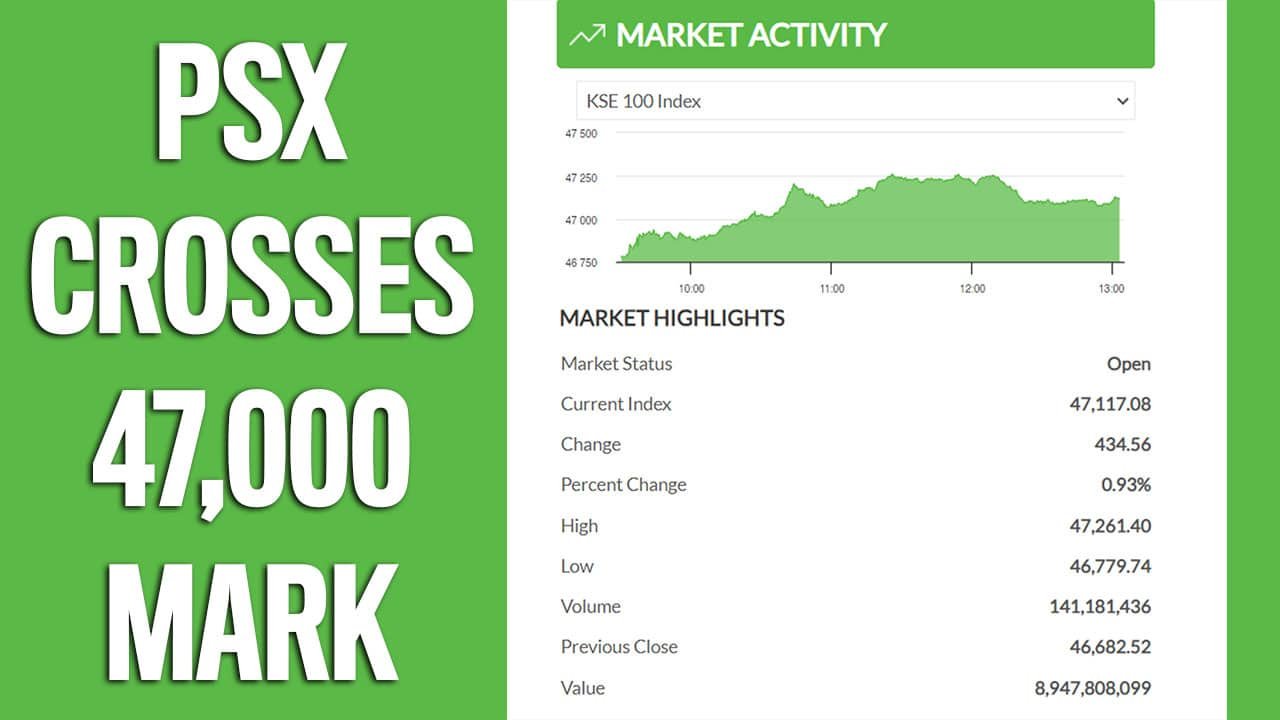
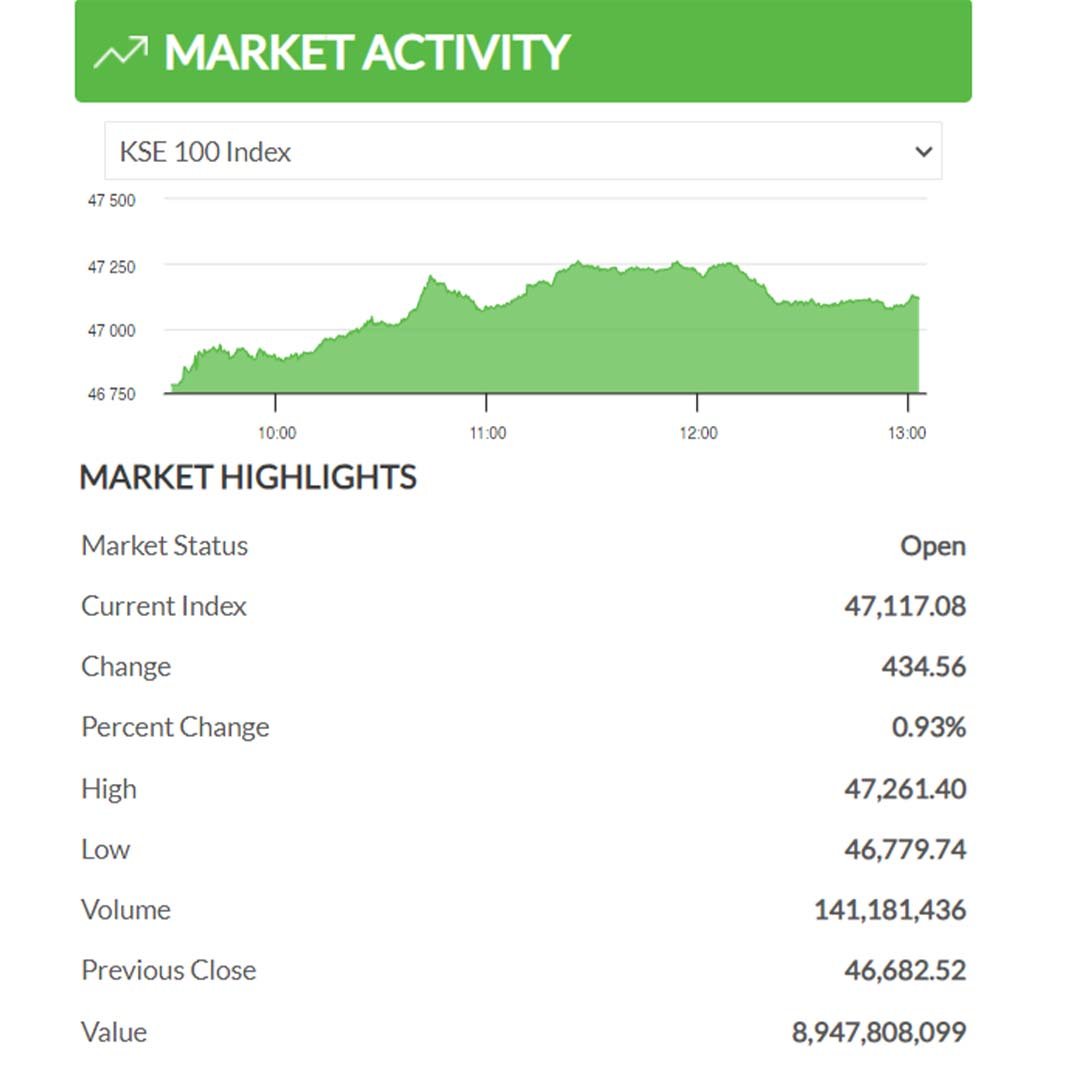
    The Pakistan Stock Exchange witnessed a significant surge as the benchmark KSE-100 index surpassed the 47,000 milestone on Thursday, reaching its highest point in 21 months. This remarkable upswing was fueled by positive market sentiment following the recent International Monetary Fund (IMF) deal.

    Notably, the bullish position was further fortified by impressive corporate performance, particularly within the index-heavy sectors. At 12:10 pm, the benchmark index surged by 560 points, settling at 47,242.9 points, marking its peak since November 8, 2021, as reported by Arif Habib Limited (AHL), a prominent brokerage firm.

    AHL emphasized that the market had recorded a noteworthy gain of 5,751 points (13.9 per cent) since the staff-level agreement with the IMF for the $3 billion Standby Agreement (SBA).

    This positive momentum was attributed to increased valuations after securing the IMF SBA facility, as explained by Tahir Abbas, AHL’s Head of Research, in an interview with Geo.tv. He highlighted that the current Price-Earnings Ratio (PER) of the KSE-100 stands at 3.7x, which is relatively lower compared to the lowest recorded during the previous financial crisis in 2008 (3.9x).

    Abbas asserted that the market remains attractive, and as a result, the positive momentum is expected to continue. Analyst Saad Ali, an expert in the capital market, attributed the market’s favorable performance to the combination of IMF optimism and the outlook for enhanced macro stability, which has been complemented by strong corporate results during the present result season. Despite facing challenging macroeconomic conditions, several banks and companies have managed to surpass expectations in terms of earnings and payouts.

    Last month, Pakistan signed a short-term deal with the IMF, a crucial step that helped the country avert a potential default and bolster its foreign exchange reserves. This move has played a pivotal role in supporting the current bullish trend in the stock market.

    In conclusion, with the positive impact of the IMF deal and encouraging corporate results, the Pakistan Stock Exchange’s benchmark KSE-100 index has achieved substantial growth, positioning itself at a 21-month high. The market outlook remains promising, and experts predict further gains ahead.

  • ‘Second green revolution’ promised by PM Shehbaz through Green Pakistan Initiative 

    ‘Second green revolution’ promised by PM Shehbaz through Green Pakistan Initiative 

    After a series of moves aimed to protect Pakistan’s failing economy, including securing a crucial IMF deal, Prime Minister Shehbaz Sharif has now set his sights on supporting what he calls the backbone of Pakistan’s economy: the agricultural sector.

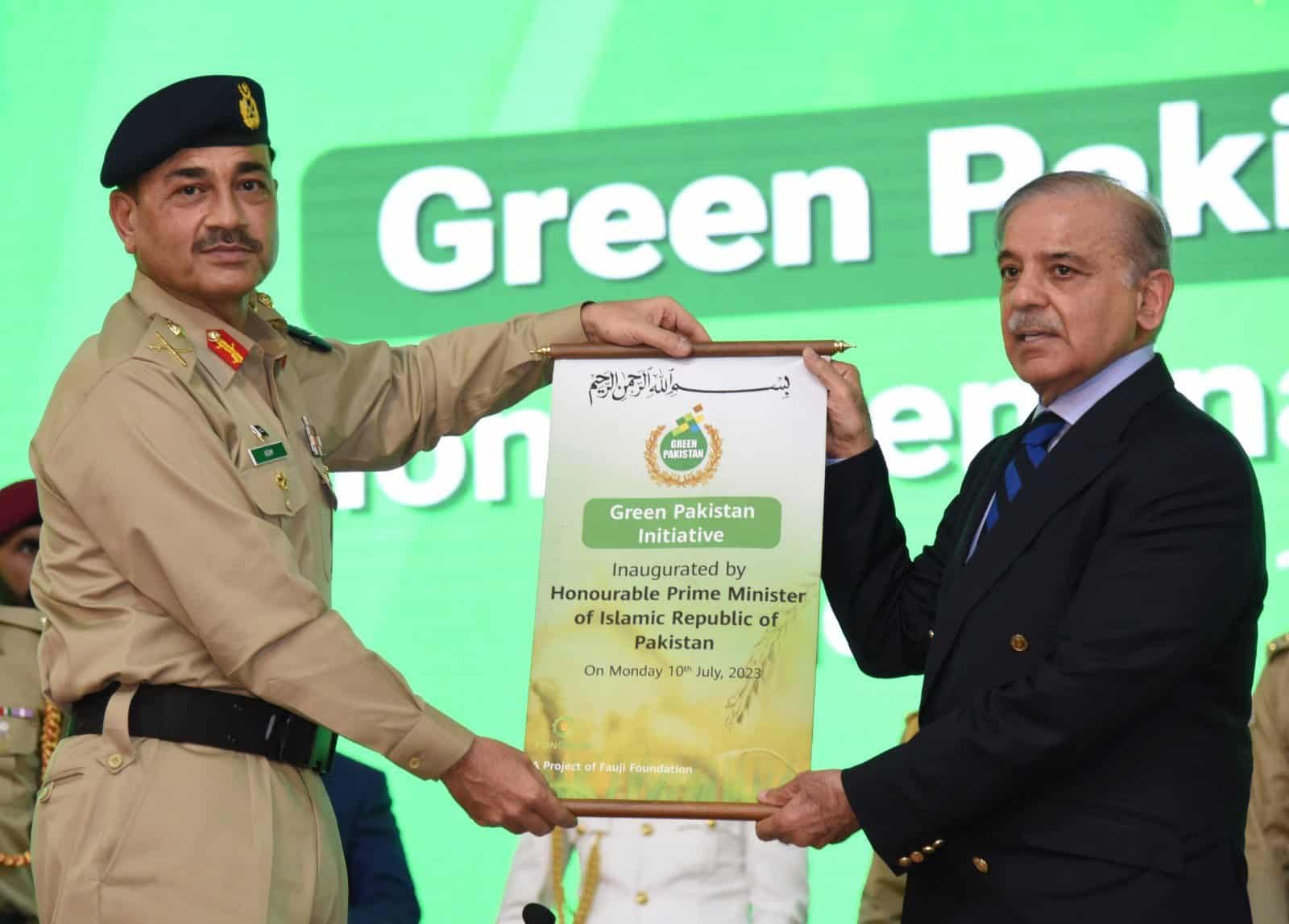
    Through his Green Pakistan Initiative, inaugurated on Monday, July 10, PM Shehbaz says 4 million jobs will be created in the agricultural sector. He also said the Green Pakistan Initiative would likely attract $50 billion in investments in the next five years.

    According to PM Shehbaz, the newly inaugurated initiative is bound to propel Pakistan into its ‘second green revolution’. In fact, the initiative follows similar schemes as those present in Ayub Khan’s regime, such as incentivising farmers by providing them with more profits for their production and providing standard seeds and fertilizers to farmers, along with equipping them with the latest technology.

    It is true that Ayub Khan’s Green Revolution changed the economic fate of the adolescent country. And a revolution of sorts is very much needed: according to PM Shehbaz, state-owned agricultural enterprises are losing PKR 600 billion annually. He noted that Pakistan imports $4.5 billion worth of palm oil, a burden on the national economy.

    At the inauguration ceremony, PM Shehbaz said that gulf countries were ready to invest in the agriculture sector and export modern machinery to Pakistan, in order to boost the production of crops in the country.

    According to The News, PM Shehbaz stated, “It is [a] demand of our national security that the country’s food security and economic security should be strengthened.”

    The inaugural seminar was attended by federal ministers, provincial chief ministers of Punjab and Sindh, chief secretaries of provincial governments, agricultural experts, and farmers from all the provinces.

    Chief of Army Staff General Asim Munir also attended the seminar as the guest of honour. He pledged the Pakistan Army’s full support for all the initiatives that fall under the Special Investment Facili­tation Council, one of which is the Green Pakistan Initiative.

    According to The News, agriculture experts and farmers highly appreciated the landmark initiative, praising the focus on promoting modern technology, the collaboration of public and private sectors, as well as trickling down dividends to local farmers in order to alleviate poverty.

  • Gold market bounces back with second consecutive price increase of Rs1,800 to Rs207,800 per tola

    Gold market bounces back with second consecutive price increase of Rs1,800 to Rs207,800 per tola

    The price of gold in Pakistan has experienced a notable increase for the second consecutive session, following a prolonged period of decline subsequent to the $3 billion deal with the International Monetary Fund (IMF).

    Data provided by the All-Pakistan Sarafa Gems and Jewellers Association (APSGJA) reveals that the price of 24-carat gold rose by Rs1,800 per tola and Rs1,543 per 10 grammes, reaching Rs207,800 and Rs178,155 respectively.

    Simultaneously, the international market witnessed a decrease in the price of gold by $23, resulting in a settlement at $1,905 per ounce.

    The gold market in Pakistan has exhibited volatility recently due to persistent political and economic uncertainty, along with high inflation. Consequently, individuals seek to invest in this valuable commodity as a means of safeguarding their assets and hedging against market fluctuations.

    The APSGJA’s data also indicates that the price of silver has remained unchanged at Rs2,380 per tola and Rs2,126.20 per 10 grammes. Notably, the previous day witnessed a Rs1,000 increase in the price of gold.

    Furthermore, the Pakistani rupee displayed a marginal recovery of 0.13 per cent against the US dollar on Thursday. The interbank market, as reported by the State Bank of Pakistan (SBP), recorded the local currency closing at Rs277.04 in relation to the greenback.

  • Govt expected to hike gas prices by 50%, electricity by Rs4 per unit for IMF deal

    Govt expected to hike gas prices by 50%, electricity by Rs4 per unit for IMF deal

    Pakistan is expected to increase gas sale prices by 45-50 per cent and electricity base tariffs by Rs3.50 to over Rs4 per unit for the fiscal year 2023-24.

    These adjustments must be notified before the upcoming meeting of the International Monetary Fund’s (IMF) Executive Board on July 12.

    According to reports, this increase in energy prices is necessary to pave the way for the $3 billion programme agreed upon under the Stand-By Arrangement (SBA) with the IMF at the staff level.

    Earlier, the Oil and Gas Regulatory Authority (Ogra) announced an increase of 50 per cent (Rs415.11 per MMBTU) for consumers of the Sui Northern Gas Pipeline Limited (SNGPL), bringing the subscribed gas price to Rs1,238.68 per MMBTU.

    Additionally, the regulator raised the gas price by 45 per cent (Rs417.23 per MMBTU) for consumers of the Sui Southern Gas Company Limited (SSGCL) for the fiscal year 2023-24. However, the government has yet to officially notify the increase in gas prices for the upcoming financial year.

    The SNGPL has an accumulated shortfall of Rs560.378 billion up to FY23, while Sui Southern has a shortfall of Rs97.388 billion. The federal government had previously notified the increase in gas sale prices based on different categories from January 1, 2023.

    As per the existing policy, high-end consumers subsidise the gas prices for low-end consumers. It is likely that the government will continue this policy, with high-end consumers paying the gas price for low-end consumers starting from July 1, 2023.

    According to The News, the entire energy sector is currently burdened by circular debt, which amounts to over Rs4,300 billion. This debt is divided between the oil and gas sector, with Rs1,700 billion, and the power sector, with Rs2,600 billion.

    The IMF emphasises the need for Pakistan to make the energy sector viable and sustainable, which requires increasing the base tariff for the fiscal year 2023-24.

  • IMF reaches $3 billion stand-by arrangement with Pakistan, averting impending default

    IMF reaches $3 billion stand-by arrangement with Pakistan, averting impending default

    The International Monetary Fund (IMF) and Pakistan have reached a staff-level agreement on a stand-by arrangement worth $3 billion, announced the lender. This decision has been eagerly anticipated by Pakistan, a South Asian nation that is on the verge of default.

    The approval of the IMF board, expected in July, is required to finalise the deal. After an eight-month delay, this agreement brings some relief to Pakistan, which is currently grappling with a severe balance of payments crisis and dwindling foreign exchange reserves.

    The funding of $3 billion, which will be disbursed over a period of nine months, surpasses initial expectations. Pakistan had been awaiting the release of the remaining $2.5 billion from a $6.5 billion bailout package that was initially agreed upon in 2019, and which expired on Friday. As a result, the country’s stock and currency markets remained closed on that day.

    According to IMF official Nathan Porter, the new stand-by arrangement builds upon the 2019 programme. Porter acknowledged the significant challenges faced by Pakistan’s economy in recent times, including devastating floods last year and rising commodity prices following the war in Ukraine.

    He stated, “Despite the authorities’ efforts to reduce imports and the trade deficit, reserves have declined to very low levels. Liquidity conditions in the power sector also remain acute.” Porter further emphasised that the new arrangement would serve as a policy anchor and a framework for financial assistance from both multilateral and bilateral partners in the foreseeable future.

    Porter also highlighted the acute liquidity conditions in the power sector, characterised by mounting arrears and frequent power outages. Reforming the energy sector, which has accumulated a debt of nearly 3.6 trillion Pakistani rupees ($12.58 billion), has been a pivotal aspect of the discussions between Pakistan and the IMF.

  • Pakistani rupee maintains upward trend for fourth consecutive day, closes at Rs285.15 against dollar

    Pakistani rupee maintains upward trend for fourth consecutive day, closes at Rs285.15 against dollar

    According to the State Bank of Pakistan (SBP), the Pakistani currency has maintained its upward trend against the US dollar for the fourth consecutive working day in the interbank market.

    The local unit (PKR) has recovered Rs0.59 against the USD, closing at Rs285.15, while the US dollar closed at Rs285.74 on the previous day.

    In contrast, the open market has seen the dollar being sold at over Rs300. Last week, the rupee reached a record low of Rs298.93 against the US dollar.

     Experts attribute the fluctuation in the dollar rate to the deadlock over the IMF deal and ongoing political unrest in the country.

    Due to the delay in the revival of the $6.5 billion International Monetary Fund (IMF) bailout programme, Pakistan is now seeking additional funding from friendly nations.

    The staff-level agreement between the International Monetary Fund and Pakistan, initially scheduled for February 9, has been postponed.