Tag: imf pakistan deal

  • IMF finally greenlights $7 billion loan for Pakistan, first tranche expected by September 30

    IMF finally greenlights $7 billion loan for Pakistan, first tranche expected by September 30

    The International Monetary Fund’s (IMF) Executive Board has finally approved the long-delayed $7 billion Extended Fund Facility (EFF) for Pakistan.

    The initial tranche of $1.1 billion is now expected to be released by the global lender on September 30.

    As per recent reports, this loan also carries an interest rate of less than 5 per cent.

    IMF is likely to release the second installment of loan within the ongoing fiscal year.

    It is worth noting that this bailout, according to Prime Minister Shehbaz Sharif, would be Pakistan’s loan from the IMF.

    The Governor of the State Bank of Pakistan (SBP) Jameel Ahmed confirmed the approval from th IMF and saod that the country would get first installment soon as Islamabad has met all demands set by the lender.

    The approval of EFF follows confirmation of bilateral loans from China, UAE, and Saudi Arabia, totalling $12 billion.

    Pakistan and the IMF had reached an agreement on the 37-month bailout programme in July but it was repeatedly delayed as Islamabad was not included on the international lender’s agenda multiple times.

  • Army gets more land for ‘agriculture’

    Army gets more land for ‘agriculture’

    The Pakistan Army is set to start agriculture farming on 41,000 acres of land in South Waziristan’s Zarmalam area.

    Peshawar Corps Commander Lieutenant General Sardar Hasan Azhar Hayat has said that the army was determined to increase agricultural farming in Khyber Pakhtunkhwa, as per Geo News.

    Lt Gen Hayat said the army has prepared a farming plan on 41,000 acres of land that had been barren for years.

    The officer was of the view that there is a vast opportunity for investment in minerals, hydropower, agriculture, and tourism in KP that can help boost the province’s resources.

    The three-star officer said the army has worked together with the civil government to bring investment in minerals, agriculture, hydropower, and tourism to the province, which is yielding positive results.

    The Pakistan Army’s decision has sparked mixed reactions among locals and experts, with some expressing concerns over the potential implications for the region.

    The move, which involves the cultivation of 41,000 acres of land, has raised questions about the long-term impact on the area’s ecosystem and implications for local communities.

    Critics argue that the project’s scale could lead to significant land and water resource depletion, impacting the livelihoods of communities dependent on the land.

    Additionally, there have been concerns about the army’s increasing involvement in civilian sectors, with some experts cautioning against potential overreach and the need to ensure civilian oversight in such initiatives.

    On October 1st this year, The Pakistan Army launched the first agriculture project under the Special Investment Facilitation Council (SIFC) to make barren lands cultivable in South Waziristan.

    The pilot project launched in the Zarmalam district of South Waziristan oversaw 1,000 acres of barren land made suitable for cultivation.

    The Pakistan Army’s decision has sparked mixed reactions among locals and experts, with some expressing concerns over the potential implications for the region.

    The move, which involves the cultivation of 41,000 acres of land, has raised questions about the long-term impact on the area’s ecosystem and the implications for local communities.

    Critics argue that the project’s scale could lead to significant land and water resource depletion, impacting the livelihoods of communities dependent on the land.

    Additionally, there have been concerns about the army’s increasing involvement in civilian sectors, with some experts cautioning against potential overreach and the need to ensure civilian oversight in such initiatives.

  • ‘Second green revolution’ promised by PM Shehbaz through Green Pakistan Initiative 

    ‘Second green revolution’ promised by PM Shehbaz through Green Pakistan Initiative 

    After a series of moves aimed to protect Pakistan’s failing economy, including securing a crucial IMF deal, Prime Minister Shehbaz Sharif has now set his sights on supporting what he calls the backbone of Pakistan’s economy: the agricultural sector.

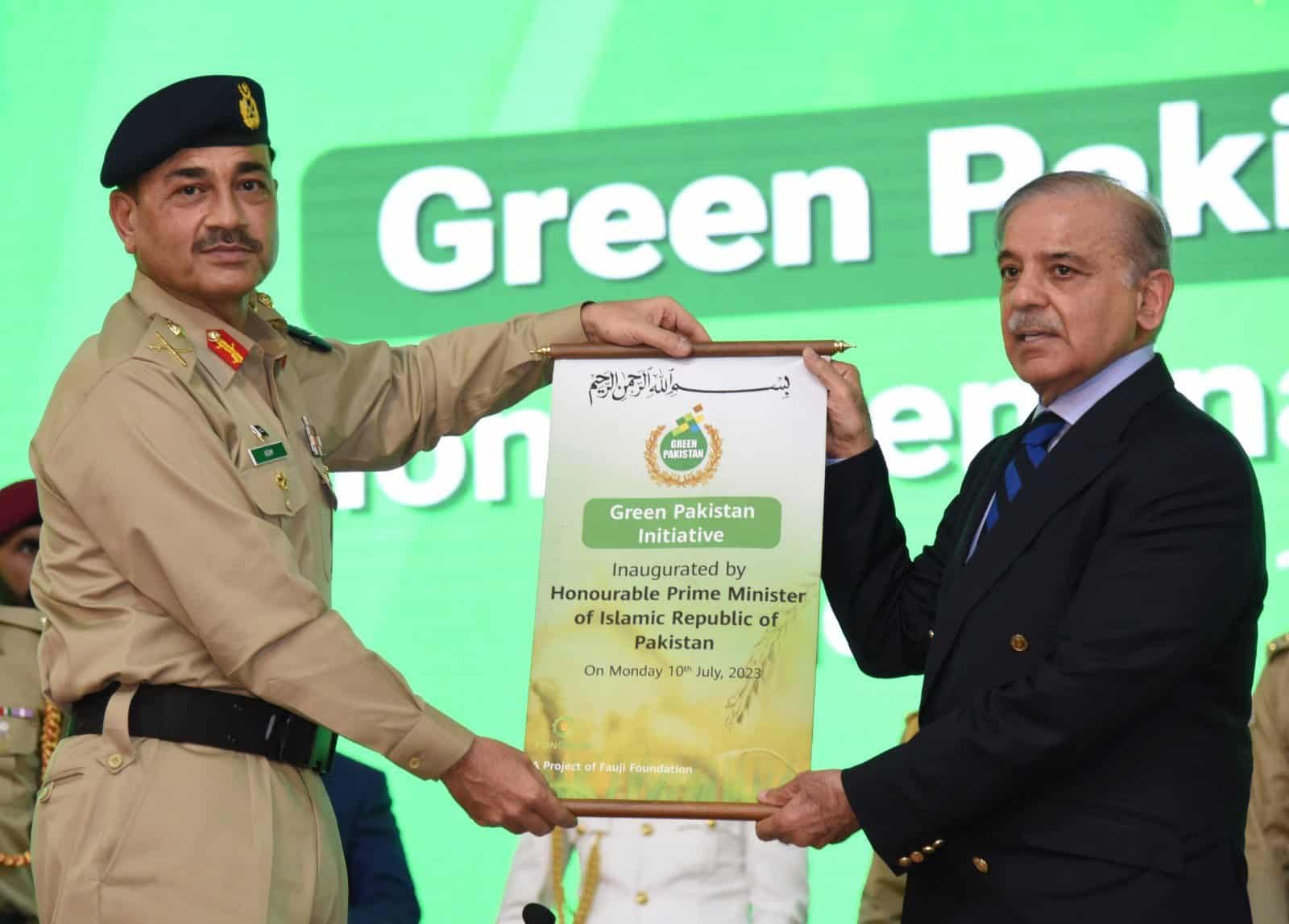
    Through his Green Pakistan Initiative, inaugurated on Monday, July 10, PM Shehbaz says 4 million jobs will be created in the agricultural sector. He also said the Green Pakistan Initiative would likely attract $50 billion in investments in the next five years.

    According to PM Shehbaz, the newly inaugurated initiative is bound to propel Pakistan into its ‘second green revolution’. In fact, the initiative follows similar schemes as those present in Ayub Khan’s regime, such as incentivising farmers by providing them with more profits for their production and providing standard seeds and fertilizers to farmers, along with equipping them with the latest technology.

    It is true that Ayub Khan’s Green Revolution changed the economic fate of the adolescent country. And a revolution of sorts is very much needed: according to PM Shehbaz, state-owned agricultural enterprises are losing PKR 600 billion annually. He noted that Pakistan imports $4.5 billion worth of palm oil, a burden on the national economy.

    At the inauguration ceremony, PM Shehbaz said that gulf countries were ready to invest in the agriculture sector and export modern machinery to Pakistan, in order to boost the production of crops in the country.

    According to The News, PM Shehbaz stated, “It is [a] demand of our national security that the country’s food security and economic security should be strengthened.”

    The inaugural seminar was attended by federal ministers, provincial chief ministers of Punjab and Sindh, chief secretaries of provincial governments, agricultural experts, and farmers from all the provinces.

    Chief of Army Staff General Asim Munir also attended the seminar as the guest of honour. He pledged the Pakistan Army’s full support for all the initiatives that fall under the Special Investment Facili­tation Council, one of which is the Green Pakistan Initiative.

    According to The News, agriculture experts and farmers highly appreciated the landmark initiative, praising the focus on promoting modern technology, the collaboration of public and private sectors, as well as trickling down dividends to local farmers in order to alleviate poverty.

  • US urges Pakistan to implement IMF reforms as economic crisis deepens

    The United States has urged Pakistan to take urgent action to implement the necessary reforms required by the International Monetary Fund (IMF) to address the country’s rising economic crisis. Inflation has been a major issue for Pakistan, and discussions between the two parties have been ongoing since January to find a consensus on multiple conditions before signing a deal that includes external financing from friendly nations.

    Elizabeth Horst, the State Department official in charge of Pakistan, stressed the importance of Pakistan’s compliance with the IMF’s agreed-upon reforms to ensure the country’s financial stability and avoid falling further into debt. She emphasised that although the reforms may not be easy, they are essential for the growth of Pakistan’s economy.

    Horst also expressed the US government’s concern over Pakistan’s economic situation and promised support for the country, particularly in policy, business, and transparency. She pointed out that the trade relationship between the two countries is already worth over nine billion dollars and will continue to increase.

    Highlighting the close cooperation between the US and Pakistan in areas such as trade and investment, climate change, and security, Horst revealed that the Pakistan-US Green Alliance has been initiated to further enhance these relations. She emphasised the importance of Pakistan’s sovereignty and that it is free to make its own choices.

    The State Department official also emphasised that both countries are working together to ensure regional security, counter-terrorism, and counter-narcotics. She expressed concern over the rising number of terrorist incidents in Pakistan and stressed the importance of continuing cooperation between the two countries to prevent Afghanistan from becoming a haven for terrorists.

    Horst concluded by stating that a peaceful and stable Afghanistan is in the interest of both Pakistan and the US. She emphasised the importance of pushing the Taliban to fulfill their promises for peace and stability, as thousands of lives have already been affected by terrorism.

  • IMF board approves disbursement of $1.17 billion in bailout funds

    IMF board approves disbursement of $1.17 billion in bailout funds

    The seventh and eighth reviews of Pakistan’s bailout programme were approved by the International Monetary Fund (IMF) board on Monday, releasing $1.17 billion to the cash-strapped nation.

    Pakistan is now set to get a $1.17 billion loan tranche from the international lender within the next six days.

    “Alhamdolillah, the IMF board has approved the revival of our EFF programme. We should now be getting the seventh and eighth tranche of $1.17 billion,” said Finance Minister Miftah Ismail in a tweet announcing the news.

    Additionally, the Finance Minister praised the Prime Minister, Shehbaz Sharif, “for taking so many tough decisions and saving Pakistan from default.”

    The previous payment was made to Pakistan in February, and the subsequent tranche was scheduled to be released following a review in March.

    However, the PTI government drastically reduced petroleum prices by providing substantial subsidies to the country, which caused the program’s fiscal objectives to be missed.

  • ‘Yeh ab tai hogaya hai Imran Khan Pakistan aur 22 crore logo se zyada eham hain’: Twitter reacts to leaked audio

    ‘Yeh ab tai hogaya hai Imran Khan Pakistan aur 22 crore logo se zyada eham hain’: Twitter reacts to leaked audio

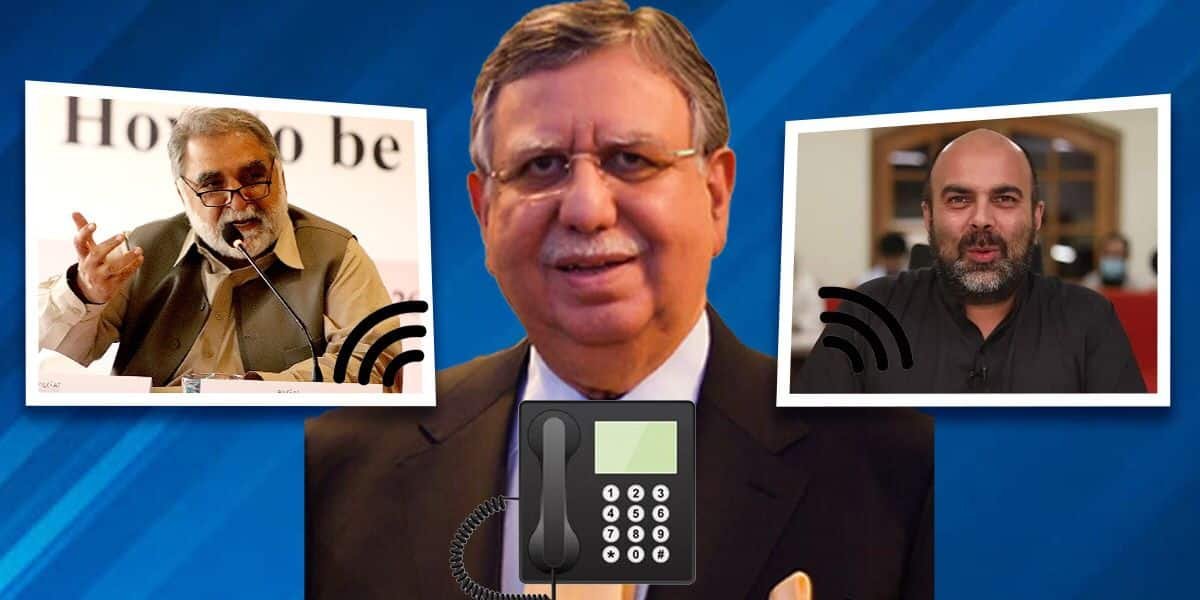
    In a leaked audio, former Finance Minister Shaukat Tarin allegedly asked Punjab Finance Minister Mohsin Leghari and Khyber Pakhtunkhwa Finance Minister Taimur Jhagra to write letters withdrawing from the International Monetary Fund’s (IMF) deal.

    Moments after the leaked audio surfaced on Twitter, both finance ministers and Tarin were under fire for their comments and how their conversations were an attempt by the Pakistan Tehreek-e-Insaf (PTI) to sabotage the IMF deal.

    Here are a few reactions.

    Meanwhile, PTI leader Asad Umar and Taimur Jhagra held a press conference following the audio leak between former federal minister Shaukat Tarin and the finance ministers of Punjab and KP.

    Umar said that Tarin, as a former finance minister, had every right to “give advice” to Jhagra and Leghari.

    “There is nothing wrong in Tarin speaking to Jhagra and Leghari on the phone and giving advice,” said Asad Umar.

  • Leaked audio: PTI’s Shaukat Tarin allegedly advising finance ministers in Punjab, KP to sabotage IMF deal

    Leaked audio: PTI’s Shaukat Tarin allegedly advising finance ministers in Punjab, KP to sabotage IMF deal

    In a leaked audio, former Finance Minister Shaukat Tarin allegedly asked Punjab Finance Minister Mohsin Leghari and Khyber Pakhtunkhwa Finance Minister Taimur Jhagra to write letters withdrawing from the International Monetary Fund’s (IMF) deal.

    You need to say now that we will not be able to honour our commitment’: Shaukat Tarin

    In one leaked audio, Tarin can be heard asking Leghari to tell the IMF that the commitment Punjab made was pre-floods and now the province “cannot honour it” due to massive losses caused by the floods.

    Tarin told Leghari to draft a letter and send it to him for review so it could be sent to the federal government and later on to the IMF representative in Pakistan.

    “You have signed a Rs750 billion [surplus] commitment with the IMF. You now need to tell them that the commitment you made was before the floods, and now [Punjab] has to spend a lot of funds for [the] floods [rehabilitation].”

    “You need to say now that ‘we will not be able to honour our commitment’,” Tarin said.

    The former FM further told Leghari that this is all he [Imran Khan] wants – for pressure to increase on the incumbent government.

    Leghari questioned if this move will affect the state and will Pakistan as a state suffer if the Punjab government does what is being asked to do so?

    “Well, frankly isn’t the state already suffering because of the way they are treating your chairman [Imran Khan] and everybody else? IMF will definitely ask them: where will you get the money from now?” Tarin responded.

    Tarin further said that the party could not bear being mistreated. “We cannot be blackmailed,” Tarin said.

    “This is what was decided yesterday, however, whether we will be releasing this to IMF or not we will ask the chairman,” revealed the former FM.

    ‘By the way, this is a blackmailing tactic’: Taimur Jhagra

    In another leaked audio conversation between Tarin and Jhagra, Tarin asked Jhagra if he had written the letter.

    “I am on the way. I have the previous letter. I will send the letter to you after drafting it,” replied Jhagra.

    Read more: Jhagra responds after Miftah accuses KP govt of jeopardising IMF deal

    “First point [of the letter] would be that we need huge financial aid for restoration of infrastructure and rehabilitation of flood affectees,” Tarin tells the KP finance minister.

    “By the way, this is a blackmailing tactic,” he admitted.

    PTI’s finance minister in KP, Jhagra further said that he knows the number two guy at IMF and he can send the letter to him. He also revealed that he had been in contact with the IMF person and that he had been getting information from him.

    Read more: IMF Executive Board meeting to discuss revival of loan plan today

    It is pertinent to mention here that the IMF executive board will meet today (August 29), to discuss the bailout plan for Pakistan.

    The 8th and 9th tranches, totaling over $1.2 billion, are anticipated to be disbursed with board approval.

  • Pakistan, IMF reach staff-level agreement to resume loan

    Pakistan, IMF reach staff-level agreement to resume loan

    The International Monetary Fund (IMF) extended the total loan size to $7 billion on Thursday and announced a staff-level agreement on the completion of two unfinished programme assessments, but cautioned Pakistan to be prepared to take any extra measures.

    “The IMF team has reached a staff-level agreement (SLA) with the Pakistan authorities for the conclusion of the combined seventh and eighth reviews of the EFF-supported program. The agreement is subject to approval by the IMF’s Executive Board. Subject to Board approval, about $1,177 million (SDR 894 million) will become available, bringing total disbursements under the program to about $4.2 billion,” IMF said in a statement.

    The statement added, “Additionally, in order to support program implementation and meet the higher financing needs in FY23, as well as catalyze additional financing, the IMF Board will consider an extension of the EFF until end-June 2023 and an augmentation of access by SDR 720 million that will bring the total access under the EFF to about $7 billion.”

    IMF team leader Nathan Porter noted in a statement “Pakistan is at a challenging economic juncture. A difficult external environment combined with procyclical domestic policies fueled domestic demand to unsustainable levels.”

    According to him, the ensuing economic overheating reduced reserve buffers, increased inflation, and resulted in significant fiscal and external deficits in FY22.

    The statement continued, “Policy priorities include the consistent implementation of the FY23 budget, which aims to reduce the government’s significant borrowing needs by targeting an underlying primary surplus of 0.4 per cent of GDP, underpinned by current spending restraint and extensive revenue mobilisation efforts targeted particularly at higher-income taxpayees.”

    According to Express Tribune, the international lender claimed that due to poor implementation of the previously agreed upon plan, the circular debt (CD) flow in the power sector is predicted to increase significantly to about Rs850 billion in FY22, exceeding programme targets, endangering the viability of the sector, and resulting in frequent power outages.

    To improve the situation in the electricity sector and reduce load shedding, the authorities are committed to resuming reforms, which crucially include the timely adjustment of the power tariff, including the delayed yearly rebasing and quarterly adjustments.

    According to the IMF, Pakistan’s headline inflation rate hit 20 per cent in June, impacting the most vulnerable people the most. The recent monetary policy boost was reasonable and necessary in this regard, and future monetary policy must be designed to ensure that inflation is slowly brought down to the medium-term goal of 5-7 per cent.

    “Importantly, to enhance monetary policy transmission, the rates of the two major refinancing schemes EFS and LTFF (which have over recent months been raised by 700 bps and 500 bps respectively) will continue to be linked to the policy rate. Greater exchange rate flexibility will help cushion activity and rebuild reserves to more prudent levels,” it added.

    The unconditional cash transfer (UCT) Kafalat scheme reached nearly 8 million households during FY22, with a permanent increase in the stipend to Rs14,000 per family, while a one-time cash transfer of Rs2,000 (Sasta Fuel Sasta Diesel, SFSD) was made to approximately 8.6 million families to lessen the effects of the inflationary crisis.

    The government has increased the BISP budget for FY23 from Rs250 billion to Rs364 billion in order to expand the SFSD programme to more non-BISP, lower-middle class beneficiaries and to accommodate 9 million extra families into the BISP safety net.

    The statement further stated that in order to maintain the effectiveness of the anti-corruption agencies (including the National Accountability Bureau) in investigating and prosecuting corruption cases, the authorities are putting in place a strong electronic asset declaration system.

    According to the SLA for the combined seventh and eighth reviews, consistent execution of the defined policies will support the development of growth that is more equitable and sustainable.

    “The authorities should nonetheless stand ready to take any additional measures necessary to meet program objectives, given the elevated uncertainty in the global economy and financial markets,” the statement concluded.