Tag: import

  • Export industry is one of the highest priorities of govt: Ishaq Dar

    Export industry is one of the highest priorities of govt: Ishaq Dar

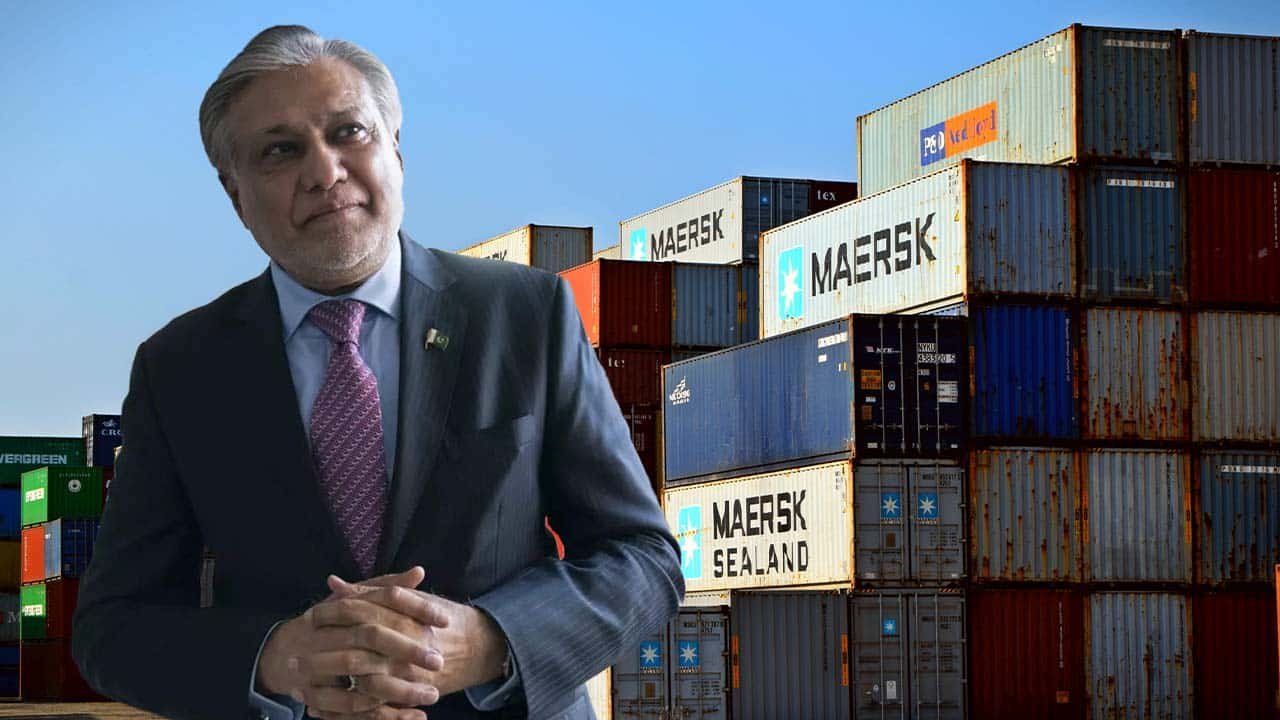
    Federal Minister for Finance and Revenue Ishaq Dar on Monday said that the government will make it easier for all exporters to import the raw materials, components, and accessories they need to meet their demands, including five previously zero-rated export-oriented sectors.

    “Export industry is one of the highest priority of our government,” the minister wrote on Twitter.

    “Five (previously) zero-rated export-oriented sectors and all other exporters will be given complete facilitation for import of raw material, parts, and accessories to meet their export requirements,” Dar added.

    The announcement comes as the country battles a dire foreign exchange crisis and industries, notably exporters, struggle to get their Letters of Credit (LC) issued

    At Karachi port, thousands of containers containing raw materials, food items, and medical supplies are stranded due to a shortage of dollars.

    Banks are refusing to grant fresh letters of credit for importers due to a shortage of needed dollars, which is undermining an economy already under pressure from high inflation and weak GDP.
  • Russian delegation will visit Pakistan tomorrow to discuss long-term oil and gas deal

    Russian delegation will visit Pakistan tomorrow to discuss long-term oil and gas deal

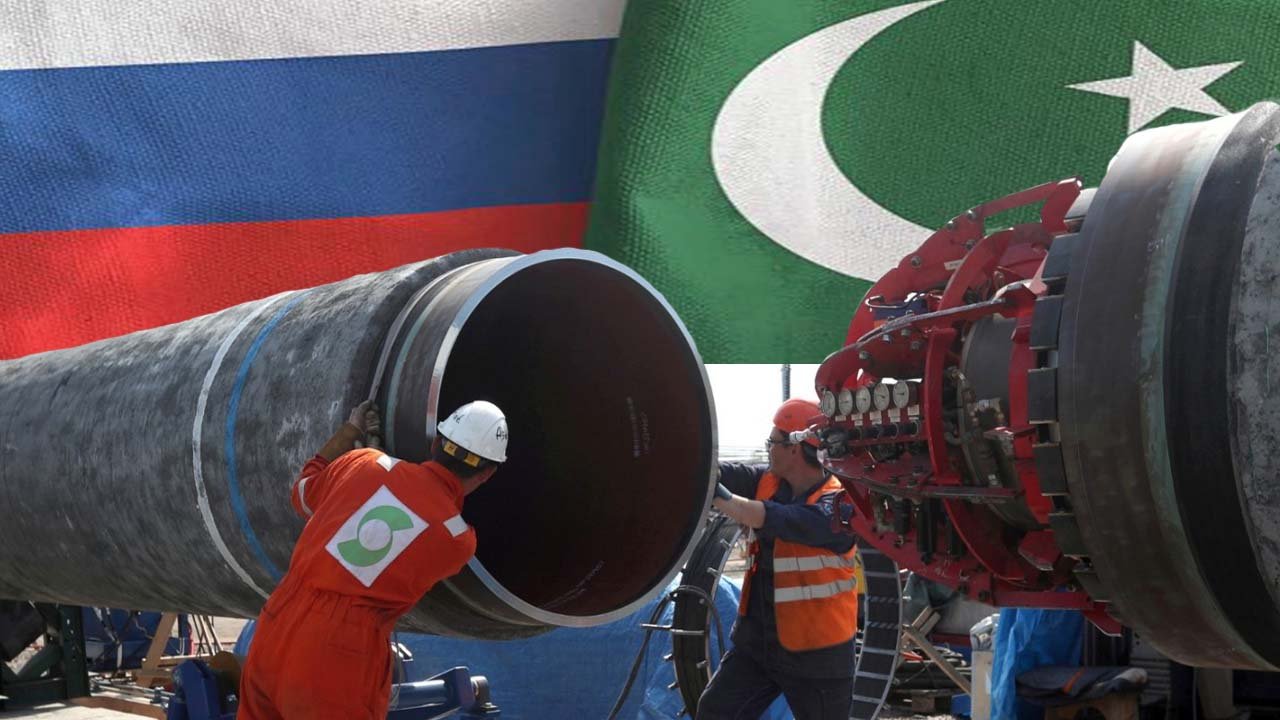
    The much-touted $3 billion Pakistan Stream Gas Pipeline (PSGP) project, as well as a long-term trade agreement for oil and liquefied natural gas (LNG), will be the topics of bilateral negotiations between Pakistan and a Russian delegation that will arrive tomorrow.

    The team, which consists of 80 personnel, will land in Pakistan on Tuesday for three days of bilateral discussions through the Inter-Governmental Commission forum (IGC).

    For the IGC negotiations, the Pakistani delegation will be led by Federal Minister Sardar Ayaz Sadiq. Both states must first negotiate the IGA (inter-governmental agreement), which was finalised and signed in the case of the Pakistan Stream Gas Pipeline Project (PSGP), formerly known as the North-South Gas pipeline project, in order to import Russian oil and LNG on a GtG basis.

    According to The News, the shareholding and facilitation agreement for PSGP was still in draught form on February 24, 2022, when former prime minister Imran Khan travelled to Moscow. Both parties wanted to sign the PSGP agreement during the Imran and Putin meeting, but it was not able to be done since the experts from both sides could not agree on several terms of the shareholding agreement.

    Currently, the G7 nations have capped the price of Russian crude oil at $60 per barrel and forbade the use of Russian ships to carry oil. In exchange, Moscow promised to stop selling oil to nations who agree to a Western price restriction on its petroleum.

    The Pakistani side will talk about the shipment costs, the premium by the shipping trader, the insurance coverage, and the payment options.

    Agribusiness, energy, customs, industry, education, research and technology, information and communication technologies, communication, roads and postal service, railroads, and finance are all included in the IGC’s agenda as areas for cooperation in trade and investments. Additionally, Pakistan’s debt to Russia will be settled and discussed.

    The potential for cooperation in the areas of electric power, hydropower, renewable energy sources, and oil and petrol production will also be discussed by the two sides.

    In their response, the Pakistani team proposed to change the model of the PSGP project. The Russian side said that the model of the project under GtG (government-to-government) arrangement had already been settled, save for some clauses of the shareholding agreement, which would soon be finalized.

  • SBP-held foreign exchange reserves dropped to 9-year low of $4.34 billion

    SBP-held foreign exchange reserves dropped to 9-year low of $4.34 billion

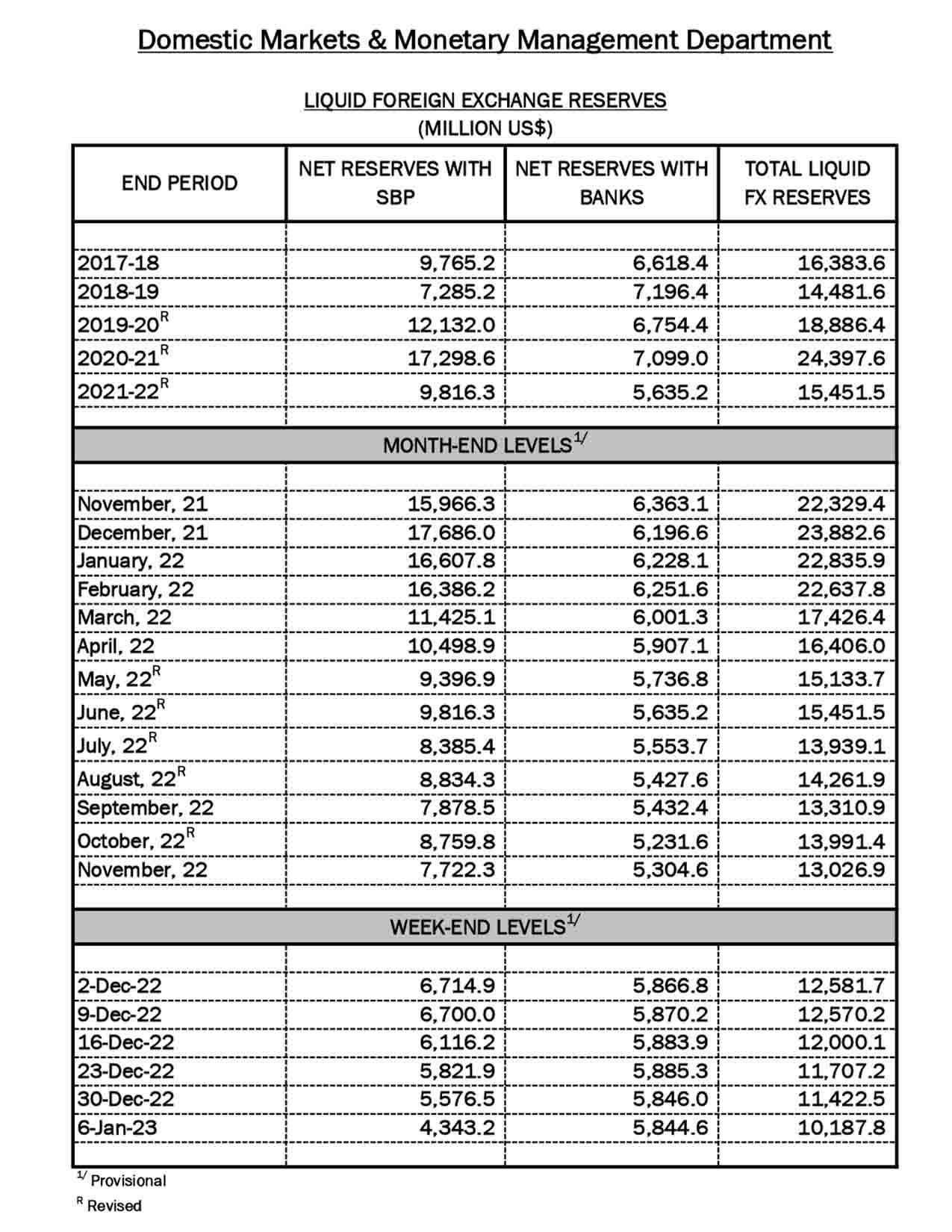
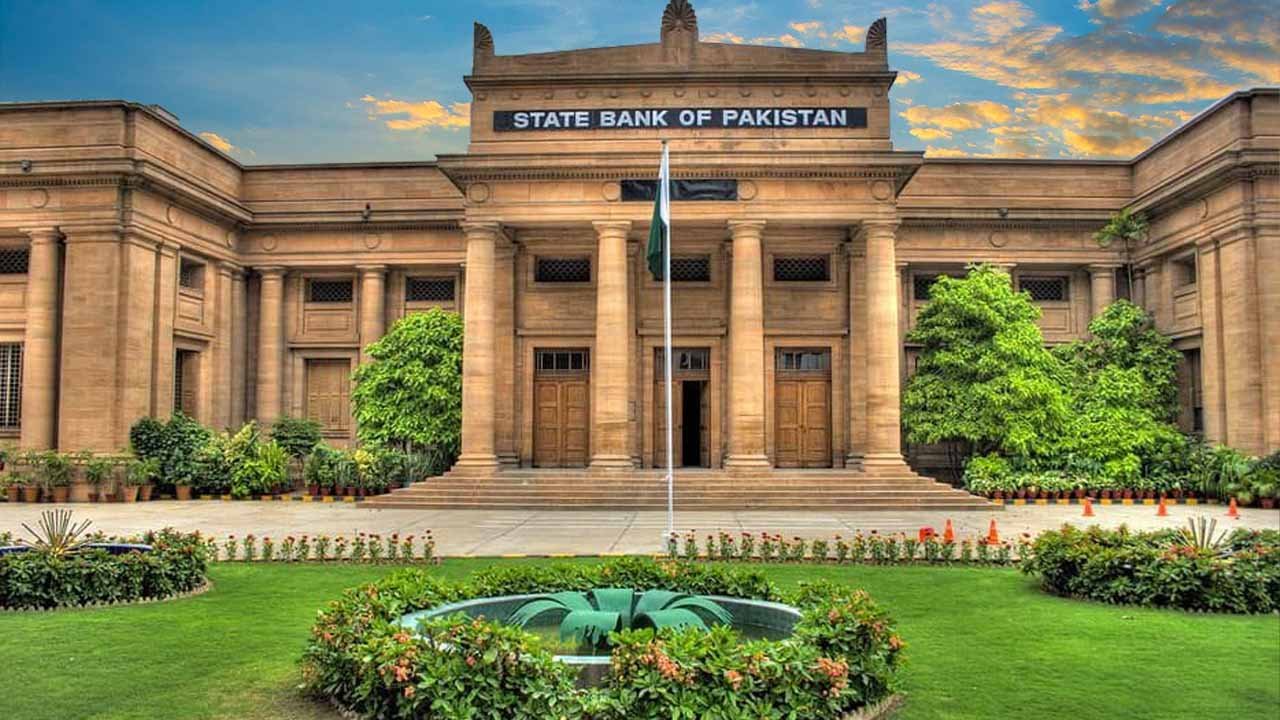
    The State Bank of Pakistan’s (SBP) foreign exchange reserves fell to $4.34 billion, its lowest level since February 2014, due to a lack of dollar inflows from the International Monetary Fund (IMF) or friendly nations.

    The SBP disclosed on Thursday that due to the repayment of external debt, its reserves fell by $1.23 billion during the week ended January 6.

    The country has been experiencing a severe dollar shortage, which is having a negative impact on the capacity to import even food and industrial raw supplies. The country doesn’t have enough dollars, according to the most recent status of foreign exchange reserves, to pay for even one month’s worth of routine imports.

    Data showed that commercial banks held $5.84 billion in net foreign currency reserves, while the overall amount of liquid foreign exchange reserves was $10.18 billion.

    Ever since the beginning of 2022–2023, reserves have been rapidly decreasing. In the upcoming months, analysts predict rising inflation and limited industrial output as manufacturing is constrained by the scarcity of imported raw materials.

    According to Geo, United Arab Emirates (UAE) will roll over the existing loan of $2 billion and give an additional $1 billion loan, which should stabilise the reserve position in the coming days.

    As the government strives to reduce imports amid a dollar shortage, the reserves, which fell to their lowest level since February 2014, would now only provide import coverage of 0.82 month.

  • SBP to lift import restrictions next week

    SBP to lift import restrictions next week

    The government has lifted import restrictions on commodities intended for vehicle manufacturing, mobile production, solar power equipment, and nuclear reactors for power generation projects commencing in 2023, despite Pakistan’s limited foreign exchange reserves.

    Simultaneously, authorised dealers (ADs – largely commercial banks) have been encouraged to prioritise the import of food and energy products. They should consider enabling the import of non-essential and luxury products after first providing for the necessities.

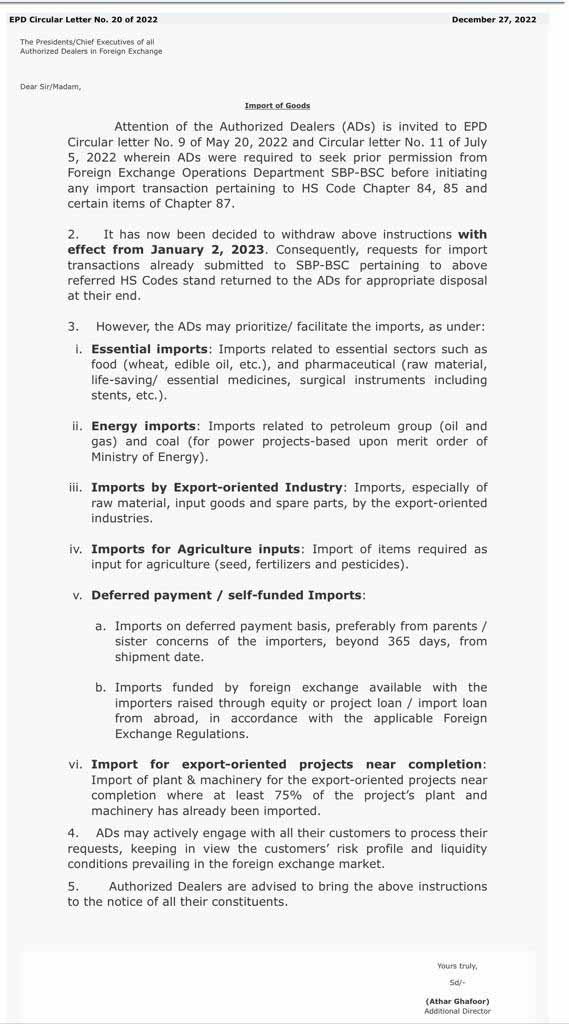
    The State Bank of Pakistan (SBP) reminded ADs on Tuesday that for the past eight months, they had been required to obtain prior permission from the Foreign Exchange Operations Department, SBP-BSC, before initiating any import transaction involving HS Code Chapters 84, 85, and certain items of Chapter 87.

    “It has now been decided to withdraw instructions (of prior permission) with effect from January 2, 2023. Consequently, requests for import transactions already submitted to SBP-BSC pertaining to referred HS codes stand returned to the ADs for appropriate disposal at their end,” the SBP said in the circular.

    Arif Habib Limited (AHL) Head of Research Tahir Abbas said that the import system may “continue to work in its present form. The removal of restrictions will not re-open imports in a full-fledged manner.”

    He stated that due to the country’s short foreign exchange reserves, the government has encouraged banks to first allow the import of necessary items before catering to others.

    The SBP advised ADs (commercial banks) to “prioritise and facilitate the import of essential sectors such as food (wheat and edible oil) and pharmaceuticals (raw material, life-saving or essential medicines, and surgical instruments, including stents).”

    According to Express Tribune, the second priority of ADs is to focus on energy imports “like oil, gas, and coal” (for power projects based on the merit order of the Ministry of Energy).

    Imports for export-oriented businesses should be prioritised as well. They should facilitate “imports, especially of raw materials, input goods, and spare parts, by the export-oriented industries,” stated the SBP. Imports of agri-inputs should be the fourth priority of ADs, as explained by SBP: “import of items required as inputs for agriculture (seed, fertilizers, and pesticides).”

  • Yamaha Pakistan increases bike prices by up to Rs13,500 due to an increase in production costs

    Yamaha Pakistan increases bike prices by up to Rs13,500 due to an increase in production costs

    Yamaha Motor Pakistan on Tuesday announced an increase in the prices of its overall motorcycle lineup owing to an increase in production costs.

    According to a notification made in this respect, the Japanese bike manufacturer raised the price of its five models by up to Rs13,500, with the new rates taking effect on January 4, 2023.

    The price of the YB125 Z model has been increased by Rs12,000 to Rs305,500. The price of the YB125 Z DX model has also been increased to Rs327,000 from Rs314,500, according to Geo.

    Model Old price Retail price excluding tax Sales tax 17 per cent New price Increase
    YB 125Z Rs293,500 Rs261,111 Rs44,389 Rs305,500 Rs12,000
    YB 125Z DX Rs314,500 Rs279.487 Rs47,513 Rs327,000 Rs12,500
    YBR 125 Rs322,500 Rs287,179 Rs48,821 Rs336,000 Rs13,500
    YBR125G Rs336,000 Rs298,718 Rs50,782 Rs349,000 Rs13,500
    YBR 125G
    Matte dark grey
    Rs339,000 Rs301,282 Rs51,218 Rs352,000 Rs13,500
  • Landa Bazar traders threaten to close shops due to increased taxes on imported products

    Landa Bazar traders threaten to close shops due to increased taxes on imported products

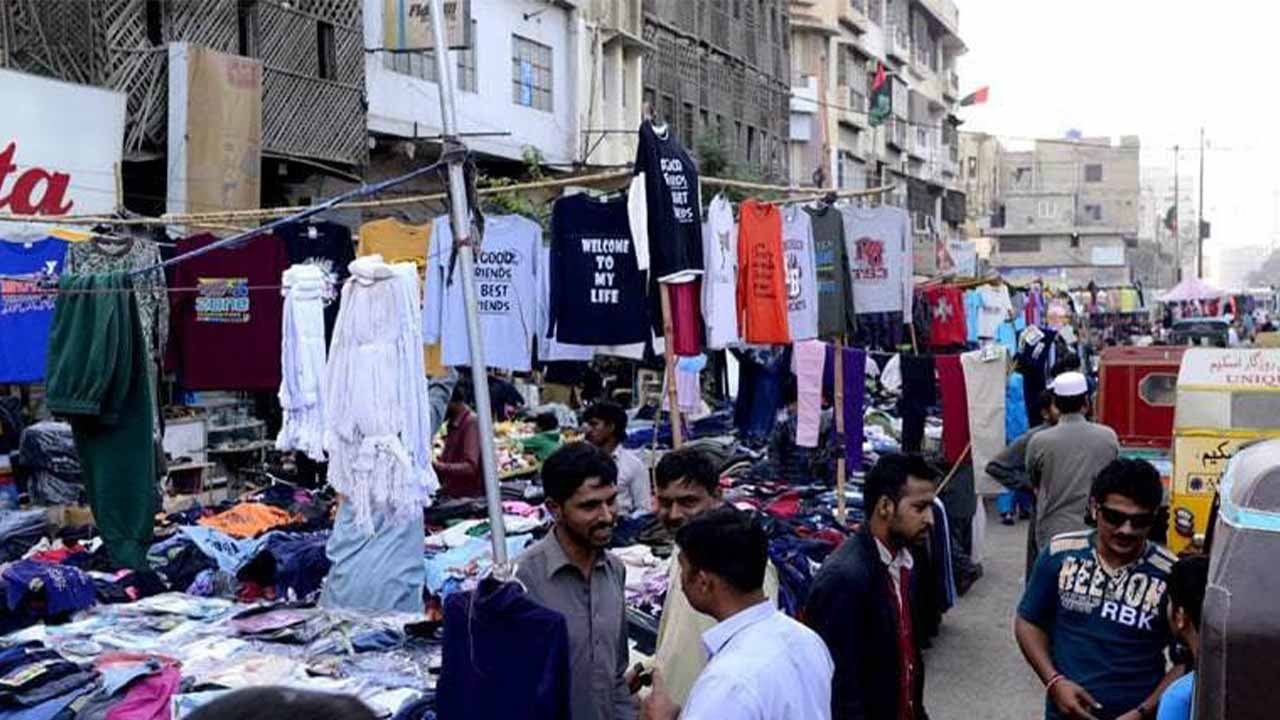
    Shop owners at Landa Bazaar Karachi have threatened to close their shops in protest of the hike in import tariffs.

    Muhammad Usman, secretary general of the Pakistan Second Hand Clothing Merchant Association, urged that the government remove the increased levies placed on imported cotton clothing at a news conference while threatening to close their stores.

    The spokesperson pointed out that the price of imported used clothing had increased due to government action. With the value of the dollar rising steadily, it is getting harder for people to satisfy their necessities. The authorities have raised the valuation on imported goods in such circumstances, he said.

    It was previously reported on December 23 that the government increased the tax on imported items from Rs81 to Rs225 per kg, forcing the dealers to increase the cost of normally inexpensive shirts, blankets, and other warm clothing.

    In the country’s numerous “Landa Bazars,” shoppers shopping for affordable winter clothing will have to contend with inflationary pressure.

    According to the announcement made in this respect, in addition to the sales tax and customs duty of 5 per cent, which are levied on imported used products, there is also a regulatory charge of 10 per cent and an income tax of 5.5 per cent.

    The price of imported used goods, such as warm clothing, sweaters, blankets, jackets, and shoes, as well as children’s toys, would increase as a result of the tax rate increase.

  • Suzuki announces free registration for Wagon R amid sales slump, production issues

    Suzuki announces free registration for Wagon R amid sales slump, production issues

    Suzuki Wagon R buyers can now benefit from a free registration offer on the purchase of an automatic gear shift (AGS) variant thanks to a limited-time offer from Pak Suzuki Motor Company (PSMC).

    According to sources, the automaker is expected to deliver the vehicle 45 to 90 days from the time of booking.

    The company made the announcement on its official Facebook account, stating:

    Don’t wait to avail this amazing offer. Offer is valid across all Suzuki Authorized Dealerships for a limited time only. Terms and conditions applied.

    The Suzuki Wagon R’s base price will drop as a result of this, as stated by the Islamabad Excise and Taxation Department, which states that the registration cost for all vehicles with an engine capacity of under 1000cc is equal to 1 per cent of the car’s original price.

    Meanwhile, Suzuki has not yet made a formal announcement or acknowledged any rumours that the company may be considering retiring the Wagon R owing to weak sales, significant price increases, and production problems.

    Prior to the Suzuki Alto, the 1000cc Wagon R was one of the most popular vehicles on the local auto market.

  • Exports from Pakistan witness 35.7% increase in first four months of FY23

    According to data from the Pakistan Bureau of Statistics (PBS), exports from Pakistan increased by 35.77 per cent in rupee terms during the first four months of the current fiscal year (2022-23) compared to the same time previous year.

    According to Geo, exports from July through October (2022-23) were Rs2,131,776 million, up from Rs1,570,136 in the corresponding period the previous year. This represents a growth of 35.77 per cent.

    In comparison to October 2021, when exports were Rs423,063 million, the country’s exports rose by 24.29 per cent to Rs525,831 million in October 2022.

    When compared to the exports of Rs563,714 million reported in September 2022, the exports climbed by 6.72 per cent in October 2022 on a monthly basis.

    The main commodities of exports during October 2022 were:

    Knitwear (Rs86,400 million), readymade garments (Rs60,778 million), bedwear (Rs47,895 million), cotton cloth (Rs37,407 million), rice other than basmati (Rs20,344 million), towels (Rs17,553 million), made-up articles, excluding towels & Bedwear (Rs12,758 million), fish products (Rs12,057 million), rice Basmati (Rs11,375 million) and cotton yarn (Rs10,819 million).

    On the other side, imports increased by 12.87 per cent from July through October 2022 to a total of Rs4,701,648 million, compared to Rs4,165,590 million during the same time previous year.

    Imports totaled Rs1,039,036 million in October 2022 compared to Rs1,232,299 million in September 2022 and Rs1,093,545 million in October 2021, a drop of 15.68 per cent over September 2021 and 4.98 per cent over October 2021.

    The major imports during October 2022 were:

     Petroleum products (Rs100,436 million), petroleum crude (Rs82,124 million), natural gas, liquified (Rs65,485 million), palm oil (Rs59,739 million), plastic materials (Rs47,301 million), iron & steel (Rs38,517 million), raw cotton (Rs29,943 million), iron & steel scrap (Rs26,037 million), electrical machinery & apparatus (Rs24,058 million) and medicinal products (Rs23,234 million).

  • Pakistan imported tea worth $192.474 million during 4MFY23

    Pakistan imported tea worth $192.474 million during 4MFY23

    In comparison to the same month last year, tea imports increased by 2.21 per cent during the first four months of the current fiscal year, APP has reported.

    Tea imports from July-October (2022-23) were recorded at $192.474 million against imports of $188.304 million from July-October (2021-22), according to data from Pakistan Bureau of Statistics (PBS).

    The data showed that the quantity of tea imports actually declined during the study period by 8.90 per cent, from 84,590 metric tonnes in the preceding year to 77,065 metric tonnes in the same months of the current fiscal year.

    On a year-on-year (YoY) basis, tea imports surged by 54.09 per cent in October 2022 when compared to the imports of the same month of last year. The country imported tea worth $57.272 million in October 2022 as opposed to $37.169 million in exports in August of the previous year.