Tag: income tax

  • FBR collects highest-ever tax of Rs6 trillion in FY22

    FBR collects highest-ever tax of Rs6 trillion in FY22

    The Federal Board of Revenue (FBR) achieved a significant feat by collecting a record Rs6,000 billion in revenue during the previous fiscal year 2021–2022.

    The FBR reported that during the current fiscal year, it collected Rs2,205 billion in income tax, Rs2,773 billion in sales tax, and Rs1,007 billion in customs duty. The organisation in charge of collecting taxes also released Rs305 billion in refunds during that time.

    According to former finance minister Shaukat Tarin, the government of Imran Khan’s policies and the country’s economic growth allowed FBR to meet its revenue goals.

    Tarin insisted that the government should continue enforcing the prior administration’s tax laws. According to Tarin, the government shouldn’t impose additional taxes on the current taxpayers. Heavy taxes shouldn’t be imposed on the economy’s productive sectors, he continued.

    The government has given the general public significant tax breaks on a number of necessities, but the FBR claims that these tax breaks haven’t prevented revenue collection from continuing on an unprecedented and constant growth trajectory. Sales tax on all POL products has been eliminated for the first time in the nation’s history, costing the FBR Rs45 billion per month.

    In order to maximise revenue potential through digitization, transparency, and taxpayer facilitation, the FBR has implemented a number of novel interventions at both the policy and operational levels. In addition to ensuring transparency, facilitating taxpayers, and making business easier, this has led to a steady increase in revenue collection.
  • Govt raises tax rates for salaried class on IMF demands

    Govt raises tax rates for salaried class on IMF demands

    In response to the International Monetary Fund’s (IMF) recommendation to eliminate relief provided on June 10, the coalition government on Friday announced amended tax deduction rules for the salaried class.

    The News reported on Saturday that the Federal Board of Revenue’s (FBR) target for tax collection for the fiscal year 2022–23 has been raised to Rs7,470 billion, an increase of Rs466 billion.

    In order to raise the collection, the government had to take harsh measures, such as boosting the tax rates for high earners to raise Rs120 billion for fighting poverty and Rs35 billion for the salaried class.

    For the upcoming fiscal year 2022–2023, the government imposed a 10 per cent super tax on 13 high-earning sectors, which will cost Rs80 billion in income.

    The government increased the Personal Income Tax (PIT) by Rs80 billion by abolishing tax relief worth Rs47 billion and then increasing the tax amount by Rs35 billion. As a result, the FBR was expected to collect Rs235 billion from the salaried class in the upcoming budget, up from Rs200 billion in the preceding fiscal year.

    The PTI-led government had promised to raise the tax revenue by Rs335 billion by increasing the tax slab rates for the salaried class, but the PDM-led coalition government persuaded the IMF to accept Rs100 billion less than the amount the PTI-led government had promised to raise.

    The government suggested a tax rate of 2.5 per cent for the salaried class for income brackets of Rs50,000 to Rs100,000. The proposed tax rate increased to 12.5 per cent for income earners who make between Rs100,000 and Rs300,000 per month.

    The FBR proposed raising the tax rate from 17.5 per cent to 20 per cent in cases where the taxable income is greater than Rs3,600,000 but not greater than Rs6,000,000. The FBR tax rate is proposed to rise from 22.5 per cent to 25 per cent where the taxable income exceeds Rs6,000,000 but does not exceed Rs12,000,000.

    The FBR will charge a tax amount of Rs2,004,000 plus 32.5 per cent of the amount exceeding Rs12,000,000 on an annual basis where the taxable income exceeds Rs12,000,000. The FBR suggested a 35 per cent tax rate for the aforementioned income.

  • Here are the latest income tax rates and slabs for salaried class

    Here are the latest income tax rates and slabs for salaried class

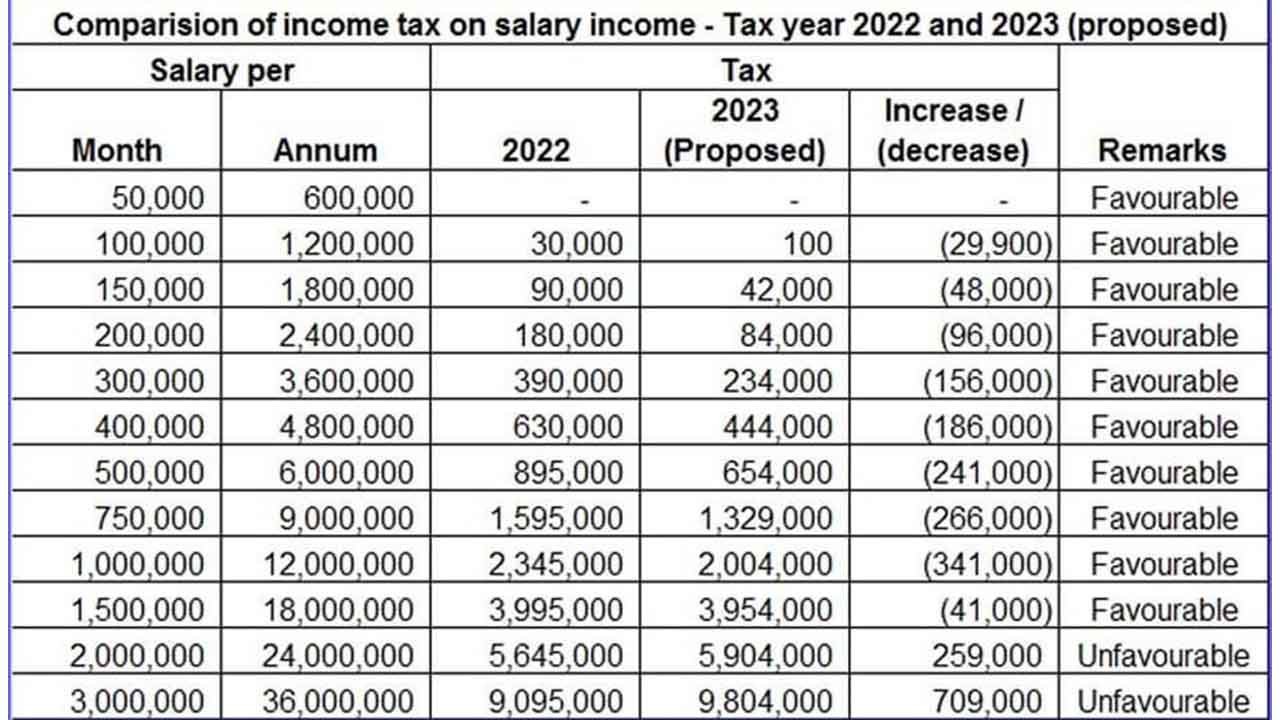
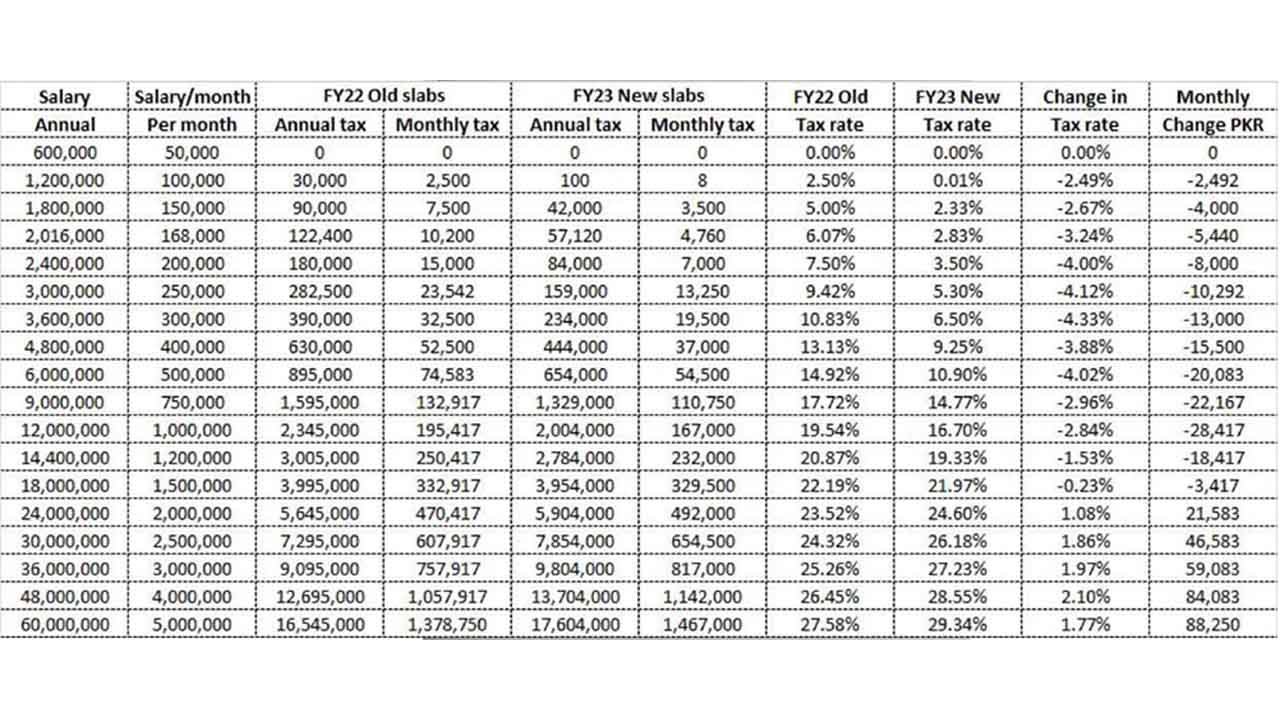
    In the budget for fiscal year 2022-23, the government has exempted those earning up to Rs100,000 per month from paying income tax, up from Rs50,000 last year.

    For the salaried income group, the latest budget is a mishmash as the government reduced tax rates and the number of slabs while eliminating available credit through the omission of deductible allowance for profit on debt and tax credit for investment in shares, health insurance, and pension funds.

    Moreover, the government has released a revamped list of income tax brackets for salaried employees. There were previously 12 slabs, which have now been shrunk to seven.

    Here are the new slabs:

    1. For annual incomes less than Rs600,000 (below Rs50,000 per month)
    2. For a yearly income of Rs600,000-Rs1.2 million (Rs50,000 to Rs100,00 per month).
    3. For annual earnings of Rs1.2m-2.4m (Rs100,000 to Rs200,000 per month)
    4. For annual earnings of Rs2.4m-3.6m (Rs200,000 to Rs300,000 per month)
    5. For earnings of Rs3.6m-6m (Rs300,000 to Rs500,000 per month)
    6. For annual earnings of Rs6m-12m (Rs500,000 to Rs10,00,000 per month)

    For annual earnings of more than $12 million (more than $100,000 per month), income tax is not to be levied on people earning between 0 and Rs600,000 per year (where income from salary exceeds 75 per cent of taxable income). A nominal amount of Rs100 will be subtracted per year from those earning between Rs600,000 and Rs1.2 million.

    Employees getting paid more than Rs1.2 million but less than Rs2.4 million per year will be levied 7 per cent of the amount that exceeds Rs1,200,000 in the third slab.

    An employee getting paid Rs1,400,000 per year will be levied 7 per cent of Rs200,000 (Rs1,400,000 minus Rs1,200,000 since that is the amount exceeding Rs1,200,000).

    As per the latest budget resolution, the government recommended an income tax rate of 20 per cent on small business earnings, 42 per cent on banking, and 29 per cent on related companies.

  • PANAH suggests tobacco taxes be raised even higher

    PANAH suggests tobacco taxes be raised even higher

    Pakistan National Heart Association (PANAH) has proposed that the government increase tariffs on unnecessary and harmful tobacco products. Increased tobacco-related levies will lessen diseases and healthcare expenses while also helping to generate tax revenue.

    Sanaullah Ghumman, PANAH’s General Secretary, announced this at a news conference held by the Pakistan National Heart Association on Wednesday at a local hotel.

    Smoking, according to Sanaullah Ghumman, is not healthy for human health in any aspect, and it is the first step toward addiction. Health experts and civil society groups have also urged the Prime Minister to increase tobacco goods taxes.

    A significant number of health experts and civil society representatives attended the event. Tobacco kills 8 million people worldwide each year, according to a global study, and more than 1.5 million individuals in Pakistan lose their lives each year owing to smoking.

    On World Food Safety Day, PANAH proposed that tariffs on sugary drinks be increased as well, as these beverages are harmful to children and cause a variety of health problems.

    Sanaullah Ghumman spoke at the event, urging a 30 per cent rise in tobacco product taxes to protect minors from tobacco usage.

    “This will be a win-win situation for us,” he continued, “since it will lower the health burden while also dramatically increasing revenue”. PANAH, he claimed, had been educating the public about a variety of dangerous diseases, including heart disease and its causes, for 39 years.

  • Direct taxes target predicted at Rs2,560 billion for FY 22-23

    In an attempt to meet the Federal Board of Revenue’s (FBR) revenue collection target of Rs7,255 billion for the upcoming fiscal year, the direct taxes target has been predicted at Rs2,560 billion, up from Rs2,182 billion in 2021-22.

    According to Brecorder, the indirect taxes (net) estimates were predicted at Rs4,695 billion in the macroeconomic framework for 2022-23. Direct taxes forecasts included income tax and withholding taxes, whereas indirect taxes projections included sales tax, customs duty, and Federal Excise Duty (FED).

    The indirect tax goal for 2022-23 has been set at Rs4,695 billion, up from Rs3,647 billion in 2021-22, representing a Rs1,048 billion rise. The indirect tax revenue for the fiscal year 2021-22 was Rs3,440 billion.

    The entire collection of indirect taxes in 2020-21 was Rs3,008.2 billion. Direct taxes are expected to reach Rs2,560 billion in the next fiscal year, up from Rs2,182 billion in 2021-22, a Rs378 billion increase.

    Read more: PM Shehbaz directs to eliminate taxes on raw materials used by export industries

    During the first 11 months of the current fiscal, the FBR collected roughly Rs1.9 trillion in direct taxes. In the fiscal year 2020-21, direct tax collections totalled Rs1,726.0 billion. Withholding taxes account for 72 per cent of the total direct tax collection.

  • Pakistan records 13.8 per cent inflation in May

    Pakistan records 13.8 per cent inflation in May

    The latest data provided by the Pakistan Bureau of Statistics (PBS) on June 1, inflation continued to rise in May 2022, with the Consumer Price Index (CPI)-based reading coming in at 13.8 per cent year on year, up from 13.4 per cent the previous month and 10.9 per cent in May 2021.

    In May 2022, inflation climbed by 0.44 per cent month over month, compared to 1.6 per cent the previous month and 0.1 per cent in May 2021. This brings average inflation in 11MFY22 to 11.29 per cent year over year, up from 8.83 per cent in 11MFY21.

    Rising prices have emerged as a major source of concern for the economy of the South Asian country, which is grappling with dwindling foreign exchange reserves and a growing import bill.

    The State Bank of Pakistan (SBP) hiked the main interest rate by 150 basis points to 13.75 per cent last month in an attempt to combat economic headwinds.

    The existing administration, on the other hand, has indicated that it will partially remove subsidies by raising petroleum product tariffs by Rs30 per liter, a move that is projected to raise inflation.

    As per a report from Brecorder, on a month-on-month basis, Inflation in Urban areas increased by 0.3 per cent in May 2022 as compared to an increase of 1.6per cent in the previous month and increase of 0.2per cent in May 2021.

    In the meantime, CPI inflation in urban areas grew 12.4 per cent year over year in May 2022, compared to 12.2 per cent the previous month and 10.8 per cent in May 2021.

    It climbed by 0.3 per cent month over month in May 2022, compared to a 1.6 per cent increase the previous month and a 0.2 per cent increase in May 2021.

    In rural areas, CPI inflation climbed by 15.9per cent year over year in May 2022, compared to 15.1 per cent the previous month and 10.9 per cent in May 2021. It climbed by 0.6 per cent month over month in May 2022, compared to an increase of 1.6 per cent the previous month and a fall of -0.03 per cent in May 2021.

    In May 2022, the SPI inflation grew by 14.1 per cent year over year, compared to 14.2 per cent a month earlier and 19.7 per cent in May 2021. On a month-over-month basis, it climbed by 0.6 per cent in May 2022, compared to 1.5 per cent a month earlier and 0.8 per cent in May 2021.

  • Govt considers imposing special levy in the upcoming budget

    Govt considers imposing special levy in the upcoming budget

    The government is considering imposing a specific levy or increasing the tax burden on paid and non-salaried classes earning more than Rs20 million per year in the upcoming budget 2022–23.

    Prime Minister Shehbaz Sharif presided over a high-level meeting to discuss the next budget’s essential components. The premier will have to decide whether to increase tax revenue and thus increase subsidies or cut the tax revenue objective.

    The administration is considering increasing the tax burden on the rich and affluent instead of increasing the percentage of indirect taxes. Top government officials admitted, “Yes, we are considering hiking taxes on the rich.” One of the proposals is to impose a tax modelled after the super tax, which was originally imposed at a rate of 5% on income earners earning Rs50 million per year but was gradually reduced and then repealed.

    For the approaching budget 2022-23, PM Shehbaz will have to choose either increasing subsidies and increasing the FBR’s tax collection target or reducing subsidies and lowering the FBR’s tax collection target.

    The government will have to choose between these two options in order to comply with the IMF’s proposed fiscal framework.

    After talks with the international lender ended inconclusively the day before, Pakistan’s government increased local fuel prices on Friday to meet a major condition imposed by the International Monetary Fund for resuming its bailout programme.

    Miftah Ismail, Pakistan’s finance minister, said on Tuesday that if offered, Pakistan would buy oil and food at reduced costs from Russia, if Moscow did not impose sanctions on Islamabad. He added, though, that Russia had not made such an offer so far.

    Mr Ismail told CNN’s Becky Anderson that Moscow had not responded to the previous government’s letter requesting cheaper oil from Russia.

    The finance minister also stated that if the economy had let it, the current government would have called early elections, but that in the current situation, the government’s first priority is to stabilise the country’s finances.

  • Additional tax to be levied on high-earning businesses

    Additional tax to be levied on high-earning businesses

    In the budget (2022-23), the government intends to impose a time-limited levy or additional income tax on the yearly income earned by the steel industry, pharmaceutical business, and other profit-generating segments, as well as increase the minimum tax from two to six percent on the import of edible oil

    According to reliable sources, the government has made the decision to increase the rate of least tax on the import of edible oil from two to six percent in the next fiscal budget to boost the occurrence of levy on this large profit-earning sector. The steel sector’s minimum tax rate will be raised in the new budget.

    It is worth noting that the fresh charge will only be levied on industries and sectors that make massive profits, and it would only be in place for a limited time.

    According to Brecorder, the steel sector’s profits have increased by 20-30 per cent, but they are not paying the requisite tax bills. As a consequence, an extra income tax or levy on the yearly earned income by the steel industry, pharmaceutical sector, and other sectors earning windfall profits has been proposed for 1-2 years.

    Added income taxor levy will be paid in conjunction with the filing of tax records. The levy would be time-limited and could be imposed for one or two years.

    The Federal Board of Revenue (FBR) levies a two per cent least tax on edible oil imports, which is decided to ascend to six per cent beginning with the next fiscal year. Earnings in the edible oil industry are very high, with massive profits, but tax payments are consistent or on the low side.

    The Federal Board of Revenue (FBR) is updating a list of high-profit industries based on tax financial records, annual financial statements, and third-party data.

    A new section in the Income Tax Ordinance 2001 would be introduced through the new Finance Bill 2022 for the imposition of the said levy on high profit earning sectors.

  • FBR records 29.1% growth during July 2021 to March 2022, despite providing ‘massive tax relief’

    The provisional revenue collection data for the months of July 2021 to March 2022 of the current financial year 2021-22 have been announced by the Federal Board of Revenue (FBR).

    The net collection was Rs575 billion for the month of March 2022, up 20.5 per cent from Rs477 billion in March 2021.

    Conversely, the gross revenues, rose by 28.9 per cent in the current financial year, from Rs3,577 billion in July 2020 to March 2021 to Rs4,611 billion in July 2021 to March 2022. Furthermore, the amount of reimbursements granted in March 2022 was Rs31.9 billion, compared to Rs26.3 billion in March 2021, showing a 21.3 per cent upsurge.

    Then again, refunds of Rs229 billion were paid from July 2021 to March 2022, a 25 per cent increase over the Rs183 billion paid the previous year.

    Read more: Petrol, Diesel prices to remain unchanged till April 15

    It is worth noting that the continuous remarkable growth in revenue collection has been achieved despite the government providing ‘massive tax relief’ to the general public on a variety of vital commodities.

    For the first time in Pakistan’s history, the sales tax on all petroleum products was abolished, costing the FBR Rs45 billion in the past month.

  • Zardari corruption case: NAB references busted, not in accordance with law

    The Islamabad High Court (IHC) on Tuesday declared the National Accountability Bureau (NAB) reference against former president Asif Ali Zardari ‘ultra vires and not according to the law’, reports The News.

    IHC Chief Justice (CJ) Athar Minallah condemned NAB authorities and said that all its references got busted for not being prepared as per law. He said that the Bureau was just wasting its time by making pointless references, adding that NAB was not above the law.

    “How the bureau could declare null and void the Income Tax Order by itself,” the CJ observed, adding that NAB did not have any jurisdiction to nullify the Federal Board of Revenue (FBR) Assessment Order.

    Earlier, IHC had noticed that NAB challenged the acquittal request of Zardari, without obtaining the original record of the case.

    The court noted that it took NAB seven years to realise that the appeals were filed without possessing the original record.

    CJ Minallah said NAB should now admit it had made a mistake by filing these references since it did not have proof against the former president.

    “And if indeed, there were no proofs, then the court will also take action against the former bureau chairman in whose tenure these cases had been filed,” said the IHC CJ.