Tag: India

  • Couple marries in PPE kit after bride tests positive for COVID-19

    Couple marries in PPE kit after bride tests positive for COVID-19

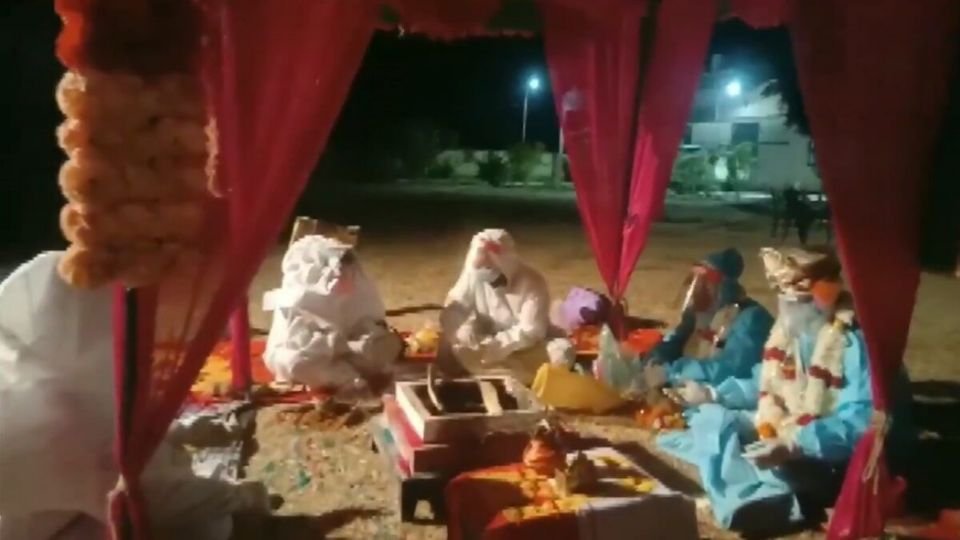
    A couple from Rajasthan, India got married in personal protective equipment (PPE) after the bride tested positive for COVID-19.

    Indian media reported that a couple exchanged their wedding clothes for PPE kit and venue for a coronavirus treatment centre over a wedding hall.

    Wearing garlands around their neck, the bride and groom got married in the presence of a priest and three others. All the guests present at the ceremony also wore PPE. The ceremony soon went viral on social media.

  • Diljit Dosanjh gave Kangana Ranaut a piece of mind and we’re here for it

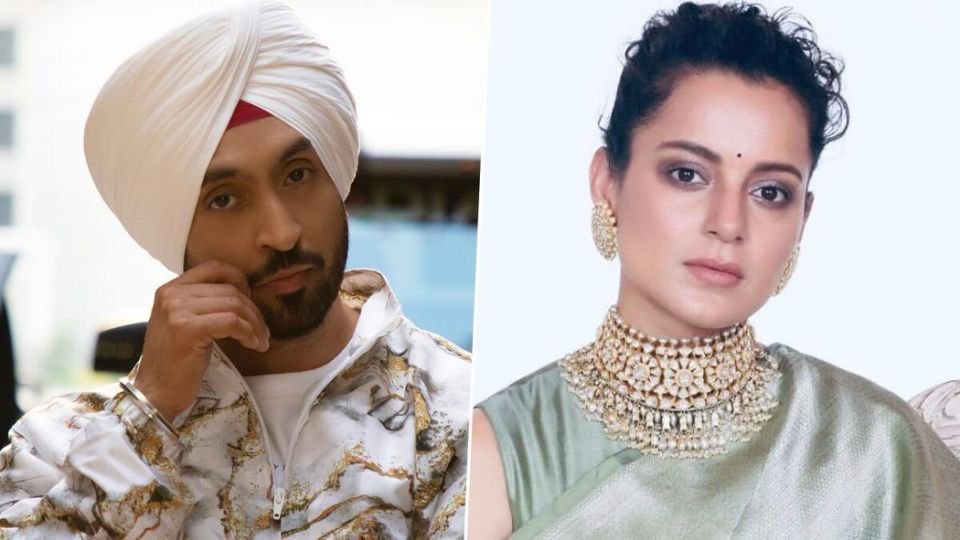
    Diljit Dosanjh gave Kangana Ranaut a piece of mind and we’re here for it

    An epic Twitter feud between Kangana Ranaut and Diljit Dosanjh over the ongoing farmer’s protests in India is making headlines across the subcontinent. In case, you have no idea what happened, keep reading.

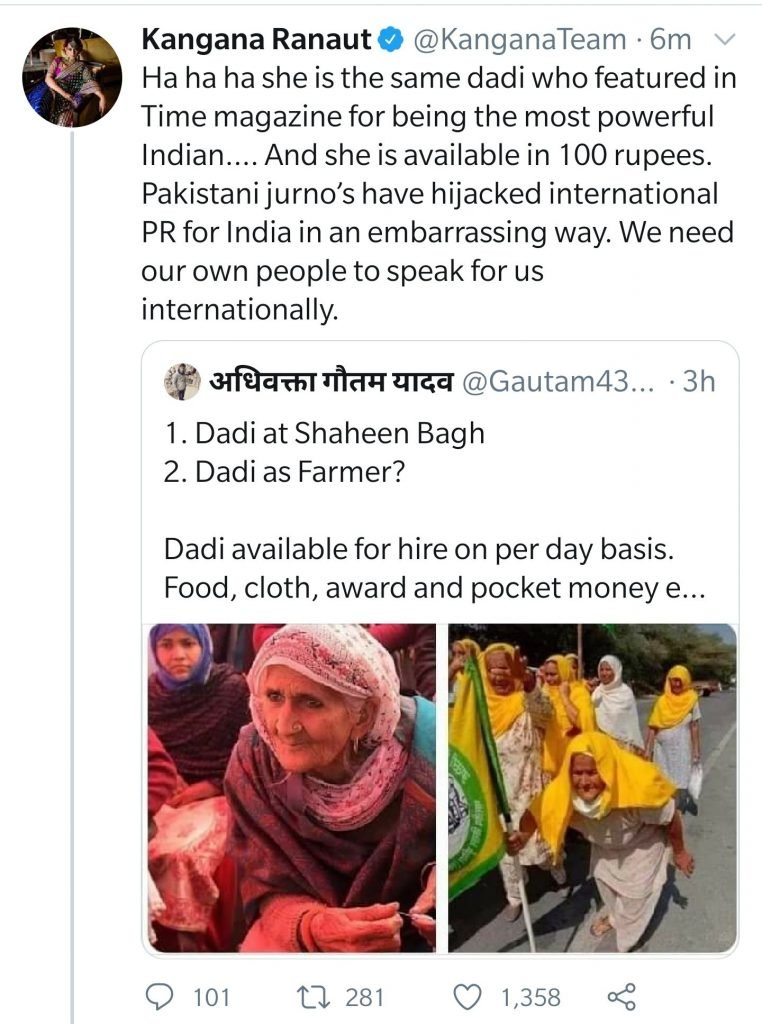
    The fight started when Dosanjh hit out at Ranaut for misidentifying an elderly Sikh woman from the farmers’ protest as Bilquis Bano – the octogenarian who made international headlines during the anti-CAA protests earlier this year in the Delhi neighbourhood of Shaheen Bagh – and said the woman joined the protest for Rs 100 only. Ranaut later deleted the tweet after she was called out for spreading misinformation.

    Sharing a video of the woman speaking on the issue, Dosanjh advised Kangana to listen to the video.

    “One should not be this blind,” he added.

    What followed was an ugly war of words with Dosanjh counter-attacking in Punjabi. Kangana did not hold herself back while attacking Diljit, referring to him as “Karan Johar ke paltu“.

    In response to this, Dosanjh told Kangana that she is well-versed with the art of playing with people’s emotions. No surprises there. The actor has on several occasions also propagated hate against Pakistan.

    Kangana continued to drag KJo into the conversation without any reason. Her hatred for the filmmaker is hardly a secret.

    Diljit further pointed out to Kangana that he is a Punjabi and not a “Bollywood wala” and that Bollywood invites him to do films.

    Kangana then hit back by accusing the Punjabi singer of provoking farmers against the country.

    When one Twitter user called out the actor for insinuating that Johar offers work in exchange for sex, Kangana attacked him also.

    However, Diljit did not stop and continued to school Kangana over her irresponsible statements.

    Other Punjabi artists including Mika Singh and Gippy Grewal stepped in to support Diljit and voice their distaste over Kangana’s comments.

    Case registered against Kangana

    Meanwhile, the Sikh Gurdwara Management Committee (DSGMC) has sent a legal notice to actor Kangana Ranaut, seeking an unconditional apology for her “derogatory” tweets against farmers and activists involved in the protest against the Centre’s farm laws. They have also requested Ranaut to remove the particular tweets.

    “We have sent a legal notice to Kangana for her derogatory tweet calling the aged mother of a farmer as a woman available for Rs 100. Her tweets portray farmers protest as anti-national. We demand an unconditional apology from her for her insensitive remarks on farmers protest,” said president of DSGMC Manjinder Singh Sirsa, in a tweet.

    Farmer’s Protest

    Thousands of farmers have gathered at Delhi’s gateways to demand a repeal of the Centre’s three new farm laws. The protesting farmers, mainly from Punjab and Haryana as well as Uttar Pradesh, are worried the new laws will eliminate the safety cushion of a Minimum Support Price and procurement system, while rendering ineffective the mandi system that ensures earnings for various stakeholders in the farm sector.

    The government has been in talks with farmer leaders to resolve the issue.

  • Superstar Rajinikanth launches his own political party

    Putting an end to all speculations, Tamil actor Rajinikanth on Thursday announced that he would launch his political party in January 2021, months ahead of the Assembly polls in Tamil Nadu. He said an official declaration regarding the same will be made on December 31.

    In a brief statement released on Twitter, Rajinikanth said that his party would fight the Assembly election in 2021 and “emerge victorious”.

    “A non-corrupt, honest, transparent and secular party with a spiritual politics” would “definitely win the next elections,” read the superstar’s tweet.

    However, the actor did not clarify whether he would contest the 2021 state elections. In March 2020, Rajinikanth had said that he would not be a Chief Minister candidate or contest the polls. But sources close to the actor said he would actively take part in election campaigns and rallies while staying secure in a strict bio-bubble.

    Shortly after his tweet, Rajinikanth addressed a press conference in which he explained his reasons for joining the politics. He said that his aim was to bring a change in Tamil Nadu.

    “I am just an instrument. Only people can bring about change. If I win, it is the people’s victory. If I am defeated, it will be their defeat. We need to change everything. If not now, then never,” he said.

    Rajinikanth had announced his entry into politics in 2017 at a time when Tamil Nadu faced a vacuum after the demise of AIADMK chief Jayalalithaa and ailing of DMK chief M Karunanidhi.

    Read more – Guess which Bollywood superstar just followed Mahira Khan on Instagram

    Soon after the announcement, fans of Rajnikanth burst crackers and distributed sweets in Tiruchirappalli.

    Tamil Nadu Deputy Chief Minister O Panneerselvam (OPS) welcomed Rajnikanth’s entry into politics and hinted towards a possible coalition as well.

    “We welcome great actor Rajinikanth’s decision to enter politics. In politics, anything can happen. If there is any chance, an alliance can be formed with his party,” Panneerselvam told the media.

    Tamil Nadu is set to go to Assembly elections in 2021.

  • Egg on face of Modi’s India with highest bribery rate in Asia

    Egg on face of Modi’s India with highest bribery rate in Asia

    India has the highest bribery rate in Asia and the most number of people who use personal connections to access public services, according to a new report by Transparency International (TI).

    According to Global Corruption Barometer (GCB) Asia, nearly 50 per cent of those who paid bribes were asked to do so, while 32 per cent of those who used personal connections said they would not receive the service otherwise.

    The report is based upon the survey which was conducted between June 17 and July 17 this year in India with a sample size of 2,000.

    “With the highest bribery rate [39 per cent] in the region, India also has the highest rate of people using personal connections to access public services [46 per cent],” the report said.

    Bribery in public services continues to plague India. Slow and complicated bureaucratic process, unnecessary red tape and unclear regulatory frameworks force citizens to seek out alternate solutions to access basic services through networks of familiarity and petty corruption, the report said.

    “Both national and state governments need to streamline administrative processes for public services, implement preventative measures to combat bribery and nepotism, and invest in user-friendly online platforms to deliver essential public services quickly and effectively,” the report said.

    Although reporting cases of corruption was critical to curbing the spread, a majority of citizens in India, 63 per cent, think that if they reported corruption, they would suffer retaliation, it said.

    In several countries, including India, Malaysia, Thailand, Sri Lanka and Indonesia, sexual extortion rates are also high and more must be done to prevent sextortion and address specific-gendered forms of corruption, the report said.

    Sextortion is extorting money or sexual favours from someone by threatening to reveal evidence of their sexual activity through means like morphed images.

    In India, 89 per cent think government corruption is a big problem, 18 per cent offered bribes in exchange for votes and 11 per cent experienced sextortion or know someone who has.

    “About 63 per cent of surveyed people think the government is doing well in tackling corruption while 73 per cent said their anti-corruption agency is doing well in the fight against corruption,” it said.

    Based on fieldwork conducted in 17 countries, the GCB surveyed nearly 20,000 citizens in total.

    The report said the results showed that nearly three out of four people think corruption is a big problem in their country and the survey also found that nearly one in five people who accessed public services, such as health care and education, paid a bribe in the preceding year.

    This equates to approximately 836 million citizens in the 17 countries surveyed, it said.

    After India, Cambodia has the second-highest bribery rate at 37 per cent, followed by Indonesia (30 per cent) while the Maldives and Japan maintain the lowest overall bribery rate (2 per cent), followed by South Korea (10 per cent) and Nepal (12 per cent).

    “However, even in these countries, governments could do more to stop bribes for public services,” the report said.

    The report concluded by noting that daily experience with corruption and bribery remains alarmingly high, with nearly one in five citizens paying a bribe to access key government services, such as health care or education, and one in seven being offered a bribe to vote one way or another at elections.

    “In several countries, including India, Malaysia, Thailand, Sri Lanka and Indonesia, sexual extortion rates are also high and more must be done to prevent sextortion and address specific-gendered forms of corruption,” it said.

    The report further said that to provide victims of corruption with channels for redress, governments must ensure that bribery was criminalised and actively investigated and prosecuted.

    “Citizens must have access to safe and confidential reporting mechanisms and governments must do more to ease citizens’ fear of retaliation in reporting corruption. Despite these challenges, citizens are largely optimistic about the future and believe that ordinary people can make a difference in the fight against corruption,” the report said.
  • Man watches ‘Bigg Boss’ as doctors perform brain surgery on him

    Man watches ‘Bigg Boss’ as doctors perform brain surgery on him

    An Indian man from Andhra Pradesh reportedly watched reality TV show Big Boss to stay awake during a brain surgery. Doctors at a private hospital in the state’s Guntur district conducted the rare and critical open-brain surgery, in which the patient had to be kept awake.

    According to reports, as the doctors performed the surgery on the 33-year-old patient named Vara Prasad, he watched Bigg Boss and the 2009 Hollywood sci-fi movie Avatar.

    While three surgeons removed a recurrent glioma (a type of tumor), the man enjoyed the show followed by the Hollywood sci-fi movie Avatar on a laptop.

    While further details of the surgery are not specified, pictures of the operation were shared on social media channels, with many users wondering how this was possible.

    However, in a similar incident, in January, Dagmar Turner, a professional violinist played her violin while undergoing a critical brain procedure.

  • Netflix in trouble for kissing scenes in temple in ‘A Suitable Boy’

    Netflix in trouble for kissing scenes in temple in ‘A Suitable Boy’

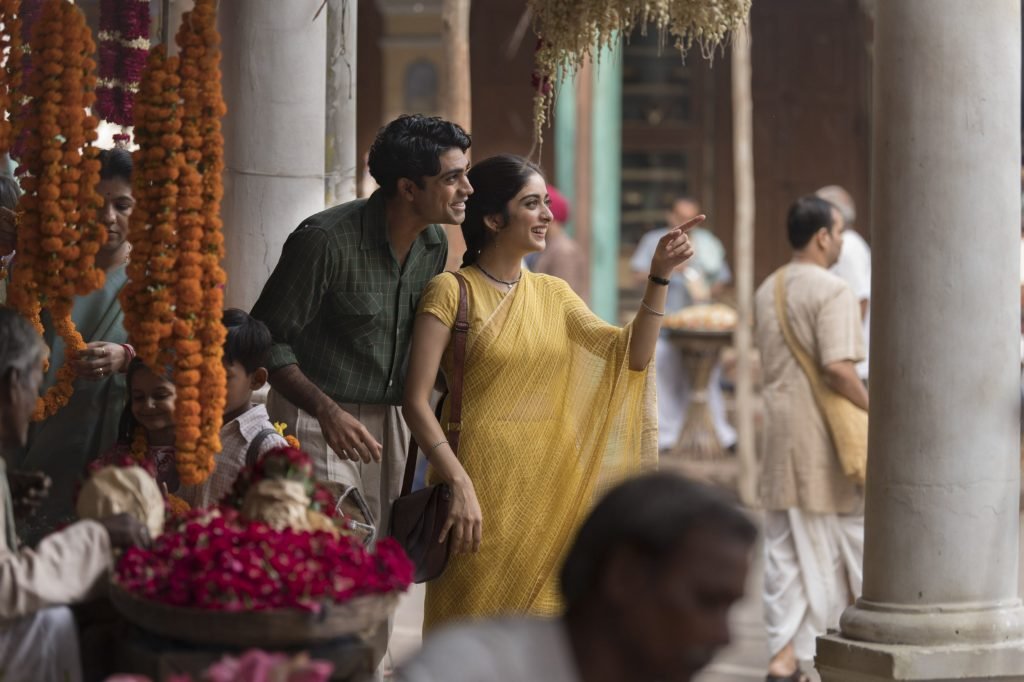
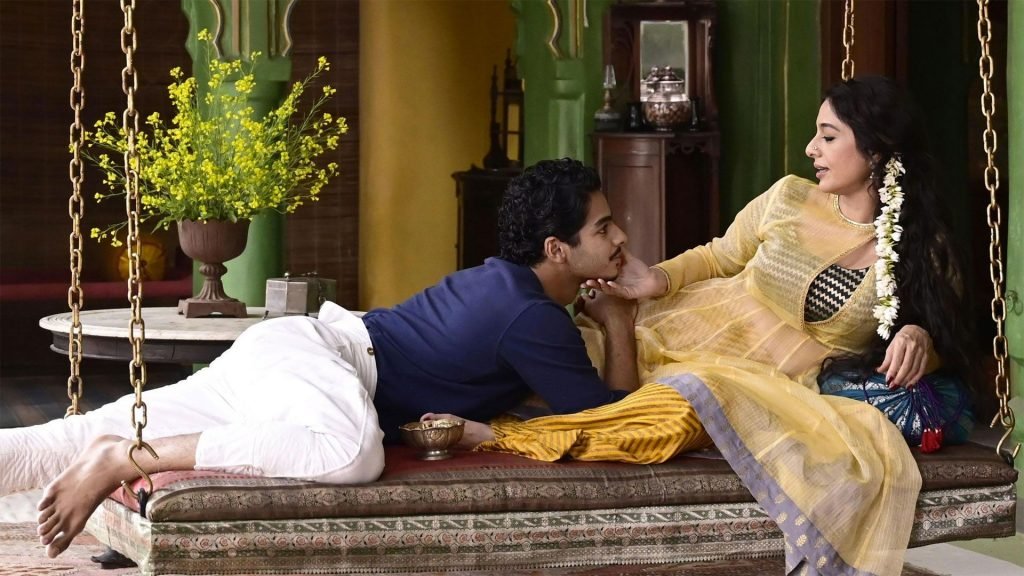
    An Indian state on Sunday asked police to investigate Netflix series A Suitable Boy after a member of the country’s ruling party objected to scenes in the series, in which a Hindu girl kisses a Muslim boy against the backdrop of a Hindu temple.

    The series, based on an English novel by one of India’s leading writers Vikram Seth, follows a young girl’s quest for a husband in the backdrop of newly independent India (1951). It is directed by celebrated Indian filmmaker Mira Nair.

    “It has extremely objectionable scenes that have hurt the feelings of a particular religion,” Narottam Mishra, the interior minister of the central state of Madhya Pradesh, said on Twitter.

    “I’ve directed police officers to get this controversial content tested” to determine “what legal action can be taken against the producer-director of the film for hurting religious sentiments”.

    He later said: “For objectionable scenes in the web series A Suitable Boy, an FIR has been lodged against Monika Shergill (Vice President Content, Netflix India) and Ambika Khurana (Director, Public Policy at Netflix) associated with the management under Section 295 A (willfully hurting religious sentiments) in the Civil Lines Police Station of Reeva.”

    Gaurav Tiwari, a leader of the youth wing of India’s ruling Hindu nationalist Bharatiya Janata Party (BJP), which also governs Madhya Pradesh, has filed a separate complaint against Netflix and warned of street protests by Hindus if the series is not taken off the platform. He also accused the show and streaming platform of promoting ‘love jihad’ – a term radical Hindu groups use to accuse Muslim men of converting Hindu women by marriage.

    A Netflix India spokesman declined comment on the police complaint.

    It is pertinent to mention here that the six-part series was officially commissioned by BBC Studios and produced on a budget of £16 million making it one of the most expensive BBC series ever made. Netflix is the exclusive distributor of the series for all global territories, except continental North America and China. It released on the streaming platform on October 23, 2020.

    Social media commentators say the scope for creative freedom is narrowing in India, especially when it involves any depiction of Hindu-Muslim relations.

    Many Indians took to Twitter demanding a boycott of Netflix, which sees India as one of its most promising growth markets, but where its shows have faced legal challenges.

    Last month, a unit of India’s Tata conglomerate withdrew a jewellery advertisement featuring a Hindu-Muslim family celebrating a baby shower, following threats to one of its stores and wide criticism on social media.

    Earlier this month, the Indian government announced rules to regulate content on video streaming platforms including Netflix, Amazon Prime Video and Walt Disney’s Hotstar.

  • PM claims to have intelligence on Nawaz’s ‘treason’

    PM claims to have intelligence on Nawaz’s ‘treason’

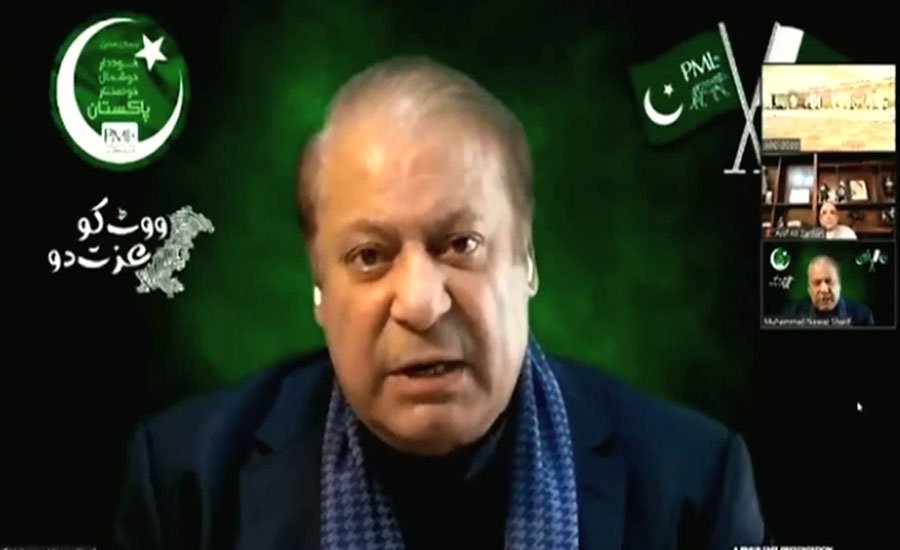
    Prime Minister Imran Khan has claimed to have intelligence on Pakistan Muslim League-Nawaz (PML-N) supreme leader Nawaz Sharif, alleging that former ambassador to the United States (US) Hussain Haqqani was “running Nawaz’s communication strategy”.

    Speaking to a private media outlet on Thursday, the premier was referring to the former PM’s recent speeches in public meetings of his party and the Pakistan Democratic Movement (PDM) during which he had accused the army establishment of orchestrating his ouster.

    Nawaz had gone on to name the Army and Inter-Services Intelligence (ISI) chiefs and said that there was “a state above the state”.

    Reacting to his political rival’s statements, Imran on Thursday accused Nawaz of trying to create rifts within the armed forces by encouraging army personnel to “rebel against” the military leadership.

    “When they say that the [military leadership] is bad and the rest of the army is good; is army a democratic party that would move a no-confidence motion? You [Nawaz] are telling the army to launch a coup, to rebel [against the leadership]. Can there be a bigger [form of] treason?”

    When asked if the government would take up a treason case against Nawaz, the premier did not give a clear answer and said, “Treason cases are hard to prove.”

    He said that he had information on Nawaz’s activities but added that “court cases cannot be filed on agencies’ reports”.

    WATCH VIDEO:

    “A person who is sitting outside in a Mayfair luxury flat bought with stolen money is telling the army [personnel] to rebel. He is also trying to drive a wedge in the judiciary by taking the name of one judge saying he is good while another, who was a chief justice and gave the Panama judgement against him, was a bad judge.”

    “Imran Khan is a Bollywood villain but Nawaz is a democrat. The person who grew up in Ziaul Haq’s lap is a democrat today, while Imran Khan who started his party from scratch, who mobilised people to come to power is an army puppet!”

    “Nawaz Sharif suits India, not Imran Khan.”

  • After Pakistan issues new map, Nawab of Junagarh says princely state will soon become its part

    Months after Islamabad issued a new political map that also included occupied Kashmir among other erstwhile princely states currently under Indian rule, Nawab of Junagarh Muhammad Jahangir Khanji has said that the city in the Indian state of Gujarat “will soon become a part of Pakistan”.

    Addressing a news conference in Islamabad, Nawab Khanji urged the United Nations (UN) to play its role in the liberation of Junagarh from Indian occupation. He also appealed to Prime Minister (PM) Imran Khan to become its ambassador as he did in the case of Kashmir to highlight the issue of liberation from New Delhi’s illegal rule at all international forums.

    The Nawab said a secretariat of Junagarh should be established in Islamabad to bring the princely state closer to Pakistan and told the participants that November 9 was observed as a black day as on this day in 1947 India occupied the territory of Junagarh.

    “The occupation was against the international law and norms,” he said, adding that a living nation should remember its history and act accordingly.

    Junagarh, he said, had a territory of 4,000 square miles and a 100-mile coastline along the Arabian Sea with many ports. Among the 562 princely states in the sub-continent, Junagarh was the sixth richest and a welfare state which provided free education to its citizens and took responsibility to provide healthcare facilities to all of them, Dawn quoted him as saying.

    He recalled that in October 1947, during his visit to Pakistan his grandfather Nawab Mahabat Khan signed an agreement of accession to Pakistan. During the visit, his grandfather held a meeting with Quaide Azam Muhammad Ali Jinnah and decided to accede the state to Pakistan.

    The treaty of accession was ratified by the Constituent Assembly of Pakistan.

    In the absence of his grandfather, India landed its troops and occupied the territory of Junagarh on November 9, 1947, he said.

    The Nawab said that after the creation of India and Pakistan, the sovereign rulers of the states were given the right of choice to stay independent or accede to India or Pakistan.

    He said that Pakistan took the case of occupation of Junagarh to the United Nations Security Council (UNSC).

    He vowed to continue struggle for the liberation of Junagarh.

    “I will not rest and will not stay quiet till I have achieved my goal of the liberation of Junagarh,” he said.

    The Nawab said that Junagarh was part of Pakistan and it would remain so.

    He said that Hindu and Muslim communities in Junagarh still expressed their loyalties to the Nawab of Junagarh. Indian Prime Minister Narendra Modi should know that Junagarh would be part of Pakistan, he said.

    He said it was a dream of the Quaid-i-Azam and his grandfather that Junagarh should be part of Pakistan.

    In reply to a question, he said 2.5 million people belonging to Junagarh lived in Pakistan.

    He said his grandfather never claimed any property or benefits in Pakistan.

  • Girl climbs atop advertisement board to protest against arranged marriage

    Girl climbs atop advertisement board to protest against arranged marriage

    An Indian girl frorm Madhya Pradesh climbed atop an advertisement board, demanding to marry a boy against her mother’s wishes.

    The pictures shared on social media, showed her sitting atop the advertisement board and speaking on the phone.

    Later, crowds began to gather below her to see her actions.

    According to local media reports, the police also reached the spot and tried to convince the girl to come down. However, she refused.

    The police personnel then contacted the boy she wanted to marry. Pardesipura Sub-Inspector (SI) Ashok Patidar said the girl decided to come down after the boy insisted that she come down.

    The girl had climbed the advertisement board after her mother forced her to marry a boy of the family’s choice.

  • Police arrest murderer of eight-year-old child via ‘spelling mistake’

    Police arrest murderer of eight-year-old child via ‘spelling mistake’

    Indian police identified an alleged murderer, who kidnapped and murdered his eight-year-old distant cousin, through a spelling test.

    According to details, the 22-year-old accused identified as Ram Pratap Singh, allegedly kidnapped the eight-year-old boy, from his grandmother’s house. He then used a stolen phone to send a ransom note to the family demanding Rs 200,000 for the release of the child.

    In the message, he wrote: “Do lakh rupay Seeta-Pur lekar pahuchiye. Pulish ko nahi batana nahi to haatya kar denge (Reach Sitapur with Rs 2 lakh. Don’t inform the police or your son will be killed).”

    The family approached police after more than a week and registered a missing complaint after which an investigation was initiated.

    “We swiftly formed teams to trace the kidnapped boy and called back on the same number but it was switched off. The cyber-surveillance cell was roped in and we detained the subscriber, who seemed illiterate and unable to write an SMS,” the local police said.

    The investigators detained 10 suspects, including the accused, from the area on the basis of clues gathered through the area’s CCTV footage and tip-offs.

    All of them were asked by the cops to write a sentence: “Main police main bharti hona chahta hoon. Main Hardoi se Sitapur daud kar ja sakta hoon (I want a police job. I can run from Hardoi to Sitapur).”

    Singh, who made spelling mistakes in his ransom note once again repeated them by writing ‘pulish’ for police and ‘Seeta-pur’ for Sitapur, resulting in his arrest.