Tag: India

  • Pakistan declared ‘more attractive destination for global investors than India’

    An international credit rating agency, Moody’s Investors Service, has upgraded the outlook for Pakistan’s economy from negative to positive, declaring the country a more attractive destination for global investors than India as the latter’s credit outlook downgraded to negative earlier this year, Sputnik News reported.

    According to the agency, upgrade in Pakistan’s status is driven by “Moody’s expectations that the balance of payments dynamics will continue to improve”. On the other hand, it said that India’s outlook downgraded, “on concerns that its economic growth would remain materially lower than in the past”.

    “Moody’s decision to change the outlook to negative reflects increasing risks that economic growth will remain materially lower than in the past, partly reflecting lower government and policy effectiveness at addressing long-standing economic and institutional weaknesses than Moody’s had previously estimated, leading to a gradual rise in the debt burden from already high levels.”

    Meanwhile, Prime Minister (PM) Imran Khan’s Adviser on Finance and Revenue Dr Abdul Hafeez Sheikh said the upgradation of outlook to stable was affirmation of the government’s success in stabilising the country’s economy and laying a firm foundation for robust long term growth.

    The announcement also pushed Pakistan’s stock market above 40,000 points — highest after a gap of 10 months.

    The premier himself has also claimed that over the first four months of the current fiscal year beginning April 2019, Pakistan’s current account deficit fell by 73.5%, as compared to the same period last fiscal year. “The country’s exports of goods and services in October 2019 rose 20 per cent over the previous month and 9.6 per cent over October 2018.”

  • Maiden trial of India’s ‘nuclear-capable’ missile ends in failure

    Maiden trial of India’s ‘nuclear-capable’ missile ends in failure

    The maiden night trial of India’s “nuclear-capable” Agni-III missile ended in failure on Saturday after it crashed into the sea in Odisha, according to a report published by Indian news outlet New Indian Express.

    According to the details, the missile deviated from its flight path and the mission team had to terminate it.

    “Starting from the launch to the first phase separation, everything was smooth in accordance with the mission plan but suddenly it started behaving abnormally” the publication quoted sources as saying.

    “It could possibly be due to metallurgical defects,” it added.

    The missile, which could carry both conventional and nuclear warheads weighing up to 1.5 tonnes, had already been inducted in the inventory back in 2011.

    Two other variants of the missile, Agni-I and Agni-II, have failed during both development and user trials in the past. Agni-II had failed to deliver desired result during its first night trial in 2009.

  • Lahore is the capital of Khalistan: Google

    Lahore is the capital of Khalistan: Google

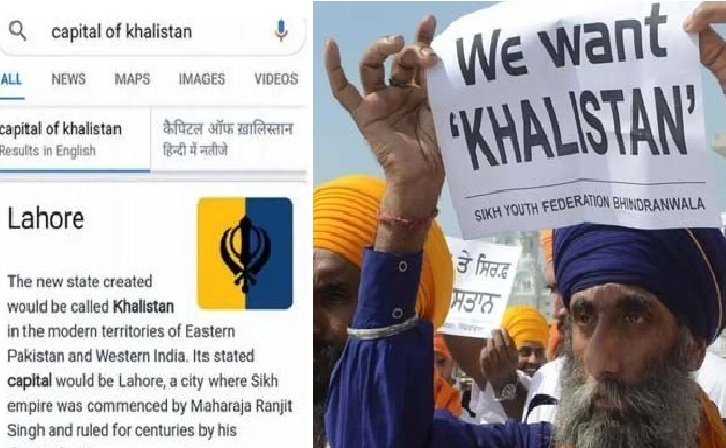
    In yet another faux pas, Google now says that ‘Lahore’ is the capital of Khalistan — a seperate country that Indian Sikhs seek as their homeland in the Punjab region of eastern Pakistan and western India.

    An Indian Twitter user attached the screenshot of the Google search declaring Lahore as the capital of Khalistan state with a blue-saffron flag and a ‘Khanda’ insignia of Sikhism on it.

    Indian media went into haywire following the circulation of the images, saying that Google search had “substantiated its accusations on Pakistan for fanning and supporting the separatist movement”.

    “The new state created would be called Khalistan in the modern territories of Eastern Pakistan and Western India. Its stated capital would be Lahore, a city where the Sikh empire was commenced by Maharaja Ranjit Singh and ruled for centuries by his descendants,” one of the search results read.

  • Indian Sikh donates 900sq ft land for mosque after Kartarpur opening

    An Indian Sikh has donated his 900 square foot (sq ft) land for the construction of a mosque in celebration of Sikhism founder Baba Guru Nanak’s 550th birth anniversary and Pakistan’s inauguration of the Kartarpur Corridor to facilitate Indian Sikh pilgrims.

    According to media reports, the 70-year-old merchant, Sukhpal Singh Bedi, who is a resident of Purkazi town of Muzaffarnagar district in the Indian state of Uttar Pradesh (UP), has said that the gesture is a tribute to Baba Guru Nanak’s teachings of peace and love.

    “Bedis, originally hailing from the Bedian town near Lahore, are the direct descendants of Baba Guru Nanak and so I feel it was my responsibility to make an example by following his teachings,” he reportedly said, hoping that the gesture will foster communal union in the area.

    He had handed over the documents of the land to Zahir Farooqui, the Nagar Panchayat chairman, who has thanked Bedi on behalf of the Muslim community.

    AYODHYA DISPUTE:

    The development comes days after the Supreme Court of India gave its verdict in the historic Ayodhya dispute case. Putting to rest the decades-old Ram Janmabhoomi-Babri Masjid land dispute case, the Indian Supreme Court had on November 9 decided in favour of Hindus as it allotted Ayodhya land to Ram Janambhoomi Nyas (Ram Birthplace Trust).

    Ram Janmabhoomi Nyas is an organisation to promote and oversee the construction of a temple in Ayodhya at the Ram Janmabhoomi, the reputed site of the birth of Rama, the seventh and one of the most popular avatars of Hindu God Vishnu.

    With a five-judge bench pronouncing its unanimous judgment that was reserved last month on the Ayodhya case involving the 1992 demolition of the Babri Masjid, it ordered allotment of five-acre alternative land to Muslims for setting up of a mosque while deciding in favour of Hindus.

    The ruling said the Indian government will formulate a scheme in three months to set up a board of trustees for the construction of the temple at the disputed structure.

    “This court must accept faith and accept the belief of worshippers. The court should preserve balance,” Chief Justice of India (CJI) Ranjan Gogoi said while reading out the judgement.

    The court said Hindus believe that Lord Ram was born under the dome, adding that faith is a matter of individual belief.

    It said there is evidence that Ram Chabutra, Sita Rasoi was worshipped by the Hindus before the British came. The court said evidence in the records shows that Hindus were in the possession of outer court of the disputed land.

    “Arguments were made on archaeology report. Archaeological Survey of India’s credentials are beyond doubt and its findings can’t be neglected,” the court said.

    The court said that titles can’t be decided on faith and belief but on claims. The judgement stated that historical accounts indicate the belief of Hindus that Ayodhya was the birthplace of Lord Ram.

    The Indian SC dismissed the plea of Shia Waqf Board on a claim to the Babri Masjid, saying there was no evidence that Muslims abandoned the mosque. Hindus always believed the birthplace of Lord Ram was in the inner courtyard of the mosque, the verdict added. 

    According to the court, it is clearly established that Muslims offered prayer inside the inner courtyard and Hindus offered prayers in the outer courtyard.

    Ahead of the verdict, appeals for peace were made by the Hindu and Muslim organisations and various political leaders, including Indian Prime Minister (PM) Narendra Modi.

    Meanwhile, Delhi Police said it will initiate strict legal action against mischief-mongers or those found indulging in any activity that may adversely affect peace and public order.

    “Activities on social media platforms will be under observation,” said the police.

    Earlier, authorities banned the assembly of more than four people at one place in and around Ayodhya, a town in the northern state of Uttar Pradesh while the government ordered all schools and colleges to remain closed until Monday.

    BABRI MASJID DESTRUCTION:

    Babri Masjid was a mosque in Ayodhya, India. Located in Ayodhya district, at a spot believed by Hindus to be the birthplace of Hindu deity Rama, it has been a bone of contention between the Hindu and Muslim communities since the 18th century.

    The destruction of the mosque in 1992 sparked massive Hindu-Muslim violence that left around 2,000 people dead.

    Hindu hardliners say the mosque was built after a temple dedicated to the Hindu god was destroyed by Muslim invaders. After the demolition of the mosque, Hindus and Muslims took the issue to a lower court, which, in 2010 ruled that the disputed land should be divided into three parts — two for Hindus and one for Muslims.

  • Paresh Rawal speaks up for Muslim professor’s hiring in India

    Paresh Rawal speaks up for Muslim professor’s hiring in India

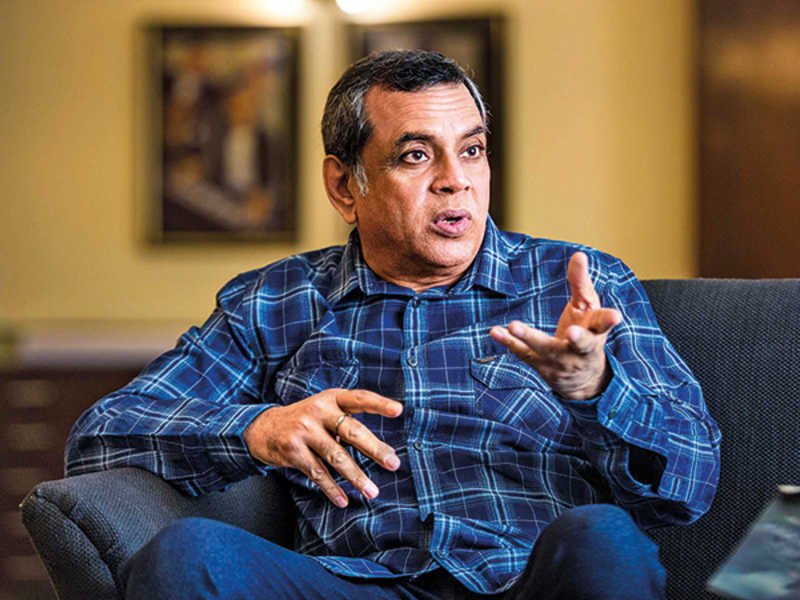
    Bollywood’s veteran actor Paresh Rawal is raising his voice in support of an Indian Muslim university professor Feroz Khan. According to reports, Dr Feroze was being hired to teach Sanskrit and people were protesting against that because they thought that the language needed to be protected.

    Paresh voiced his disbelief at the protest and highlighted the “irony” that Professor Feroze had done his Masters and PhD in Sanskrit.

    He added that if that if the protestors logic was to be followed, the “late Shri Mohammad Rafi ji should not have sung any BHAJANS and Naushad Saab should not have composed it!”

    Hardline Hindu students at Banaras Hindu University (BHU) are holding a sit-in outside the vice-chancellor’s office against the appointment of Professor Feroz Khan. Their stance is that since most Hindu religious text is in Sanskrit, they don’t want a Muslim professor for teaching linguistic lessons about Sanskrit.

    On the other hand, there were a few students who were in favor of the Muslim professor’s appointment.

  • VIDEO: New Delhi university students sing ‘Hum Dekheinge’ by Faiz Ahmad Faiz

    Students of New Delhi’s Indian Institute of Mass Communication (IIMC), have grabbed the attention of thousands of internet users for singing Pakistani Marxist poet and author Faiz Ahmad Faiz’s iconic poem ‘Hum Dekheinge’.

    According to journalist Pervaiz Alam, the recitation came after he asked the students to sing a song for him while conducting a media workshop.

    “I asked students to sing a song for me and they chose Hum Dekhenge by Faiz as I conducted a media workshop at the IIMC in New Delhi on 21 Nov. Meet the vibrant students of Indian Institute of Mass Communication [sic],” he tweeted while sharing the video.

    WATCH VIDEO:

    ‘HUM DEKHEINGE’:

    The popular revolutionary poem was written by Faiz in 1979 when he was in Honolulu for a writers’ conference. The poem was included in Faiz’s seventh poetry book titled “Mere Dil Mere Musafir” in 1981 and is known for its rendition by singer Iqbal Bano.

    The poem’s beginning deals with conventional themes such as injustice and oppression, then gives way to more overtly religious symbolism. Faiz writes that the idols will be lifted from the Kabah and goes on to describe a revolutionary inversion of power, where the pure-hearted, who were outlawed, or cast out, will be honoured.

    The crowns (of those in power) will be thrown up in the air (alluding to a celebration) and their thrones will be cast low. The final stanza of the poem is the most religious in tone, declaring that the only name (essentially on people’s lips) will that be of Allah and a great revolutionary cry of “I am Truth” will go up and people of faith will rule again.

    In recent times, the poem has become an anthem for rights activitsts taking to streets across the Indian subcontinent.

  • Worst air quality: Lahore tops global list as Pakistan beats India, again

    Lahore on Thursday once again topped the global list of cities with poor air quality as monitors showed an average “hazardous” Air Quality Index (AQI) of 335.

    According to Newsweek Pakistan, residents of the capital of the country’s most populous province woke up again to the sight of a haze covering the city, with residents complaining of sore throats, itchy eyes and other ailments linked to inhaling toxic material through the smog that has increasingly become a regular fixture.

    While the average AQI for the entire city stood at 335 around noon, parts of the city with individual air quality monitors showed the figure rising as high as 763, which posits a PM2.5 of nearly 900 ug/m3 — the equivalent of smoking nearly 40 cigarettes.

    While smog is not a new phenomenon in Pakistan, it has taken on greater urgency this year amid ever worsening air quality that is particularly unhealthy for children, the elderly and the infirm. In 2007, the Lahore High Court (LHC) ordered authorities to prepare a smog response action plan to overcome the health crisis. The Punjab Environment Protection Council, however, adopted a plan that utilised a modified AQI classification system, which claims a PM2.5 rating of 60 is “satisfactory” even though US AQI adopted by much of the world declares it “unhealthy”.

    PM2.5 refers to atmospheric particulate matter that has a diameter of less than 2.5 micrometers, so small that they can only be detected with an electron microscope. These fine particles, which can come from various sources including power plants, motor vehicle emissions, and agricultural burning, last longer in the air than heavier particles. This increases chances of them being inhaled by humans and animals, where they can bypass the nose and throat and penetrate deep into the lungs. The air pollution worsens during winter, emerging as smog, due to temperature inversion, which produces a layer of warm air that traps air pollutants.

    Meanwhile, schools on Friday will once again remain closed across the city due to smog. Both public and private schools in Gujranwala and Faisalabad will also remain shut.

    The Punjab School Education Department has issued a notification in this regard as well.

  • VIDEO: Altaf sings ‘Sare Jahan Se Acha’ on Indian channel

    Muttahida Quami Movement (MQM) founder Altaf Hussain, who has been declared an absconder by Pakistan in murder, terrorism and hate-speech among others cases, has sung an the popular Indian national song “Sare Jahan Se Acha” on an Indian news channel.

    Speaking to India’s Republic TV, Altaf said there was no difference between people of Pakistan and India, “We used to visit each other on Eid and Diwali and share each others’ pain.”

    WATCH VIDEO:

    The MQM founder further said that he was compelled to leave Pakistan as “there existed a nexus of the military and politicians in the country and assassins had been hired to kill him”.

    The 66-year-old politician is living in London for more than two decades now and was recently banned from appearing on any form of media in the UK or Pakistan by the Westminster Magistrates’ Court, after Scotland Yard charged him with a terrorism offence in the incitement speech inquiry against him.

    Altaf was charged with encouraging terrorism after a 2016 address to supporters in Karachi that was followed by violent protests. 

    He faces several years imprisonment for the speech which was “likely to be understood” as encouraging supporters to acts of terrorism or was “reckless” of the possible consequences.

    Altaf had earlier requested Indian Prime Minister (PM) Narendra Modi to help him by giving him asylum in India besides financial help to him and his companions. Meanwhile, Lawyers are assessing whether Hussain has breached his bail conditions by asking the Indian premier to let him stay in India while he awaits trial of his case.

  • ‘Left suppressed Pakistan because my followers wanted me to be safe,’ Altaf tells Indian media

    ‘Left suppressed Pakistan because my followers wanted me to be safe,’ Altaf tells Indian media

    Muttahida Quami Movement (MQM) founder Altaf Hussain, who has been declared an absconder by Pakistan in murder, terrorism and hate-speech cases among others, has called the country a suppressed nation where his life is in danger.

    Speaking to a India’s Republic TV, Altaf said he was compelled to leave Pakistan as “there existed a nexus of the military and politicians in the country and assassins had been hired to kill him”.

    The 66-year-old politician is living in London for more than two decades now and was recently banned from appearing on any form of media in the UK or Pakistan by the Westminster Magistrates’ Court, after Scotland Yard charged him with a terrorism offence in the incitement speech inquiry against him.

    Altaf was charged with encouraging terrorism after a 2016 address to supporters in Karachi that was followed by violent protests. 

    He faces several years imprisonment for the speech which was “likely to be understood” as encouraging supporters to acts of terrorism, or was “reckless” of the possible consequences.

    Altaf had earlier requested Indian Prime Minister (PM) Narendra Modi to help him by giving him asylum in India besides financial help to him and his companions. Meanwhile, Lawyers are assessing whether Hussain has breached his bail conditions by asking the Indian premier to let him stay in India while he awaits trial of his case.

    WATCH VIDEO:

  • Google Maps get an Indian arrested in Pakistan

    Google Maps get an Indian arrested in Pakistan

    Two Indian nationals were arrested by the Pakistani police for illegally entering the country last week.

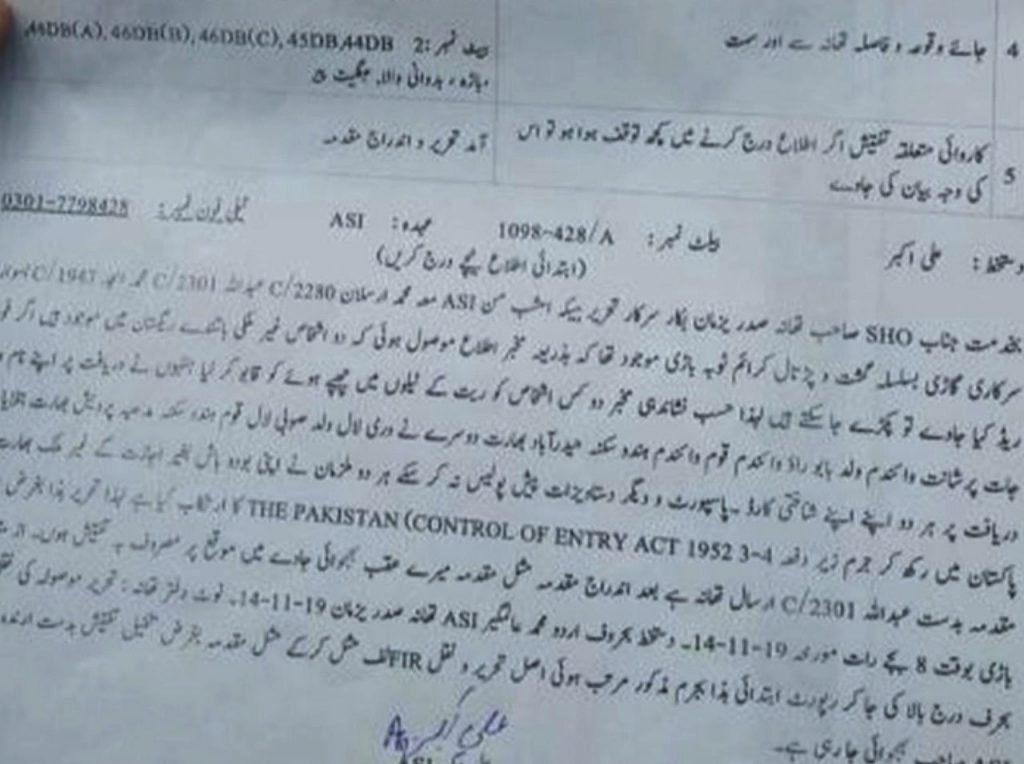
    Prashant Maidam, a software engineer from Hyderabad, and Durmi Lal, a farmer from Madhya Pradesh, were arrested in the Cholistan desert area in Bahawalpur on November 14th as per an FIR.

    The Bahawalpur police registered an FIR against them under the Pakistan (Control of Entry) Act.

    They had crossed the border without any identification papers and proper documents, such as a valid visa and passport, police sources told The Hindu.

    Police sources said Prashant told them that he was in love with a woman in Turkey and was going there through Pakistan and Afghanistan. Prashant was reportedly on foot and following Google Maps route.

    Bahawalpur Judicial Magistrate Yazman asked the local police to travel to Multan and hand over the two Indians to the Federal Investigation Agency (FIA). Bahawalpur police sources said that the two Indian nationals were thoroughly investigated and were sent back from Multan as the FIA doesn’t think this case falls under its jurisdiction.

    The two are now back in the custody of the Bahawalpur police.

    “Prashant is lucky he was arrested here. We don’t know what would have happened if he had gone to Afghanistan via Pakistan,” said one police officer.

    Police sources said the two will most likely be repatriated after due process is followed. The Indian High Commission will have to get in touch with the police and initiate the process of repatriation.