Tag: Indian Prime Minister Narendra Modi

  • ‘Dear Mian Sahib’: Modi’s letter to Nawaz emerges

    ‘Dear Mian Sahib’: Modi’s letter to Nawaz emerges

    Indian Prime Minister (PM) Narendra Modi wrote a letter to former premier Nawaz Sharif to offer his condolences after the death of the latter’s mother Begum Shamim Akhtar, it has emerged.

    Begum Shamim passed away last month.

    The letter, dated November 27, was delivered to Pakistan Muslim League-Nawaz (PML-N) Vice President Maryam Nawaz by the Indian High Commission in Islamabad last week. Charge d’ Affairs of Indian High Commission Gaurav Ahluwalia asked her to convey the letter to her father Nawaz.

    In the letter itself, Modi shared a personal memory of meeting Sharif’s late mother during his visit to Jati Umra residence back in 2015.

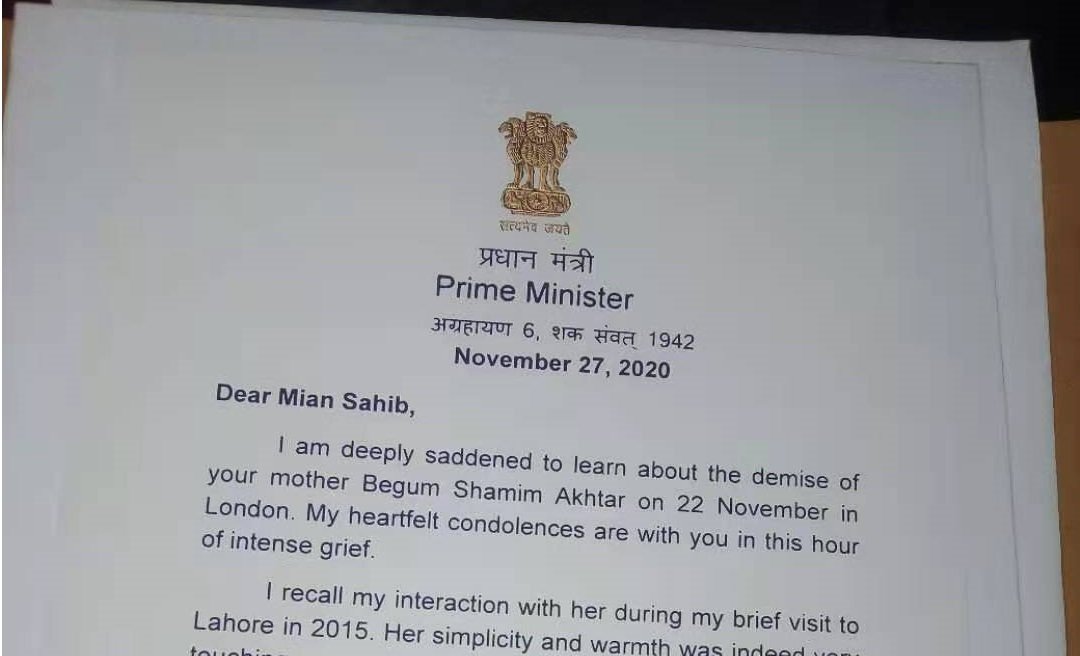
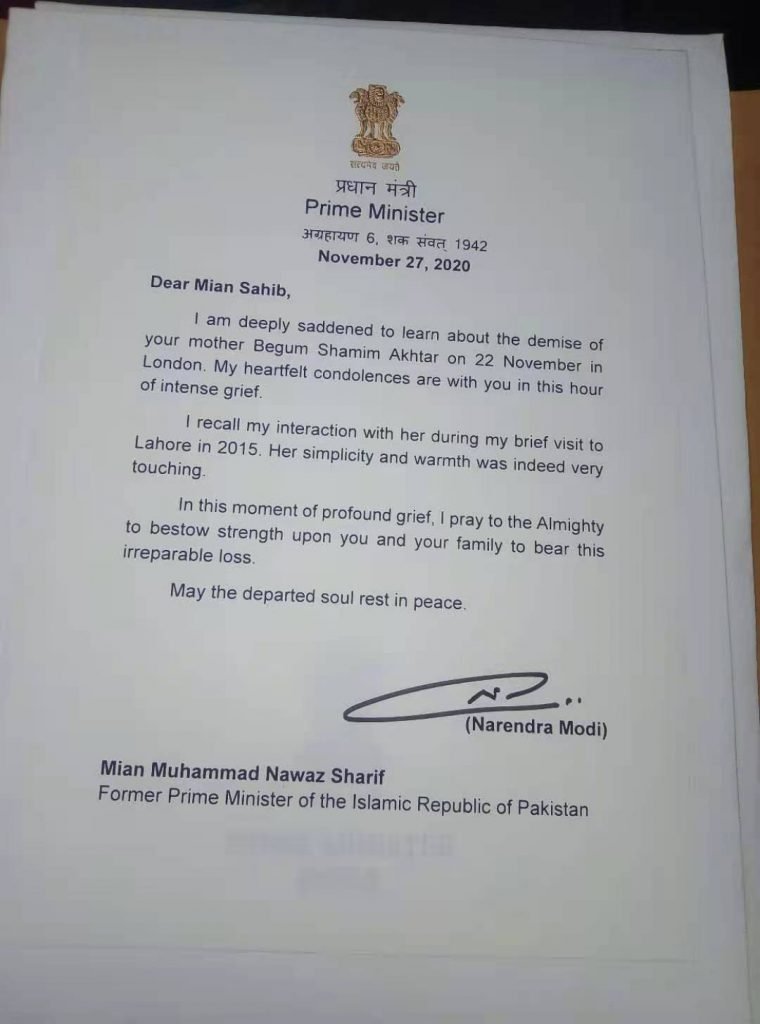
    “I am deeply saddened to learn about the demise of your mother Begum Shamim Akhtar on November 22 in London. My heartfelt condolences are with you in this hour of intense grief,” wrote the Indian premier.

    “I recall my interaction with her during my brief visit to Lahore in 2015. Her simplicity and warmth was indeed very touching,” Modi wrote, expressing his personal bond with the Sharif family.

    “In this moment of profound grief, I pray to the Almighty to bestow strength upon you and your family to bear this irreparable loss. May the departed soul rest in peace,” Modi added.

    It may be noted that it was Nawaz who started developing a personal relationship with Modi soon after he was elected PM in 2014 by personally making a visit to his oath-taking. Nawaz also sent a white sari for Modi’s mother, who had gifted a shawl to Nawaz’s mother when he had visited India.

  • Egg on face of Modi’s India with highest bribery rate in Asia

    Egg on face of Modi’s India with highest bribery rate in Asia

    India has the highest bribery rate in Asia and the most number of people who use personal connections to access public services, according to a new report by Transparency International (TI).

    According to Global Corruption Barometer (GCB) Asia, nearly 50 per cent of those who paid bribes were asked to do so, while 32 per cent of those who used personal connections said they would not receive the service otherwise.

    The report is based upon the survey which was conducted between June 17 and July 17 this year in India with a sample size of 2,000.

    “With the highest bribery rate [39 per cent] in the region, India also has the highest rate of people using personal connections to access public services [46 per cent],” the report said.

    Bribery in public services continues to plague India. Slow and complicated bureaucratic process, unnecessary red tape and unclear regulatory frameworks force citizens to seek out alternate solutions to access basic services through networks of familiarity and petty corruption, the report said.

    “Both national and state governments need to streamline administrative processes for public services, implement preventative measures to combat bribery and nepotism, and invest in user-friendly online platforms to deliver essential public services quickly and effectively,” the report said.

    Although reporting cases of corruption was critical to curbing the spread, a majority of citizens in India, 63 per cent, think that if they reported corruption, they would suffer retaliation, it said.

    In several countries, including India, Malaysia, Thailand, Sri Lanka and Indonesia, sexual extortion rates are also high and more must be done to prevent sextortion and address specific-gendered forms of corruption, the report said.

    Sextortion is extorting money or sexual favours from someone by threatening to reveal evidence of their sexual activity through means like morphed images.

    In India, 89 per cent think government corruption is a big problem, 18 per cent offered bribes in exchange for votes and 11 per cent experienced sextortion or know someone who has.

    “About 63 per cent of surveyed people think the government is doing well in tackling corruption while 73 per cent said their anti-corruption agency is doing well in the fight against corruption,” it said.

    Based on fieldwork conducted in 17 countries, the GCB surveyed nearly 20,000 citizens in total.

    The report said the results showed that nearly three out of four people think corruption is a big problem in their country and the survey also found that nearly one in five people who accessed public services, such as health care and education, paid a bribe in the preceding year.

    This equates to approximately 836 million citizens in the 17 countries surveyed, it said.

    After India, Cambodia has the second-highest bribery rate at 37 per cent, followed by Indonesia (30 per cent) while the Maldives and Japan maintain the lowest overall bribery rate (2 per cent), followed by South Korea (10 per cent) and Nepal (12 per cent).

    “However, even in these countries, governments could do more to stop bribes for public services,” the report said.

    The report concluded by noting that daily experience with corruption and bribery remains alarmingly high, with nearly one in five citizens paying a bribe to access key government services, such as health care or education, and one in seven being offered a bribe to vote one way or another at elections.

    “In several countries, including India, Malaysia, Thailand, Sri Lanka and Indonesia, sexual extortion rates are also high and more must be done to prevent sextortion and address specific-gendered forms of corruption,” it said.

    The report further said that to provide victims of corruption with channels for redress, governments must ensure that bribery was criminalised and actively investigated and prosecuted.

    “Citizens must have access to safe and confidential reporting mechanisms and governments must do more to ease citizens’ fear of retaliation in reporting corruption. Despite these challenges, citizens are largely optimistic about the future and believe that ordinary people can make a difference in the fight against corruption,” the report said.
  • Modi invites Imran Khan to New Delhi

    Indian Prime Minister (PM) Narendra Modi has invited his Pakistani counterpart, Imran Khan, to participate in the Shanghai Cooperation Organisation (SCO) heads of government meeting being held in New Delhi on November 30.

    According to reports, the Indian premier invited all the eight members and four observer countries on Tuesday during the online summit of the organisation held in Moscow, chaired by Russian President Vladimir Putin.

    The News quoted sources as saying that the Russian president appreciated Pakistan’s proposals on various counts.

    Modi, who tried to demean the objectives of the SCO, tried to take on Pakistan and China in the same stroke without naming them under the garb of respect of sovereignty and said in muffled words that India believed that to enhance connectivity it was important that we move forward while respecting one another’s sovereignty and territorial integrity.

    He boasted that India had always been resolute in working in sync with principles laid out in the SCO charter, but it was unfortunate that there had been repeated efforts to unnecessarily bring bilateral issues in the SCO agenda which was in violation of the SCO spirit.

    It was an assault on Pakistan and China’s policies of enhancing connectivity in the region.

    Modi referred to the Shanghai spirit and SCO charter, but he conveniently forgot that it was India that had humiliated the two documents by its actions and inactions.

    Diplomatic sources told the English daily that none of the significant member countries’ premiers will attend the New Delhi virtual meeting except Russian PM Mikhail Mishustin while the Chinese premier, Li Keqiang, and PM Imran might not be available to attend the heads of government meeting.

    Foreign Secretary Sohail Mahmood or Additional Foreign Secretary Syed Faisal Tirmizi are likely to represent Pakistan at the huddle.

  • Pakistan Twitter mocks Indian PM over parrot snub

    Pakistan Twitter mocks Indian PM over parrot snub

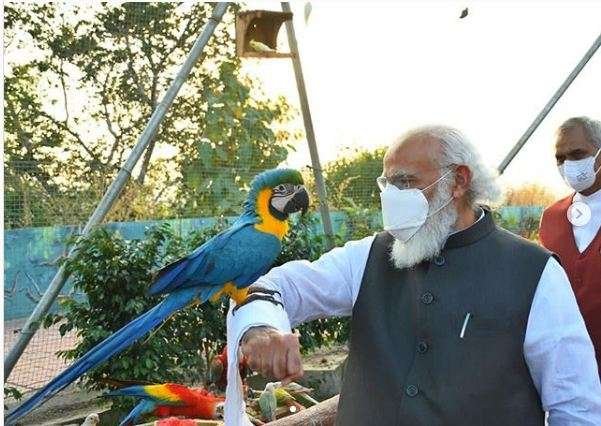
    Indian Prime Minister Narendra Modi is being trolled by the Pakistani Twitterati for getting an embarrassing reaction from a macaw in Kevadia Zoological Park, during his two-day visit to the Indian state of Gujarat.

    Recently, the Indian PM went to Kevadia for the inauguration of the Sardar Patel Zoological Park, which is also known as Jungle Safari. During his visit, the employees of the park tried to get a Macaw to sit on the PM’s arm. But the now infamous parrot refused to comply and was repeatedly seen rejecting the advances of the prime minister.

    The parrot has shot to fame, as Twitter gets flooded with comments by those who were cracked up by the parrot’s reaction to the strongest man in the country.

    Here are some of the comments:

    https://twitter.com/tweetbyali/status/1323164410416893960?s=20