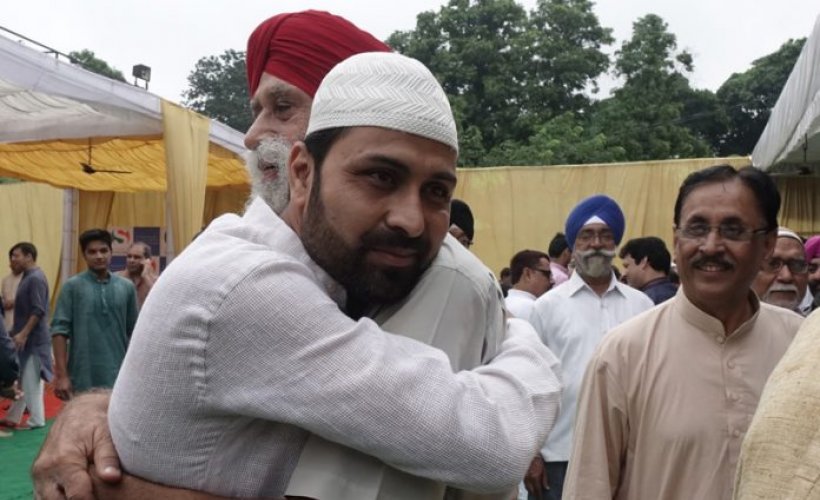
An Indian Sikh has donated his 900 square foot (sq ft) land for the construction of a mosque in celebration of Sikhism founder Baba Guru Nanak’s 550th birth anniversary and Pakistan’s inauguration of the Kartarpur Corridor to facilitate Indian Sikh pilgrims.
According to media reports, the 70-year-old merchant, Sukhpal Singh Bedi, who is a resident of Purkazi town of Muzaffarnagar district in the Indian state of Uttar Pradesh (UP), has said that the gesture is a tribute to Baba Guru Nanak’s teachings of peace and love.
“Bedis, originally hailing from the Bedian town near Lahore, are the direct descendants of Baba Guru Nanak and so I feel it was my responsibility to make an example by following his teachings,” he reportedly said, hoping that the gesture will foster communal union in the area.
He had handed over the documents of the land to Zahir Farooqui, the Nagar Panchayat chairman, who has thanked Bedi on behalf of the Muslim community.
AYODHYA DISPUTE:
The development comes days after the Supreme Court of India gave its verdict in the historic Ayodhya dispute case. Putting to rest the decades-old Ram Janmabhoomi-Babri Masjid land dispute case, the Indian Supreme Court had on November 9 decided in favour of Hindus as it allotted Ayodhya land to Ram Janambhoomi Nyas (Ram Birthplace Trust).
Ram Janmabhoomi Nyas is an organisation to promote and oversee the construction of a temple in Ayodhya at the Ram Janmabhoomi, the reputed site of the birth of Rama, the seventh and one of the most popular avatars of Hindu God Vishnu.
With a five-judge bench pronouncing its unanimous judgment that was reserved last month on the Ayodhya case involving the 1992 demolition of the Babri Masjid, it ordered allotment of five-acre alternative land to Muslims for setting up of a mosque while deciding in favour of Hindus.
The ruling said the Indian government will formulate a scheme in three months to set up a board of trustees for the construction of the temple at the disputed structure.
“This court must accept faith and accept the belief of worshippers. The court should preserve balance,” Chief Justice of India (CJI) Ranjan Gogoi said while reading out the judgement.
The court said Hindus believe that Lord Ram was born under the dome, adding that faith is a matter of individual belief.
It said there is evidence that Ram Chabutra, Sita Rasoi was worshipped by the Hindus before the British came. The court said evidence in the records shows that Hindus were in the possession of outer court of the disputed land.
“Arguments were made on archaeology report. Archaeological Survey of India’s credentials are beyond doubt and its findings can’t be neglected,” the court said.
The court said that titles can’t be decided on faith and belief but on claims. The judgement stated that historical accounts indicate the belief of Hindus that Ayodhya was the birthplace of Lord Ram.
The Indian SC dismissed the plea of Shia Waqf Board on a claim to the Babri Masjid, saying there was no evidence that Muslims abandoned the mosque. Hindus always believed the birthplace of Lord Ram was in the inner courtyard of the mosque, the verdict added.
According to the court, it is clearly established that Muslims offered prayer inside the inner courtyard and Hindus offered prayers in the outer courtyard.
Ahead of the verdict, appeals for peace were made by the Hindu and Muslim organisations and various political leaders, including Indian Prime Minister (PM) Narendra Modi.
Meanwhile, Delhi Police said it will initiate strict legal action against mischief-mongers or those found indulging in any activity that may adversely affect peace and public order.
“Activities on social media platforms will be under observation,” said the police.
Earlier, authorities banned the assembly of more than four people at one place in and around Ayodhya, a town in the northern state of Uttar Pradesh while the government ordered all schools and colleges to remain closed until Monday.
BABRI MASJID DESTRUCTION:
Babri Masjid was a mosque in Ayodhya, India. Located in Ayodhya district, at a spot believed by Hindus to be the birthplace of Hindu deity Rama, it has been a bone of contention between the Hindu and Muslim communities since the 18th century.
The destruction of the mosque in 1992 sparked massive Hindu-Muslim violence that left around 2,000 people dead.
Hindu hardliners say the mosque was built after a temple dedicated to the Hindu god was destroyed by Muslim invaders. After the demolition of the mosque, Hindus and Muslims took the issue to a lower court, which, in 2010 ruled that the disputed land should be divided into three parts — two for Hindus and one for Muslims.