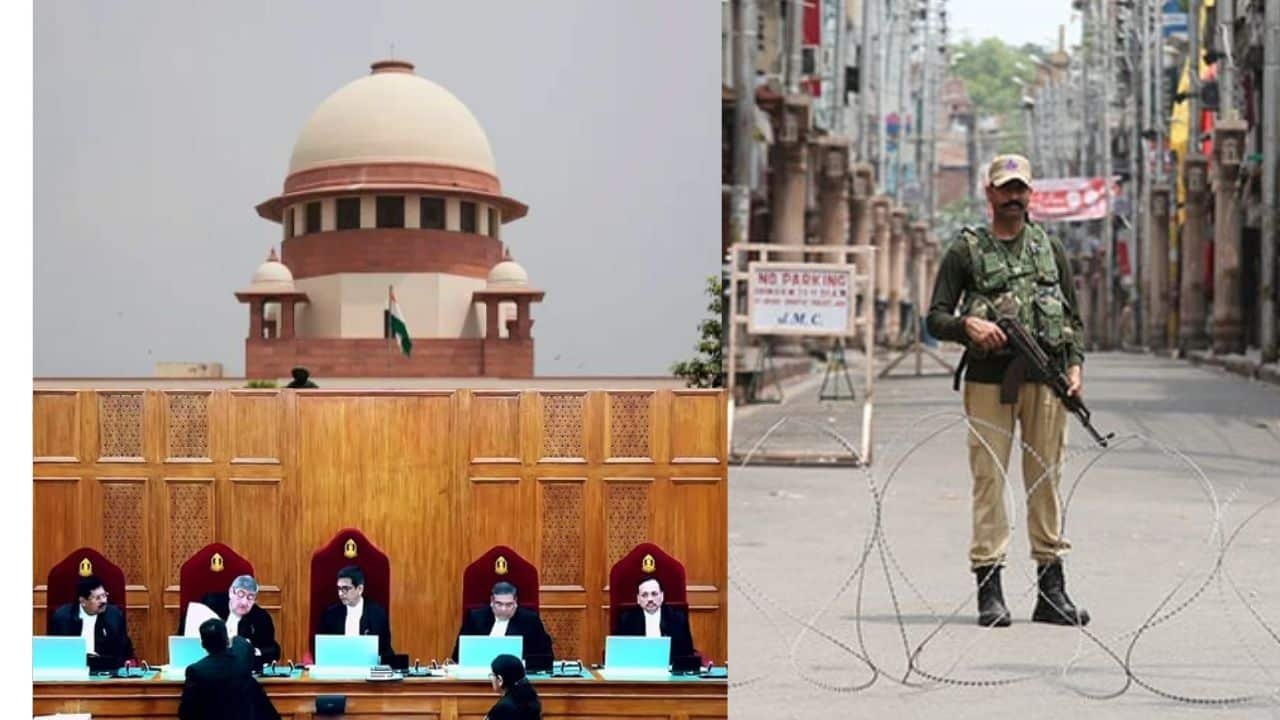
A five-judge constitution bench, presided by Chief Justice of India DY Chandrachud, has given its verdict on the Union government’s 2019 move to amend Article 370 of the constitution, the abrogation of which ended the special status of Jammu and Kashmir.
The decision was reserved earlier on September 5 this year, after 16 days of hearings.
The unanimous verdict by the panel of five judges came in response to more than a dozen petitions challenging the revocation and a subsequent decision to split the region into two federally administered territories, the central government, on the other hand, had defended its action, asserting there was no “constitutional fraud” in nullifying the provision.
Chief Justice said that Jammu and Kashmir held no internal sovereignty after accession to India. The court maintains that the president has the right to abrogate any of the articles in the Constitution. The same was carried out on August 5 2019.
The order also declared that the reorganisation of the erstwhile state into Union Territories in 2019 was a temporary move, it directed the Centre for the restoration of statehood and for Legislative Assembly elections to be held.
We have held that Article 370 is a TEMPORARY PROVISION: Chief Justice of India. #Article370 pic.twitter.com/21jewviXdP
— All India Radio News (@airnewsalerts) December 11, 2023
However, Justice Kaul recommended in his opinion that a Truth and Reconciliation Commission should be set up in Jammu and Kashmir, for the acknowledgement of acts of rights violations in the region.
The revocation was one of Mr Modi’s poll promises in 2019 and the court’s decision comes months before he seeks a third term. Local politicians in the region have expressed disappointment over the order.
Former Chief Minister Omar Abdullah posted on X (formerly Twitter) that he was “disappointed but not disheartened”. An hour later, he also posted Faiz Ahmed Faiz poem, “Dil na umeed to nahi, na kaam he to hai”.
Disappointed but not disheartened. The struggle will continue. It took the BJP decades to reach here. We are also prepared for the long haul. #WeShallOvercome #Article370
— Omar Abdullah (@OmarAbdullah) December 11, 2023
Dil na umeed tou nahi ⁰Na kaam hi tou hai ⁰Lambi hai gham ki shaam⁰Magar shaam hi tou hai
— Omar Abdullah (@OmarAbdullah) December 11, 2023
Meanwhile, Narendra Modi, Prime Minister of India wrote this decision is “a resounding declaration of hope, progress and unity”.
Today’s Supreme Court verdict on the abrogation of Article 370 is historic and constitutionally upholds the decision taken by the Parliament of India on 5th August 2019; it is a resounding declaration of hope, progress and unity for our sisters and brothers in Jammu, Kashmir and…
— Narendra Modi (@narendramodi) December 11, 2023
Amit Shah, a major proponent of Hindutva supremacy and Indian Home Minister, criticised India’s first Prime Minister, Jawaharlal Nehru, on the Kashmir issue, saying in Parliament, “I say this with full responsibility that Kashmir suffered due to two blunders by Nehru. First, the ceasefire (with Pakistan) was announced when our forces were winning…before winning the whole of Kashmir. The second blunder was to take the Kashmir issue to the United Nations.”
“Nehru made a blunder, not a mistake.”#POK was created because of Nehru’s mistake.
I support the term “Nehruvian Blunder” in the House, Pandit Nehru made 2 historic mistakes regarding Kashmir”: @AmitShah
#JammuKashmir #article370 #Nehru #Amitshah pic.twitter.com/FJLnqRw0ku— Siddhant Anand (@JournoSiddhant) December 6, 2023
Today he posted on Twitter that because of this decision “separatism and stone pelting are now things of the past.”
After the abrogation of #Article370, the rights of the poor and deprived have been restored, and separatism and stone pelting are now things of the past. The entire region now echoes with melodious music and cultural tourism. The bonds of unity have strengthened, and integrity…
— Amit Shah (@AmitShah) December 11, 2023
Asaduddin Owaisi says, ” We are disappointed by this verdict.”
#WATCH | On SC upholding abrogation of Art 370 in J&K valid, AIMIM MP Asaduddin Owaisi says, ” We are disappointed by this verdict….” pic.twitter.com/3IyWkH2tX5
— ANI (@ANI) December 11, 2023
“Pakistan categorically rejects the judgement announced by the Supreme Court of India on the status of Indian Illegally Occupied Jammu and Kashmir (IIOJK),” states the statement released by the Ministry of Foreign Affairs in Pakistan.
: PR NO. 2️⃣2️⃣5️⃣/2️⃣0️⃣2️⃣3️⃣
Pakistan Rejects the Indian Supreme Court’s Verdict on Indian Illegally Occupied Jammu and Kashmir
⬇️ https://t.co/bsemHte2nF pic.twitter.com/DsFH9AovuE
— Spokesperson MoFA (@ForeignOfficePk) December 11, 2023
Caretaker Foreign Minister of Pakistan Jalil Abbas Jilani posted on Twitter that “The judicial endorsement by the Indian Supreme Court has no legal value.”
International law doesn’t recognize India’s unilateral and illegal actions of 5 August 2019. The judicial endorsement by the Indian Supreme Court has no legal value. Kashmiris have an inalienable right to self determination in accordance with the relevant UN SC resolutions.
— Jalil Abbas Jilani (@JalilJilani) December 11, 2023