Tag: inflation

  • Open market: Lemon being sold at Rs1,100 per kg in Lahore

    Open market: Lemon being sold at Rs1,100 per kg in Lahore

    The local price of lemon increased by Rs105 per kg, to Rs770 to 775 per kg, and was sold at an unbelievable price of Rs1,100 per kg in open markets and a few online stores with available stock.

    Due to the district administration’s inability to impose official rates at Ramazan bazaars, consumers are unable to get relief from overbilling and skyrocketing rates of fruits and vegetables in Lahore. 

    High prices of perishable commodities are massively affecting the urban population due to rising production costs and transportation costs from rural production centers to urban areas.

    Read more: Shopkeepers fined in Islamabad for not adhering to DC rates

    Senior administrators and Prime Minister Shehbaz Sharif paid surprise visits to Ramazan bazaars, but shoppers were not relieved. Containing volatility and successfully administering official rate lists to bring inflation relief to the public is a task for the new government.

  • Toyota Pakistan announces another massive price hike for all cars

    Toyota Pakistan announces another massive price hike for all cars

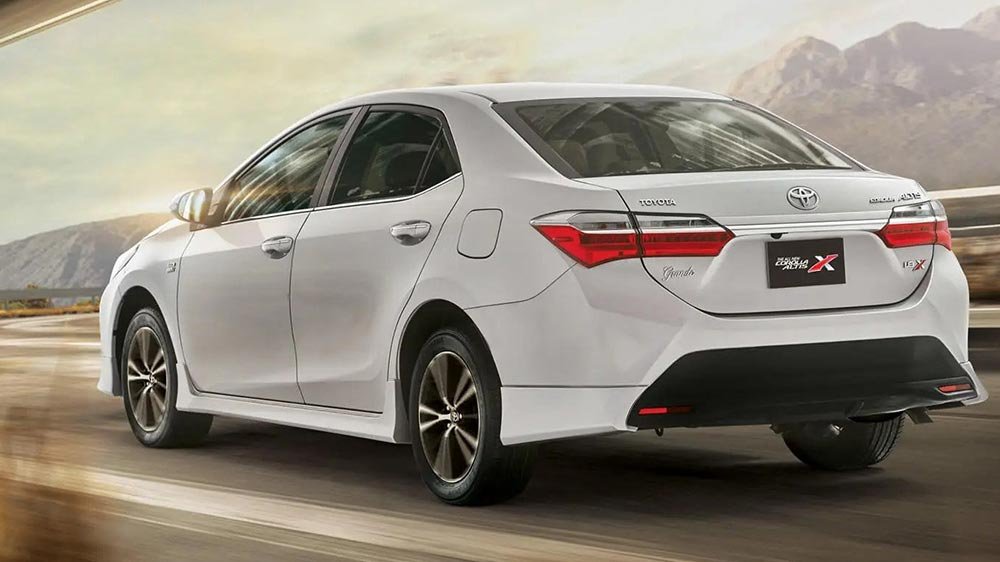
    For the second time in less than a month, Toyota Indus Motor Company (IMC) has announced a hefty price increase for all of its locally assembled vehicles. The increase was attributed by the corporation to the ongoing depreciation of the local currency against the US dollar.

    All variants from Toyota have received a hike of more than Rs170,000, which goes up to nearly Rs600,000.

    Toyota Corolla

    The old price of the Corolla Altis X Manual 1.6 was Rs3,749,000, and it will now cost Rs3,909,000 after a rate hike of Rs160,000.

    The Altis X Automatic 1.6 witnessed a price increase of Rs170,000, and now costs Rs4,099,000, up from Rs3,929,000 earlier.

    Altis X Automatic 1.6 Special Edition (SE) was previously priced at Rs4,309,000 and is now priced at Rs4,509,000.

    Altis X CVT-i 1.8, which also got a Rs200,000 hike, bringing the rate to Rs4,499,000, up from Rs4,299,000 previously.

    The price of the Altis Grande X CVT-i 1.8 (Beige Interior) has increased by Rs210,000, bringing the total price to Rs4,859,000, up from Rs4,649,000 previously.

    The Corolla Altis Grande X CVT-i 1.8 (Black Interior) was priced at Rs4,689,000, which now costs Rs4,899,000 after a price increase of Rs210,000.

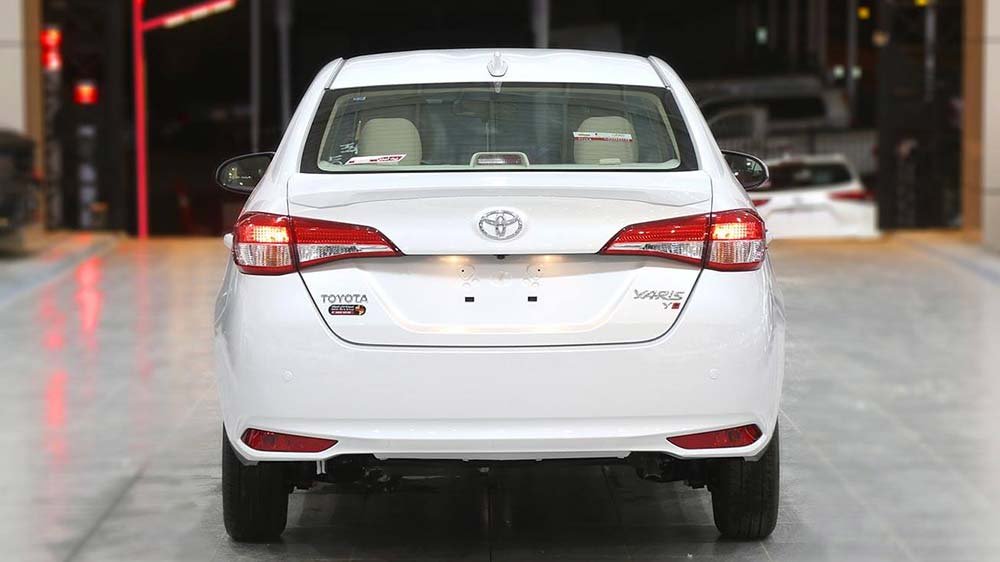
    Toyota Yaris 

    The present price of the Yaris GLI MT 1.3 is Rs2,899,000, however after a price increase of Rs140,000, the new price is Rs3,039,000.

    Yaris ATIV MT 1.3, saw a price increase of Rs150,000, bringing the total price to Rs3,209,000, up from Rs3,059,000 previously.

    Yaris GLI CVT 1.3, and following the recent rise of Rs140,000, the car’s new price is Rs3,249,000, up from Rs3,109,000.

    Yaris ATIV CVT 1.3, used to cost Rs3,229,000, is now priced at Rs3,449,000 after a price spike of Rs150,000.

    The revised pricing of the Yaris ATIV X MT 1.5 is Rs3,449,000, an increase of Rs160,000. It was last sold for Rs3,289,000.

    The new price of the Toyota Yaris ATIV X CVT 1.5 is Rs3,659,000, increase from the original price of Rs3,499,000.

    Toyota Revo

    The earlier price of the Hilux E was Rs7,059,000, and following a Rs300,000 rise, it would now cost Rs7,359,000.

    Hilux Revo G Manual 2.8: The business raised the price by Rs330,000, bringing it to Rs7,989,000, up from Rs7,659,000 previously.

    The Hilux Revo G Automatic 2.8 has increased by Rs350,000, bringing its new price to Rs8,379,000, up from Rs8,029,000 previously.

    Hilux Revo V Automatic 2.8 was formerly priced at Rs8,839,000, but it is now priced at Rs9,229,000, a Rs390,000 increase.

    The Hilux Revo Rocco, which used to cost Rs9,319,000, now costs Rs9,729,000 after a price increase of Rs410,000.

    Toyota Fortuner

    Fortuner 2.7 G, formerly priced at Rs9,499,000, will now cost Rs9,959,000 after a price increase of Rs460,000.

    Fortuner 2.7 V now costs Rs11,459,000 instead of Rs10,949,000, a huge difference of Rs510,000.

    Fortuner 2.8 Sigma 4, received a price hike of Rs550,000, bringing it to Rs12,039,000, up from Rs11,489,000 previously.

    The fourth is the Fortuner Legender, which used to cost Rs12,099,000 but now costs Rs12,679,000 after an Rs580,000 price increase.

    Customers affected by the new pricing

    The new price will apply to all bookings placed after April 30, 2022. All orders placed before March 23 will be charged at the previous rate. All vehicles booked between March 23 and April 29, 2022, or before June 20, 2022, will be billed at the old rate. From March 23 to April 29, 2022, or before June 20, 2022, all DFS orders will be invoiced at the earlier rate.


  • Pakistan’s foreign currency reserves down by $328 million

    Pakistan’s foreign currency reserves down by $328 million

    State Bank of Pakistan (SBP) on April 28, revealed that the central bank’s foreign exchange reserves fell by 3 per cent on a weekly basis.

    The central bank’s foreign currency reserves were $10,558.2 million on April 23, a $328 million decrease from the previous day’s total of $10,885.7 million. according to the SBP, this decline was caused by external debt and other payments.

    Pakistan’s total liquid foreign currency reserves, comprising net reserves held by banks other than the SBP, were $16,668.2 million. Banks held a total of $6,110 million in net reserves.

    SBP’s foreign exchange reserves reached an all-time high of $20.15 billion in the week ending August 27, 2021, after Pakistan received a general allocation of Special Drawing Rights (SDRs) worth $2,751.8 million from the IMF on August 24.

    Pakistan bought $2.5 billion using Eurobonds on March 30, 2021, by offering attractive interest rates to lenders in order to enhance foreign exchange reserves.

    Read more: All banks to remain open this Saturday

    On July 9, 2019, it received the first loan amount of $991.4 million from the IMF, which helped to boost reserves. The IMF released the second loan tranche of approximately $454 million in late December 2019.

  • Eid-ul-Fitr 2022: Here’s why Pakistan is paying a lot more than last year for clothes, food

    Eid-ul-Fitr 2022: Here’s why Pakistan is paying a lot more than last year for clothes, food

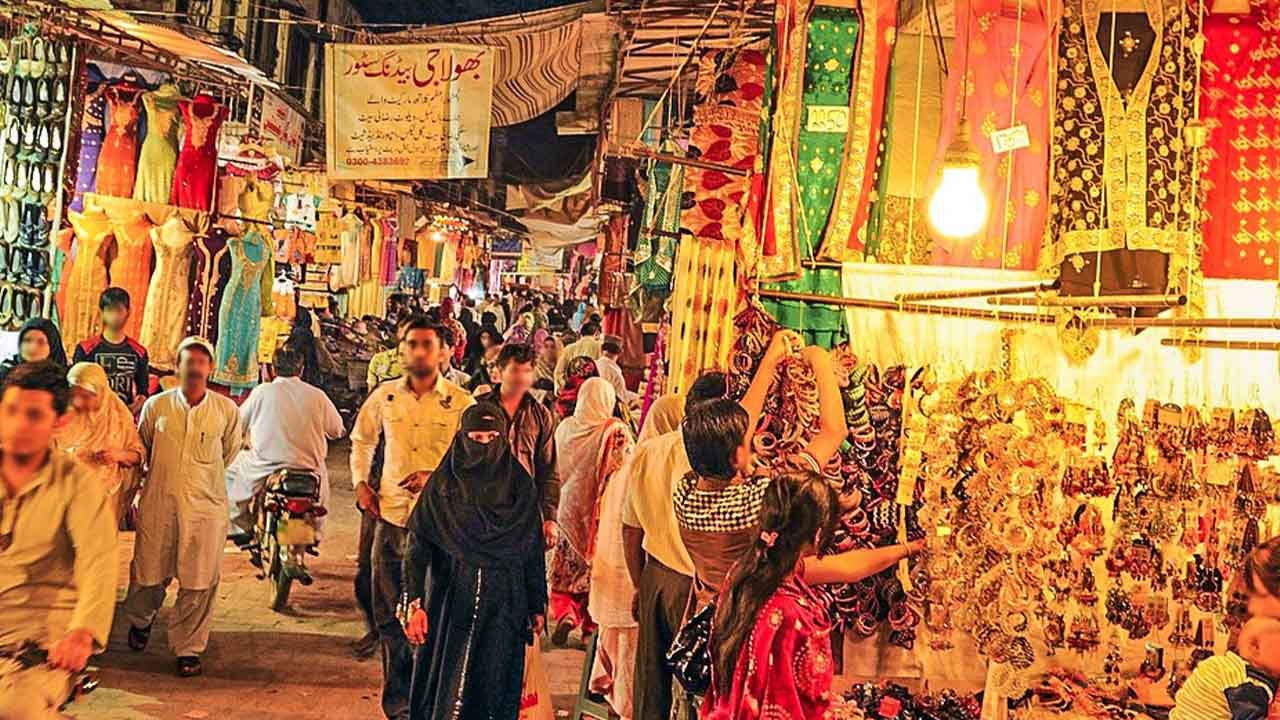
    Cities are decked with spectacular illumination around shopping malls, major streets, and side lanes as Eid shopping begins. Despite growing inflation, there is a lot of hustle in commercial areas.

    But do you know how much higher we are paying for everything this year, from food to clothing, than we did last year?

    Undoubtedly, the PTI-led government struggled to contain inflation, which experts said, was the outcome of record-high global commodity prices and 51 per cent devaluation of the Pakistani rupee (PKR).

    In January 2022, inflation climbed by 13 per cent year on year basis compared to 12.3 per cent in the previous month and 5.7 per cent in January 2021. It is pertinent to mention that inflation reached an all-time high of 14.6 per cent in January 2020.

    The Consumer Price Index (CPI) accelerated in March 2022 over the same month a year ago, according to the inflation bulletin released by the Pakistan Bureau of Statistics (PBS). The index remained higher compared to the preceding month during five out of the past six months.

    Inflation Comparison – January 2022

    General CPI inflation, increased by 13.0 per cent on a year-on-year basis in January 2022 as compared to an increase of 12.3 per cent in the previous month and 5.7 per cent in January 2021. On a month-on-month basis, it increased by 0.4 per cent in January 2022 as compared to decrease of -0.02 per cent in the previous month and a decrease of -0.2 per cent in January 2021.

    Urban CPI inflation, increased by 13.0 per cent on a year-on-year basis in January 2022 as compared to an increase of 12.7 per cent in the previous month and 5.0 per cent in January 2021. On a month-on-month basis, it increased by 0.1 per cent in January 2022 as compared to an increase of 0.3 per cent in the previous month and a decrease of -0.2 per cent in January 2021.

    Rural CPI inflation, increased by 12.9 per cent on a year-on-year basis in January 2022 as compared to an increase of 11.6 per cent in the previous month and 6.6 per cent in January 2021. On a month-on-month basis, it increased by 0.9 per cent in January 2022 as compared to a decrease of -0.5 per cent in the previous month and a decrease of -0.3 per cent in January 2021.

    Wholesale Price Index (WPI) inflation on a year-on-year basis increased by 24.0 per cent in January 2022 as compared to an increase of 26.2 per cent a month earlier and an increase of 6.4 per cent in January 2021. WPI inflation on a Month-on-month basis increased by 0.6 per cent in January 2022 as compared to a decrease of -0.2 per cent a month earlier and an increase of 2.5 per cent in a corresponding month i.e. January 2021.

    Urban Consumer Price Index (UCPI)

    The Urban Consumer Price Index of January 2022 increased by 0.06 per cent over December 2021 and increased by 12.99 per cent over the same month of the last year (January 2021).

    Month-on-Month Inflation

    Main contributors to month-on-month and year-on-year percentage changes are mentioned below:

    Increase in prices of food items: Pulse Masoor (6.13 per cent), Gram whole (4.79 per cent), Fruits (4.11 per cent), Besan (3.82 per cent), Pulse Gram (3.44 per cent), Pulse Mash (3.37 per cent), Wheat (2.68 per cent), Pulse Moong (1.88 per cent), Meat (1.78 per cent) and Rice (1.28 per cent).

    Increase in prices of garments and other items: Woolen Readymade Garments (6.67 per cent), Solid Fuel (5.16 per cent), Hosiery (1.93 per cent), Motor Fuel (1.75 per cent), Cleaning & Laundering (1.59 per cent), Washing soap/Detergents/Match Box (1.46 per cent) and Liquefied Hydrocarbons (1.29 per cent).

    Year-on-Year Inflation – January 2021

    Edible items

    Increased: Cooking Oil (54.33 per cent), Vegetable Ghee (47.4 per cent), Mustard Oil (46.68 per cent), Pulse Masoor (41.3 per cent), Fruits (28.35 per cent), Gram Whole (24.7 per cent), Meat (22.38 per cent), Chicken (17.08 per cent), Pulse Gram (15.67 per cent), Beans (15.37 per cent), Pulse Mash (12.46 per cent) and Vegetables (11.58 per cent).

    Garments and others

    Increased: Electricity Charges (56.20 per cent), Liquefied Hydrocarbons (53.35 per cent), Motor Fuel (36.22 per cent), Footwear (25.47 per cent), Cleaning & Laundering (22.03 per cent), Washing soap/Detergents/Match Box (17.95 per cent), Motor Vehicle Accessories (14.04 per cent), Woolen Readymade Garments (13.03 per cent) and Plastic Products (11.72 per cent).

    Year-on-Year Inflation – March 2022

    CPI National for the month of March, 2022 increased by 12.72 per cent over March, 2021. The Urban CPI recorded an increase of 11.94 per cent while Rural CPI recorded an increase of 13.88 per cent.

    Edible items in urban areas

    Increased: Tomatoes (148.65 per cent), Mustard Oil (59.91 per cent), Vegetable Ghee (49.56 per cent), Cooking Oil (48.05 per cent), Pulse Masoor (38.32 per cent), Vegetables (34.92 per cent), Fruits (32.00 per cent), Gram whole (25.37 per cent), Meat (23.68 per cent), Chicken (19.59 per cent) and Beans (13.62 per cent).

    Edible items in rural areas

    Increased: Tomatoes (158.82 per cent), Cooking Oil (63.47 per cent), Mustard Oil (57.2 per cent), Vegetable Ghee (56.43 per cent), Vegetables (45.62 per cent), Fruits (37.80 per cent), Pulse Masoor (37.46 per cent), Meat (25.19 per cent), Beans (17.38 per cent), Wheat Flour (16.22 per cent), Chicken (15.09 per cent) and Tea (11.74 per cent).

  • ‘Sasta Ramzan Bazaar’ fails to provide relief in third Ashra

    Residents of Rawalpindi are still hoping for some relief at Ramzan Bazaars and utility stores. In the first two Ashras, the ‘Sasta Ramzan Bazaars’ have utterly failed to grab the public‘s interest by offering substandard items at hefty prices.

    People from all walks of life even urged Prime Minister (PM) Shahbaz Sharif to pay unannounced visits to Rawalpindi’s ‘Sasta Ramzan Bazaars’ and other open marketplaces to check the pricing and quality of products being sold in the last ‘Ashra’.

    In fact, all government personnel, even Deputy Commissioners and Commissioners, are expressing minimal concern to provide assistance to the public as they know they will be transferred after the oath of chief minister in Punjab is taken.

    According to trustworthy sources, the Punjab government will deploy strictly professional policemen around the province, especially in Rawalpindi, to bring a positive change despite the fact that the holy month is about to end.

    Read more: Lahore continues to face gas and power outage in Ramzan

    Due to the district government’s incompetence and poor administration, the ‘Sasta Ramazan Bazaars’ organised at Chungi No 22, Jarahi on Adiala Road, Committee Chowk, and Haidri Chowk have all miserably failed to provide assistance to the populace.

  • Global oil prices rise amid supply concerns

    Global oil prices rise amid supply concerns

    Oil prices increased on April 20, swamped by fears about tightening supply as the European Union (EU) considers a possible ban on Russian oil imports, which would further impede global oil commerce.

    After reaching a high of $109.80, Brent oil futures finished up $1.53 to close at $108.33 a barrel. After earlier reaching a high of $105.42, U.S. West Texas Intermediate (WTI) crude futures ended up $1.60, or 1.6 per cent, at $103.79.

    Consumers also reacted to continued disruptions in Libya, where blockades at major fields and export terminals have resulted in a loss of about 550,000 barrels per day of oil supply.

    Brent has climbed about 8 per cent in the last seven days of trading, but the advance has been calm and steady, unlike the frenzy that surrounded Russia’s invasion of Ukraine in late February and again in mid-March.

    Last week, US crude exports increased to more than 4 million barrels per day, slightly countering Russian crude losses caused by US and European bans.

    Read more: Pakistani rupee plunges by Rs1.05 against the US dollar

    The oil market is still constrained, with the Organization of Petroleum Exporting Countries and its affiliates, led by Russia, striving to achieve output commitments and US crude inventories plunging dramatically in the week ending April 15.

  • Pakistani rupee plunges by Rs1.05 against the US dollar

    Pakistani rupee plunges by Rs1.05 against the US dollar

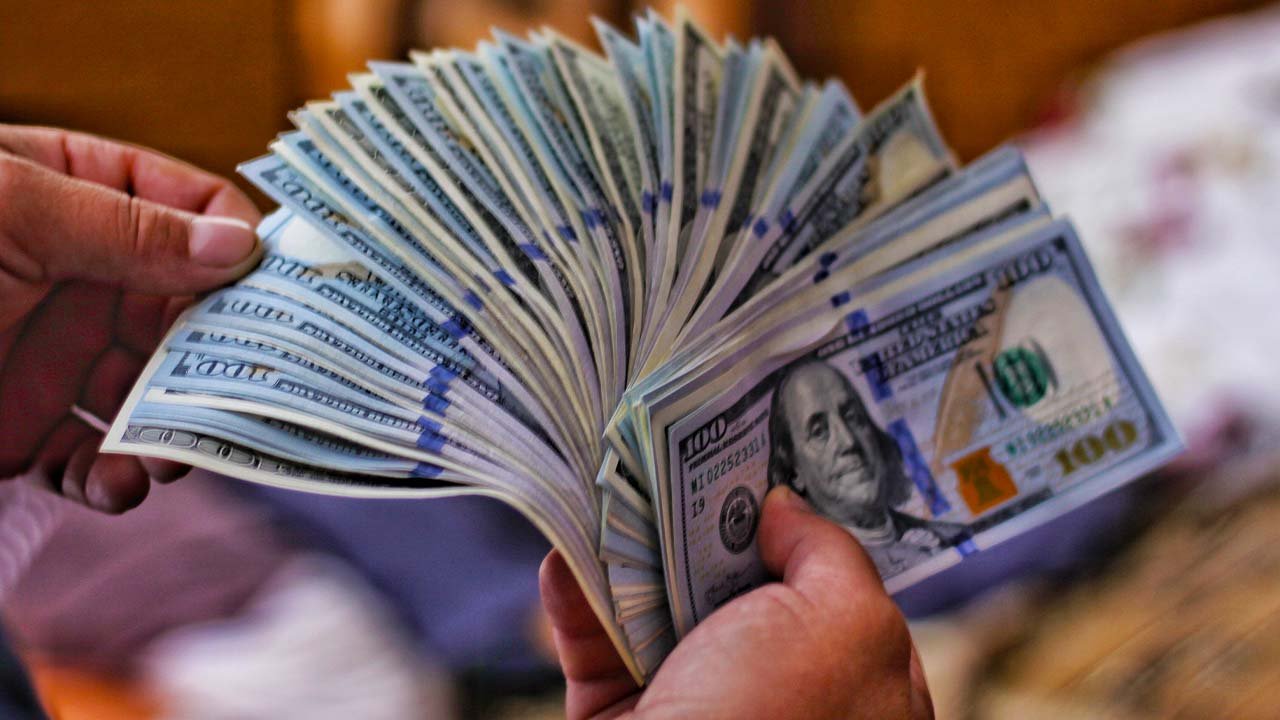
    In today’s interbank session, the Pakistani rupee (PKR) fell by Rs1.05 versus the US dollar (USD), concluding at Rs186.97 per US Dollar, compared to Rs185.92 per USD on April 20.

    The rupee had a tumultuous market session, with an intraday high of Rs187.10 and a lowest of Rs186.25. This depreciation of PKR is attributed to the country’s expanding current account deficit and dwindling foreign exchange reserves. However, the country must pay a significant amount in the final quarter of FY22, putting additional strain on the local unit.

    Pakistan’s currency has lost Rs29.42 versus the US dollar since July 21. According to data published by Mettis Global, the rupee declined by Rs10.45 in CYTD, with the month-to-date (MTD) position showing a drop of 1.87 percent.

    PKR has shed 18.56 per cent versus the US dollar in the previous 52 weeks, with a low of 186.97 today and a peak of 152.27 on May 7, 2021.

    Furthermore, the local currency has lost 10.11 per cent versus the euro since its high on May 5, 2021. Since its high on May 7, 2021, it has declined 13.24 per cent against the pound.

    Read more: PKR continues losing streak against US dollar, sheds Rs1.48

    The PKR slid Rs2.4 against the pound sterling, completing the day at Rs244.4 per GBP, down from Rs241.97 per GBP the previous session. Similarly, the PKR lost three rupees against the euro, closing at Rs204.08 at the interbank today.

  • Another hike of Rs4.9 per unit approved in power tariff

    Another hike of Rs4.9 per unit approved in power tariff

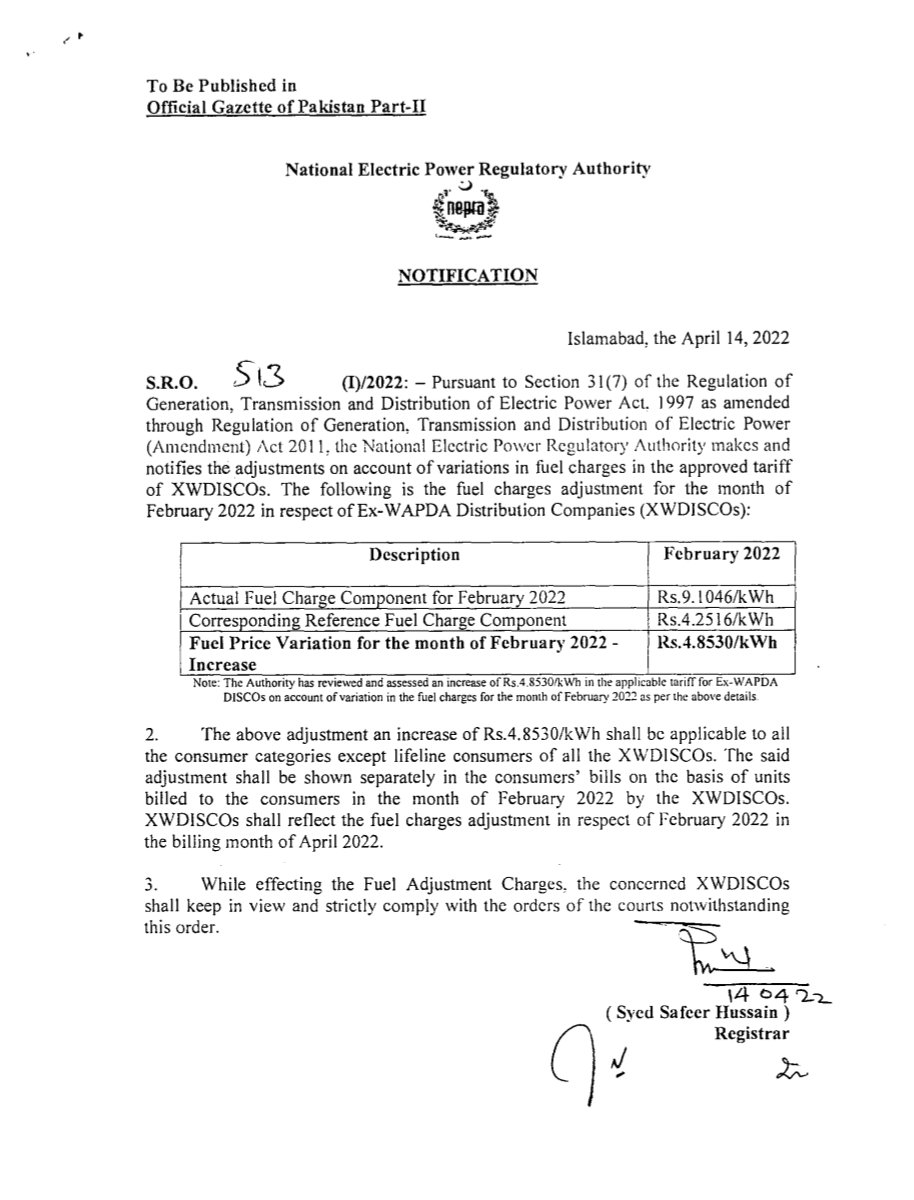
    Owing to the monthly Fuel Cost Adjustment (FCA) for February, the National Electric Power Regulatory Authority (NEPRA) on April 15 increased the price of electricity by Rs4.85 per unit.

    It has also announced an increase in the price of power, stating that the power output in February was more expensive than the previously set fuel price.

    According to the notice, the power distribution companies (DISCOs) will collect the amount from electricity consumers in the April bill. In addition, consumers will be hit with a charge of Rs37.7 billion, excluding general sales tax (GST). However, K-Electric and lifeline customers will be exempt from the hike.

    On March 31, the NEPRA held a hearing to determine the FCA but did not make a decision. The Central Power Purchasing Agency (CPPA) requested that the cost per unit be increased to Rs4.94 by the NEPRA.

    Following the monthly FCA, which only operates for one month, the administration had already hiked the power price to Rs5.95 per unit for the month of January.

    As per NEPRA’s data, the most expensive energy production sources, including High-Speed Diesel (HSD) and Residual Fuel Oil (RFO), were used more than average in the prior months, raising the overall cost of production.

  • PM Shehbaz rejects OGRA’s proposal, petrol price to remain unchanged till April 30

    PM Shehbaz rejects OGRA’s proposal, petrol price to remain unchanged till April 30

    Pakistan’s new Prime Minister (PM) Shehbaz Sharif on Friday dismissed the proposal from the Oil and Gas Regulatory Authority (OGRA) to raise the price of petroleum products for the fortnight. The recent decision is aimed at providing relief to the public affected by inflation.

    It is worth noting that the present government’s choice to maintain the same prices will oblige it to provide another substantial subsidy till the end of April 2022.

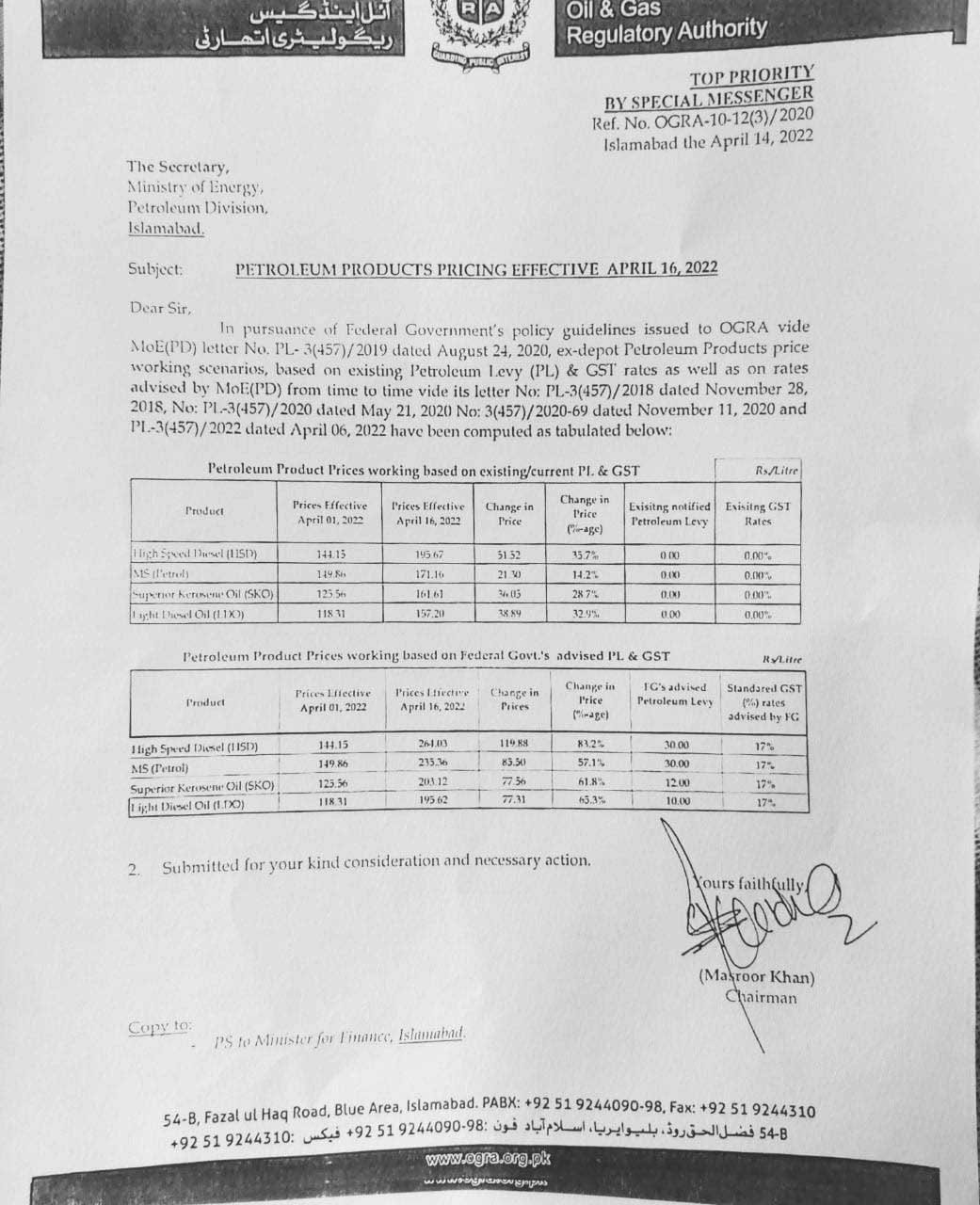
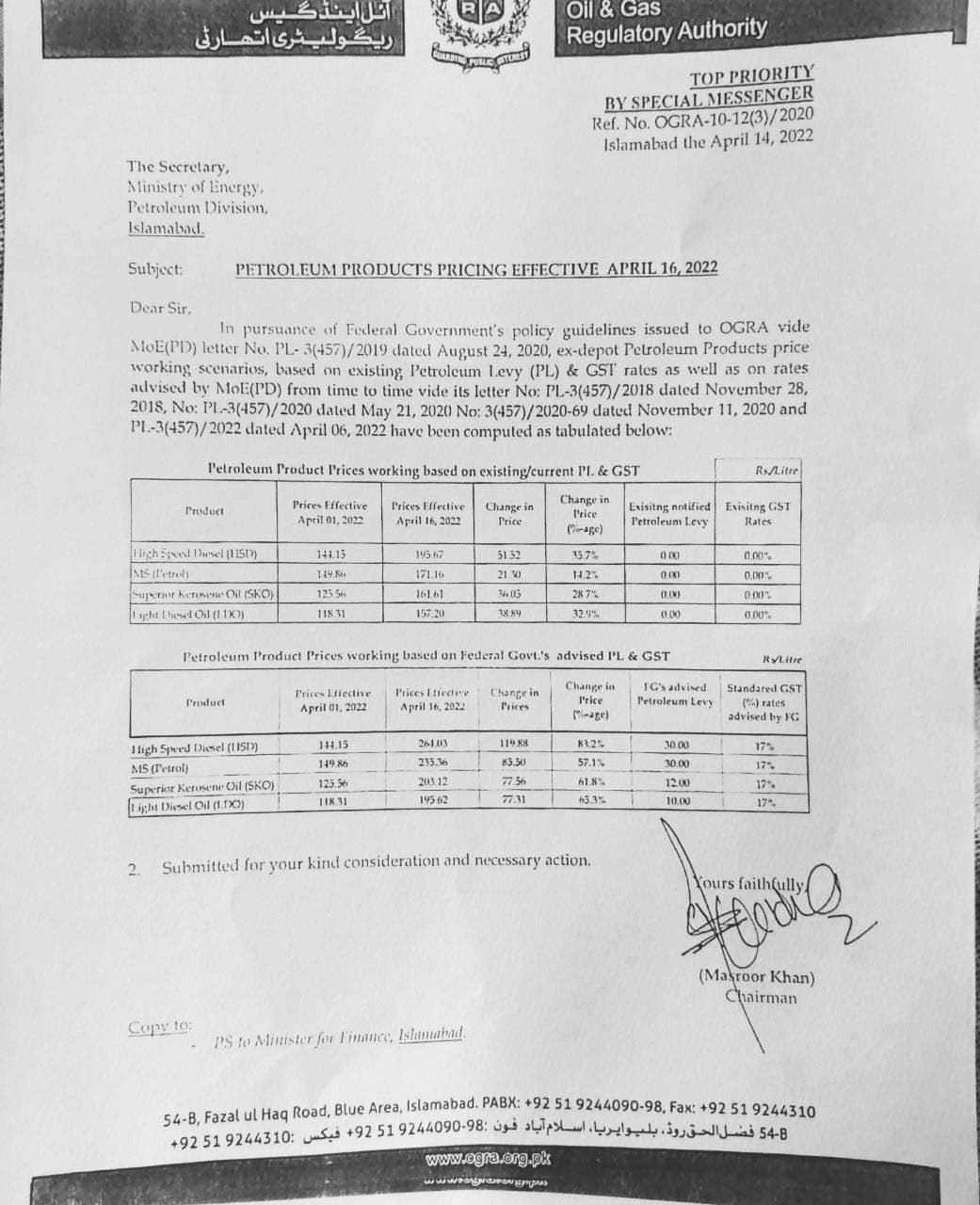
    Earlier, OGRA suggested to the Finance Division that the price of petrol be increased by Rs21.50 and that of diesel be hiked by Rs51.30 in view of the current petroleum levy and general sales tax (GST).

    Read more: Massive hike of Rs83.5 for petrol, Rs119 for diesel proposed by OGRA

    The authority also proposed a hike of Rs83.50 per liter of petrol and Rs119.88 per liter of diesel considering the federal government’s recommended petroleum levy of Rs30 and 17 per cent GST, as per the official statement.

  • Massive hike of Rs83.5 for petrol, Rs119 for diesel proposed by OGRA

    Massive hike of Rs83.5 for petrol, Rs119 for diesel proposed by OGRA

    The Oil and Gas Regulatory Authority (OGRA) suggested the federal government elevate fuel prices by up to Rs83.5 per liter for petrol and Rs119 for diesel.

    A summary to the petroleum division was presented by OGRA for the huge increase in petroleum rates to come into effect on April 16 in Pakistan.

    The proposed raise was calculated using a 70 per cent GST rate plus a Rs30 per liter levy. It is worth noting that the current duty on fuel and diesel is Rs30 per liter, plus 17 per cent GST.

    On the basis of complete levy and taxes, the body has recommended raising petrol prices by Rs83.5 per liter, while diesel prices should be raised by Rs119 per liter.

    According to reports, the OGRA proposed raising the petrol price to Rs21.53 per liter in line with the current tax rate, Rs51.3 for diesel, and Rs77.56 for kerosine oil on the grounds of full tax and levy.

    Read more: Gold prices go up by Rs350 per tola to Rs130,300

    Concerning other oil products, a full tax rate and levy hike of Rs77.31 was suggested for light diesel, Rs36.5 for kerosine oil, and Rs38.89 for light diesel. According to sources, the finance ministry would make the final decision on the OGRA summary after briefing Prime Minister Shehbaz Sharif.