Tag: inflation

  • Man jumps off 3rd floor of a Karachi mall, commits suicide due to unemployment

    Man jumps off 3rd floor of a Karachi mall, commits suicide due to unemployment

    A young man has committed suicide by jumping from the third floor of a mall in Karachi. As per Jang, 27-year-old Zuhair Asim had been unemployed for a very long time.

    According to the details, the deceased was the resident of Ancholi and was the eldest of four siblings.

    FB Industrial Area Station House Officer (SHO) Jamil Abbasi has said that the man likely committed suicide due to unemployment. “He was taken to a private hospital in Karachi’s Gulshan-i-Iqbal area where he was pronounced dead,” the official added.

    In a Facebook post, the management of the mall termed it as an “unfortunate incident.” The statement further said that “an individual jumped before he could be stopped”.

    “The mall authorities immediately took him to the nearest hospital and informed the police, who are now investigating the case,” the statement added.

    Earlier this month, Muhammad Faheem, a former employee of a private media news organisation, committed suicide after being fired from his job. As per reports, he committed suicide due to continuing financial problems.

    Read more- TV channel production operator commits suicide after being fired

    It is pertinent to mention here that inflation in Pakistan has increased to 11.5 per cent from 9.2 per cent, the highest increase in the past 20 months influenced by a record hike in fuel prices last month.
  • Inflation hike up to 11.5pc, highest in 20 months

    An increase in consumer prices continued as inflation rises up to 11.5 per cent from 9.2 per cent in November, the highest increase in the past 20 months due to a record hike in fuel prices last month, reports Dawn. This has been revealed by Pakistan Bureau of Statistics (PBS) data.

    Inflation measured by the Consumer Price Index (CPI) increased to its highest level in 20 months.

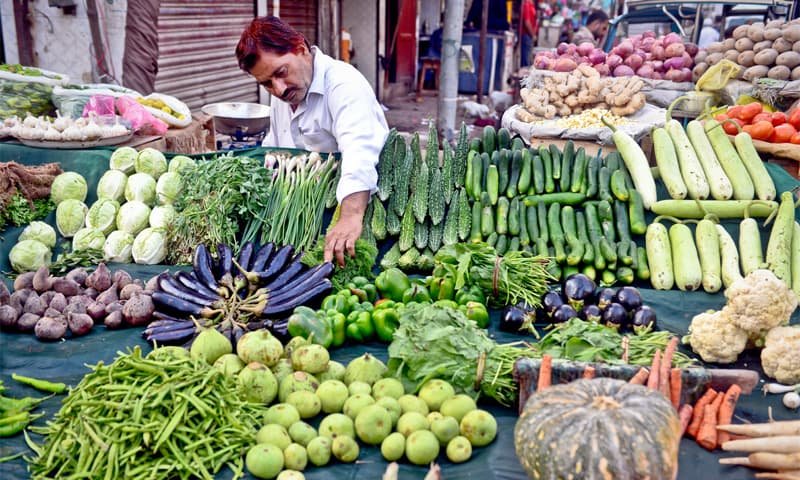
    Prices of fresh vegetables, fruits, and meat have also shown a significant increase in major urban and rural centres.

    The average inflation during the July-November period rose to 9.32 per cent on a yearly basis.

    Currently, the government aims to increase agriculture productivity for food security and self-sufficiency to counter food inflation by offering Agri-loans.

    The finance division in its recent report claimed that taking into account new price impulses in November and the low base effect, inflation would remain between 8.5 and 9.5 per cent, but the November inflation has already surpassed the projected figure.

  • ‘I am not making any profit’, food-price inflation is crushing Pakistan’s poorest

    The New York Times (NYT), in an article has documented the lives of the public in the wake of high inflation in Pakistan.

    Pakistan, which is already under heavy debt has recently reached an agreement with the International Monetary Fund (IMF) for the first one billion dollars of what is expected to be a 6 billion dollars rescue package announced by the government earlier this week. Last month, Saudi crown prince, Mohammed bin Salman, pledged 4.2 billion in cash assistance to Pakistan.

    “The economy is the biggest threat that the government is in fact facing right now. This is basically eroding the very basis of their public support, said Khurram Husain, a business journalist in Karachi.

    Journalists Emily Schmall and Salman Masood reported on the life of 66-year-old Muhammad Nazir, a shopkeeper who canceled his daughter’s wedding and despite having a motorcycle at home, walks to his shop. Many of his shelves are empty because he can’t afford to stock the same supply of candy, soft drinks, and cookies that he once did.

    “I am not making any profit these days. Still, I come here every day, open the shop and wait for customers,” Nazir said.

    Saleem Shahzad, a plumber who recently moved his six-year-old son to a less expensive school said, “[The Prime Minister] Imran Khan is a good person and is still liked by many, but his team is not performing. It is incompetent.”

    According to government data, inflation in Pakistan surged 9.2 per cent in October from the year 2020. The cost of basic food items this month increased by 17 per cent. Pakistan’s biggest food import is palm oil, which has also jumped in price. Moreover, in recent months Pakistanis have seen standard gas prices jump to 34 per cent.

  • Govt plans to provide gas three times a day for cooking only

    The government has decided to provide gas to the residential sector only three times a day for cooking purposes throughout December to March to minimise gas shortages in Pakistan, reports Dawn.

    “Gas to residential sector shall be provided three times a day for cooking only,” the meeting was informed by the Ministry of Energy (Petroleum Divi­sion), who added that Regasified Liquefied Natural Gas (RLNG) diversion to domestic consumers is to be made bare minimum for stability.

    Gas supply to power and fertiliser sectors of the country is expected to remain stable. Their supply and demand would remain unchanged.

    This was all decided by Cabinet Committee on Energy (CCoE) during a meeting presided over by Minister for Planning and Develop­ment Asad Umar. This is part of the Gas Load Management Plan for winter 2021-22, which was presented to the committee.

    It should be noted that the world is experiencing a fuel and gas shortage as recently it has been reported that the United States (US) government urged its citizens to leave Haiti because of the severe lack of fuel and closing down of gas stations in the country that have affected hospitals, schools, and banks.

    During the meeting, Oil and Gas Regulatory Authority (OGRA) also presented their additional measures against illegal gains and other revised rules according to which fines have been revised for licensees. The maximum penalty for major violations now starts from Rs10 million to Rs500 million.

    Like every year, Pakistan is expected to be hit by a major gas crisis, reports Geo News.

    One of the reasons is that local discoveries of gas have witnessed a dip, so the domestic gas reserves are reduced, the sources explained, adding that the local gas supply stood at 4,300 mmcfd a few years back but now it has depleted and stands at 3,300 mmcfd. 

  • Govt to stop release of weekly Sensitive Price Index after severe backlash due to inflation

    Govt to stop release of weekly Sensitive Price Index after severe backlash due to inflation

    After severe criticism due to uncontrolled inflation, the federal government has decided to stop the release of weekly Sensitive Price Index (SPI) data and instead release monthly Consumer Price Index (CPI), reports Business Recorder.

    This decision was taken by the Federal Cabinet in its meeting held on November 2, presided over by Prime Minister (PM) Imran Khan.

    The cabinet took note of the presentation by the Finance Division on prices of essential kitchen items and observed that despite inflationary pressure, prices in Pakistan were still lower in comparison to other regional countries.

    The Cabinet directed the Planning, Development & Special Initiatives Division to only release CPI on monthly basis, instead of weekly SPI, in line with the practice prevalent internationally.

    The Cabinet also directed the Finance Division to include Sri Lanka in the price comparison with regional countries.

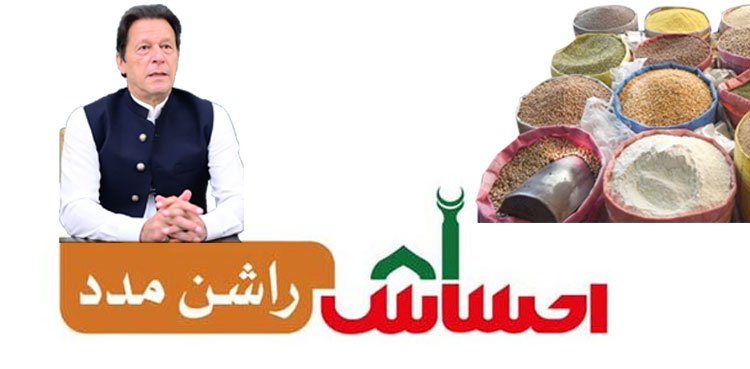
  • Everything you need to know about Ehsaas Rashan programme

    Everything you need to know about Ehsaas Rashan programme

    The registration of poor families whose monthly income is less than Rs31,000 has begun today under the Ehsaas Rashan Programme. Special Assistant to the Prime Minister on Poverty Alleviation and Social Protection Dr Sania Nishtar, giving details of the programme, said that the eligible families will be able to obtain items of daily use like flour, oil, sugar and pulses at subsidised rates from Utility Stores and retail stores (kiryana shops). Small retail stores opened even in streets and localities will also provide this facility if they are registered and authorised for this system.

    Registration process:

    The National Socio Economic Registry (NSER) survey of the Benazir Income Support Programme (BISP) has been completed.  A database of 27 million households was originally developed during a nationwide survey under the Pakistan People’s Party (PPP) government in 2010-11.

    Another survey will be used to identify deserving families for this new pro-poor programme. It will take three or four weeks to complete the process of registration. The beneficiaries will need a mobile phone number registered on their Computerised National Identity Card (CNIC), which will be produced before the specific stores from which purchases on subsidised rates will be sought.

    How will it work?

    The kiryana merchants will require downloading the relevant app on their Android phones, entering CNIC numbers of the customers and pass on the benefits after authentication from the back-end immediately.

    The customer will receive a verification code, which would be entered by the kiryana merchant in the app.

    Eligibility Criteria:

    20 million households across Pakistan with a poverty score of less than 39 and an income of Rs 31,000 per month.

  • ‘Loves to fool common men’: Dur-e-Fishan hits out at PM Imran Khan

    ‘Loves to fool common men’: Dur-e-Fishan hits out at PM Imran Khan

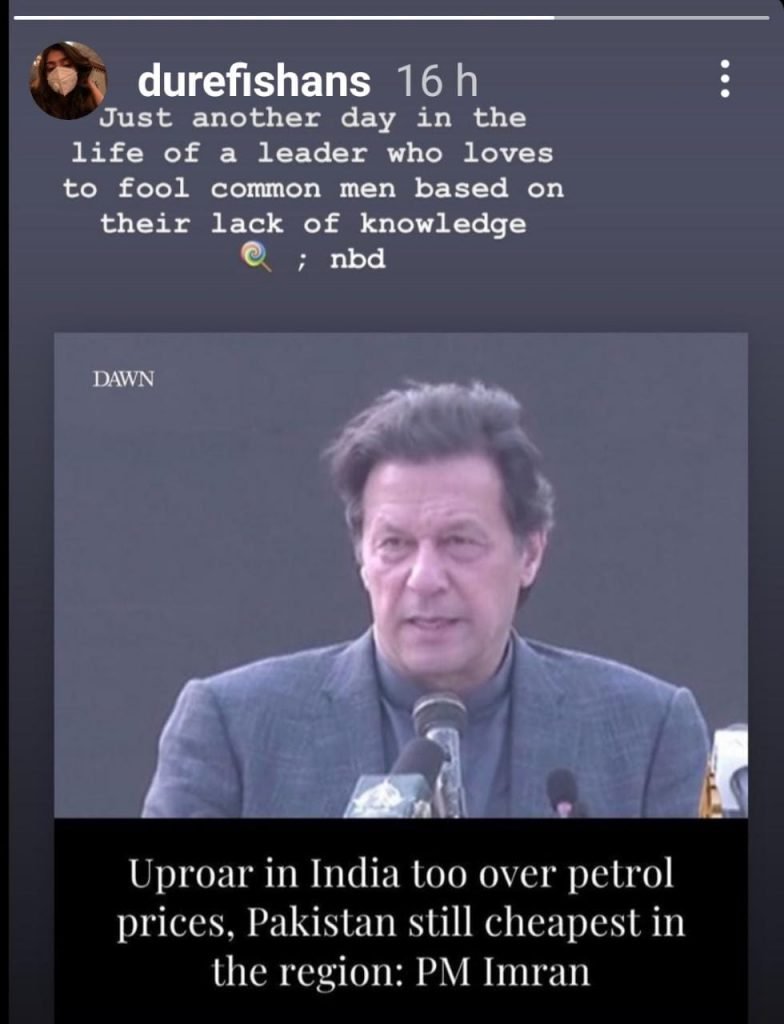
    Actor Dur-e-Fishan Saleem took to her Instagram stories to slam Prime Minister Imran Khan for his recent statement on Inflation.

    The Dilruba star wrote that the PM loves to fool common men as they lack fundamental knowledge about sociopolitical matters.

    PM stated recently while addressing a public gathering in Attock after laying the foundation stone of a Maternal and Child Hospital, “In India today, there is uproar as well [over petrol prices] and the petrol price per litre is Rs150 while it is Rs200 in Bangladesh. [On the other hand] it is the lowest in Pakistan at Rs146.”

    He said that among the oil-importing countries, Pakistan had the lowest prices for petrol and diesel.

    The premier said that inflation had occurred globally due to the Covid-19 pandemic causing various issues such as supply shortages, trade closure, lockdowns, reduced buying and selling.

    She recently appeared on Ahsan Khan’s chat show along with his Pardes co-star Affan Waheed. The duo indulged in candid conversation over their personal and professional lives.

    Affan Waheed in two minds on working with Dur-e-Fishan: 'We bonded over time

    The Do Bol star revealed that Dur-e-Fishan was proposed by a white classmate in America when she was doing her bachelors.

    He said that the Dilruba diva even considered the proposal but eventually turned it down. On being asked about the same by Ahsan, Dur-e-Fishan answered that she was just 19 years old back then so it was too early to get married also she had apprehensions about her mother’s reaction on the same so she declined his proposal after considering it shortly.

  • ‘Three sugar mills in Sindh were shut down, leading to an increase in the price of sugar to Rs140 per kg’: PM Khan

    ‘Three sugar mills in Sindh were shut down, leading to an increase in the price of sugar to Rs140 per kg’: PM Khan

    Prime Minister (PM) Imran Khan during an address at a ceremony in Attock on Friday said that Sindh shut down three operational sugar mills, which contributed to an increase in the price of sugar.

    “The price of sugar in Pakistan has hit Rs140 per kg. I inquired why this was so. I learned that three sugar mills in Sindh, which were operational, were shut down,” the prime minister said.

    The prime minister went on to say that he subsequently learnt that due to the reduced supply, the sugar mills in Punjab began to hoard the commodity.

    “I told the chief secretary that our law forbids hoarding and so if the sugar mills are doing so, we must retrieve the stock and bring it out to the market so the price drops.”

    “We found out that since July, the sugar mills have obtained a stay order against the rule. And so our government was unable to do anything,” PM Imran Khan said.

    “This is a gross injustice that the sugar mafia earns billions after having broken the backs of our people. And when the government moves to do something, they obtain stay orders,” he remarked.

    PM Khan claimed that there was uproar in India as well over high petrol prices and Pakistan still had the cheapest petrol prices in the region.

    “In India today, there is uproar as well [over petrol prices] and the petrol price per litre is Rs150 while it is Rs200 in Bangladesh. [On the other hand] it is the lowest in Pakistan at Rs146,” the premier said.

    “The biggest [impact] of what happened was that the oil price first decreased and now in the last three months it has doubled […] when oil becomes expensive, then everything becomes expensive.”

    “When there was inflation in the whole world then obviously Pakistan is in this same world and not in the heavens so we also had to be affected. As a result, we fully tried and are still trying to protect our people from this inflation.”

    The prime minister’s comments come the same day as the government increased petroleum prices by up to Rs8.14 per litre with immediate effect to ensure the revival of the International Monetary Fund (IMF) programme.

  • ‘Govt is only giving takleef’, Opposition slams price hike

    The Opposition slammed Prime Minister (PM) Imran Khan’s government for increasing petroleum prices once again and setting a new record in the country’s history.

    Pakistan Muslim League-Nawaz (PML-N) President Shehbaz Sharif said, “Government officers are being changed because of incompetence but Imran Khan is still sitting on his seat after the biggest incompetence and corruption,” adding that it had been proved that the incumbent government could “only give takleef (trouble) to people instead of relief”.

    “[PM] Imran Niazi has become a killer of people’s joy,” tweeted Shehbaz.

    Pakistan People’s Party (PPP) Chairperson Bilawal Bhutto-Zardari took to Twitter and wrote, “Govt increase petrol in the dead of night by Rs8. Increase of almost 20rs in less than a month.”

    PPP leader Sherry Rehman also slammed the government and tweeted, “Days after announcing a ‘relief package’, PTI govt drops another petrol bomb by hiking petrol prices by a whopping Rs8.14/L. Petrol prices now stand at a record Rs145.8/L. First time in Pakistan’s history that prices of all petroleum products are above Rs110/L.”

    PML-N leader Marriyum Aurangzeb demanded the resignation of PM Khan. “Increasing the price of petrol and sugar under the relief package is only increasing the hardships of the people and making life easier for the mafia and filling their pockets.”

    Earlier today, the Opposition protested against the ‘petrol bomb’ by walking out during Senate proceedings.

    Meanwhile, PPP Senator Bahramand Khan Tangi chose to protest the increase in petrol prices by cycling to Parliament House from Parliament Lodges.

  • Petroleum prices increased by up to Rs8.14 per litre

    Petroleum prices increased by up to Rs8.14 per litre

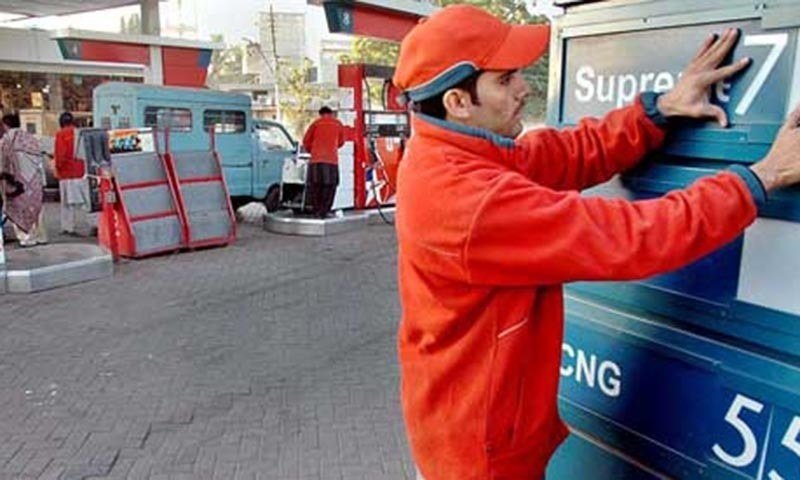
    The government increased the petroleum prices again by up to Rs 8.14 per litre early in the morning on Friday.

    For the first time in the country’s history, the prices of all the petroleum products are above Rs110 per litre, reported Dawn.

    The announcement was made by the Ministry of Finance on Friday with immediate effect to ensure the revival of the International Monetary Fund (IMF) programme.

    The government increased the price of petrol and high speed diesel by Rs 8.03 and Rs 8.14 per litre, respectively. Similarly, the prices of kerosene and light diesel oil were increased by Rs 6.27 and Rs 5.72 per litre, respectively.

    Under the notification, the new price of petrol is Rs145.82 per litre The price of High Speed Diesel (HSD) is now Rs142.62 per litre.

    The price of kerosene is set at Rs116.53 per litre. Likewise, the rate of light diesel oil (LDO) has increased to Rs114.07.

    The news came forward after Prime Minister (PM) Imran Khan’s announcement of the “biggest” relief package worth Rs120 billion. However, he cautioned that there will be an increase in fuel prices in the coming days.