Tag: inflation

  • Fifth-lowest growth rate in South Asia as inflation continues to rise in Pakistan: Asian Development Bank

    Fifth-lowest growth rate in South Asia as inflation continues to rise in Pakistan: Asian Development Bank

    The Asian Development Bank (ADB) on Wednesday projected that inflation in Pakistan would remain the highest in the region at 7.5 per cent, and the economy would grow by 4 per cent – the fifth-lowest growth rate among seven South Asian nations, contradicting the government’s claim of lowest prices in the country, reported Shahbaz Rana for The Express Tribune.

    Pakistan’s “economy is expected to continue recovering in the fiscal year 2021-22, with real GDP projected to rise by 4 per cent”, according to the ADB report.

    It was the fifth-lowest economic growth rate in the region as the economic growth rate in the Maldives (15 per cent) and India (7.5 per cent) remain the highest in the region. Bangladesh is projected to grow at 6.8 per cent and Nepal at 4.1 per cent in 2022, according to the ADB.

    The ADB said that the 4 per cent growth rate was contingent on the resumption of structural reforms later in the year in an ongoing programme under the International Monetary Fund (IMF) Extended Fund Facility.

    “The economic outlook is clouded, however, by high uncertainty because it is closely tied to the course of the pandemic in Pakistan and globally.”

    The ADB has also cautioned about a further increase in prices in Pakistan, provided the Pakistan-IMF deal collapses.

    “Risk of inflation higher than forecast derives from any unusual increase in oil prices or from potential currency depreciation in the wake of any early winding down of the ongoing IMF programme,” said the ADB.

  • Twitter reacts to hike in petroleum prices, Fawad defends

    Twitterati reacted to the hike in petroleum prices in Pakistan, using the hashtag #PTIPetrolBomb, which is currently in the top trends.

    Musician and politician Jawad Ahmad tweeted: ”Petrol price is up by Rs 5/litre.It won’t affect the elite & ruling class whichever party they belong to. Youth of Pakistan! These people have so much money that their next many generations would live comfortably with it. They fight on TV & social media but actually, they’re all one.”

    Former anchorperson Gulmeenay tweeted, “My husband and I run a small food delivery service. We cannot currently afford a rider so he does the deliveries himself. This petrol price increase (and all the previous increases) literally impacts our income and our ability to pay bills and feed ourselves.”

    Apart from this, some people had hilarious responses to the petrol price hike.

    Senior journalist Mansoor Ali Khan quote-tweeted Punjab Police’s tweet about abandoned cars picture and said, “As petrol becomes more expensive, you will find most cars have been abandoned.”

    A parody news page tweeted: “The PM could not sleep all night as petrol was increased by Rs 5 per litre, say sources.”

    Minister for Information and Broadcasting Fawad Chaudhry, while responding to a journalist on Twitter, has defended the hike in petroleum prices by the government.

    “Oil prices in Pakistan are still the lowest in the region. If we had oil wells, things would have been different but we have to buy it from abroad, so the price is bound to go up if it increases in the oil market. This is the case for the rest of the imports. The real achievement is that the income of 75 per cent of the population has also increased significantly,” tweeted Chaudhry.

    The government on Wednesday notified an increase in the price of petrol by Rs 5 per litre and diesel by Rs 5.1 per litre.

  • Petrol price goes up by Rs 5 per litre

    The federal government has issued a notice to increase the price of petrol by Rs 5.0 per litre and diesel by Rs 5.1 per litre, reported Geo News.

    Apart from this, the prices of kerosene and light-diesel oil (LDO) have also been increased by Rs 5.46 and Rs 5.92 per litre, respectively. Now the new price for petrol will be Rs. 123.30 per litre, diesel will be 120.4 per litre, kerosene will be 92.26 per litre and LDO will be 90.69.

    Earlier the price of petrol was increased by Rs 5 per litre in July.

    According to Finance Minister, Shaukat Tarin the prices will be implemented from today (Thursday).

  • 46% unhappy, 32% satisfied with Punjab govt: Survey

    46% unhappy, 32% satisfied with Punjab govt: Survey

    46 per cent of the people in Punjab are rating the Pakistan Tehreek-e-Insaf (PTI) provincial government’s performance as bad, while the PTI still enjoys the support of a good 32 per cent who are satisfied with their performance, reported The News.

    The Institute for Public Opinion Research (IPOR) conducted an all-Punjab survey to gauge the feelings of voters and measure their understanding of the current political situation.

    The voters had a mixed reaction to the situation, on the one hand, half of the voters (49 per cent) were not happy with the rising prices of daily essentials and (57 per cent) declaring things were not heading in the right direction, while on the other hand, despite all these problems, majority 52 percent of the voters said they are still willing to let the current government complete its five-year term.

    49 per cent of the respondents reported inflation as the most important issue they are facing these days, while 19 per cent said unemployment, followed by 13 per cent poverty, and another 09 per cent said corruption.

  • Shaukat Tarin presents the Pakistan Economic Survey 2020-21

    Shaukat Tarin presents the Pakistan Economic Survey 2020-21

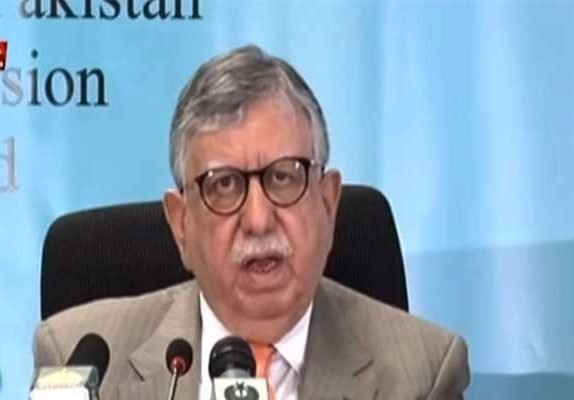
    Finance Minister Shaukat Tarin presented the Pakistan Economic Survey 2020-21 at a press conference in Islamabad on Thursday. However, the document did not have the latest figures on poverty and unemployment.

    Tarin revealed that the industrial and services sectors had helped the country post-Gross Domestic Product growth of 3.94 per cent in the first nine months of the fiscal year [FY](July to March), significantly higher than the target of 2.1 per cent.

    “The agriculture and manufacturing sectors helped the economy grow to 4.4%, laying stress on the need for sustainable growth in Pakistan in the years to come,” added Tarin.

    Coronavirus Pandemic

    The minister opened his press briefing by speaking highly of Prime Minister Imran Khan’s policies in combating the coronavirus pandemic.

    “The government itself had set [GDP] growth will be 2.1pc and the IMF predicted even lower. But the decisions by this government such as incentivising manufacturing and textiles, construction, and interventions in agriculture have helped the economy recover,” said Tarin.

    He said many people lost their jobs when the pandemic hit Pakistan, however, due to PM’s visionary policy of not imposing a complete lockdown across the country, millions of people who were unemployed were hired again. 

    “The economy is recovering,” he said. 

    Remittances

    Tarin said Pakistan’s remittances had broken records, adding that they had crossed $26bn. He said that lately imports, especially food in the form of wheat and sugar, were increasing as Pakistan’s economy was growing at the same time. 

    “We were net exporter of food but now, we have become a net importer,” he said. “Our exports registered a growth but our remittances increased manifold,” he added. 

    Ehsaas Programme

    Tarin spoke highly of the Ehsaas programme, adding that the World Bank had described it as “one of the best and the largest” poverty alleviation initiatives across the globe. 

    “Full credit goes to Sania Nishtar,” he said, adding that handing out cash to 15 million people was not a small achievement.

    Growth rate

    Tarin said he had told the prime minister it was time to focus on sustainable growth “until we go to 5-8pc GDP growth”.

    “We will do interventions and take care of the poor. The poor man has been crushed in this stabilisation phase because the dreams we have shown them have been of a trickledown economy. And this can only happen when growth is sustainable and continuous for 20-30 years,” he said.

    “Countries which had sustainable growth, they grew continuously for 20-30 years. What have we done? Every time we grow by borrowing money, which is credit-based growth.”

    Current Account

    According to the survey, during FY 2021, while the world was reeling from the economic impact of the pandemic, Pakistan’s “external sector appeared as a key buffer for resilience.”

     “The main driver of improvement in current account balance was the robust growth in remittances,” it stated.

    Trade Deficit

    “During July-March FY 2021, export of goods grew by 2.3 percent to $18.7 bn as compared to US$ 18.3 bn the same period last year. Import of goods grew by 9.4pc to $37.4 bn as compared to US$ 34.2 bn last year. Consequently, the trade deficit increased by 17.7per cent to $18.7bn as compared to $15.9bn last year,” the survey said.

    Inflation

    The finance minister said the government wanted to control inflation “but prices are still high and affecting the common man”.

    “So the way to solve this is by increasing production and that is why we have focused on agriculture in this budget,” Tarin said.

    Federal Board of Revenue (FBR)

    Speaking about the FBR, Tarin said he would end the practice of people being harassed by the bureau. “FBR will not audit [businesses or persons] but a third-party audit will be conducted,” he said. 

    International Monetary Fund (IMF)

    Tarin said Pakistan’s negotiations with the IMF were ongoing, adding that the international money lender had asked the government to hike tariffs and increase taxes. 

    The finance minister said Pakistan and the IMF want the same thing; sustainable growth, adding that the country cannot afford to increase taxes or hike tariffs so that the poor and the salaried class do not feel additional burden of inflation. 

    “This is a red line for the prime minister,” he said. “We will not further burden the poor,” he added. 

    Energy Sector

    Tarin said Pakistan’s economy was burdened due to the overcapacity in the power sector, saying that “it was a very big challenge and a black hole” for Pakistan. 

    Privitisation

     Tarin said it was fair to ask how he can privatise state-owned enterprises when all others, before him, promised to do the same but failed to. 

    “Nawaz Sharif used to shout the same slogan during the first time [when he was prime minister] and then for a second time [when he again became the prime minister] and then a third, but nothing happened,” he said. 
  • Inflation and other troubles: 73% Pakistanis believe country headed in wrong direction

    A recent survey by IPSOS Pakistan has revealed that nearly 73 per cent people believe the country is headed in the wrong direction.

    At least 1,000 people from all over the country participated in the latest survey that was conducted during the third week of March.

    Inflation has become the biggest issue for Pakistanis, as two-thirds of survey participants described the current economic situation as bad with increasing skepticism about any betterment in their conditions.

    Nearly 23 per cent found nothing wrong in the policies of the incumbent government while around 70 per cent expressed concern.

    Some 38 per cent of the participants believed there wouldn’t be any improvement in economic conditions in the next six months while 29 per cent viewed the same time period as one during which good news on the economic front will be here.

    33 percent maintained their moderate perspective on this.

    Inflation and unemployment were among the greatest concerns of the people in almost all parts of the country.

  • Incumbent government fails to control inflation, 9.1pc ahead of Ramzan

    The Consumer Price Index (CPI) witnessed a new round of inflation (increase in prices of goods and services) up to 9.1 per cent from 8.7 per cent in February.

    Inflation took place primarily due to price increase in food items, clothing and footwear, say the Pakistan Bureau of Statistics (PBS).

    Non-food items also witnessed a price hike due to higher energy rates in Pakistan. Due to the shortage of production, at the beginning of the current Fiscal Year (FY), inflation stood at 9.3pc in July that eased down to 8.2pc.

    On a month-on-month (MoM) basis, inflation increased by 0.36pc due to the increasing price of cooking oil, sugar, wheat, pulses, petroleum products, and electricity charges.

    Higher food prices pulled up inflation by 11.5pc YoY and 1.7pc MoM in the urban areas of Pakistan. The situation is similar in the rural areas where the food items prices increased 11.1pc YoY and 1.5pc, on MoM in March.

    The MoM increase indicates that prices of essential food items will see a further rise next month. The weekly prices also show an upward movement which will drag monthly inflation.

    The urban areas saw a price hike in March from the previous month included eggs 12.96pc, fruits 10pc, potatoes 9.54pc, chicken 6.58pc, sugar 4.82pc, tomatoes 4.67pc, pulse mash 4.57pc, pulse gram 4.39pc, rice 1.61pc, and wheat flour 1.46pc.

    The items whose prices declined in urban areas were onions 2.37pc, dried fruits 2.19pc, fish 1.78pc and vegetable 1.48pc.

    In rural areas, egg prices were higher by 15pc, chicken 12.21pc, potatoes 11.43pc, fruits 6.08pc, sugar 5.77pc, besan 4.71pc, pulse gram 3.89pc, gram whole 2.53pc, pulse mash 2.52pc, pulse masoor 2.18pc, vegetable ghee 1.58pc, cooking oil 1.53pc, and wheat flour by 0.97pc.

    Whereas tomato prices decreased by 6.10pc, fish 1.14pc, condiments & spices 0.61pc, and wheat 0.33pc.

    Average inflation measured by the Sensitive Price Index (SPI) surged to 18.7pc in March from 11.9pc during the previous month. On an MoM basis, it increased by 5.7pc in March.

    The Wholesale Price Index was slightly up from the previous month’s 9.5pc to 14.6pc in March. WPI inflation MoM increased by 3.7pc in March.

  • Faisalabad man refuses to marry daughter into family that praised PM Imran

    Faisalabad man refuses to marry daughter into family that praised PM Imran

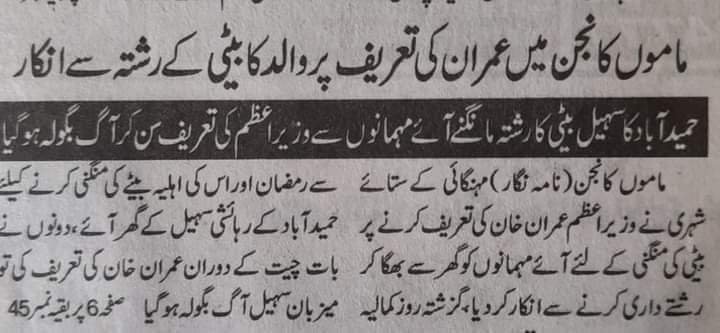
    A man in Faisalabad rejected a marriage proposal for his daughter after the other side praised Prime Minister (PM) Imran Khan, an undated Urdu newspaper clipping claimed.

    According to the report, the man, namely Hameed of Mamu Kanjan town in Tandlianwala, lost his temper when his potential son-in-law’s family praised the ruling Pakistan Tehreek-e-Insaf (PTI) and PM Imran.

    Done of inflation, Hameed lost his cool when Kamalia’s Ramzan and his wife praised the Imran-led PTI as the two families met to discuss the kids’ engagement, the report said.

    “He [Hameed] kicked the guests out of his house and refused to forge relations with them,” read the clipping.

    A massive loyalty shift has been reported among the supporters of the now ruling PTI as the opposition continues to support people against the government’s economic policies.

    Pakistan’s inflation rate, which was until recently at a record high, was 10.58% for 2019, a 5.5% increase from 2018.

    The premier claimed on Sunday that inflation had currently declined from the level of 2018 when the PTI came to power.

    “The government’s efforts are coming to fruition as both the consumer price index and core inflation had touched lower than the time of government’s formation,” he tweeted.

    “More good news on the economic front. Consumer price index and core inflation are both now lower than when our government was formed,” he said.

    Planning Minister Asad Umar also said on Twitter that inflation during January was down to 5.7% while core inflation was at 5.4%.

    “In July 2018, prior to the PTI government’s formation, CPI [consumer price index] was 5.8% and core inflation was 7.6%,” the minister said in his tweet.

    However, the Economic Survey 2019-20 released by the government as part of the current fiscal year’s budget documents and the current official data of the Pakistan Bureau of Statistics (PBS) depict a contrary picture about food inflation as the prices of essential items have gone up to between 50% and over 80% in the retail market as compared to prices in 2017-18.

  • PM believes his popularity is rising, opposition is propagandising inflation

    PM believes his popularity is rising, opposition is propagandising inflation

    Prime Minister (PM) Imran Khan has said the opposition was just propagandising inflation as all economic indicators were highlighting a positive trend, The News reported.

    He expressed these views while chairing a meeting to review the overall political situation in the country as well as the government’s media strategy. Imran directed his economic team to highlight the successes achieved by the government in the media.

    He said the political leaders responsible for the current economic mess were misleading the masses to save their face and politics. He maintained that it was due to the policies of the previous governments that the masses were suffering, say media reports.

    “We have overcome the effects of their economic decisions after two years of work and finally the economy is witnessing stability,” he added. The premier said the benefits of growing economy would soon be shifted to the masses.

    “The economic team should tell the masses as to how the previous governments ruined the economy,” he said.

    The premier added that the public gatherings in Swat and Hafizabad had once again proved that the Pakistan Tehreek-e-Insaf (PTI) enjoyed the confidence of masses.

    “PTI will also clean sweep the Gilgit-Baltistan elections as the support of the people at the rallies prove the rise in our popularity,” he said.

  • Inflation: Armed forces demand 20 per cent increase in salaries

    Inflation: Armed forces demand 20 per cent increase in salaries

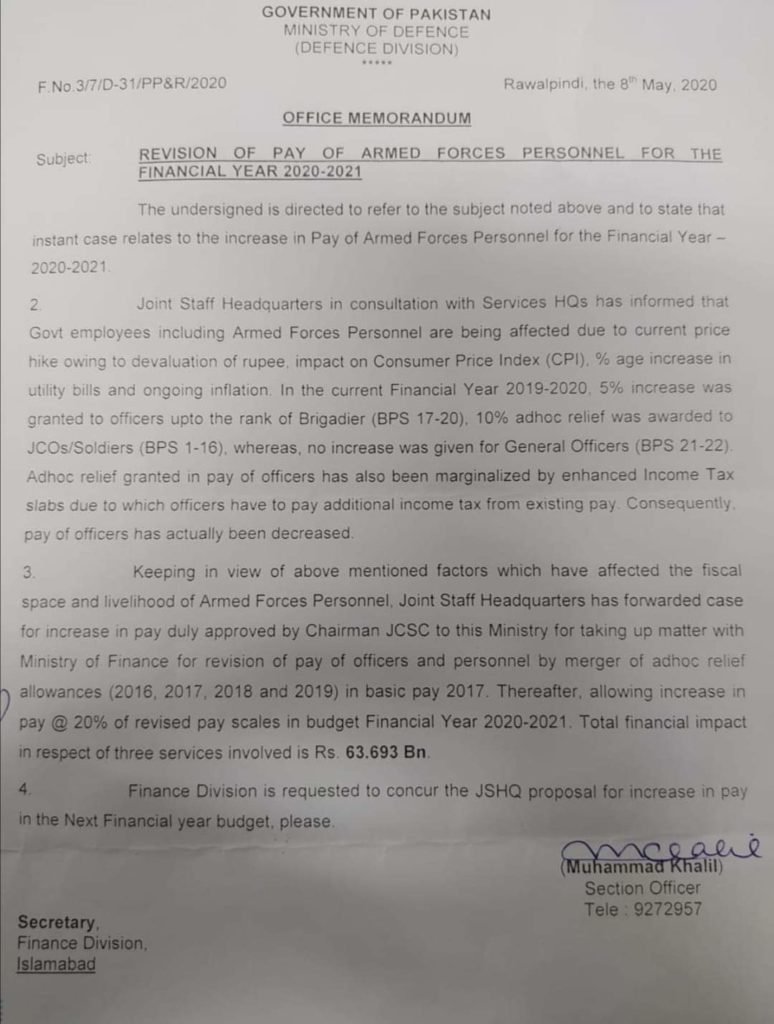
    The armed forces of the country have sought a 20 per cent increase in the salaries of their personnel for the financial year 2020-2021, which will cost an estimated Rs63.67 billion.

    According to a letter forwarded by the Defence Ministry to the Finance Division, a copy of which is available with The Current, the joint staff headquarters, in consultation with the services headquarters, has sought an increase in the salaries of armed forces personnel for being affected due to the current price hike owing to the impact of the devaluation of rupee on consumer price index (CPI), increase in utility bills and the persisting wave of inflation.

    In the current financial year 2019-2020, a five per cent increase was granted to the officers up to the rank of brigadier (BPS 17-20) and 10 per cent ad hoc relief was awarded to JCOs/soldiers (BPS 1-16), whereas no increase was given to general officers (BPS 21-22).

    Ad hoc relief granted in the pay of the officers has also been marginalised by enhanced income tax slabs due to which officers have to pay additional income tax from existing pay.

    Consequently, the pay of officers has actually decreased during the current financial year, the document maintained.

    Keeping in view the above mentioned factors, which have affected the fiscal space and livelihood of the armed forces personnel, joint staff headquarters have forwarded a case for the increase in pay duely approved by the chairman joint chief of staff committee to the Defence Ministry for taking up the matter with the Finance Ministry for the revision of pay of armed forces personnel.

    The Defence Ministry had also sought that the adhoc relief allowance for the year 2016, 2017, 2018 and 2019 be merged in the basic pay scale, and proposed a 20 per cent increase in the revised pay scale in the upcoming budget 2020-2021.

    Meanwhile, according to a Defence Ministry official, if the proposal of merging of four ad hoc allowances into revised pay scale is allowed along with a 20 per cent raise in salaries and pension of all employees, including civilians and armed forces, it will require Rs150 to Rs200 billion in the next budget.