Tag: inflows

  • Pakistan’s default risk hits a 13-year-high, reflecting foreign investors’ lack of faith

    Pakistan’s default risk hits a 13-year-high, reflecting foreign investors’ lack of faith

    The risk of default for Pakistan, as determined by the 5-year credit default swap (CDS), increased on Tuesday by 3.07 percentage points in a single day to reach a 13-year high of 52.8 per cent, indicating that foreign investors no longer have confidence in the nation.

    Before the Covid-19 outbreak in Pakistan in February 2020, the CDS was between 5 per cent and 6 per cent.

    According to Express Tribune, owing to uncertainties surrounding the renewal of the International Monetary Fund (IMF) loan programme, it peaked at over 30 per cent in the middle of this year.

    Later, as the major lender resumed its $6.5 billion programme in late August 2022 and subsequently released a $1.2 billion tranche, the CDS experienced a small recovery.

    Today, meanwhile, it is rapidly rising once more, indicating that international investors now believe Pakistan will not be able to pay back its maturing debt.

    On December 5, 2022, the country is required to repay $1 billion to overseas investors against the maturity of the 5-year Sukuk.

    The 5-year Third Pakistan International Sukuk’s yield (rate of return) is quite high, hovering at 145 per cent. Before the Covid-19 epidemic, it was around 10 per cent.

    In addition, the yield on bonds due in 2024 and 2025 is currently high at 90 per cent and 57.5 per cent, respectively, up from a low of 10 per cent in the past.

    The country’s foreign exchange reserves have decreased by about $9 billion over the past 10 months, which has caused alarm among the foreign investors.

    They are currently only covering about 1.10 months’ worth of imports at $7.6 billion, down from $20 billion (three months’ worth of imports) in August 2021.

    Ishaq Dar, the finance minister, and Miftah Ismail, his predecessor, have taken every precaution to avoid the likely default.

    They have repeatedly reassured the foreign investors that when the time came, the nation would easily repay the maturing $1 billion in December as well as fulfil other international payment obligations.

    Foreign investors are receiving warnings from the situation that the nation may default.

    However, the leadership of the nation has fully secured the $36–40 billion needed from international lenders for the current fiscal year 2023 to pay off the nation’s approximately $21 billion in foreign debt, finance approximately $10–12 billion current account deficit, and increase its foreign exchange reserves to approximately $16 billion by June 30.

    According to experts, the country’s foreign exchange reserves will increase and confidence among foreign investors will be restored with the arrival of $1.5 billion from the Asian Development Bank (ADB) in a few days and another $500 million from the Asian Infrastructure Investment Bank (AIIB) in the current month.

    They continued by saying that the inflows should also aid in lowering bond and CDS yields.

    Experts said that Saudi Arabia was the destination of Prime Minister Shehbaz Sharif’s official visit. The host nation has declared that it is resuming its investment ambitions, which include establishing an oil refinery in Pakistan for an investment of $10 billion.

    The Kingdom’s investment choice coming to fruition will also aid in regaining the trust of foreign investors in Pakistan.

    When PM Shehbaz travels to the second-largest economy in the world in November, the nation is also anticipated to get a rollover loan from China worth $6.3 billion, they claimed.

  • PKR loses for 6th straight session due to declining reserves

    PKR loses for 6th straight session due to declining reserves

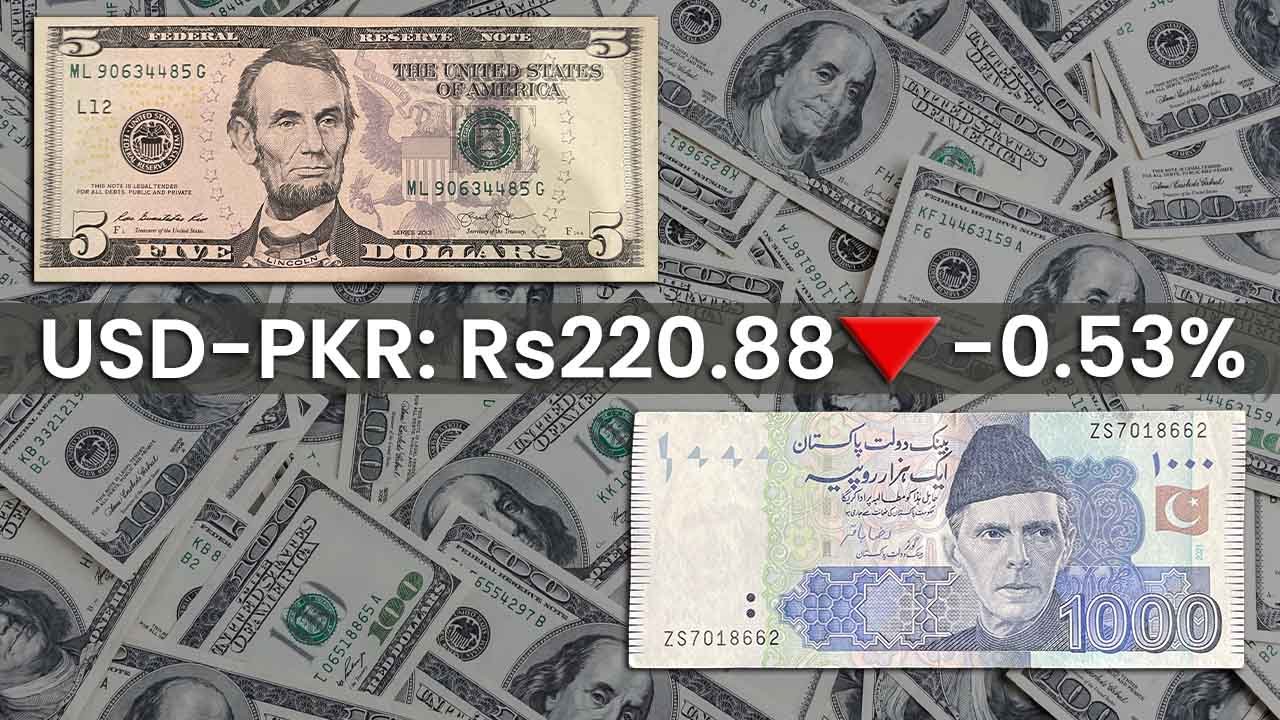
    The Pakistani rupee dropped against the US dollar for the sixth straight session on Wednesday, losing 0.53 per cent in the inter-bank market.

    According to the State Bank of Pakistan (SBP), the local currency dropped by Rs1.17, or 0.53 per cent, to close at Rs220.88. In the last six trading sessions, the rupee has lost Rs3.09, or 1.4 per cent, of its value overall.

    The rupee lost value against the US dollar on Tuesday for the fifth consecutive session, closing at Rs219.71 after losing Rs0.82 (0.37 per cent).

    According to market analysts, the local currency’s weakness is caused by declining reserves and a lack of evidence of foreign capital inflows.

    In an interview with Bloomberg, Finance Minister Ishaq Dar said that the rupee has been “heavily undervalued”.

    “It is due to speculation – and some players in the market have been responsible for that,” he added.

    Globally, the greenback hung close to a 32-year peak versus the yen on Wednesday while edging up from a two-week trough against a basket of major peers as traders weighed improved risk sentiment against the prospect of aggressive Federal Reserve rate hikes.

    The dollar index – which measures the currency against six peers including the yen, sterling and euro – edged up to Rs112.01, after dropping to the lowest since October 6 at Rs111.76 overnight.

    On Wednesday, oil prices increased marginally despite bearish factors like unclear Chinese demand growth and falling gas costs, which were offset by bullish factors like declining crude stocks and a generally undersupplied market.

  • Pakistan continues to face liquidity crunch despite IMF programme’s revival

    Pakistan continues to face liquidity crunch despite IMF programme’s revival

    Even though the International Monetary Fund (IMF) programme has resumed after a seven-month hiatus, Pakistan continues to struggle with a major dollar liquidity crunch as the catastrophic floods have exacerbated the macroeconomic conditions.

    According to Geo, since many politicians and economists advocated for Pakistan to ask the IMF for a Rapid Financing Instrument (RFI) or Natural Calamity Response-related Funding Facility, the Pakistani government has not yet submitted a new request in anticipation of the Washington-based international lender’s unenthusiastic response.

    After being put on hold in February 2022 by the previous PTI-led government’s provision of unfunded fuel and energy subsidies, the IMF project under $6.5 billion was restarted in late August.

    Since then, there has been pressure on Pakistan’s currency; nevertheless, the recent devastating floods have hurt the economy, contrary to what experts had anticipated would happen with the restart of the IMF programme.

    The rupee has dropped 9 per cent against the US dollar in recent days due to intense pressure on the currency rate.

    According to reports, the issue has gotten worse as demand for imports has multiplied and there are not enough dollars in the country. Pakistan’s macroeconomic risks are not going away without greater dollar inflows.

    The early estimates of damages have now increased to almost $18 billion as a result of the severe flooding, with Pakistan’s agriculture industry taking the biggest hit.

    The worst agricultural performance will put pressure on rising import demand for commodities, and if Pakistan cannot attract the appropriate levels of dollar inflows, food shortages may occur in the ongoing financial year.

    In contrast to the projected aim of 3.9 per cent for the current fiscal year 2022–2023, the agriculture growth could remain zero or perhaps turn negative.

  • PSX resumes recovery as KSE-100 index gains 670.87 points

    PSX resumes recovery as KSE-100 index gains 670.87 points

    The KSE-100 increased for the fourth consecutive session on Friday as the rupee continued to strengthen against the US dollar, maintaining positive investor confidence at the Pakistan Stock Exchange (PSX).

    The price of WTI crude oil was $87.95 per barrel during the day, while Brent crude oil was being sold at $93.75 per barrel, bringing the global oil prices to multi-month lows.

    The domestic equities market gained 670.87 points, or 1.62 per cent, to close at 42,096.24 points as a result of this development.

    The Pakistani currency’s ongoing rebound, which continued for the sixth day in a row against the US dollar, provided additional support for the market.

    Despite initial selling pressure on the market and a period of time in which the KSE-100 index traded flat, investor interest picked up toward the end of the first session, and the market closed roughly 300 points higher.

    The rise gained momentum in the second session, which enabled the index to pass the 42,000-point threshold and conclude with significant gains.

    The day ended strongly for index heavyweights in the banking, fertiliser, cement, chemical, automobile, and cement industries. On a weekly basis, the benchmark KSE-100 increased by 4.85 per cent. Capital Stake said that the PSX had strong sentiment for the fourth straight session.

    According to Topline Securities’ analysis, Pakistan’s stocks saw good momentum as a result of softening global energy prices for coal and oil, which experienced some correction.

    The decline enabled the market maintain its purchasing mood from Thursday and helped the KSE-100 index conclude the day at 42,096 points.