Tag: International Monetary Fund

  • Dar assures US of Pakistan’s commitment to the IMF ‘despite challenging economic conditions’

    Dar assures US of Pakistan’s commitment to the IMF ‘despite challenging economic conditions’

    Pakistan gave the United States reassurance on Wednesday that it was still committed to the International Monetary Fund (IMF) programme as the nation’s reserves fell to barely enough to cover one month’s worth of imports following another $500 million loan repayment.

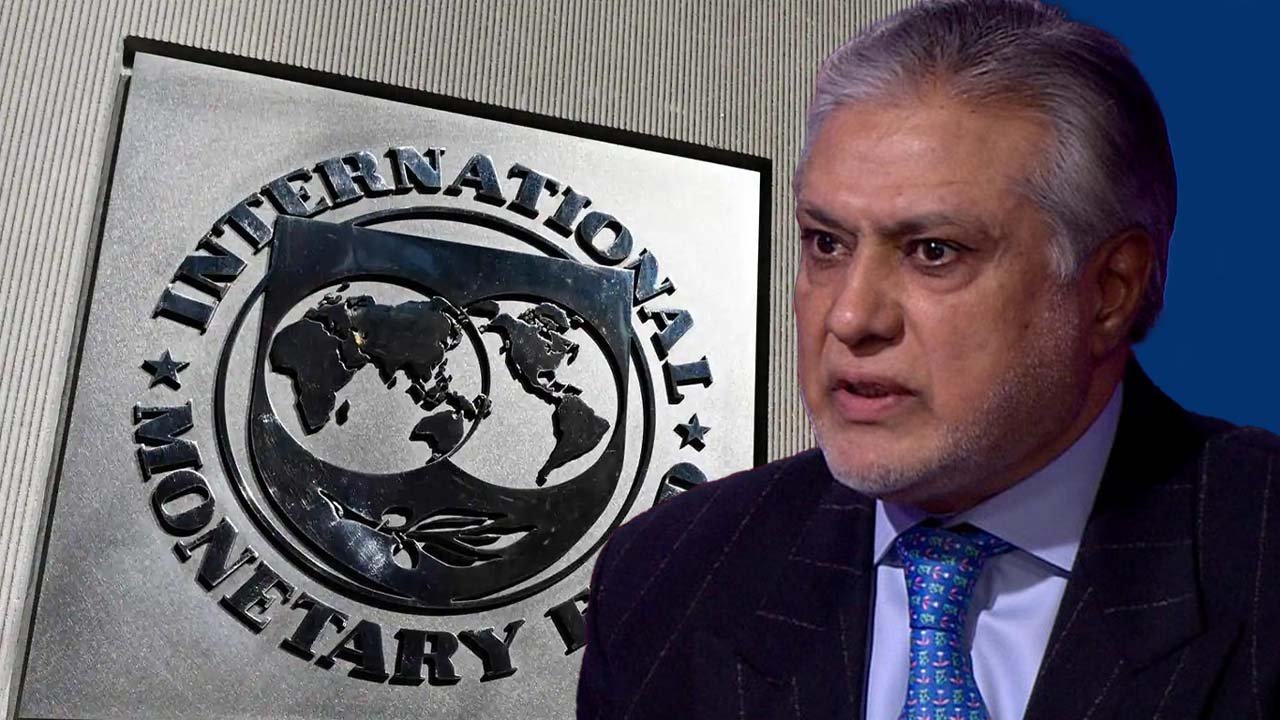
    According to a formal statement from the Ministry of Finance, Finance Minister Ishaq Dar met Robert Kaproth, Deputy Assistant Secretary of the US Department of the Treasury for Asia.

    The status of the IMF programme was discussed by both parties during the meeting. Dar informed the US official about Pakistan’s efforts to reactivate the IMF programme.

    “Despite challenging economic conditions, the government is focusing on fixing things in the right direction and introducing reforms in all sectors including the energy sector and capital market to achieve economic growth and development,” Dar told Robert.

    Pakistan has been asked by the IMF to maintain a market-based currency rate, remove import restrictions, raise taxes, and raise electricity rates. However, the administration has not yet implemented any of these steps and is holding off until there has been a formal interaction with the international lender.

    According to Express Tribune, the summit was held as foreign exchange reserves were sharply declining, falling to only two weeks’ worth of import coverage, the lowest level in more than nine years.

  • SBP-held foreign exchange reserves dropped to 9-year low of $4.34 billion

    SBP-held foreign exchange reserves dropped to 9-year low of $4.34 billion

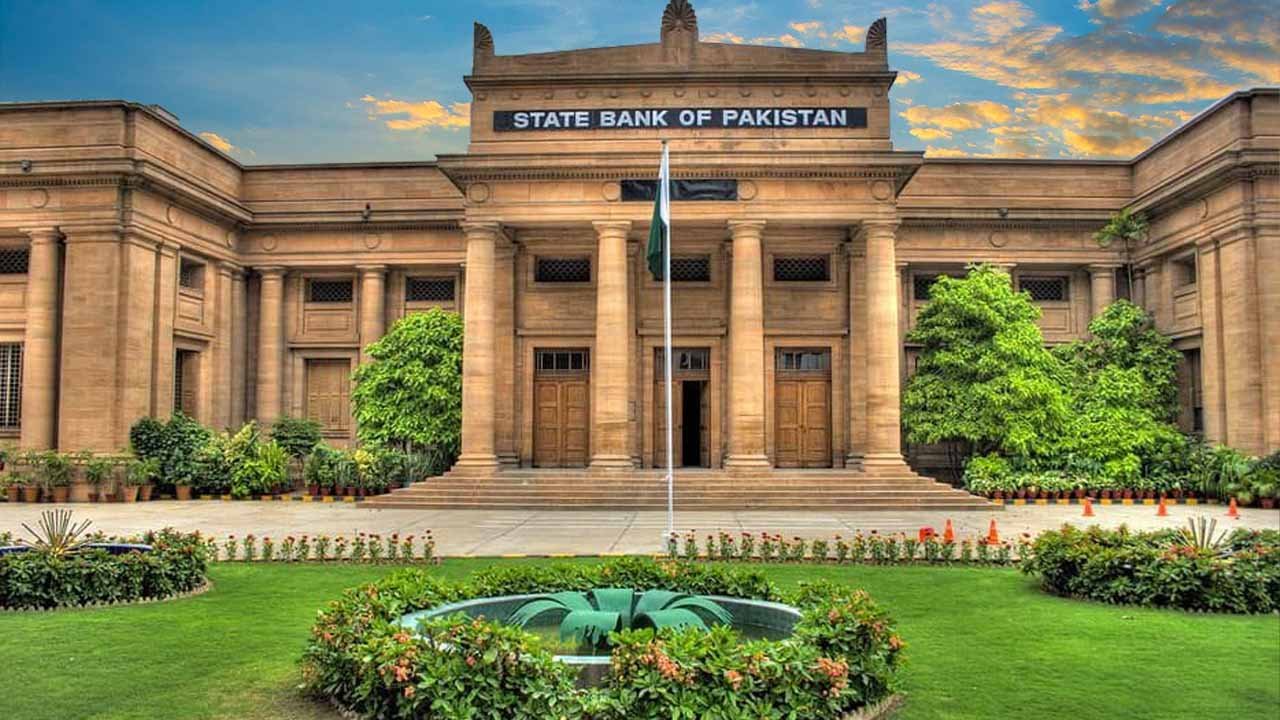
    The State Bank of Pakistan’s (SBP) foreign exchange reserves fell to $4.34 billion, its lowest level since February 2014, due to a lack of dollar inflows from the International Monetary Fund (IMF) or friendly nations.

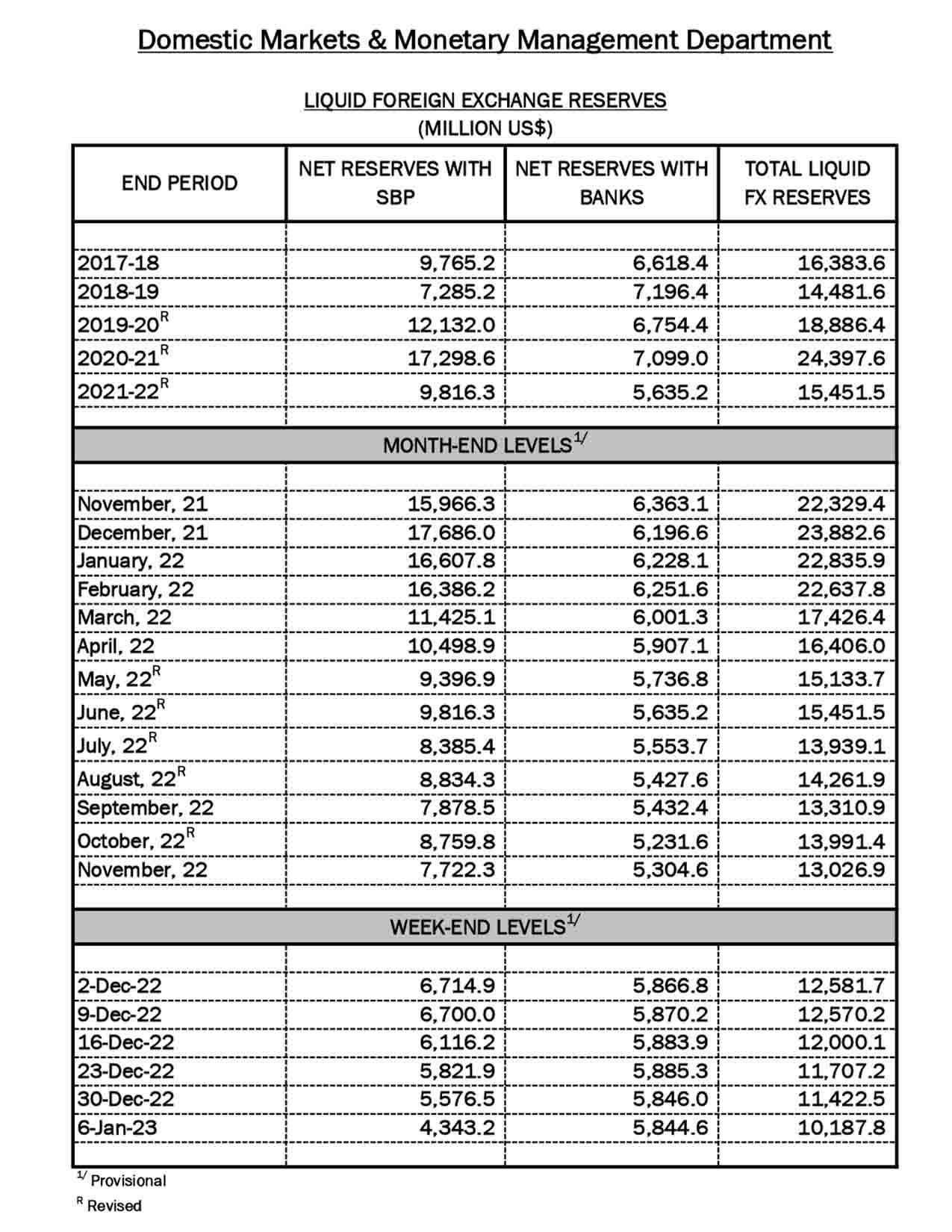
    The SBP disclosed on Thursday that due to the repayment of external debt, its reserves fell by $1.23 billion during the week ended January 6.

    The country has been experiencing a severe dollar shortage, which is having a negative impact on the capacity to import even food and industrial raw supplies. The country doesn’t have enough dollars, according to the most recent status of foreign exchange reserves, to pay for even one month’s worth of routine imports.

    Data showed that commercial banks held $5.84 billion in net foreign currency reserves, while the overall amount of liquid foreign exchange reserves was $10.18 billion.

    Ever since the beginning of 2022–2023, reserves have been rapidly decreasing. In the upcoming months, analysts predict rising inflation and limited industrial output as manufacturing is constrained by the scarcity of imported raw materials.

    According to Geo, United Arab Emirates (UAE) will roll over the existing loan of $2 billion and give an additional $1 billion loan, which should stabilise the reserve position in the coming days.

    As the government strives to reduce imports amid a dollar shortage, the reserves, which fell to their lowest level since February 2014, would now only provide import coverage of 0.82 month.

  • Pakistan will take fiscal measures set by IMF but there will be no burden on the common man: Ishaq Dar

    Pakistan will take fiscal measures set by IMF but there will be no burden on the common man: Ishaq Dar

    Federal Minister for Finance and Revenue Ishaq Dar has categorically denied rumours suggesting that the government is considering “access to foreign exchange held with commercial banks.”

    “It is categorically denied and clarified that there is no such move under consideration of the government,” said Dar, in a series of tweets.

    The statement come days after the finance minister said that the country’s foreign exchange reserves stand at $10 billion, a much higher amount than the SBP’s $5.6 billion reserves as of December 30, 2022, since “dollars held by commercial banks also belonged to the country.”

    This comment gave rise to fears that the government may confiscate dollars from private banks as had been done in 1998 when Dar was the finance minister.

    However, Dar said that his comment was “greatly misconstrued” and nothing like this would happen.

    Dar explained at a press conference with Prime Minister Shehbaz Sharif and other federal cabinet members that before 1999, all foreign currency was deposited with the State Bank of Pakistan (SBP), and private banks were not permitted to hold any foreign currency.

    “In February 1999, when I was the finance minister, we devised a system whereby a substantial amount [of dollars] remain with [private] banks. It was on June 30, 1999 that reserves were broken down into three columns — those with the SBP, commercial banks and total.

    “Whenever Pakistan’s reserves are quoted anywhere in the world — a survey or a document — the [total figure] is quoted and then a breakdown is given. I gave a breakdown too,” he added.

    The minister claimed that certain people were to blame for the country’s dire circumstances, which caused it to drop from the 24th to the 47th largest economy in 2016.

    “Even now, they cannot tolerate any good development. They gave such a twist [to my statement],” he said, adding that while the federal cabinet was busy working for Pakistan under PM Shehbaz’s guidance, such people were spreading rumours that the government would take dollars from commercial banks.

    “Nothing of that sort will happen. Everything is all worked out … and in order. Nothing to worry about,” he assured, urging those “spreading the rumours” to play a positive national role.

    Dar also tweeted about the reserves later, saying national foreign exchange reserves always include forex held with SBP and commercial banks.

    Furthermore, Dar tweeted about the reserves and stated that SBP and commercial bank holdings are usually included in the nation’s foreign exchange reserves.

    “Recently I quoted the forex reserves figure based on this principle. Some vested elements who ruined this country’s economy in the past, gave it a deliberate twist and started a campaign as if govt was considering access to foreign exchange held with commercial banks which indeed is the property of the citizens.

    “It is categorically denied and clarified that there is no such move under consideration of the government,” he emphasised.

    The finance minister once again claimed that Pakistan’s foreign exchange reserves would increase soon.

    As of December 30, 2022, Pakistan’s foreign exchange reserves had decreased to $5.6 billion, an eight-year low. This is equivalent to imports for three weeks.

    The swift decrease has made it impossible for the government to repay its international debts without taking out new loans from allies.

    Govt to comply with IMF conditions without burdening common man

    The International Monetary Fund (IMF) programme’s ninth review, which would release $1.18 billion, has been postponed for months due to the government’s refusal to comply with some conditions imposed by the international lender.

    In today’s press conference, Dar acknowledged the delay and claimed that it was due to revenue collection. The Federal Board of Revenue (FBR) missed its goal in December, the finance minister said, and the super tax that the administration enacted in June of last year had been declared unlawful by a high court.

    Dar said that his team informed the IMF that Pakistan could recover the amount easily after the Supreme Court takes a decision on the super tax.

    “We are not changing the fiscal budget target and we will achieve it,” he claimed.

    Dar said that the IMF suggested that the government implement fiscal measures and eliminate some subsidies. “We have identified some budgetary measures, but the average person won’t be overburdened.”

    He asserted that the measures would be very specific and classified.
  • Nearing default and lying about phone calls? Not good Pakistan, says IMF

    Nearing default and lying about phone calls? Not good Pakistan, says IMF

    The International Monetary Fund (IMF) stated on Sunday that Managing Director Kristalina Georgieva and Prime Minister Shehbaz Sharif spoke on the latter’s request, a claim that suggests Islamabad has continued to engage in politics while being on the verge of default.

    “The call took place in response to a request by the Prime Minister of Pakistan to discuss the International Conference on resilient Pakistan,” Esther Perez, the resident representative of the IMF told The Express Tribune.

    On Friday, the PM’s office issued an official handout stating that “the IMF managing director phoned premier Shehbaz on the phone” following his address at the Hazara Electric Supply Company’s (HAZECO) inaugural ceremony. The PM had also stated in his address that the managing director of the Fund had called him.

    As the country makes dubious claims of strength and has just $4.5 billion in foreign exchange reserves, it appears that the administration is still not ready to change its ways.

    Only three weeks’ worth of imports may be covered using the remaining funds. Pakistan has paid back $8.5 billion in debt during the past three months (January through March). Included in this is a $2 billion loan to the UAE for which the government is attempting to obtain a rollover.

    Given the long-standing animosity between the two parties, such factually erroneous claims might make it harder for Pakistan to persuade the IMF.

    Due to its propensity to make pledges while receiving a loan tranche but then break them after the tranche has been released, the country has had a rough history with the IMF. This has led to a significant gap.

    A spokesperson of the IMF in a statement to the media also said that “the Managing Director had a constructive call with Prime Minister Sharif in the context of the International Conference on Resilient Pakistan to be held in Geneva on Monday, January 9.”

    The MD once more conveyed her sympathies to those who were directly impacted by the floods, and it was also said that she backed Pakistan’s attempts to create a more robust recovery.

    Additionally, the PM asserted on Friday that an IMF delegation will visit Pakistan in a matter of two to three days.

    “I asked her to send an IMF team for the completion of the pending 9th review of the programme so that the next loan tranche is released. She assured that the mission will visit [Pakistan] in the next two to three days,” Shehbaz had said.

    However, in its statement to the media, the IMF spokesperson said that the IMF “delegation is expected to meet with Finance Minister Ishaq Dar on the sidelines of the Geneva conference to discuss outstanding issues and the path forward”.

    The self-claimed deadline, which ends on Monday, for the 9th review mission’s arrival in Pakistan was not mentioned in the statement.

    On Saturday, it was revealed that due to significant debt repayments, Pakistan’s official foreign exchange reserves have for the first time dropped to a perilous level of $4.5 billion.

    The sources in the finance ministry also stated that no dates for the IMF review mission had been decided upon as of the PM’s address.

    Additionally, the prime minister said that Georgieva had asked if Saudi Arabia and China were aiding Pakistan.

    After thereafter, Pakistan’s interior minister Rana Sanullah said that even foreign countries won’t assist without the IMF’s protection.

    “If we back out from these [IMF] conditionalities, then our economic survival will become next to impossible and even our friendly countries cannot extend financial help to us,” Sanaullah had said in Faisalabad.

    The interior minister had said that if the current administration tried to adhere to the strict requirements of the IMF, inflation would soar, prices would soar, and the economy would suffer.

    Since the 9th review negotiations between Islamabad and the Fund have not concluded as of yet, a $1.1 billion loan tranche has been withheld.

    In order for the World Bank and the Asian Infrastructure Investment Bank (AIIB) to disburse their funds, Pakistan is eager to finish the ninth review.

    Disagreements about import restrictions, currency rate regulations, demands for the imposition of more taxes, and raising energy costs to pay off over Rs500 billion in circular debts have caused the discussions to be postponed.

  • IMF team to visit Pakistan in 2-3 days to finalise ninth review

    IMF team to visit Pakistan in 2-3 days to finalise ninth review

    A delegation from the International Monetary Fund (IMF) will visit Pakistan in two to three days to “undertake and complete” the key ninth review, according to Prime Minister (PM) Shehbaz Sharif.

    PM Shehbaz said that he spoke to IMF Managing Director Kristalina Georgieva and stressed that Pakistan will complete the IMF bailout programme.

    “I told her to ease the terms of the deal because I cannot burden the common man any further. We have imposed taxes on the rich strata of the society. I requested her to send a delegation for the ninth review and she replied that a team will visit Pakistan in 2-3 days.”

    “After inquiring about Pakistan’s relations with China and Saudi Arabia, she also told me that China had urged IMF to support Pakistan,” he said.

    The IMF programme is currently stalled, with experts suggesting that the government is reluctant to implement some of the lender’s conditions over their effect on political capital in a year when elections are scheduled to take place.

    PM Shehbaz said that Pakistan was trying to mend its ties with friendly countries as well. “We should appreciate friendly countries for supporting Pakistan over the past few years but the previous government slapped allegations of corruption on Chinese firms and jeopardised the China-Pakistan Economic Corridor (CPEC).”

    He stated that the former leadership “had angered friendly nations”, adding that the contribution of Saudi Arabia, UAE and China to Pakistan’s economy is priceless.

    Pakistan needs the IMF programme to restart due to its declining rupee, shrinking reserves, and worse macroeconomic indices.

    The State Bank of Pakistan’s (SBP) foreign exchange holdings dropped by another $245 million on Thursday, down to a critically low level of $5.58 billion. Since April 2014, SBP-held reserves have never been this low.

    At the same time, the government has also been unable in obtaining crucial support from allies.

    The challenge has left Pakistani authorities scurrying to set up foreign exchange amid increased concerns over the country’s capacity to pay its debts and fund imports.

    Additionally, there are market rumours that Pakistan could possibly default, but the Pakistani government is still confident that Saudi Arabia would provide essential assistance for the country’s foreign exchange reserves.

  • SBP-held foreign exchange reserves drop to 8-year low

    SBP-held foreign exchange reserves drop to 8-year low

    The foreign exchange reserves held by the State Bank of Pakistan (SBP) continued their declining spree, plunging by $584 million to reach $6.1 billion as of December 16.

    According to SBP, this is the lowest level of reserves since April 2014.

    SBP’s reserves have decreased by $11.6 billion over the past 12 months. The central bank’s reserves, which were $17.7 billion in December 2021 and are now at $6.1 billion, hardly cover a month’s worth of imports.

    Pakistan’s total liquid foreign reserves are currently $12 billion, with $5.9 billion of that amount held by commercial banks as net foreign reserves.

    The lack of foreign assistance along with a delay in the IMF program’s revival, a greater trade imbalance, and rising foreign debt payments severely depleted the reserves.

    The Fund’s criticism over an elevated budget deficit is said to be the reason why the ninth review discussions have been postponed.

    While the IMF urges that the government must stabilize the economy, the government seems unwilling to levy more taxes in order to raise income.

  • Pakistan to get high speed train technology from China

    Pakistan to get high speed train technology from China

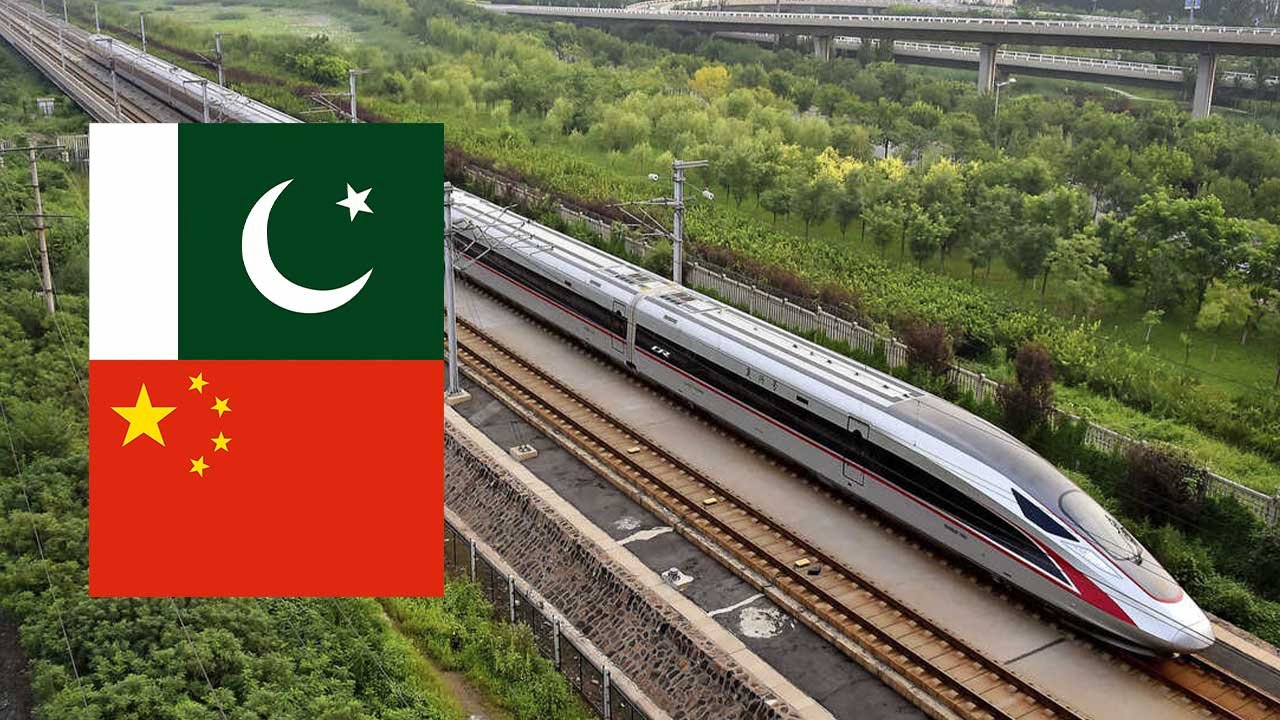
    In accordance with Chinese President Xi Jinping’s pledge to assist cash-strapped Pakistan in its financial position, Pakistan and China have decided to begin a high-speed train project for roughly $9.85 billion.

    According to a statement from the Prime Minister’s Office, the Main Line-1 is “a project of strategic importance” and the agreement was made during a meeting in Beijing between Prime Minister Shehbaz Sharif and Xi.

    The project entails modernising a 1,163-mile colonial-era track that runs from Karachi to Peshawar in order to accommodate high-speed trains, according to Bloomberg.

    The project, which has been in consideration for years, was officially approved by Pakistan earlier this week without disclosing the source of finance or offering any technical information.

    Officials in Pakistan anticipated receiving loans from China for the upgrading.

    The US has long criticised China for employing what it refers to as “debt diplomacy” to increase the dependence of developing countries on Beijing. Despite this, China postponed an earlier bailout for Pakistan as its debt skyrocketed, and it has been reducing loans to Africa as its economy weakens.

    According to a report from the International Monetary Fund (IMF) published in September, state-owned commercial banks in China are owed nearly 30 per cent of Pakistan’s foreign debt.

    Xi and PM Shehbaz decided to finalise the plans for a Karachi inner-city train route during their meeting. The Chinese president also announced that his country would give Pakistan 500 million yuan ($68.7 million) to aid with reconstruction after flooding over the summer that caused more than 500,000 people to lose their homes.

    The People’s Bank of China said in a statement that the central banks of both nations had signed an agreement of cooperation on a yuan clearing in Pakistan on Wednesday without providing many other specifics.

  • Pakistan’s removal from FATF grey list to help with its reputation and IMF’s next review

    Pakistan’s removal from FATF grey list to help with its reputation and IMF’s next review

    Experts predict that the country’s reputation would recover and it would get a credit rating upgrade from international agencies as Pakistan was taken off the Financial Action Task Force (FATF) list of nations under increased monitoring.

    According to Geo, the removal will allow Pakistan to smoothly complete the forthcoming review of the IMF’s Extended Fund Facility since the International Monetary Fund (IMF) used the execution of FATF action plans as a structural benchmark.

    Pakistan has been removed off the FATF’s “grey list,” as was to be expected, but the nation will continue to cooperate with the organisation and the Asia Pacific Group to strengthen its anti-money laundering (AML) and counter-terrorist financing (CFT) framework. FATF made this announcement following the conclusion of its two-day meeting in Paris on Friday.

    Fitch downgrades Pakistan’s rating to CCC+

    Yet on the other side, Fitch Ratings lowered Pakistan’s Long-Term Foreign-Currency Issuer Default Rating (IDR) to “CCC+” from “B-” on Friday, which experts believe is bad news for the nation’s recovery from the mega floods. The reversal comes as the country’s fragile economy continues to face challenges from all directions.

    The company claims that sovereign states with a grade of “CCC+” or lower do not normally receive outlooks. The primary factors that contributed to a downgrading, according to the agency, were increasing liquidity and policy concerns.

    “The downgrade reflects further deterioration in Pakistan’s external liquidity and funding conditions, and the decline of foreign exchange reserves,” Fitch Ratings said. “This is partly a result of widespread floods, which will undermine Pakistan’s efforts to rein in twin fiscal and current account deficits.”

  • IMF lowers growth prediction for FY23, cautions ‘the worst is yet to come’

    IMF lowers growth prediction for FY23, cautions ‘the worst is yet to come’

    The International Monetary Fund (IMF) on Tuesday warned that the worst was yet to come as it further cut its projection for global economic growth to minus 2 per cent amid persistently increasing inflation.

    According to Dawn, the global lender of last resort projected Pakistan’s GDP growth rate at 3.5 per cent and inflation at about 20 per cent in its World Economic Outlook (WEO) 2023 – Countering the Cost-of-Living Crisis with the caveat that “the 2022 projections for Pakistan are based on information available as of the end of August and do not include the impact of the recent floods.”

    The fund forecasted Pakistan’s current account deficit at 2.5 per cent of GDP for the current fiscal year, down from 4.6 per cent last year, and the unemployment rate at 6.4 per cent on the same basis. Therefore, all of these projections are based on dated information that has drastically changed over the past two weeks.

    The Asian Development Bank estimated Pakistan’s growth rate to be 3.5 per cent late last month, compared to the World Bank’s projection of 2 per cent last week.

    According to the IMF, its projections call for global growth to decline from 6 per cent in 2021 to 3.2 per cent in 2022 and then further to 2.7 per cent in 2023, which is 0.2 per cent below the July forecast, with a 25 per cent chance that it will dip below 2 per cent.

    The three greatest economies—the United States, the European Union, and China—will continue to stagnate, while more than one-third of the world economy will contract this year or the following year. It said that Russia’s invasion of Ukraine was still seriously destabilising the world economy and that “in short, the worst is yet to come.”

    The fund urged international decision-makers to maintain their composure while storm clouds formed. It blamed the lasting consequences of three strong forces—the Russian invasion of Ukraine, a cost-of-living crisis brought on by persistent and expanding inflation pressures, and the downturn in China—for the severe economic challenges the world economy is currently facing.

    According to the WEO, worldwide inflation would increase from 4.7 per cent in 2021 to 8.8 per cent in 2022 before falling to 6.5 per cent in 2023 and 4.1 per cent by 2024. With more variation in emerging markets and developing nations, upside inflation shocks have been most common in advanced economies.

    The fund recommended emerging market officials to batten down the hatches right away. IMF access to preventative instruments should be urgently considered by eligible nations with strong policies who want to increase their liquidity reserves.

    As too many low-income countries were in or on the verge of debt distress, the countries should also try to reduce the effects of upcoming financial instability by a combination of preventative macroprudential and capital flow measures, where appropriate.

    The IMF stated that in order to prevent a wave of sovereign debt crises, the Group of Twenty’s Common Framework’s progress toward orderly debt restructurings for the most impacted was urgently required. Time could be rapidly running out.

  • Ishaq Dar leaves for US to attend annual IMF, World Bank meetings

    Ishaq Dar leaves for US to attend annual IMF, World Bank meetings

    The Federal Minister of Finance and Revenue Ishaq Dar would ask the World Bank (WB) for an early release of cash and the International Monetary Fund (IMF) to relax the program’s rules.

    Alongside the annual meeting, Ishaq Dar will meet representatives from the IMF and WB. He will also meet representatives of the global rating agency Moody’s and the IMF to examine the state of the economy and the loan programme.

    According to Dawn, the discussions will also include participation from the Finance Secretary and the Governor of the State Bank of Pakistan (SBP).

    At a press conference on Saturday, the minister firmly denied rumours that he will visit the Paris Club to reschedule loans from multilateral lenders and donor organisations.

    The minister added that they had complied with the report of the most recent Moody’s credit rating in a hurry and that the ministry had provided its response in a press release.

    The Prime Minister met with representatives from the World Bank and the International Monetary Fund last month on the UN sidelines to review the current flood situation and request relief in the programme terms, which they pledged to take favourably.