Tag: internet

  • Multinational companies plan to leave Pakistan as internet disruptions continue, says PBC

    Multinational companies plan to leave Pakistan as internet disruptions continue, says PBC

    The Pakistan Business Council (PBC) warned on Friday that numerous multinational companies are planning to relocate their offices from Pakistan, with many having already left the country, due to severe internet disruptions.

    “Many multinational companies (MNCs) are either planning to relocate their back offices from Pakistan or have already done so, as the reported imposition of a firewall causes widespread internet disruptions across the country,” the PBC stated.

    Alarm bells went off when the Dubai Chamber of Commerce released a report highlighting that 3,968 Pakistani companies were registered in Dubai between January and June 2024.

    Pakistan ranked second among the top countries whose companies registered in Dubai, signalling an exodus of businesses from Pakistan.

    Hundreds of thousands of skilled and unskilled workers already exist in the country in search of better opportunities abroad.

    “While we struggle with the costs of idle capacity in power generation leading to unemployment and loss of exports and tax revenue, we now have to contend with the threat of idle capacity in the emerging software sector due to poor firewall execution,” lamented the body.

    The tech industry has expressed serious concerns about the internet slowdown, warning that it could cost the debt-ridden nation up to $300 million.

  • ‘It’s not possible’; Reporting in internet-challenged Pakistan

    ‘It’s not possible’; Reporting in internet-challenged Pakistan

    With the primary shift from newspapers to television channels and now to digital media applications, the dissemination of information has become increasingly competitive for newsrooms, with the latest updates just a click away.

    “Delays can be managed with newspapers, but today everything is in your hands—specifically, mobile phones,” says Raees Ansari, Bureau Chief of Geo News in Lahore.

    “Every single second is crucial in reporting now; some footage needs to be sent and put on air instantly. But due to poor network conditions and slow WhatsApp, content is not being sent on time, which is affecting our professional activities,” he reveals.

    Over the past week, internet users across Pakistan have reported network disruptions, with WhatsApp, Facebook, and Instagram experiencing slowdowns, hindering online activities. The Pakistan Telecommunication Authority (PTA) has denied any connection between these issues and the alleged firewall installation.

    Since the ban on X (formerly Twitter) on February 17, 2024, many have turned to Virtual Private Networks (VPNs). The ongoing disturbances, however, have complicated internet usage, which is crucial for a number of professions.

    Sumaira Raja, an investigative reporter, who is mostly found out on the field, complains of encountering issues with not only the internet but also phone signals which often prevents her from conveying news on time.

    “I also experience delays with receiving beepers, as head office frequently reports that the number is not available due to poor signals. This situation makes it very difficult to do my job. I’ve tried using a VPN, but it hasn’t worked,” Raja says.

    Sports journalist Faizan Lakhani recalls when javelin champion Arshad Nadeem returned to Pakistan on August 17 after winning the gold medal at the Paris Olympics, all the visuals sent through WhatsApp by reporters were delayed, and they struggled to download them unless they used a VPN.

    “This situation is very challenging and affects our workflow. When reporters are working on a story or covering an event, they need to stay connected with the desk. We usually rely on voice notes to pass instructions, but since we started encountering this issue, we are struggling with that method too,” he says.

    “We have been told that the network disruption is because of the firewall installation. While things are becoming easier around the world, it has been getting harder for us. Everything is happening with the help of technology and the current situation is a major challenge.” says Ansari.

    What’s happening?

    A highly placed source in the IT industry identifies that filtering of content delivery networks (CDNs) through Firewall is causing content to be routed via internet backbone rather than CDNs.

    “This means that around 4 TBs of internet traffic previously served through CDNs, hosted in Pakistan, is becoming ineffective. When all traffic goes on backbone bypassing CDNs, it’s causing massive slowdown at many western destinations that’s happening now,” he explains.

    Recently, Fiverr, an online marketplace for freelance services, warned clients that Pakistani freelancers may experience delays due to internet issues and the use of VPNs to change their locations.

    “Brace for impact. God save the internet in Pakistan”, says the IT expert.

    Background

    It all started on February 17, 2024, about a week into the new government, when X (formerly Twitter) was banned.

    Initially, amid the uproar, the government remained silent on the matter while the Pakistan Telecommunication Authority (PTA) seemed aloof until the High Courts of Sindh and Islamabad intervened. The PTA eventually admitted that the ban on X was imposed on the orders of the Ministry of Interior based on reports from intelligence agencies.

    The government eventually justified the ban by attributing it to national security concerns, citing ‘digital terrorism‘ and online propaganda as among the threats.

    Earlier in August, Provincial Information Minister Azma Bokhari stated that the government is not against social media but wants to focus on rules and regulations, which, if enforced, could lead to the removal of the ban on X.

    The disruption has now extended beyond X, affecting other widely used apps along with the internet.

    Ironically, since the February 2024 election, the new government has emphasised the need to grow the tech industry in Pakistan.

    In March, Lahore Knowledge Park (a science park) was handed over to the Punjab Central Business District Development Authority with the approval of Chief Minister Punjab Maryam Nawaz, with the goal of establishing Pakistan’s largest IT city.

    In June, Prime Minister Shehbaz Sharif visited Shenzhen— the tech hub in China— in hopes of future collaboration. Ironically, he posted on X (Twitter), expressing how “impressed” he was by the “city’s skyline and development that symbolizes modern-day China.”

    Given the lack of proper infrastructure in the country amid burgeoning surveillance, how will Pakistan evolve in the rapidly transforming digital world? It remains to be seen – but likely we won’t be able to download it.


  • Social media apps including WhatsApp experiencing slowdowns yet again

    Social media apps including WhatsApp experiencing slowdowns yet again

    Users across various cities in Pakistan are dealing with drastically slow internet. Reports indicate that messaging apps like WhatsApp are also facing slowdowns.

    People are encountering issues with messages not being downloaded on WhatsApp.

    Geo news reports that according to Down Detector, a website that monitors social media app performance, WhatsApp, Facebook, and Instagram are among the platforms that have been slow.

  • Internet speed normalises worldwide, remains slow in Pakistan

    Internet speed normalises worldwide, remains slow in Pakistan

    An undersea cable cut last week disrupted internet service globally, bringing speeds down across the world, but got resolved within two days. Despite the restoration of online communication worldwide, internet speed in Pakistan is still slow.

    Experts attribute the slow internet to technical reasons.

    According to Samaa News, telecom expert Pervaiz Iftikhar explains that internet access via mobile devices relies on spectrum, and Pakistan has the lowest spectrum availability in the region. Additionally, the penetration of optical fiber is very low, which affects internet speed.

    It has also been noted that cable quality, digital traffic growth, and climate change impact internet service, but there are also rumors that the internet may be slowing down due to a firewall.

    Cyber expert Ammar Jafari points out that while firewalls are necessary for securing systems, every country has the right to protect its own networks to prevent the spread of harmful content or other problems.

    Others, however, argue that slow internet speeds are detrimental to the country’s economy. Officials from the IT Ministry have requested an explanation from PTA to determine the cause of the slow internet, as only the regulator can provide the full truth.

  • X will be restored whenever government signals, says PTA chairman

    Chairman of the Pakistan Telecommunication Authority (PTA), Major General (retd) Hafeezur Rehman, stated that social media platform X (formerly Twitter), which is currently banned on government request, will be restored only if the government authorises so.

    Chairman Pakistan Telecommunication Authority (PTA) Major General (retd) Hafeezur Rehman reaffirmed that there have been no cyber attacks on telecom infrastructure in the past two years. He stated that the PTA engages platforms on complaints related to social media content violating Pakistani laws and can block social media platforms upon government directive. He noted TikTok’s prompt response to complaints compared to X (formerly Twitter), which acts on only seven per cent of reported violations.

    Responding to Senator Abdul Qadir’s query about unblocking X, Chairman PTA reiterated that the decision rests with the government. He also discussed the licensing process for IoT technology, revealing recent initiatives.

    Federal Minister of Law and Justice Nazir Tarar expressed concerns over posts on social media platforms that could provoke religious sentiments, emphasizing that protests often follow such incidents. He differentiated government actions on YouTube and TikTok from those on X, highlighting differing approaches.

    Chairman PTA addressed VPN usage in Pakistan, acknowledging a significant decline in X users (70%) due to VPN restrictions. He mentioned plans to whitelist specific VPNs for legitimate use in Pakistan.

    Chairman PTA also highlighted the tax burden on telecom users in Pakistan (34.50%), comparing it with rates in neighboring countries like Sri Lanka (20-40%), Bangladesh (21-33%), India (18.5%), and Nepal (26%).

  • Internet shuts down in Waziristan after optical fiber break

    Internet shuts down in Waziristan after optical fiber break

    Waziristan’s internet service has been disrupted following a break in the optical fiber network.

    The district administration has reported that residents are experiencing significant difficulties after internet outage.

    According to the administration, the optical fiber was damaged between Bannu and Mir Ali, causing the service disruption.

  • Old video of KRQ asking women to kidnap him to show equality has internet in fits

    Old video of KRQ asking women to kidnap him to show equality has internet in fits

     
    An old video of controversial writer Khalil-Ur-Rehman has gone viral on social media after he was abducted and held for ransom by a woman.

    In the video, he talks about equality, challenging women to abduct a man and assault him.

    Qamar said, “I’ve never heard of a case where five girls together kidnapped a man. So, if you want to achieve equality, then do it and show us.”
    The host asked, “Alright, how about you kidnap someone?”
    Khalil Ur Rehman Qamar responded, “Kidnap me, then I’ll find out if you’re really achieving equality.”

    Qamar has lodged an FIR stating that a woman named Amna contacted him, inviting him to her home late in the night to “discuss a drama project.” When he arrived, armed men assaulted him and held him for ransom.

     Social media is abuzz with reactions to the news, and many could not resist taking a dig at Qamar’s earlier statement. Here are some of the funniest reactions:

  • Same same but different: Hania Aamir’s Indian look-alike takes the internet by storm

    Same same but different: Hania Aamir’s Indian look-alike takes the internet by storm

    Social media is buzzing with another doppelganger drama and this time, it’s creating quite a stir.

    Get ready for the story of Hania Aamir’s Indian lookalike.

    Yes, you read that right – the dazzling dimple queen of Pakistani showbiz has a doppelganger, and he’s gaining attention from across the border!

    A viral video on social media shows a young man from India lip-syncing to a Punjabi track, bearing a striking resemblance to Hania. The internet reacted swiftly, with comments pouring in faster than you can say “twinning.”

    “Is this Hania Aamir’s twin brother?” joked one user.

    Another added, “He looks more like Hania than Hania herself!”

    The resemblance is uncanny, sparking both funny and heartfelt reactions. Some sharp-eyed fans even noted a resemblance to Imran Ashraf’s character Bhola, saying, “He looks like Imran Ashraf with bangs and dimples.”

    Many agreed that the Indian guy is “a mix of Imran Ashraf and Hania Aamir.”

    Both Indians and Pakistanis have united in their fascination, agreeing that this viral sensation could easily be Hania’s double. The photos showing their striking similarities make it hard to tell them apart.

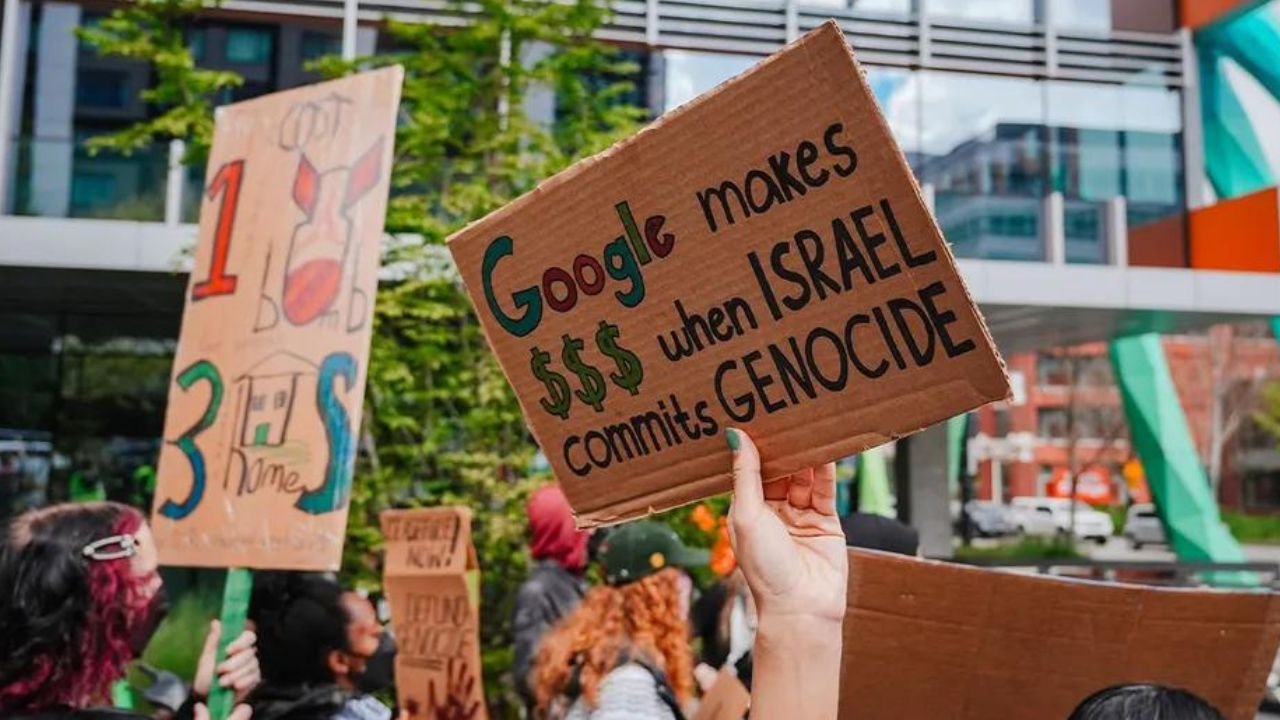
  • Google fires 28 workers protesting contracts with Israel

    Google fires 28 workers protesting contracts with Israel

    New York, United States – Google fired 28 employees following a sit-down protest over the tech giant’s contract with the Israeli government, a Google spokesperson said Thursday.

    The Tuesday demonstration was organized by the group “No Tech for Apartheid,” which has long opposed “Project Nimbus,” Google’s joint $1.2 billion contract with Amazon to provide cloud services to the government of Israel.

    Video of the demonstration showed police arresting Google workers in Sunnyvale, California, in the office of Google Cloud CEO Thomas Kurian’s, according to a post by the advocacy group on X, formerly Twitter.

    Kurian’s office was occupied for 10 hours, the advocacy group said.

    Workers held signs including “Googlers against Genocide,” a reference to accusations surrounding Israel’s attacks on Gaza.

    “No Tech for Apartheid,” which also held protests in New York and Seattle, pointed to an April 12 Time magazine article reporting a draft contract of Google billing the Israeli Ministry of Defense more than $1 million for consulting services.

    A “small number” of employees “disrupted” a few Google locations, but the protests are “part of a longstanding campaign by a group of organizations and people who largely don’t work at Google,” a Google spokesperson said.

    “After refusing multiple requests to leave the premises, law enforcement was engaged to remove them to ensure office safety,” the Google spokesperson said. “We have so far concluded individual investigations that resulted in the termination of employment for 28 employees, and will continue to investigate and take action as needed.”

    Israel is one of “numerous” governments for which Google provides cloud computing services, the Google spokesperson said.

    “This work is not directed at highly sensitive, classified, or military workloads relevant to weapons or intelligence services,” the Google spokesperson said.

    jmb/nro

    © Agence France-Presse

  • Google to delete incognito search data to end privacy suit

    Google to delete incognito search data to end privacy suit

    San Francisco (AFP) – Google has agreed to delete a vast trove of search data to settle a suit that it tracked millions of US users who thought they were browsing the internet privately.

    If a proposed settlement filed Monday in San Francisco federal court is approved by a judge, Google must “delete and/or remediate billions of data records” linked to people using the Chrome browser’s incognito mode, according to court documents.

    “This settlement is an historic step in requiring dominant technology companies to be honest in their representations to users about how the companies collect and employ user data, and to delete and remediate data collected,” lawyer David Boies said in the filing.

    A hearing is slated for July 30 before Judge Yvonne Gonzalez Rogers, who is to decide whether to approve the deal that would let Google avoid a trial in the class-action suit.

    The settlement calls for no cash damages to be paid but leaves an option for Chrome users who feel they were wronged to sue Google separately to get money.

    The suit originally filed in June of 2020 sought at least $5 billion in damages.

    “We are pleased to settle this lawsuit, which we always believed was meritless,” Google spokesman Jorge Castaneda said in a statement.

    “We are happy to delete old technical data that was never associated with an individual and was never used for any form of personalization.”

    The object of the lawsuit was the “Incognito Mode” in the Chrome browser that plaintiffs said gave users a false sense that what they were surfing online was not being tracked by the Silicon Valley tech firm.

    But internal Google emails brought forward in the lawsuit demonstrated that users using incognito mode were being followed by the search and advertising behemoth for measuring web traffic and selling ads.

    The lawsuit, filed in a California court, claimed Google’s practices had infringed on users’ privacy by intentionally deceiving them with the incognito option.

    The original complaint alleged that Google had been given the “power to learn intimate details about individuals’ lives, interests, and internet usage.”

    “Google has made itself an unaccountable trove of information so detailed and expansive that George Orwell could never have dreamed it,” it added.

    The settlement requires Google, for the next five years, to block third-party tracking “cookies” by default in Incognito Mode.

    Third-party cookies are small files which are used to target advertising by tracking web navigation and are placed by visited sites and not by the browser itself.

    No cookies?

    Google earlier this year began limiting third-party cookies for some users of its Chrome browser, a first step towards eventually abandoning the files that have raised privacy concerns.

    Google announced in January 2020 that it would begin eliminating third-party cookies within two years, but the start has been delayed several times amid opposition from web media publishers.

    Cookies have recently been subject to greater regulation, including the European Union’s General Data Protection Regulation introduced in 2016 as well as regulations in California.