Tag: internet

  • English court jails first offender for ‘cyber-flashing’

    English court jails first offender for ‘cyber-flashing’

    London, United Kingdom – A court in eastern England on Tuesday became the first in the country to jail someone for a new cyber-flashing offence, sentencing a convicted sex offender to 66 weeks in prison.

    A judge at Southend Crown Court handed Nicholas Hawkes, 39, the jail term after he previously admitted to the newly designated offence at an earlier appearance.

    Cyber-flashing, which can involve offenders sending people an unsolicited sexual image on social media, dating apps or by other electronic communication, became a crime in England and Wales on January 31.

    It was part of the government’s Online Safety Act.

    Hawkes, from Basildon, east of London, pleaded guilty to two counts of sending a photograph or film of genitals to cause alarm, distress or humiliation.

    He had admitted the latest offences of sending unsolicited images to a 15-year-old girl and a woman on February 9.

    The woman took screenshots of the photograph on WhatsApp and reported him to police the same day.

    Hawkes was already on the sex offenders register after a conviction last year of sexual activity with a child under 16 years old and exposure, for which he also received a community order.

    On Tuesday he also pleaded guilty to breaching that order and breaching a suspended sentence for another sexual offence.

    Victims of the new cyber-flashing offence and other image-based abuses have lifelong anonymity from the moment they report it under the Sexual Offences Act.

    jj/phz/

    © Agence France-Presse

  • Quetzal Softalogy Partners with Sagevanguard Tech to Introduce Cutting-Edge Commercial WiFi Routers to Pakistan

    Quetzal Softalogy Partners with Sagevanguard Tech to Introduce Cutting-Edge Commercial WiFi Routers to Pakistan

    Quetzal Softalogy Pvt. Ltd. and Sagevanguard Tech have forged a strategic partnership to introduce cutting-edge commercial WIFI routers and other IT products to Pakistan. The routers, capable of connecting 256 devices and featuring mesh capability at commercial level.

    In this groundbreaking collaboration, Sagevanguard Tech, a Hong Kong-based leader in wireless network technology, is teaming up with Quetzal Softalogy, Pakistan to bring advanced commercial WIFI routers to Pakistan. These state-of-the-art routers not only support up to 256 devices at one time with mesh capability for seamless connectivity but also mark the beginning of a comprehensive venture. Mr. Noah from Sagevanguard Tech will lead operations in the Pakistani market, overseeing not only the distribution of routers but also the development of technology-based AI devices. Beyond technological innovation, Quetzal Softalogy’s commitment to minimizing the digital divide in Pakistan is a core aspect of this partnership, with a focus on fostering development in underserved areas.

    About Sagevanguard Tech: Sagevanguard Tech, based in Hong Kong, is a leading company dedicated to wireless network technology. With a focus on research, development, and innovation in the field of commercial networks, Sagevanguard Tech aims to drive the future of digital connectivity and create broader business possibilities for customers through advanced technological solutions.

    About Quetzal Softalogy Pvt. Ltd.: Quetzal Softalogy Pvt. Ltd. is a prominent provider of ICT solutions and services, offering network design, software and mobile app development, web design, and IT consultancy. With a commitment to innovation and excellence, Quetzal Softalogy seeks to empower businesses and organizations through cutting-edge technology.

    For media inquiries, please contact:
    +92 301 8481054

  • ‘Ensure uninterrupted Internet access’; Sindh High Court orders on Jibran Nasir’s petition

    ‘Ensure uninterrupted Internet access’; Sindh High Court orders on Jibran Nasir’s petition

    The Sindh High Court (SHC) has issued a directive on Wednesday, instructing the government and the Pakistan Telecommunications Authority (PTA) to ensure uninterrupted internet access until February 8, the scheduled date for the general elections in the country.

    The order came from a two-member bench led by SHC Chief Justice Aqeel Ahmed Abbasi, following a petition filed by lawyer and independent candidate Jibran Nasir. The petition addressed the recent “unconstitutional” internet outages experienced across the country in the past month.

    Jibran took to X (former Twitter) and said, “SHC has directed PTA and Govt to ensure smooth uninterrupted access to Internet till Election Day 8th Feb to ensure no further pre poll rigging happens and any rigging attempts on Election Day can also be reported through social media.”

    “This is not just stopping the PTI from contesting free and fair elections — which is pre-poll rigging — but is also hindering the way of independent candidates like me,” he stated, highlighting that the internet and social media were efficient and cost-effective platforms to reach out to voters.

    Notably, three nationwide disruptions occurred on December 17, January 7, and January 20, coinciding with virtual events organized by the Pakistan Tehreek-e-Insaf (PTI) on social media platforms. The PTI had recently approached the Supreme Court, urging it to take notice of the suspension of internet services and the blocking of social media websites.

    During a press conference earlier in the week, caretaker Information Minister Murtaza Solangi attributed the outages to “technical” issues and system installations. He also stated that there was “no guarantee” such incidents wouldn’t occur in the future.

    In Nasir’s petition, the PTA, the federal government, and the Ministry of Information Technology and Telecommunications were named as respondents. Nasir argued that the act of shutting down mobile internet and broadband services should be declared as “unconstitutional, illegal, disproportionate, unreasonable, and without lawful authority.”

    The plea further sought the immediate restoration of access to social media platforms and the suspension of any directives restricting access to social media until the conclusion of the general elections.

    In response to the petition, the SHC issued notices to the respondents and directed authorities to ensure uninterrupted internet access until the general elections on February 8. The hearing has been adjourned until January 29.

    Read more: PTA warns of possible internet disruption in next 90 days

  • PTA warns of possible internet disruption in next 90 days

    PTA warns of possible internet disruption in next 90 days

    Pakistani internet users experienced disrupted internet once again on January 20 — previously disrupted on December 17 and January 7. The Pakistan Telecommunication Authority (PTA) claimed that the internet disruption was caused by technical reasons — system upgrades.

    Caretaker Information Minister Murtaza Solangi has on Tuesday reiterated the claims of technical issues while also warning of the possibility of further hiccups.

    These frequent and dubiously timed blackouts have brought PTA under public scrutiny.

    Samaa news writes that “Pakistan’s tech-savvy populace expressed palpable outrage at the apparent lack of transparency and the extended timeframe for resolution”.

  • Unregistered sims are being used by fraudsters, terrorists

    Unregistered sims are being used by fraudsters, terrorists

    Federal Investigation Agency (FIA) Cyber Crimes has submitted a report on the fraudulent acquisition of biometrics of mobile SIMs to the Ministry of Home Affairs.

    As restrictions have tightened, counterfeiters have also invented new methods, according to the FIA report, including the use of fake thumbprints for SIM registration.

    According to the report, more than 80,000 SIMs registered on silicon thumbs were reported in four years. Fraudsters are said to obtain fingerprints by luring people into registering for voter lists or for obtaining cheaper essential items etc. which are then imprinted on silicon thumbs and SIMs are consequently registered.

    According to the report, it has been revealed that unregistered SIMs are being used by terrorists. More than 3,500 SIMs obtained on fake registrations are active right now out of which 93 cases were registered over the past four years, 193 people were arrested, and 294 fake biometric devices were also used.

  • Asian Development Bank believes Pakistan is the “least ready” country for digital education

    Asian Development Bank believes Pakistan is the “least ready” country for digital education

    The Asian Development Bank (ADB) in its report titled “Toward mature digital education ecosystems, the Digital Education Readiness Framework”, has stated that Pakistan is the least ready country for digital education among the developing member countries (DMC).

    The report has highlighted major areas of improvement in Pakistan, including low internet connectivity, low fixed broadband speeds, high fixed line broadband costs and low rural electricity supply. Only 34.1 percent of households are connected with an internet connection.

    There is an absence of teacher training in information and communication technology (ICT) skills with a special focus on delivering online education. Pakistan has also the lowest shares of ICT graduates from the total pool of tertiary education graduates-1.1 percent- standing at the lowest among all 10 ADB members.

    However, Pakistan has surpassed all countries in its cable TV subscriptions coverage with over 482 subscriptions per 1000 persons. The country’s household TV coverage rate is at 62.8 percent.

    Six of the ten DMCs are in the “initial category of readiness”. They are Cambodia, Bangladesh, the Kyrgyz Republic, Mongolia, Pakistan and Fiji in order.

    The other four countries in the “emerging category of readiness” are Indonesia, the Philippines, Vietnam and Uzbekistan.

    Fixed broadband prices play an important role in the ranking of these countries. While Cambodia, Indonesia and Pakistan are least affordable in broadband, Bangladesh, Mongolia and Uzbekistan are the most affordable.

    The difference between the model country’s normalized score and the highest-scoring country’s score is almost 45 points.

  • 5G coming to Pakistan in 10 months

    5G coming to Pakistan in 10 months

    Caret­aker Federal Minister for IT and Telecommunication Dr Umar Saif and Pakistan Telecomm­unication Auth­ority (PTA) Chairman retired Major General Hafeezur Rehman have announced that 5G services will be launched within 10 months.

    Dr Umar Saif said that hinderances in launching 5G services will be countered swiftly and issues in regards to taxation, teledensity and spectrum will be addressed.

    Moreover, quality of the service will also be worked on in order to cater to the masses with the imminent 5G auction.

    Both the IT minister and Chairman PTA highlighted that Pakistan’s cellular service quality ranks very very low — 79 out of 100 according to the Inclusive Internet Index — reason being the lack of investment in the telecom infrastructure.

    According to Dawn.com, PTA officials pointed out to the minister that telecom operators in Pakistan only have 274 MHz spectrum to serve the 7th largest number of telecom users in the world, whereas, a single telecom operator in Australia uses over 345 MHz.

    “For better telecom services, we must ensure immediate improvement in 4G infrastructure and accelerate the rollout of 5G in Pakistan,” the PTA chief said.

    While the Minis­try announced to launch 5G by the middle of 2023 and was seeking foreign investment, a digital emergency has also been declared due to the “high cost of doing business and restrictions on imports of components and technical parts”, reports Dawn.com.

  • ZETA Technologies achieves LDI License to enhance Pakistan’s Call and Internet Connectivity

    ZETA Technologies achieves LDI License to enhance Pakistan’s Call and Internet Connectivity

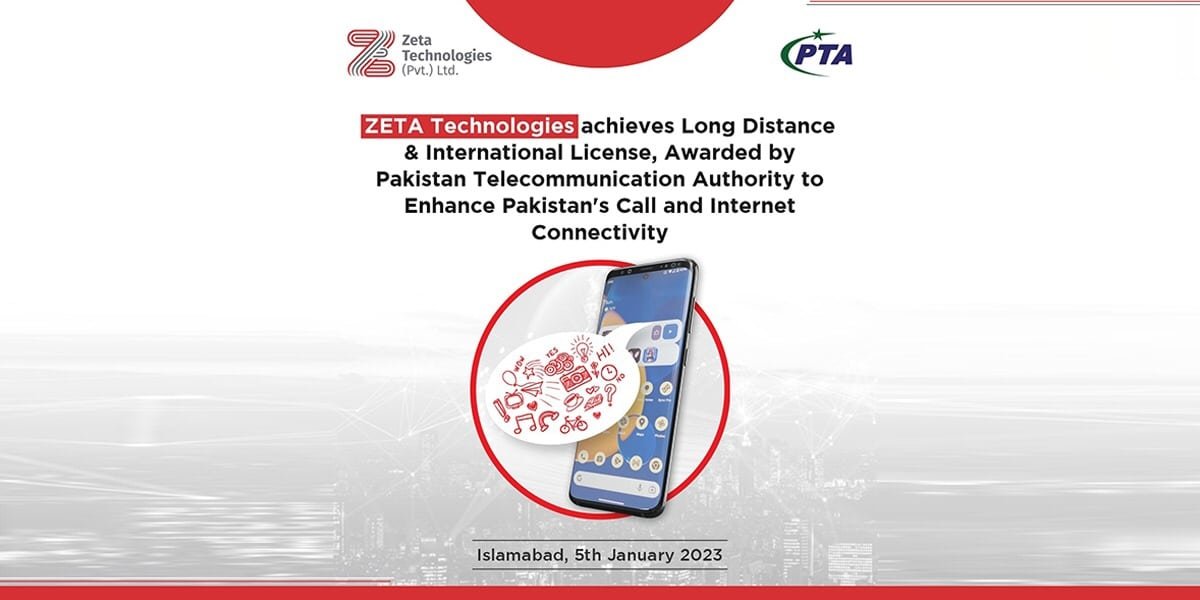
    Zeta Technologies (Pvt.) Ltd. gained another landmark by receiving an LDI License, awarded by Pakistan Telecommunication Authority (PTA) at the license awarding ceremony. The LDI license allows massive headway into Pakistan’s global connectivity. A company must have financial standing and compliance with telecom regulator before the license is granted.

    After years of arduous work and fulfillment of professional responsibilities, Zeta Technologies has secured this prestigious milestone. Zeta Technologies will undertake international/national telecommunication services using LDI license according to its terms and conditions.

    Mr. Baleegh Afridi, CEO of Zeta Technologies, attended the signing ceremony at PTA Headquarters. While making his statement, Mr. Baleegh Afridi said, “Getting this LDI license allows us to venture into other opportunities, including fiber deployment and landing station. Along the way, we will be able to create job opportunities for citizens of Pakistan in the current uncertain economic situation.” He also added, “I would like to thank my entire team for their persistent efforts and hard work, which has helped us in acquiring the license”.

    Today is a proud day for Zeta Technologies!

    This is a sponsored article.

  • Mobile banking grows by 100% during FY22 in Pakistan

    Mobile banking grows by 100% during FY22 in Pakistan

    According to the State Bank of Pakistan’s (SBP) Annual Payment Systems Review, the size of the digital payments ecosystem witnessed massive increase over the previous fiscal year. The report reveals that internet banking expanded by 51.7 per cent to 141.7 million users in FY22, while mobile phone banking increased by 100.4 per cent to 387.5 million.

    There were 15 million P2P (Person-to-Person) Raast users registered, who carried out 7.9 million transactions worth Rs102.1 billion.

    The report also notes that during FY22, there were 8.4 million and 12.3 million users of mobile phones and internet banking, respectively.

    In terms of transactions, mobile phone banking increased by 100.4 per cent to 387.5m, while internet banking grew by 51.7 per cent to 141.7m during the year.

    In 2021–2022, internet banking transactions had a value of Rs10.2 trillion, increasing 81.1 per cent. The volume of e-commerce transactions increased by 107.4 per cent to 45.5 million, and the value increased by 74.9 per cent to Rs106 billion.

    A total of 32,958 point-of-sale devices were installed during FY22, which caused the network to grow by 45.8 per cent to 104,865. The number of online retailers registered with the banks increased over this time from 3,003 to 4,887. The nation’s ATM network expanded by 4.8 per cent during the course of the year, totaling 17,133 machines.

  • Twitter offices close as hundreds of workers resign, #RIPTwitter trends

    Twitter offices close as hundreds of workers resign, #RIPTwitter trends

    Twitter has announced that its office buildings will be temporarily closed, effective immediately and that the offices will reopen on Monday, November 21.

    Twitter employees were informed regarding the closure in a letter, but the company withheld an explanation for this.

    The statement comes as there are rumours that several employees were leaving after the new owner, Elon Musk, told them to sign up for “long hours at high intensity” or quit.

    Mr Musk stated that those who didn’t sign up by Thursday, November 17 would receive three months’ worth of severance money.

    The corporation said earlier this month that it will be laying off almost 50 per cent of its workers.

    The news that Twitter had temporarily closed its offices today coincided with indications that several employees had already left in protest at Mr Musk’s new contract terms.

    To announce their departure from the company, employees have begun tweeting using the hashtag #LoveWhereYouWorked and a saluting emoji.

    One former Twitter employee who wished to remain anonymous told BBC: “I think when the dust clears today, there’s probably going to be less than 2,000 people left.”

    They added that everyone in their team had been terminated.

    “The manager of that team, his manager was terminated. And then that manager’s manager was terminated. The person above that was one of the execs terminated on the first day. So there’s nobody left in that chain of command.”

    Around 7,500 people worked for Twitter before Elon Musk took over. Thousands of contract workers were also reportedly employed by the company, the majority of whom are believed to have been let go.

    Another person claimed that despite being ready to put in long hours, they had quit their job.

    “I didn’t want to work for someone who threatened us over email multiple times about only ‘exceptional tweeps should work here’ when I was already working 60-70 hours weekly,” they said.

    The richest person in the world acquired Twitter last month in a $44 billion deal, becoming the company’s CEO in the process.

    In response to a query on worries that Twitter was set to shut down after the notification about the closure of Twitter’s offices was sent, Mr Musk tweeted: “The best people are staying, so I’m not super worried”.