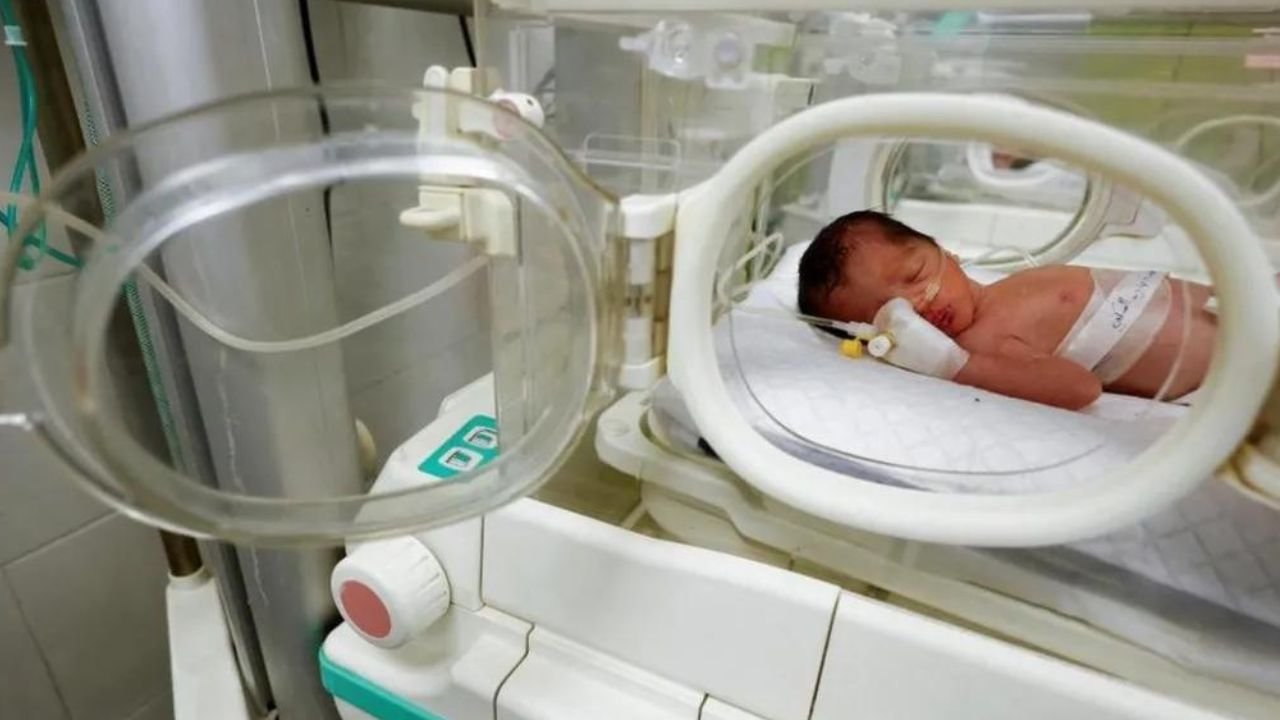
The daughter of a pregnant woman who was martyred in the Israeli attack at Rafah in the occupied Palestinian territory of Gaza, has also died.
Last week, a pregnant woman, Sabrin Al-Sakini, her husband and three-year-old daughter were martyred as a result of the Israeli attack in the Rafah area of Gaza. The doctors saved the daughter of Sabrin Al-Sakini by performing an emergency operation and the new-born girl was named ‘Shaheed Sabreen’s daughter’.
The doctors who took care of the baby girl said that the weight of the baby girl at the time of birth was 1.4 kg and that her condition was improving. However, according to the British Broadcasting Corporation, the newborn girl died yesterday and was buried next to her mother.
More than 34,000 people have been martyred as a result of the ongoing Israeli aggression in Gaza since October 7, 2023, including more than 14,000 children and more than 9,000 women.
A number of journalists from Gaza took to social media to report that Israeli forces conducting operations inside Al-Shifa hospital are torturing and raping women present inside.
Photojournalist and videographer Wissam Nasser from Gaza said that a man and his wife taking shelter inside the hospital along with their two children had an alleged heinous encounter with the Israeli forces. “The preganant wife was forcibly undressed by Israeli forces despite informing them of her pregnancy; they continued to kick her. Then they assaulted and raped her in front of her family and other men,” Wissam shared.
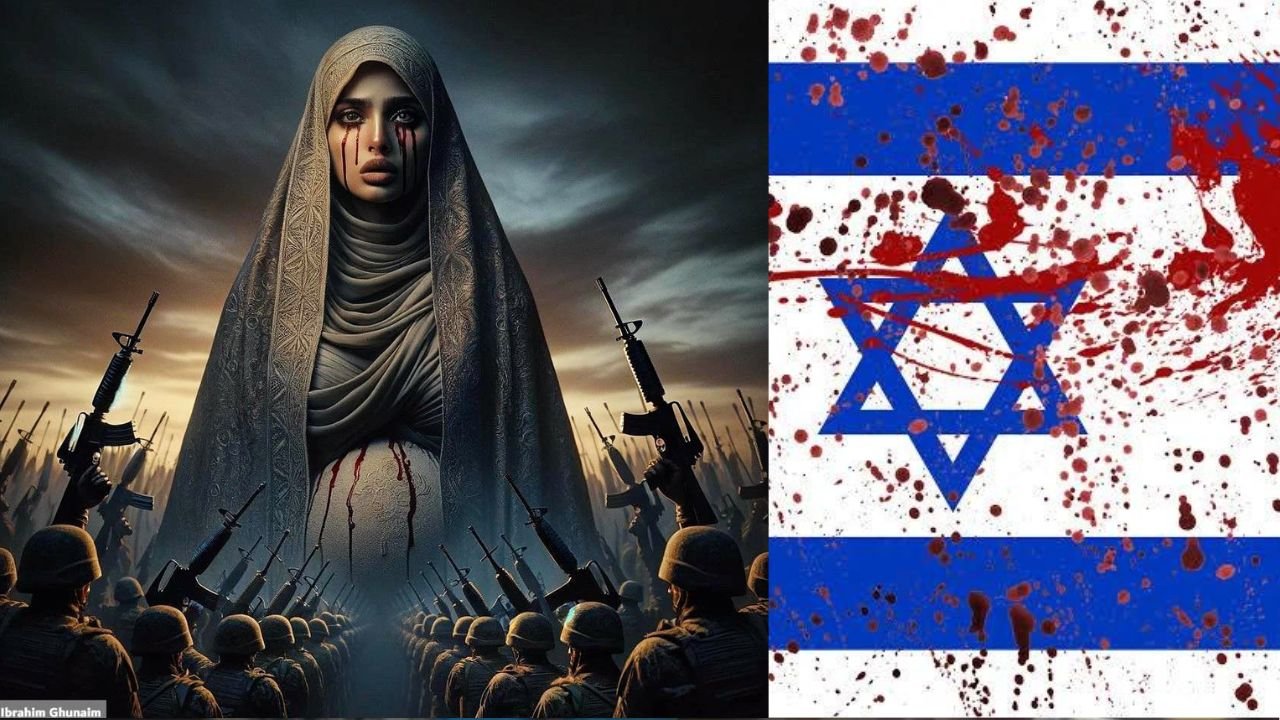
He also shared a dark art work by the artist Ibrahim Ghunaim featuring a pregnant woman with tears of blood running down her eyes. He captioned it, “According to testimonies from inside Al shifa hospital, Israeli invading troops raped a Palestinian pregnant woman in front of her husband and other men then they killed her. This is happening situation the holy month of Ramadan while starving Palestinians are fasting. Absolutely shocking, disgusting and shows their evil nature‼‼”
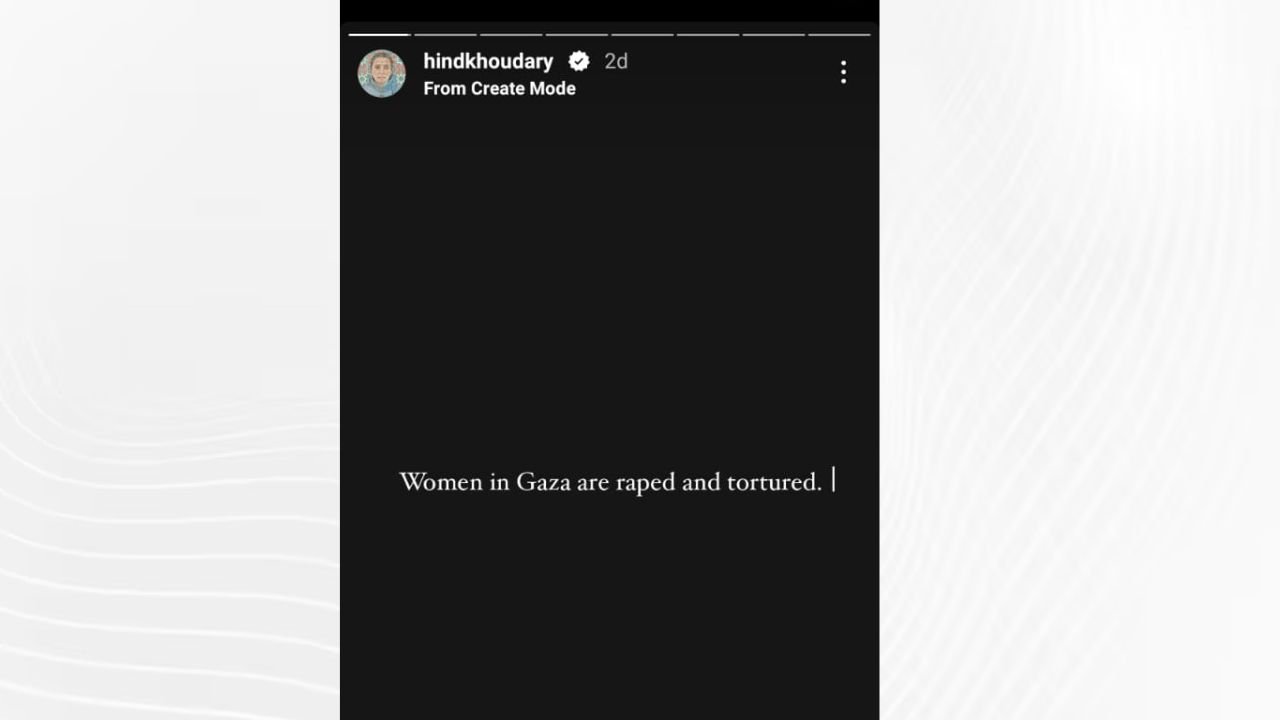
Another Palestinian journalist Hind Khoudary took to Instagram stories and posted, “Women in Gaza are raped and tortured.”
Various Palestinian media outlets have also confirmed the claims and presented eye-witness accounts.
Middle East Eye reported a woman’s eye-witness account by Ms. Jamila al-Hissi as to what is happening inside Al-Sifa hospital. “They raped women, kidnapped women, executed women, and pulled dead bodies from under the rubble to unleash their dogs on them.” She further lamented, “Is there anything more horrifying than hearing women call for help, and when we try to reach them to provide assistance, they shoot at us.”
Israeli forces have been attacking and laying siege to al-Shifa Hospital since Monday, March 18. The medical complex is the largest in the Gaza Strip, with some 30,000 people seeking refuge there prior to the current raid.
Journalist Sami Alsultan shared a video testimony of a woman who was forcefully expelled from Al Shifa complex with her children while IDF took her husband, killed her husband’s uncle and grandfather.
In another video shared by Middle East Eye, a woman named Nisreen was seen sharing how IDF barged into their home, stripped her naked and took all her belongings away.
Doctor Aliyah Khan spoke to Middle East Monitor and shared testimonies from Canadian physicians serving in Gaza. They reported on a case where a woman was raped for two days until she lost the ability to speak. Another woman was stripped in front of her brother and husband. When they tried to cover her, they were killed by Israeli soldiers.
Hind Khoudary in collaboration with Palestinian Feminists shared the disturbing surge of women victims of rape and torture in Gaza. It called out the deafening silence of Western feminists and mainstream media over the issue.
Global superstars Penelope Cruz and Angelina Jolie are raising their voice for the starving people of Gaza.
Cruz, the Spanish actress famous for Vanilla Sky, shared a United Nations Instagram post about the imminent famine in Gaza and how people in the besieged strip are starving to death.
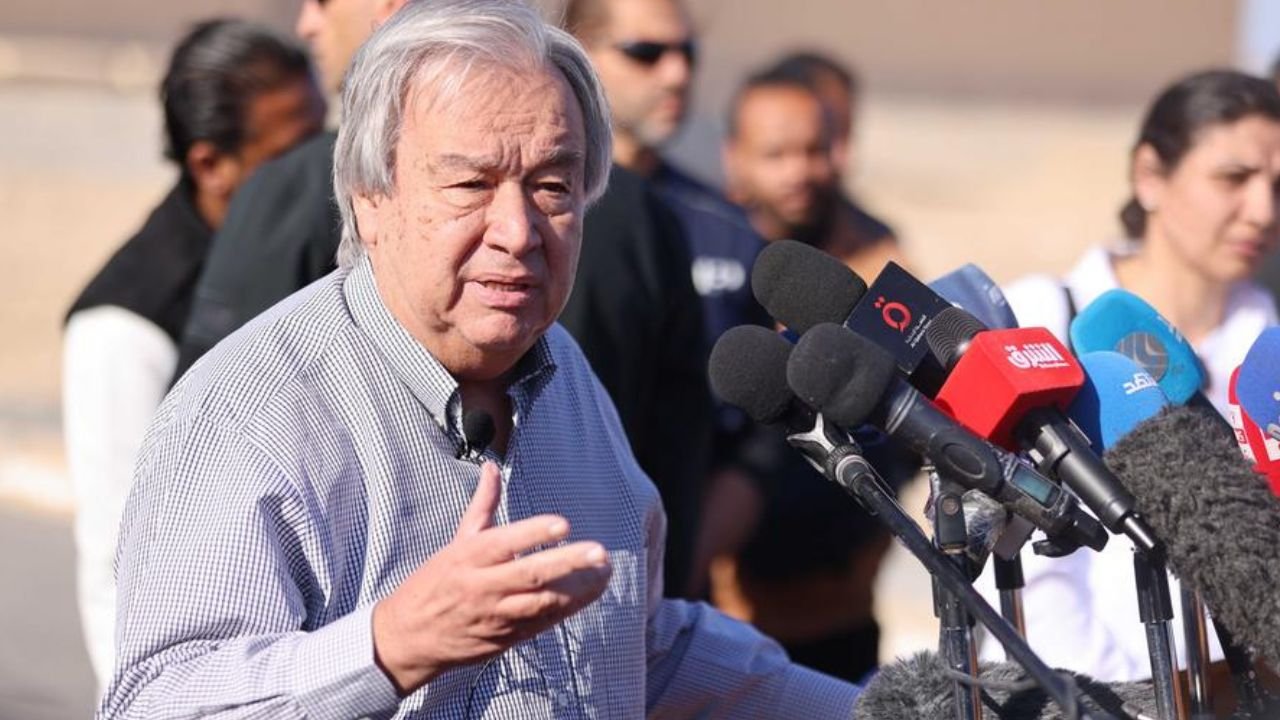
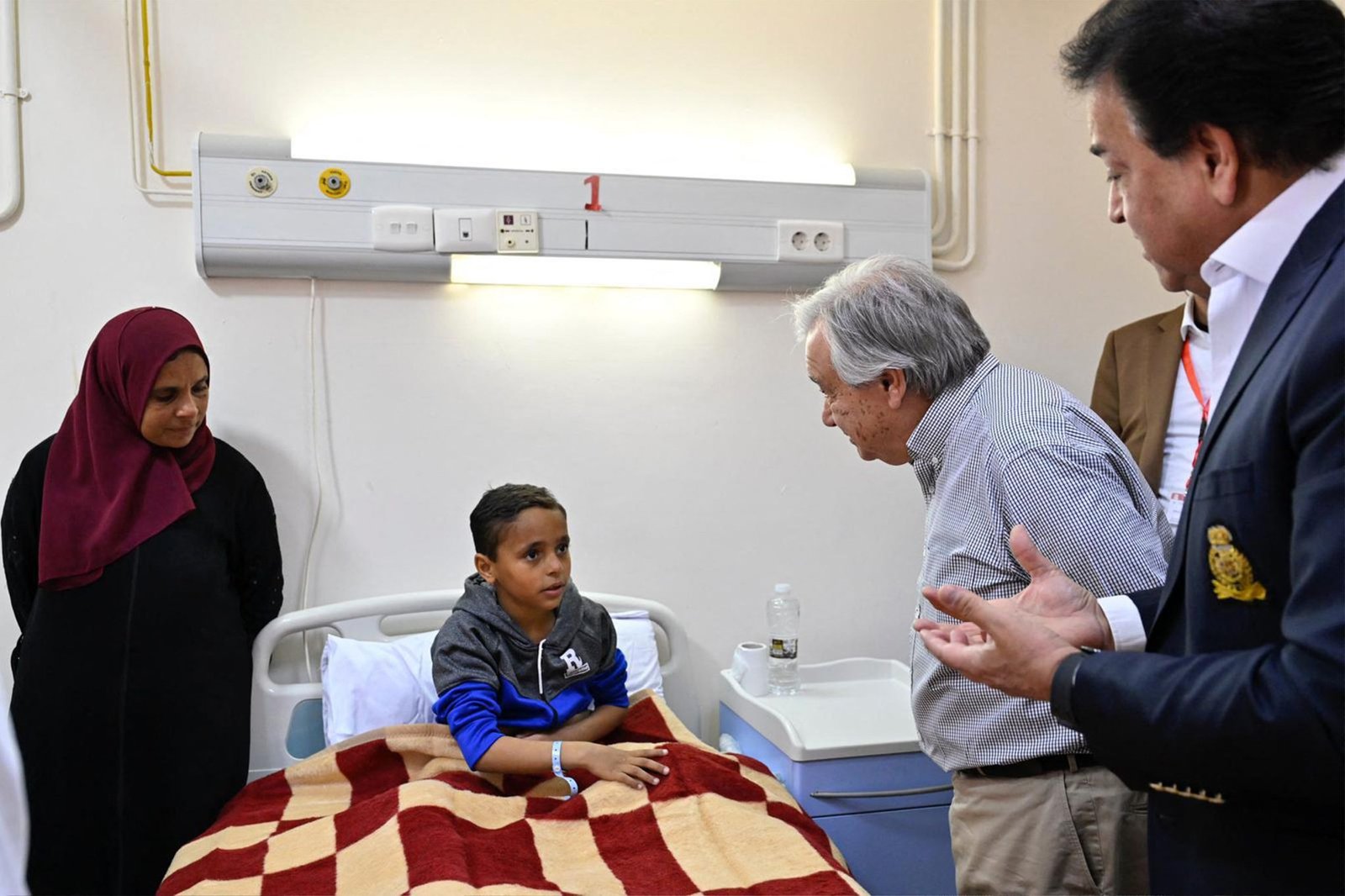
UN chief Antonio Guterres, on a visit to the doorstep of Gaza, on Saturday said the world has seen enough of the war’s horrors and appealed for a ceasefire to allow in more aid.
‘Palestinians in Gaza—children, women, men—remain stuck in a non-stop nightmare,’ he said on the Egyptian side of the Rafah crossing where truckloads of aid trickle into Gaza but the population is stalked by ‘hunger and starvation’.
This handout pictured released by the United Nations press office shows UN Secretary-General Antonio Guterres meeting with a Palestinian child evacuated from the Gaza Strip receiving treatment at the general hospital in El-Arish in Egypt’s northeastern North Sinai province on March 23, 2024, amid the ongoing conflict in the Palestinian territory between Israel and the militant group Hamas. (Photo by Mark GARTEN / UNITED NATIONS / AFP) / RESTRICTED TO EDITORIAL USE – MANDATORY CREDIT “AFP PHOTO / UNITED NATIONS – MARK GARTEN” – NO MARKETING NO ADVERTISING CAMPAIGNS – DISTRIBUTED AS A SERVICE TO CLIENTS – RESTRICTED TO EDITORIAL USE – MANDATORY CREDIT “AFP PHOTO / UNITED NATIONS – Mark Garten” – NO MARKETING NO ADVERTISING CAMPAIGNS – DISTRIBUTED AS A SERVICE TO CLIENTS /
‘I carry the voices of the vast majority of the world who have seen enough,’ Guterres said, deploring ‘communities obliterated, homes demolished, entire families and generations wiped out’.
He reiterated that ‘nothing justifies the horrific attacks by Hamas’ against Israel, triggering the war on October 7.
‘And nothing justifies the collective punishment of the Palestinian people,’ the United Nations secretary-general said.
Guterres, speaking at a lectern in front of the imposing gates to the Gaza side of Rafah, through which aid trucks pass, said the ‘heartbreak and heartlessness of it all’ were clear.
‘A long line of blocked relief trucks on one side of the gates. The long shadow of starvation on the other,’ which he called ‘a moral outrage.’
Guterres emphasised ‘it is more than time for an immediate humanitarian ceasefire’ and appealed to Israel for ‘total, unfettered access for humanitarian goods throughout Gaza.’
The UN chief, who makes an annual ‘solidarity mission’ to distressed Muslim communities during their holy fasting month, said that ‘in the Ramadan spirit of compassion, it is also time for the immediate release of all hostages’ captured in the October attacks and still held by militants in Gaza.
Response from Israel
Israel’s foreign minister said Saturday the United Nations had become an ‘anti-Israeli body’ under Antonio Guterres, after the UN chief called for a ceasefire on a visit to Gaza’s border.
International outrage over the heavy civilian toll and humanitarian crisis in Gaza has further worsened the long strained ties between Israel and the world body.
‘Under his (Guterres’s) leadership, the UN has become an anti-Semitic and anti-Israeli body that shelters and emboldens terror,’ Foreign Minister Israel Katz said on social media platform X.
The top Israeli diplomat criticised Guterres, who Katz said ‘stood today on the Egyptian side of the Rafah crossing and blamed Israel for the humanitarian situation in Gaza’, claiming instead that Hamas militants ‘plunder’ aid.
Katz, whose government has accused staff at the UN agency for Palestinian refugees of involvement in Hamas’s October 7 attack that triggered the war, also said Guterres spoke ‘without calling for the immediate, unconditional release of all Israeli hostages’.
Vote at Security Council
Meanwhile, a vote at the UN Security Council on a new text calling for an ‘immediate’ ceasefire in the Israel-Hamas war was postponed to Monday, diplomatic sources told AFP, after a separate, US-lead draft resolution was vetoed.
The United States, Israel’s main ally and military backer, had put forward a resolution mentioning ‘the imperative of an immediate and sustained ceasefire’ and condemning the October 7 attack by Hamas.
Russia and China on Friday vetoed that resolution, which was also opposed by Arab states for stopping short of explicitly demanding Israel immediately end its campaign in Gaza.
The new ceasefire text was meant to go to a vote on Saturday, but was pushed back to allow further discussions, the diplomatic sources said.
The new, tougher draft resolution, seen by AFP, ‘demands an immediate ceasefire’ for the ongoing Muslim holy month of Ramadan that leads ‘to a permanent sustainable ceasefire’ respected by all sides.
Eight of the council’s 10 non-permanent members have been working on the draft, which also calls for the ‘immediate and unconditional’ release of hostages seized by Hamas and the lifting of ‘all barriers’ to humanitarian aid flowing into the besieged Gaza Strip.
‘We as (the) Arab Group unanimously endorse and support the draft resolution,’ said Palestinian ambassador to the UN Riyad Mansour, who had denounced the US-led text as biased.
But US Ambassador Linda Thomas-Greenfield indicated opposition, saying the resolution would jeopardize ongoing diplomatic efforts to secure the release of hostages—the same reason the United States gave before vetoing previous ceasefire resolutions.
‘In its current form, that text fails to support sensitive diplomacy in the region. Worse, it could actually give Hamas an excuse to walk away from the deal on the table,’ she said.
Friday’s text did not explicitly use the word ‘call,’ but simply stated that a ceasefire was imperative, and linked to ongoing talks, led by Qatar with support from the United States and Egypt, to halt fighting in return for Hamas releasing hostages.
‘If the US is serious about a ceasefire, then please vote in favor of the other draft resolution, clearly calling for a ceasefire,’ China’s representative, Zhang Jun, said.
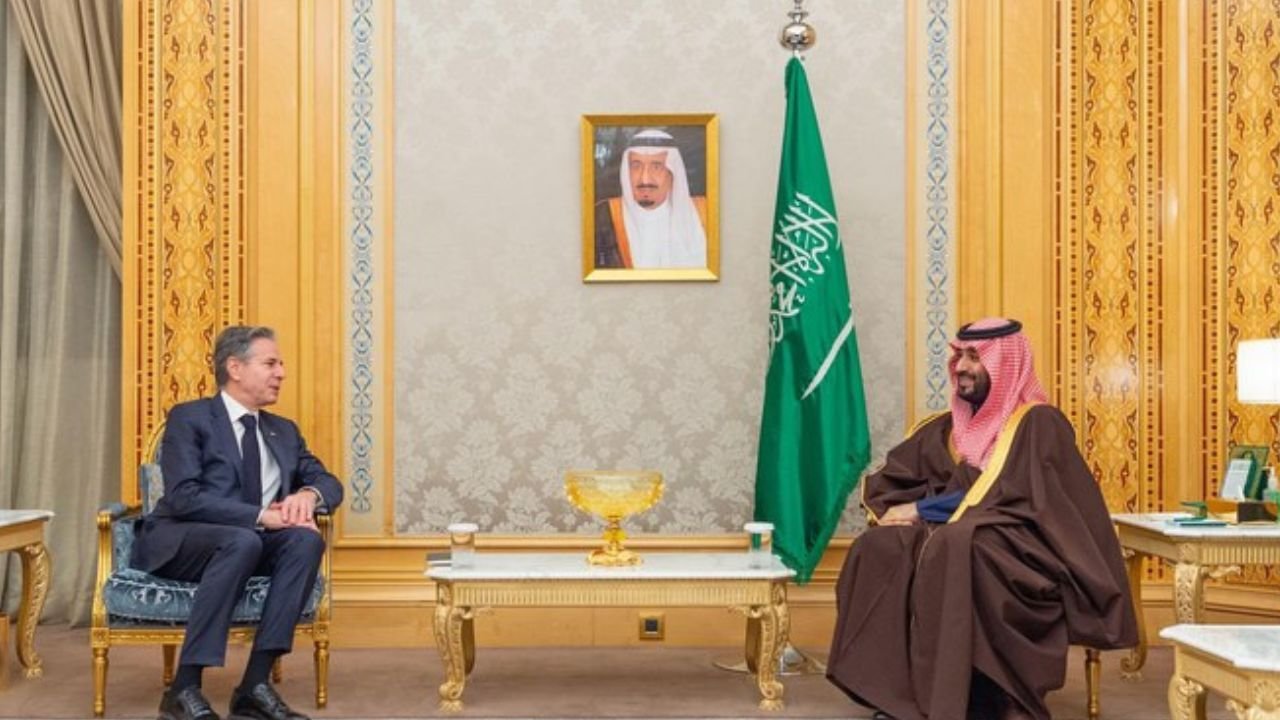
U.S. Secretary of State Antony Blinken has claimed on Thursday that the United States and Saudi Arabia have made “good progress” in talks on normalising ties between the kingdom and Israel. However, he did not provide a timeline for concluding the deal.
“I believe we can reach an agreement, which would present a historic opportunity for the two nations, but also for the region as a whole,” Blinken said at a joint press conference with Egyptian Foreign Minister Sameh Shoukry in Cairo.
Talks on normalisation had been put on ice after Oct 7 but conversations have resumed in recent months.
While trying for a ceasefire in the Gaza war, the Biden administration has been working to secure a normalisation deal as well. However, Saudi Arabia and other Arab countries want the creation of a Palestinian state to be part of any such deal with Israel.
Saudi Arabia is also looking to sign a mutual defence pact with Washington and get U.S. support for its civil nuclear program. Blinken discussed the topics on Wednesday with Saudi Crown Prince Mohammed bin Salman in Jeddah during an official visit.
“We had a very good discussion about the work that we’ve been doing for many months now on normalisation, and that work is moving forward. We’re continuing to make good progress,” Blinken said but added that he could not offer a timeframe.
Earlier a senior State Department official said Washington and Riyadh were down to a handful of bilateral issues and there was political will to address those gaps.
A pact giving the world’s biggest oil exporter U.S. military protection in exchange for normalisation would reshape the Middle East by uniting two long-time foes and binding Riyadh to Washington at a time when China is making inroads in the region.
For such a deal to advance, Israel needs to agree to a pathway for creation of an independent Palestinian state, a prospect that Israeli Prime Minister Benjamin Netanyahu has repeatedly rejected.
Washington sees any normalisation deal woven into post-war planning that would include Arab countries providing security guarantees for Israel in return for the creation of a Palestinian state under a reformed Palestinian Authority.
Blinken did not elaborate how Washington would overcome Netanyahu’s objections to creation of a Palestinian state, but said the ongoing violence benefited Iran.
“The perpetuation of this cycle only benefits Iran and the proxies that are working for it. So I think as that choice is clear, people will begin to really think about it and make decisions,” Blinken said.
Until Oct 7, both Israeli and Saudi leaders had been saying they were moving steadily toward a deal that could have reshaped the Middle East.
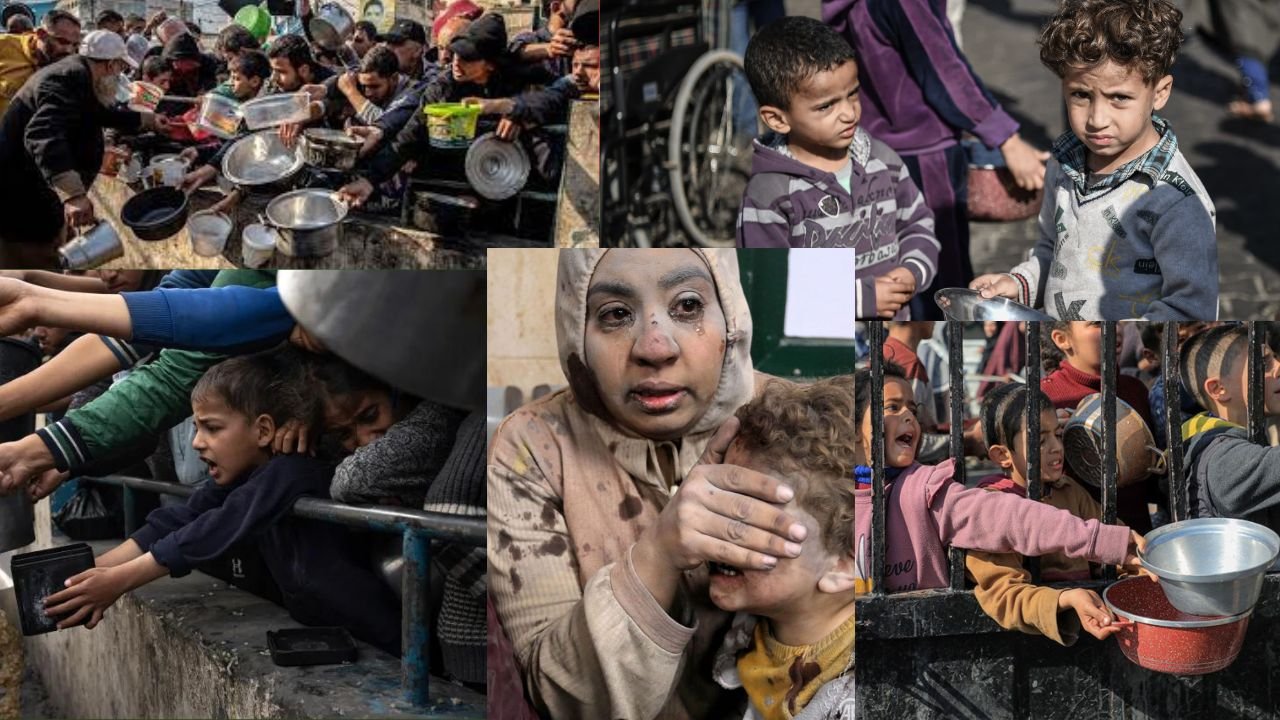
Five months of war in the densely populated Gaza enclave have triggered starvation and food shortages.
The head of the World Health Organization said only opening more border crossings for trucks carrying aid could prevent famine in Gaza.
The United Nations agency for Palestinian refugees said one of its aid warehouses in the war-ravaged Gaza Strip was “hit” on Wednesday, wounding scores of people.
“At least one UNRWA staff member was killed and another 22 were injured when Israeli forces hit a food distribution centre in the eastern part of Rafah” in southern Gaza, the agency said in a statement.
The health ministry in Gaza Strip earlier had said four people were killed in the “bombing of the warehouse”.
Wednesday’s incident comes amid mounting concern about worsening humanitarian conditions in Gaza, where Israel has carried out military operations since October intended to eliminate the Hamas militant group.
“Today’s attack on one of the very few remaining UNRWA distribution centres in the Gaza Strip comes as food supplies are running out, hunger is widespread and, in some areas, turning into famine,” said UNRWA chief Philippe Lazzarini.
He also said the UN had shared coordinates of the facility with the Israeli army on Tuesday.
An UNRWA spokeswoman said the facility was used “to distribute much-needed food and other lifesaving items to displaced people in southern Gaza”.
At least 165 UNRWA employees have been killed since the beginning of the war on Gaza, Wednesday’s UNRWA statement said.
“More than 150 UNRWA facilities were hit, some totally destroyed, among them many schools,” it said.
‘How can they bombard us?’
An AFP photographer saw victims of the strike on Wednesday arriving at Al-Najjar hospital in Rafah, at least one of whom was identified by other people at the hospital as a UN employee.
Witnesses said the strike compounded security fears in Rafah, which is overcrowded with 1.5 million mostly displaced people, further marring the normally festive Muslim fasting month of Ramazan which began on Monday.
“It’s an UNRWA centre, expected to be secure,” said Rafah resident Sami Abu Salim.
“Some came to work to distribute aid to the people in need of food during the holy month of Ramazan. Suddenly, they were struck by two missiles.”
Hasan Abu Auda, displaced from Beit Hanoun in northern Gaza, said people had come to the warehouse “to sustain themselves for their daily meals”.
“It’s Ramazan today,” he said. “How can they bombard us during the month of Ramazan?”
Israel’s aggressive military campaign in Gaza has killed at least 31,272 people, mostly women and children, according to the health ministry in the Hamas-run territory.
Gaza’s dire food shortages after more than five months of war have resulted in 27 deaths from malnutrition and dehydration, most of them children, the ministry says.
Cumbersome Israeli security checks on all cargoes entering the territory slow down the delivery of aid, and some trucks are sent back when they are found to contain forbidden items, aid workers say.
Israeli authorities say bottlenecks are caused by aid piling up on the Palestinian side as there are not enough trucks to distribute it.
Hamza, a prisoner incarcerated in an American jail and working as a janitor, donated all of his earnings to the people suffering in Gaza. The story has been widely shared across social media.
Filmmaker Justin Mashouf first shared on his socials that his incarcerated friend Hamza had asked him to help him by donating his wage money to help civilians in Gaza.
“An incarcerated brother I am in correspondence with donated $17.74 for relief efforts in Gaza. This donation is the sum of 136 hours of his labor in the prison working as a porter/janitor,” Mashouf wrote.
The selfless act left not just Mashouf but also the people on Twitter and Instagram stunned.
As Mashouf shared Hamza’s prison pay stub on social media, users raised more than $102,000 through a GoFundMe campaign. This money was intended to go to the 56-year-old Hamza who has been incarcerated for nearly 40 years and is set to be paroled this month, reports The Washington Post.
Mashouf first contacted Hamza in 2009, when he was working on his documentary “The Honest Struggle.”
The Washington Post did not publish Hamza’s legal name — “Hamza” is a chosen name — because Mashouf said Hamza feared he would be risking his parole status by seeking attention.
Legal records show that Hamza was convicted of one count of second-degree murder in 1986 and sentenced to 15 years to life. He pleaded guilty to the murder when he was a teenager, records show.
Mashouf told the Washington Post that Hamza had been convicted of the murder of an uncle.
“Hamza accidentally fired a gun at a loved one … leading to his imprisonment for over four decades,” says GoFundMe page.
At the time of his conviction, the judge told Hamza that he would be released on adult parole. However, Hamza appealed against the denial of his parole in 2013.
Records show that Hamza has appeared in front of the court multiple times but has always been denied parole.
The GoFundMe page also laid out how Hamza converted to Islam in 1989 and how he would be spending his money once released: health care, housing, clothing, food, a job search and training. Hamza has already decided, however, that some of the donations meant for him will go to others in need, Mashouf said.
After Mashouf told Hamza that the funds were in the thousands, Hamza asked him to disable donations.
“He said whatever has already been donated is sufficient for him,” Mashouf said. “And that he didn’t want to distract people from those who were suffering more than him.”
Moreover, in an update on the GoFundMe page, Hamza said he was eager to start his new life.
“I look forward to the promise of life, happiness, struggles, and dreams, to soar and spread my wings, to be a man, a human being once again now that I know the preciousness and the incalculable value of Life,” he wrote.
Mashouf said that Hamza is a qualified electrician but would need computer and technological training to get up to speed before he joins the workforce outside prison.
Hamza will also be donating his March paycheck to civilians in Gaza, one that he hopes is his final check from prison.
Prisoners in California make between 8-37 cents per hour for their labour. This is a part of forced labour permitted by the constitution. Prison labour provides $ 11 billion per year to the country’s revenue, reported AJ+ in an explainer.
The people in Gaza who have managed to escape death by Israeli strikes in a war that has been forced on them are now dying of hunger and starvation. Videos of bread made out of animal feed and kids collecting flour accidently spilled on the ground are making rounds on social media leading to the drive for the ceasefire taking momentum. As recently as February 20, the UN Food Agency put a pause on its deliveries in the North of Gaza until the conditions are in place that allow for safe distributions.
Families in Gaza are forced to forage for scraps of food left by rats and eating leaves out of desperation to survive with nearly five months of war and rapidly declining aid supplies leaving all 1.1 million children in Gaza facing starvation, Save the Children said.
Hind Khoudary, the Palestinian Journalist in Gaza reporting from the ground, took to her Instagram to plead to the world to airdrop food in Gaza as people have started eating leaves and are making bread out of animal feed. “People are eating leaves and animal food. “I am calling the world and all the countries to Airdrop food to Gaza,” she said in an Instagram story.
Ali Jadallah, a photojournalist from Gaza, shared how her mother, a dialysis patient, is suffering because of the food and health crisis in Gaza. Finding food in Gaza is the most difficult thing nowadays.
Videos of hundreds of desperate and hungry Gazans heckling the UNRWA aid truck emerged from the besieged strip. Many reports from Gaza have already been warning the global authorities of impending famine and loss of lives due to hunger.
Back in December, Human Rights Watch had accused the Israeli government of intentionally starving civilians in Gaza as part of its offensive in the besieged Palestinian territory. “The Israeli government is using starvation of civilians as a method of warfare in the occupied Gaza Strip, which is a war crime,” the New York-based group charged in a report.
Additionally, The Times posted a report about the famine-stricken conditions of the people of Gaza where a mother revealed how her breasts no longer produce milk because of long periods of starvation and how her children are suffering immensely. Explaining the food crisis the article explained how Gazans are forced to eat rotten food and hunt cats to fulfill their needs as famine hits Gaza.
More than a million people are displaced in Gaza but none is safe from hunger. It is rampant in Gaza, it is in the wasteland of al-Mawasi encampment in Gaza where handfuls of dirty flour are kneaded by mothers to make bread for their children.
It is in the fires, stoked with plastic bottles, which produce nothing but choking black smoke. Children in Gaza no longer play but lie around, exhausted by hunger. It is in food that is rotten and makes you sick but is eaten just the same. Bissan shared in one of her videos how people have been having the only bread they have with the salt.
The last nail in the coffin has duly been the suspension of the aid program of the UN agency for Palestinian refugees. Established in 1949 following the first Arab-Israeli war, the agency provides services including schooling, primary healthcare, and humanitarian aid to Palestinians in Gaza, the West Bank, Jordan, Syria, and Lebanon. It is important to note that since the onset of the war on Gaza, Israeli authorities, including Prime Minister Benjamin Netanyahu, have accused it of fuelling anti-Israeli incitement – allegations it denies. UNRWA says it has provided aid to desperate people in Gaza and used its facilities to shelter those fleeing Israeli attacks. Meanwhile, the situation is getting worse with time.
Time recently shared in an article, the hurdles around the idea of food airdrops in Gaza. “Some experts warn that humanitarian airdrops are not as simple as they sound. Aside from the cost of conducting them (up to seven times more than land transport, according to the U.N.’s World Food Programme), airdrops tend to be less efficient and more hazardous than other methods of providing humanitarian relief,” the article read.
The biggest hurdle in Gaza’s case is the lack of safety in terms of the ongoing airstrikes of Israel and the damage it has done to the land of Gaza. Michel Schaffner, the head of air operations at the International Committee of the Red Cross, told TIME in an email that for this operation the specified land needs to be secure, large, and clean enough to be free of obstacles and people. “Once the cargo is on the ground, there need to be arrangements in place as regards who will collect it, where it will be stored, and how it will be distributed. … We do not do airdrops without these measures in place,” Time quotes him.
Even though Israeli aggression is again the biggest opposing factor in this proposed solution, it is important to note that it is not a permanent solution to this problem, a ceasefire is.
An Arabic saying implies that if someone dies of hunger, the neighbour should be charged with murder yet the whole world is watching a huge population dying of hunger and there is no action regarding that.
Israeli forces disguised as doctors, nurses, and paramedical staff burst into a hospital in the occupied West Bank on Tuesday and shot three Palestinians dead, one of whom was lying paralysed in bed.
A border police counter-terrorism unit and a unit from the internal security forces, known as the Shin Bet, entered Ibn Sina hospital on the outskirts of the city’s refugee camp early Tuesday, CCTV footage of the aftermath of the operation showed.
The shooting was carried by undercover operatives while the men were sleeping at the hospital, according to the statements issued by the Palestinian Ministry of Health and the Israeli army.
The Israeli military identified one of the men killed as Mohammad Jalamneh, aged 27, who it claimed was planning an imminent attack and had been transferring weapons and ammunition to other members, Al Jazeera reported.
The two other men killed, brothers Basil Ayman Al-Ghazzawi and Mohammad Ghazzawi, were hiding inside the hospital and were involved in attacks, the military alleged. “A gun was found on a wanted person, which was confiscated by the forces.”
CCTV footage from the hospital showed a group of about 10 people, dressed in civilian clothes, pacing through a corridor, armed with assault rifles and moving into the hospital.
The hospital’s director, Dr Naji Nazzal, said the Israeli team had entered the hospital at around 5:30 am and made its way stealthily to the third floor, ringing the bell to enter the ward where the men were sleeping.
“They executed the three men as they slept in the room,” he told Reuters.
Hours later, a bloodied blue hospital pillow pierced by a bullet remained on a bed, while a folding bed nearby was also stained with blood, apparently from a shot to the head.
Targeted attacks
Dr Nazzal said Mr Basil had been receiving treatment since October 25 for a spinal injury which had paralysed him.
According to the medical staff, one of the three Palestinians killed in the hospital was being treated for an injury received during a previous army raid months ago, Al Jazeera reported.
“The Israeli army often surrounds and in some instances has attacked the three Palestinian hospitals in Jenin during nightly raids on the city,” he said. “But this is the first time they have entered a civilian medical facility in what seems to have been a well-planned, targeted assassination operation that Palestinian authorities are calling another violation of international law,” he said, adding that there were no attempts to arrest these men.
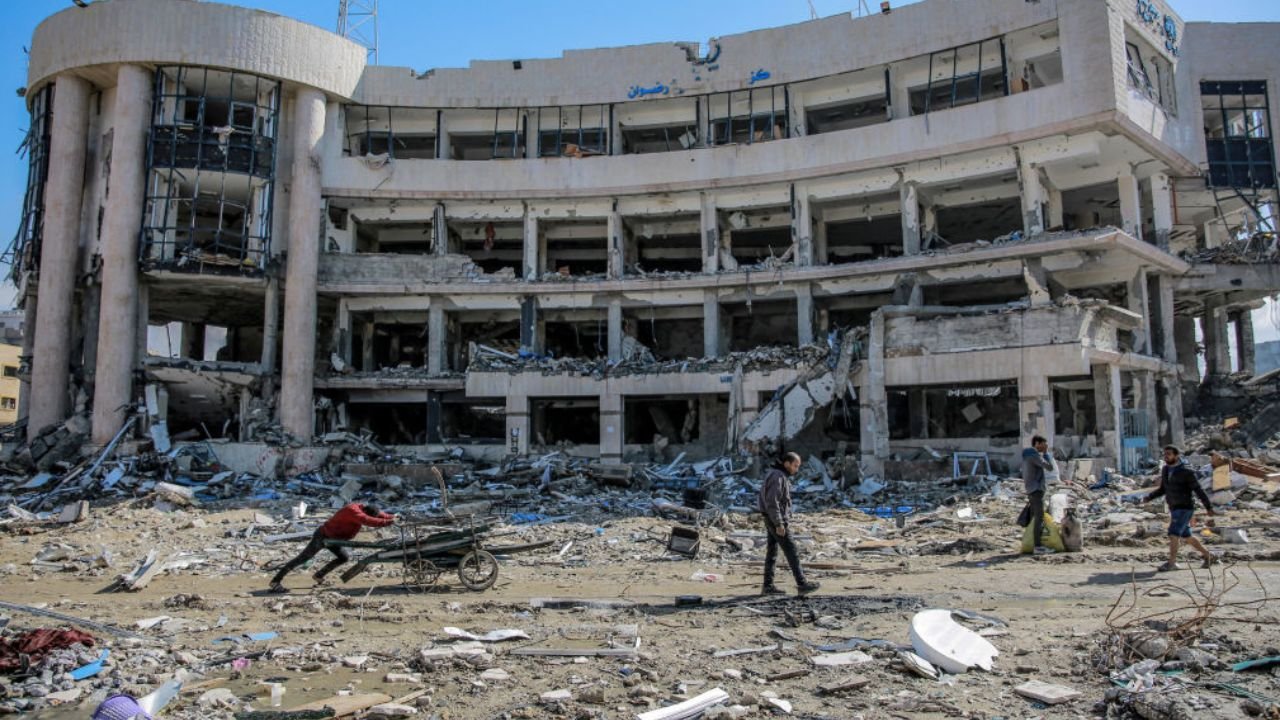
The United Nations has said that heavy fighting has “encircled” two hospitals in Khan Younis – Nasser and Al-Amal – leaving thousands of “terrified staff, patients and displaced people trapped inside”.
The World Health Organization (WHO) has said that seven out of 24 hospitals are “partially functioning” in northern Gaza and suffering a shortage of personnel and supplies.
Journalist Bisan shared a recent post detailing an attack on the Khan Yones camp by the Israeli occupation forces. Consequently, the last functioning hospital in Gaza- Al Nasser Medical Hospital- was under attack as well. Videos of gunfire surfaced on various social media platforms as well.
According to the WHO, only 15 of Gaza’s 36 hospitals are partially functional – nine in the south and six in the north. The hospitals in the south are operating at three times their capacity while facing critical shortages of basic supplies and fuel.
The facilities are “without enough specialized medical staff to manage the volume and range of injuries, nor sufficient medicines and medical supplies, fuel, clean water, or food for patients or staff”, the WHO said in a statement.
The Ministry of Health in Gaza says occupancy rates are reaching 206 percent in inpatient departments and 250 percent in intensive care units.
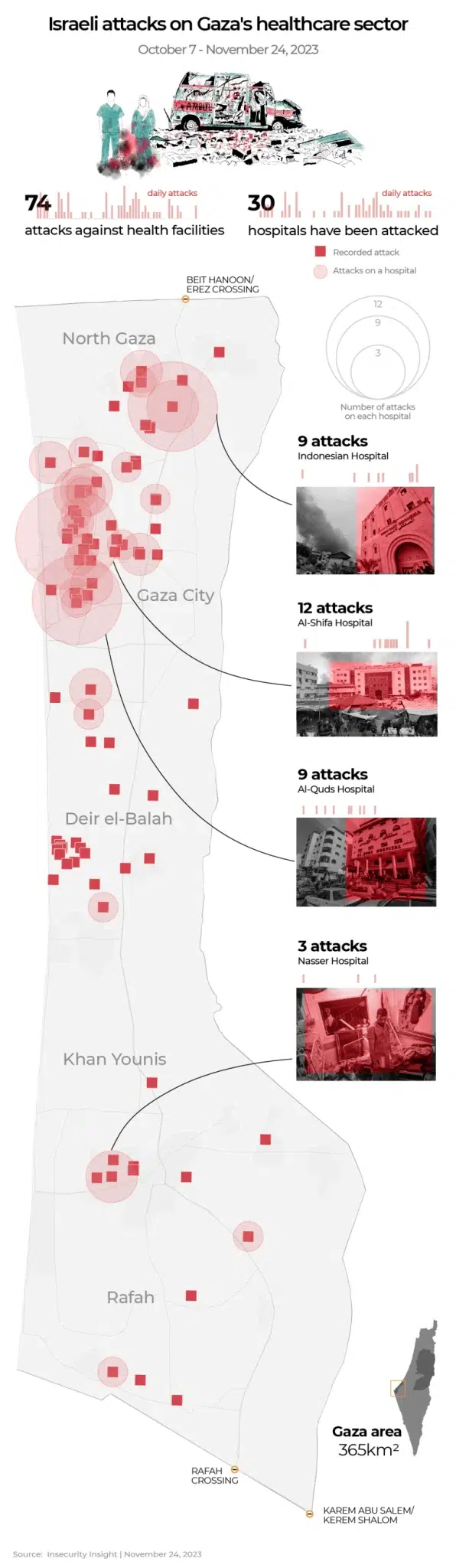
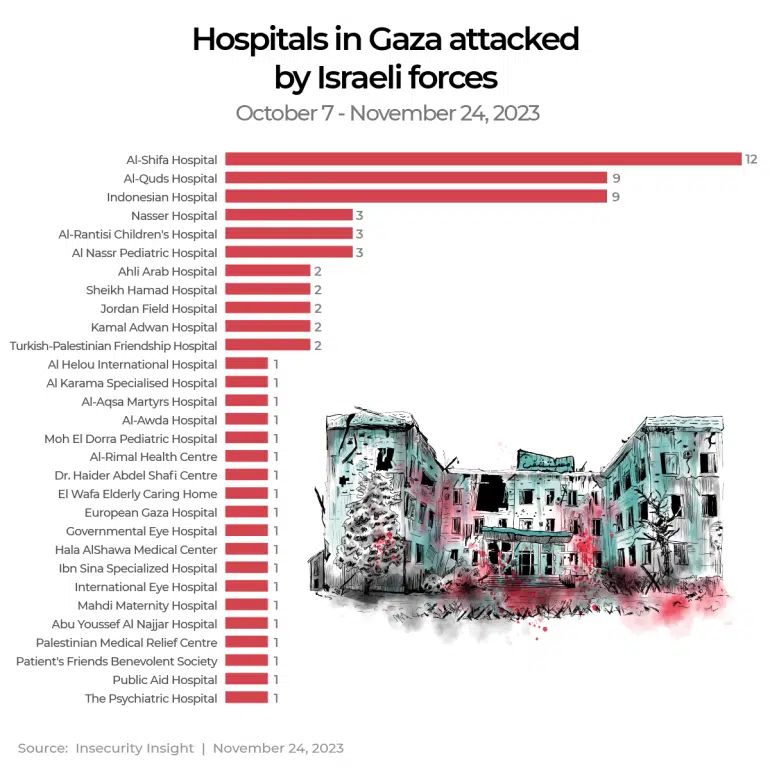
From October 7 to November 24, there were 74 Israeli assaults on health facilities with 30 hospitals attacked in Gaza, according to Insecurity Insight, a humanitarian association that collates data on threats facing people in dangerous environments. It delivered 19,000 litres (5,000 gallons) of fuel to al-Shifa Hospital on Tuesday after facing delays at a checkpoint and on damaged roads.
The hospitals that have been attacked most often include:
1. al-Shifa Hospital – attacked 12 times 2. al-Quds Hospital – attacked nine times 3. Indonesian Hospital – attacked nine times 4. Nasser Hospital – attacked three times
Insecurity Insight documented at least 26 other hospitals from across the Gaza Strip that were attacked by Israeli forces over the same period.
How Gaza’s healthcare system has been destroyed?
Mohamed S Ziara, a Palestinian doctor, talked to Al Jazeera and explained in a tone that is soft and unaffected by the rumbling explosions and pop of gunfire that can be heard in the background.
He is a plastic surgeon working 12- to 14-hour shifts, six days a week at the European Gaza Hospital (EGH) in Khan Younis, where he treats up to 15 cases a day. Ziara describes the healthcare situation as “catastrophic”.
“It doesn’t match anything I’ve seen before, even with previous escalations and war,” says Ziara, who has worked during Israel’s assaults on Gaza since 2014.
He has been posting about Israeli attacks near the EGH and the conditions inside on his Instagram account.
“No doctor wakes up in the morning and says: ‘I’m going to amputate a child’s leg without anesthesia.’”
“You don’t want to watch children suffer,” Dr Amber Alayyan with Doctors Without Borders, known by its French initials MSF, told Al Jazeera.
Chronically ill patients
In addition to immediate injuries from Israeli air strikes and artillery, patients with prior and long-term illnesses and vulnerable health conditions are faced with not being treated. According to WHO, they include:
1,100 patients in need of kidney dialysis
71,000 patients living with diabetes
225,000 patients with high blood pressure requiring medication
485,000 people with mental health disorders
cancer patients, 2,000 of whom are diagnosed each year, including 122 children
On January 7, exactly three months into the war on Gaza, WHO Director-General Tedros Adhanom Ghebreyesus said: “It is inconceivable that this most essential need – the protection of healthcare – is not assured.”