Pakistan Bureau of Statistics (PBS) revealed that the weekly Sensitive Price Indicator (SPI) for the joint consumption group fell 0.26 per cent for the week ending May 26, owing primarily to a drop in the prices of vital food products.
The consolidated index was 174.62 on May 19, 2022, compared to 175.08 on May 19, 2021, while the SPI increased 16.97 per cent year on year when the index was 149.29 on May 27, 2021.
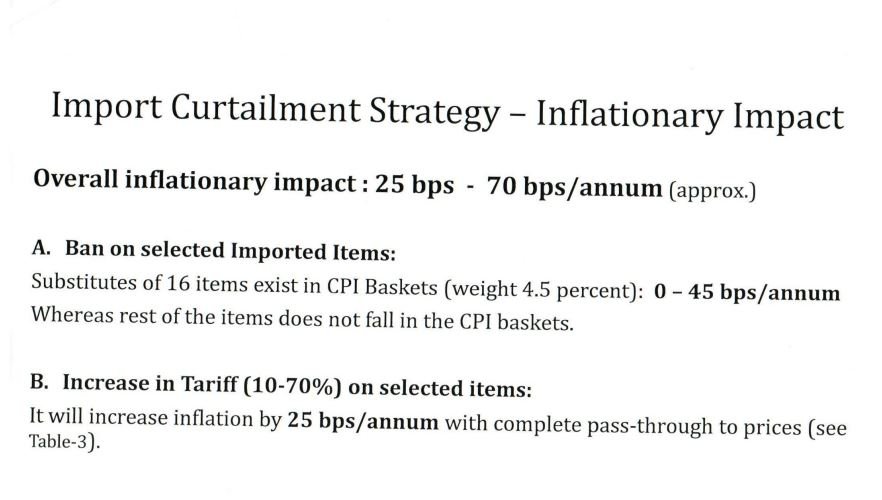
The minor price reductions in essential items may be a sign that the government is finally gaining control of the country’s skyrocketing inflation, which has afflicted the poor strata.
Here are the items that witnessed a decrease or increase in their prices:
Decrement
Wheat Flour (12.25 per cent), Chillies Powdered (6.48 per cent), Chicken (4.41 per cent), Garlic (2.99 per cent), and non-food item LPG (0.43 per cent) were among the commodities that saw a decline in their rates on a WoW premise out of the 51 supervised items, with a cumulative effect of (-1.00 per cent) into the total SPI for the blended group of goods (-0.26 per cent).
Increment
27 items elevated in the week, including potatoes (8.43 per cent), tomatoes (6.33 per cent), eggs (6.29 per cent), rice basmati broken (4.71 per cent), mustard oil (4.16 per cent), pulse masaoor (3.93 per cent), milk fresh (3.47 per cent), onions (3.03 per cent), pulse gramme (2.58 per cent), curd (2.35 per cent), washing soap (2.13 per cent), cooked beef (1.55 per cent), beef (1.42 per cent), pulse mash (1.33 per cent), cooked daal (1.24 per cent). While 19 commodities’ prices remained stable.
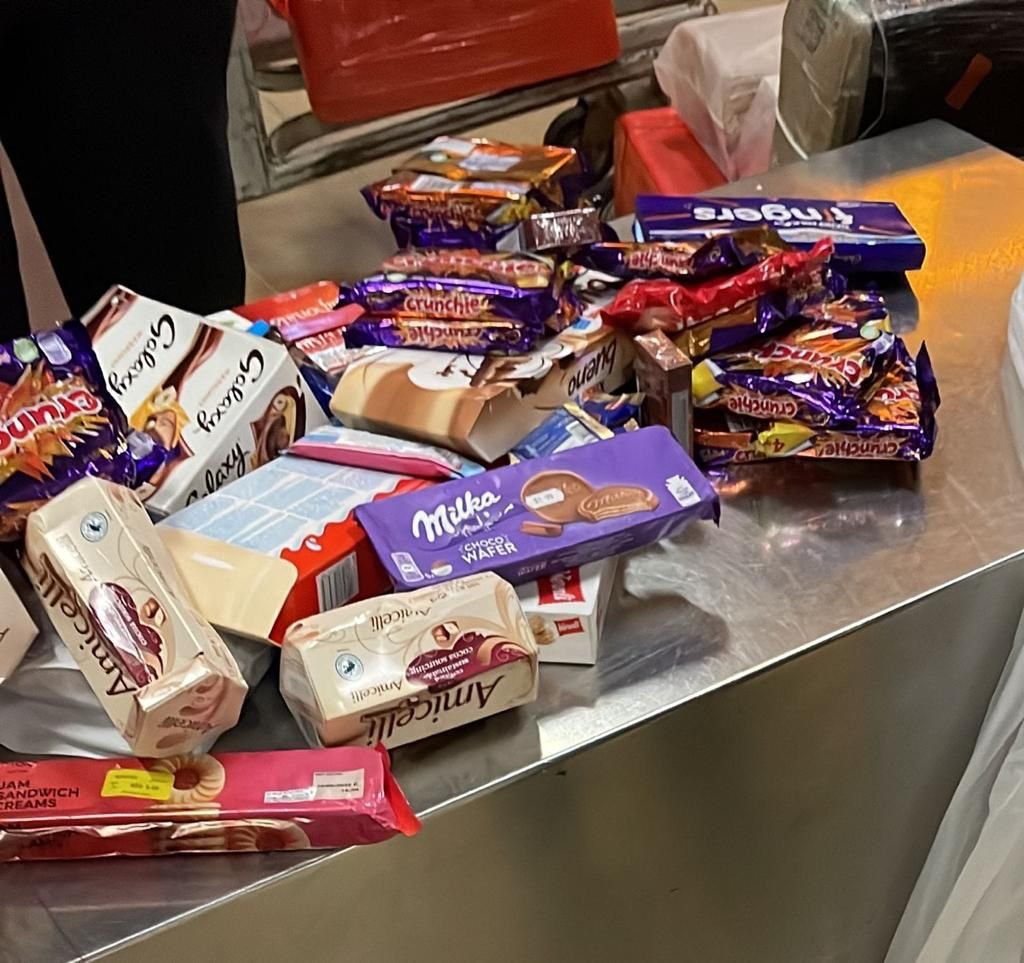
Instagram blogger @karachista1, on Tuesday, uploaded a story sharing several screenshots of conversations and images showing passengers’ items being confiscated at the Karachi and Lahore airport. Several social media users including lawyer Abdul Moiz Jaffery and actor and comedian Shafaat Ali, complained on Twitter about this being a ‘draconian step’.
The complaints ranged from AC Customs confiscating their private goods and others complaining that their bags were opened and imported items removed before they even landed in Karachi. Conflicting reports came forward with others reporting that they went through nothing like this. For some, only expensive makeup was confiscated and for others even biscuits and chocolates were not spared. Some customers were given receipts and some were not even informed.
The slip provided by the Airport Customs officers for future recovery of the items
So does this mean that if you plan on going abroad for a vacation this summer and want to bring back some goods for your family, you will not be allowed to take them from the airport? Pretty much.
We spoke to Irshad Gul, a Karachi businessman who regularly imports and exports items for his businesses. According to him, using passengers to bring back imported goods is usually considered an easy method of bringing imported items inside the country without paying any duty. He confirms that at the Karachi airport, Customs officers have become extremely vigilant, looking into all luggage bags and hand carries to scavenge for imported items. Large quantities of a single item like chocolates might be confiscated and you have to pay customs on them, but if you have a personal, small amount of chocolates, those should be allowed to go through. If you are planning to bring back some gifts from your vacation abroad, consider carrying only a few items which you can explain very well.
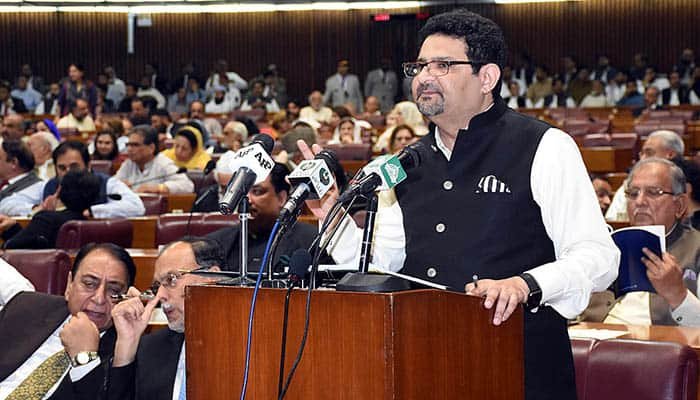
The irregularity in people’s online reported experiences only shows the usual inconsistency in Pakistani bureaucracy. A short while ago, Finance Minister Miftah Ismail tweeted an explanation for the airport and Customs staff’s behavior, clarifying that these steps are being taken to counter the smuggling of the banned items by professional packers. Although Ismail claims that ordinary citizens with a few items will not be harassed but citizens are reporting that even a few personal makeup items are being confiscated. Others say they were allowed to leave the airport unscathed.
As the govt has banned the import of a few non-essential items, we fear that smuggling of these items will increase. Therefore we have increased enforcement against professional khaipyas. Officials know who they are. Ordinary citizens bringing in a few items will not be harassed. pic.twitter.com/NFXJMAymUs
Finance Minister Miftah Ismail attached this official notice with his tweet, clarifying that all steps being taken by the airport staff are in accordance with government directive and compliance is necessary. Confiscated items include ‘food stuff, fruits, sanitary ware, used mobile phones and branded shoes’.
Several Twitter users including Shafaat Ali requested Miftah Ismail to take action as they believe personal products should be allowed and only commercial consignments should be subjected to these limitations.
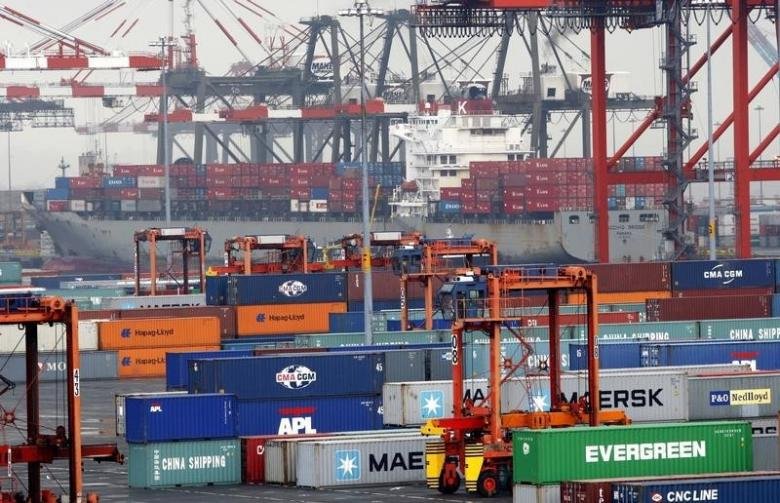
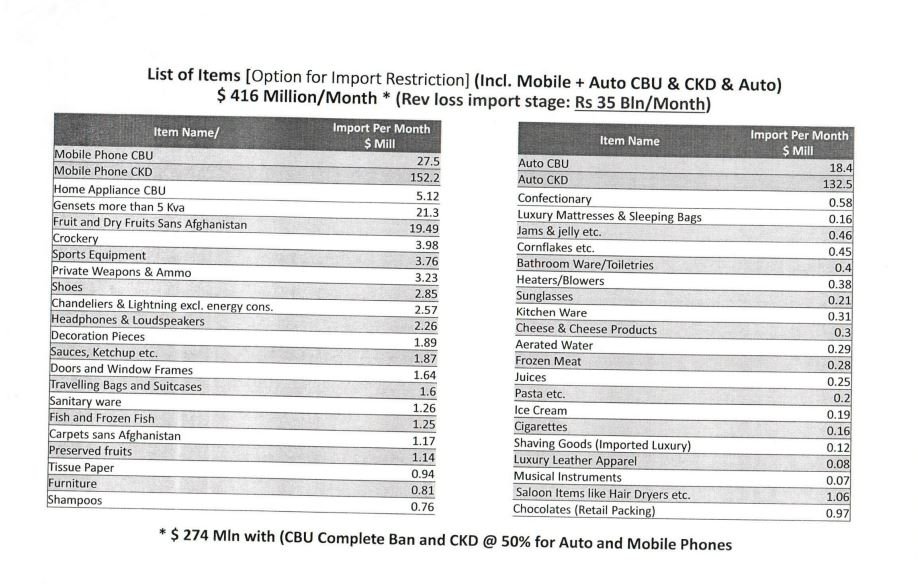
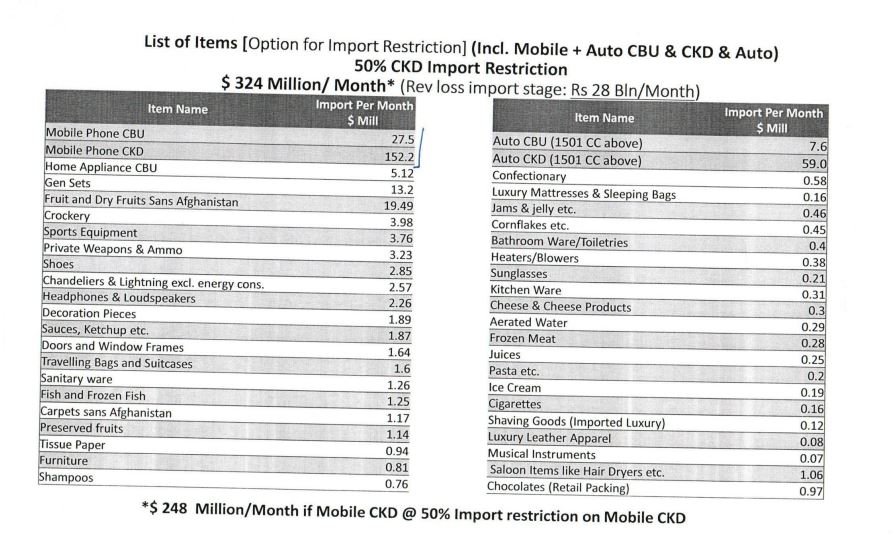
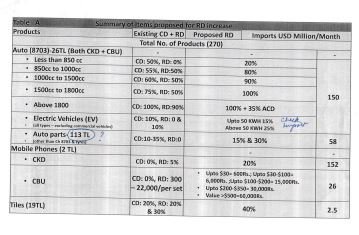
On Thursday, May 19th, 2022, the federal cabinet issued a list of 41 items which will be banned from being imported for two months. This is in an attempt to address the current account deficit. The list of products is banned from being imported into the country, which means that essentially any shops or restaurants which rely on using these products will be forced to find local alternatives.
These products will be banned regardless of what branding or packaging they use and only on the basis of whether the specific product is imported or not. Even products which are imported from abroad but packaged locally, will now be banned.
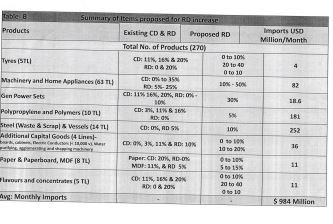
Officially released list of imported non-essential luxury items
Economists, university professors and business journalists took to Twitter to analyze and assess the merits and demerits of this decision. The discussion around luxury products and the fact that a lot of products which are labelled as “luxury items” are actually essential. Sanitary imports, valued at $16.4m are wrongly categorized as non-essential and although local alternatives also exist but it is definitions like these which disallow such decisions to be founded in research and expertise.
The valuation of these imports which was published by the Pakistan Bureau of Statistics, was being quoted to ridicule the decision by many. What’s interesting to note is that most brands which appear to be entirely local, import a major chunk of their supply and will now be forced to smuggle goods instead.
I don’t know who needs to hear this, but someone clubbed animal feed ($68m) with pet food ($5m) — and now suddenly we may have a feed crisis, b/c animal feed isn’t really a luxury and is used as a key agri input. Someone somewhere needs to amend the SRO.
Only from the data shared by PBS it becomes clear that for the fiscal year 2022, June to March, the total value of petroleum imports was $11 billion, while the total value of banning all these non-essential “luxury” items is a total $984 million, which forms only about 8.9% of the total value of petroleum imports.
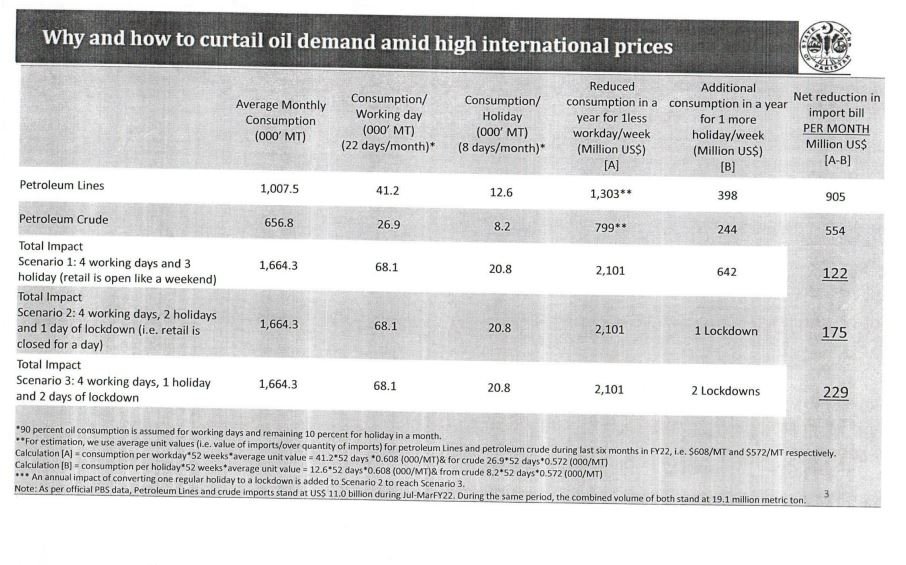
In conversation with Profit Magazine’s Ariba Shahid, she clarified that this would still prove to be a largely fruitless move since the most significant chunk of the import bill is still being used up to run the energy sector without any thought being given to the humongous fuel subsidies . “For a very long time the State Bank of Pakistan has been talking about how if we remove the oil component from it, the current account deficit is improving, which is true and basically means that people are not spending money to buy other items and most of the import bill is petrol and soy bean oil.”
This is patchwork economics, and unlikely to work
It is important to understand the deeper sources of structural imbalances
For example, one major source is unproductive sectors generating demand for foreign goods https://t.co/5bv5q2kKqS
Economists Ammar Khan and Atif R Mian also took to Twitter to analyze this decision of “patchwork economics”. Commenting on this unsustainable gap in Pakistan’s balance of payment, on April 15th, 2022 during a discussion on Pakistan’s economy at Princeton University, he explains that for Pakistan to grow it is a necessary condition for Pakistan to deal with this problem and digs deeper into the structure of the economy. He particularly takes apart urban land reforms, the necessity to levy a capital gains tax on speculative real estate transactions and analyzes how Pakistan is not even economically stable enough to grow at the rate of India and Bangladesh and it is primarily due to the elite capture of the economy that disallows the economy to attempt to fix its loopholes.
Echoing similar sentiments, Ariba Shahid explained that due to a weaker economy, the import bill is not as significantly high due to a reduced demand pull because of a lowered purchasign power and hence banning these products will be insignificant and might barely make a dent in the current account deficit. “The need of the hour is to reverse the fuel subsidy,” says Shahid, “This decision will swell up the grey market economy and smuggling will increase.”
The Federal Ombudsman’s nationwide public awareness campaign aimed at educating the wider populace and relevant groups about the skills and methods needed to combat cybercrime against children is now in full swing.
On Sunday, a representative for the Federal Ombudsman Office said that as part of the program, state-run broadcasting stations broadcast informational messages and programmes about the prevention and control of cyber-crime against children in Urdu and regional languages.
The strategic goal of the awareness campaign, according to Commissioner for Children Syeda Viqar un Nisa Hashmi, is to raise public awareness about the effects of cyber-crime abuse and exploitation of minors, as well as to educate children so that they could protect themselves from such situations.
He went on to say that politicians were encouraged to bring legal amendments to the issue as part of the protection drive. The FIA Cyber Crime Cell is also conducting operations to apprehend the remaining suspects.
Earlier, the Federal Investigation Agency’s Cyber Crime Cell also nabbed a gang in Lahore that was allegedly making money from the dark web through juvenile crime.