Tag: journalist

  • Two dozen Pak journalists prosecuted under Peca in two years

    Two dozen journalists in Pakistan have been prosecuted (2019-21) over the past under the Prevention of Electronic Crimes Act (Peca), states a report by the Freedom Network. November 2 marks the International Day to End Impunity for Crimes against Journalists.

    Most complainants against journalists charged under the Peca sought punishment rather than settlement.

    Investigative Journalist Umar Cheema reported for The News that the report’s findings were based on the analysis of cases of 23 journalists and information practitioners who were either sent notices by the Federal Investigation Agency (FIA) under Peca or charged with offenses under the same law.

    The report states: “Opinions or criticism of the military and the intelligence agencies is the most frequent complaint against journalists pursued under the Peca. Criticism in general – whether against the executive or the judiciary triggered the most complaints against journalists pursued under the Peca law. The prime nature of the complaint was alleged defamation.”

    The report provides evidence that Peca has emerged as the primary legal instrument to silence Pakistani journalists because it criminalises online expression.

    The executive director of Freedom Network Jean Bruggeman has said that Pakistani journalists are increasingly using online spaces to share independent news and critical commentary that is suppressed on traditional media.

    According to the report, Punjab has turned out to be the most dangerous region as 10 of the 23 cases were reported in the province. Federal capital Islamabad comes second when it comes to being targeted under the Peca with eight cases.

    Two-third of them are private citizens whereas opinions or criticism of the military and the intelligence agencies is the most frequent complaint pursued under the Peca.

    Furthermore, it found that the cases were registered against 56 per cent of journalists and informational practitioners who were involved in conflict with Peca between 2019 and 2012. Out of the individuals who were formally charged, around 70 per cent were arrested and half of them were tortured in custody.

    Over a third of the freelancers were targeted as they are almost equally likely to be targeted under Peca.
  • ‘Decision of England board is cowardly, was made out of fear of the players and India’: British author

    ‘Decision of England board is cowardly, was made out of fear of the players and India’: British author

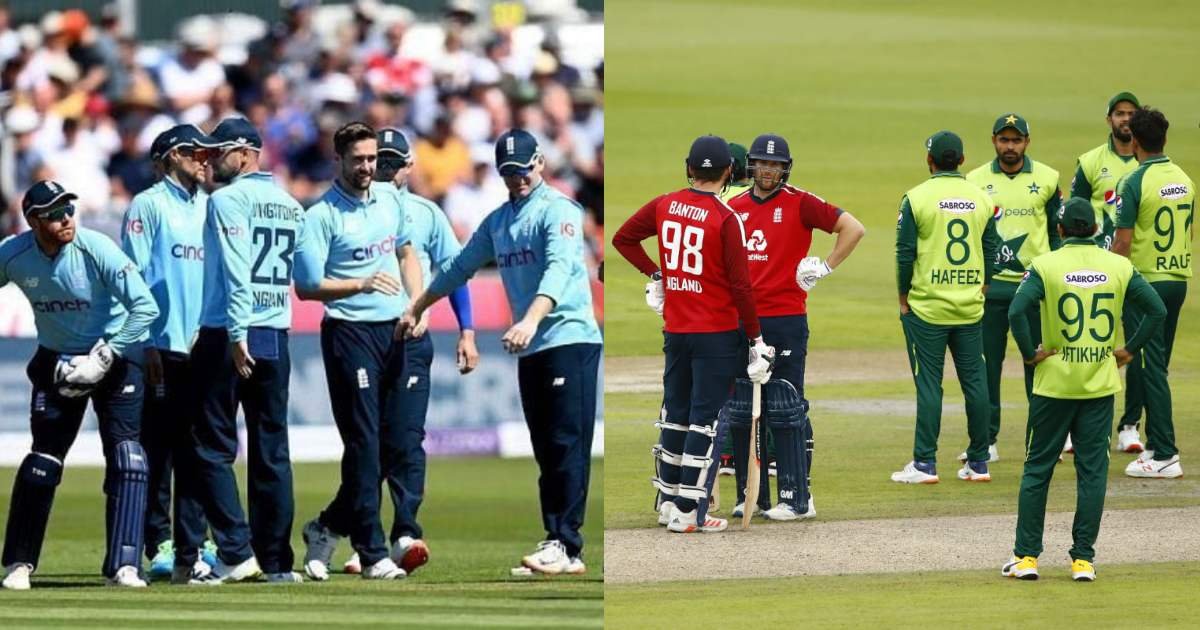
    British author and journalist Peter Oborne termed the decision of the England and Wales Cricket Board (ECB) as cowardly, saying that the decision to cancel the tour of Pakistan was taken out of fear of English players and India.

    The author slammed the English board, saying the grounds on which the visit to Pakistan was canceled were a matter of “grave concern”.

    Peter said: “The England board’s decision to cancel the tour was cowardly and out of fear of the players and India, especially the IPL. The security arrangements in Pakistan were the same as those made for Prince William and Kate Middleton. The British High Commission in Pakistan was satisfied with the security arrangements.”

    While talking to Sky News, the author said: “Not for Pakistan’s cricket, this decision is a blow to the whole world. Pakistan team is one of the best teams in the world, England apparently did not make this decision on security grounds.”

    He also criticised “invisible” Chairman ECB Ian Watmore to come on television and defend this decision.

    “We are kicking one of our closest cricketing allies on teeth because of India,” he stated.

    Oborne said that there was no change in the English board’s security advice, adding that the press release did not mention security but the players’ stress.

    He further said that Pakistan came and played in the UK even in the dangerous time of Covid-19. Pakistan did good to Britain by coming in the pandemic.

    Earlier, veteran cricket journalist George Dobell had taken the ECB to the cleaners for cancelling its tour to Pakistan and had called it out on its “hypocrisy”.

  • US right-wing journalist praises PM Khan for saving Afghan’s lives

    US right-wing journalist praises PM Khan for saving Afghan’s lives

    A right-wing television presenter, Glenn Beck has thanked Prime Minister Imran Khan in a series of tweets for his support in getting Afghans out from the war-torn country.

    Beck, who has a charity organisation called Mercury One, has been assisting with evacuations from Afghanistan since the Taliban’s takeover, revealed that Pakistan’s leadership helped with the release and departure of three flights.

    In a tweet, he stated that, “We reached out and asked numerous leaders in political and civil society around the world for help. The silence was shocking as was the outpouring of help on a humanitarian basis. We received an immediate response to our requests from PM Imran Khan of Pakistan who then acted on his willingness to assist.”

    “Pakistan has once again proven to be a valued partner in all seasons for the United States, despite recent criticisms from some sections of US media,” he added.

    While stressing that the US should recognize Pakistan’s assistance at this point, he tweeted, “We will not forget this support that has enabled America and its allies to make good on their promises to those who helped them without pause or reflection.”

    “Let no one fool you, the International Federation of Association Football (FIFA) female athletes are out because of you and Imran Khan”, he concluded in his last tweet.

    Earlier, there were reports that six chartered planes by Beck’s charity were seeking to evacuate at least 1,000 people, including more than 100 Americans. During his efforts, his supporters praised him for doing “more for Americans than all of Biden’s supporters combined.” 

    According to the statement made by Pakistan Foreign Office in early September, 12,000 people had been evacuated from Afghanistan with the help of Pakistan.

    Beck is one of the most controversial media figures in the US and quite well-known among conservative circles. 

  • President Alvi addresses joint session in NA amid media protest

    President Dr Arif Alvi addressed a joint sitting of parliament on Monday, marking the start of the fourth parliamentary year of the National Assembly amid chaos outside parliament.

    The President of Pakistan congratulated the members of parliament at the start of the new legislative year and expressed hope that democratic values and the “tradition of tolerance” flourish in Pakistan.

    Amid loud protests by the Opposition, President Alvi said: “Despite you making noise, you will have to accept the reality.”

    Dr Alvi briefly discussed the country’s progress and shed light on various topics.

    Electronic Voting Machines (EVMs)

    President Alvi stressed the need to introduce electoral reforms in order to bring transparency to elections in Pakistan.

    Financial Action Task Force (FATF)

    “People paying tax in such large numbers shows complete trust in government policies,” Alvi said, congratulating the government for devising and implementing laws and procedures to address FATF requirements.

    Sexual harassment cases

    Alvi said the government had paid “special attention” to the rights of women.

    “In recent days, incidents of sexual violence against women emerged due to which everyone is sad and I think it is a national responsibility to take steps to curb such incidents,” he said.

    President Alvi added that the government had taken measures to stop such violence and it was also society’s responsibility to play its role. “Making videos while an [harassment] incident is taking place does not suit the Pakistani society, so it will have to protect women so they can wander freely.”

    Corruption

    Because of corruption and wrong priorities, we were not only deprived of progress but also left behind in the world in human development indicators,” Alvi said.

    Health Sector

    He said that “18 million families were benefitting from the health cards so far”.

    “Pakistan is going towards universal health coverage, he added while praising the government’s efforts,” he concluded.

    Kamyab Jawan Programme

    The President noted that the government had set aside Rs260bn through which 12 million families will be given cash income, while Rs100bn had been earmarked for the Kamyab Jawan Programme to give loans to the youth to start businesses.

    Opposition walkout

    During his address, the Opposition kept booing and at last walked out of the session.

    The Opposition also accused the Pakistan Tehreek-e-Insaf (PTI) government and National Assembly (NA) Speaker Asad Qaiser of violating the Constitution by not allowing a debate on the presidential address through­out the third parliamentary year, which ended on August 13.

    Politicians including Shehbaz sharif Bilawal Bhutto-Zardari, Shahid Khaqan Abbasi, Sherry Rehman, Mian Raza Rabbani and Ahsan Iqbal joined the protest and showed solidarity with the journalists.

    “Thanks to all friends and well-wishers who were sending messages of solidarity the whole night whole day, we just finished a 24 hours protest camp in front of the parliament against threats to media and new proposed law for legalising censorship in Pakistan,” Hamid Mir tweeted, mentioning the end of the protest.

    President Alvi did not mention the journalists’ protest against the Pakistan Media Development Authority (PMDA).

  • ‘You are lucky you weren’t beheaded’, Journalists open up about Taliban beatings

    Adding to a list of Taliban atrocities, two Afghan Journalists were left with immense bruises in Kabul. Their crime: covering protests in the Afghan capital.

    According to Taqi Daryabi and his colleague Nematullah Naqdi, of the daily newspaper Etilaat Roz (Information Daily), the Taliban separated them into two rooms, insulted, and flogged them with cables after accusing them of organising the protest as per Agence France-Presse (AFP).

    https://twitter.com/lnajafizada/status/1435818054332653576?s=21

    The two were reporting on a protest by women demanding the right to work and education in front of a police station.

    Naqdi said he was stopped by a Taliban fighter as soon as he started taking pictures.

    “They told me that you cannot film’,” he told AFP. Moreover he said that Taliban fighters insulted him and kicked him in the head and that a Taliban fighter placed his foot on his head and crushed his face against the concrete. When he was asked why he was being beaten, he was told, “you are lucky you weren’t beheaded.”

    Zaki Daryabi, the daily newspaper publisher told Committee to Protect Journalist (CPJ) via phone that the Taliban subjected the reporters to severe physical abuse that he described as “torture” for four hours that each lost consciousness at least four times in custody. However, CPJ could not independently confirm allegations of torture.

    According to the BBC, their journalists were also prevented from filming. Not only this, Al-Jazeera reported that three of their reporters said that Taliban fighters pushed, slapped them and took their belongings.

    Over the last days, the Taliban detained and later released at least 14 journalists covering protests against the group, At least nine of these journalists were subject to violence during their detention.

  • Journalists reject government media bill, call it unconstitutional

    Journalists reject government media bill, call it unconstitutional

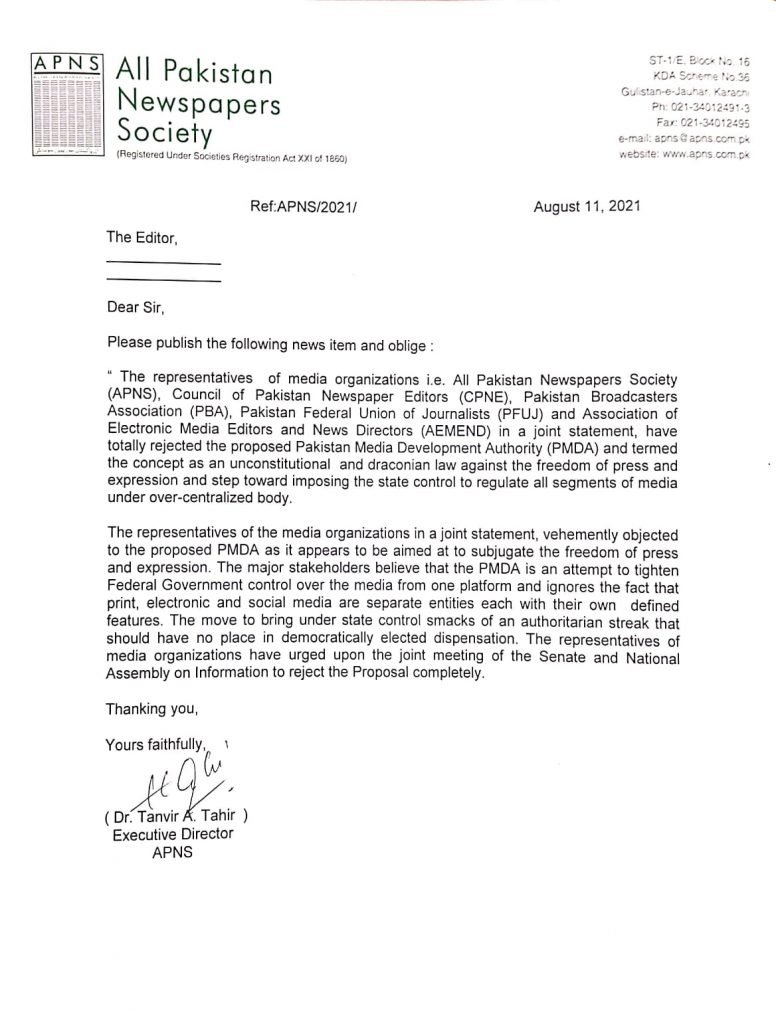
    The representatives of media organisations have rejected the proposed Pakistan Media Development Authority (PMDA) and termed the concept as an unconstitutional and draconian law against the freedom of press and expression and a step toward imposing state control to regulate all segments of media under over-centralised body.

    The major stakeholders believe that the proposed PMDA is an attempt to tighten the government’s control over the media from one platform and ignores the fact that print, electronic and social media are separate entities, each with their own defined features.

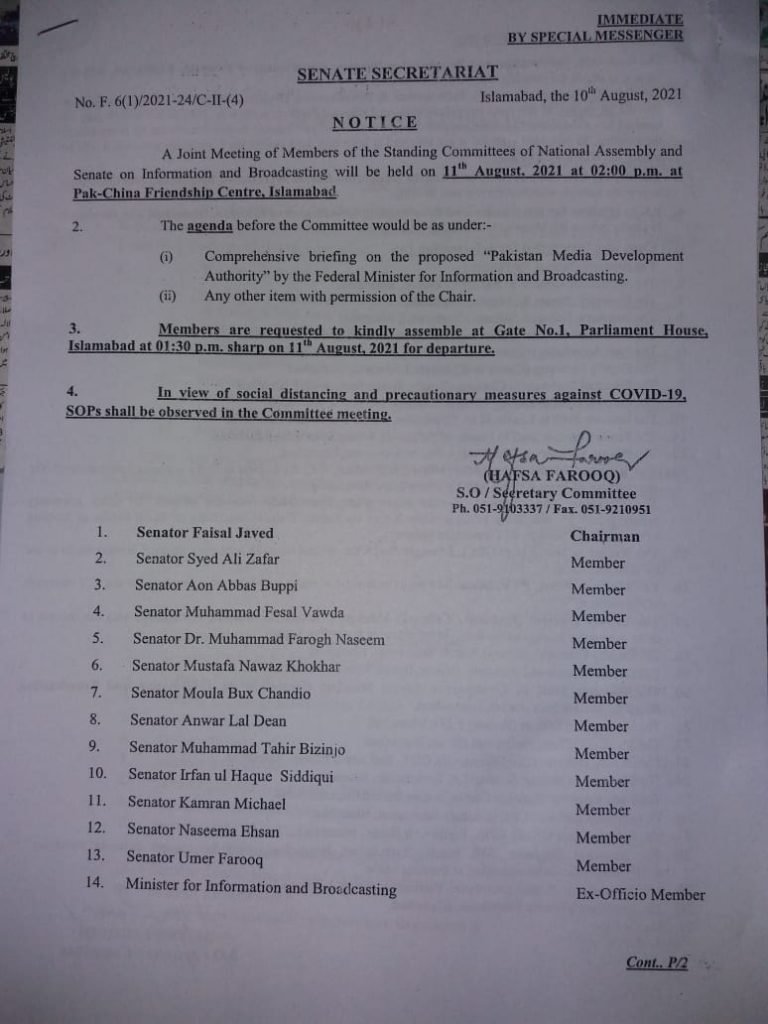
    A joint meeting of the members of the Standing Committee of National Assembly and Senate on Information and Broadcasting was held on August 11.

    Talking to The Current, Senator Mustafa Nawaz Khokhar said that a joint meeting of the Standing Committees on Information of both Houses — Senate and National Assembly— had been called by the Information Ministry to discuss the proposed media authority bill.

    “PML-N had boycotted the meeting as it was being held at the Information Ministry instead of Parliament House. When I went to the meeting, I raised some legal and constitutional points regarding the meeting,” said Khokhar.

    “I asked the government for signed permission by Chairman Senate and Speaker National Assembly as it is required by law if such meetings are called outside parliament. The government could only produce a permission letter from Chairman Senate but not Speaker National Assembly. So I raised the point that this meeting is illegal,” said Khokhar.

    “I also pointed out that since Mian Javed Latif, who is the chair of the NA Standing Committee on Information, is not present due to PML-N’s boycott, the NA Standing Committee cannot be part of this meeting. I was overruled by the government. Thus, the PPP also decided to boycott the briefing,” added Senator Khokhar.

    The agenda before the Committee was one of a comprehensive briefing on the proposed PMDA by the Federal Minister for Information and Broadcasting Fawad Chaudhry.

    As per the last known draft, the PDMA has been described in the Ordinance as “an independent, efficient, effective and transparent” Authority, which will regulate all forms of media, including digital media.

    Under the Ordinance, print and digital media will also need a license to establish and operate in the country.

    The draft describes digital media as online newspapers, web TV channels, OTT content platforms, online news channels, video logs, and YouTube channels, Netflix, Amazon Prime.

    As per the drafted Ordinance, the government could issue directives to the Authority on matters of policy, and such directives will be binding on the Authority.

    For a media organisation to operate in the country, it will be required to not broadcast, distribute or make available online any programme inciting violence or hatred or any action prejudicial to maintenance of law and order or content which defames or brings into ridicule the Head of State, or members of the armed forces, or legislative or judicial organs of the state or is obscene or vulgar.

    As per the draft, the president will set up media tribunals. An aggrieved person can file an appeal with the media tribunal within 30 days. Only the Supreme Court will have jurisdiction to question the legality of a decision taken by the media tribunals.

  • Pakistan condemns Modi for not allowing India-based foreign journalists to visit Pakistan

    Pakistan condemns Modi for not allowing India-based foreign journalists to visit Pakistan

    India has refused permission to allow five India-based international journalists to travel to Pakistan via Wagah.

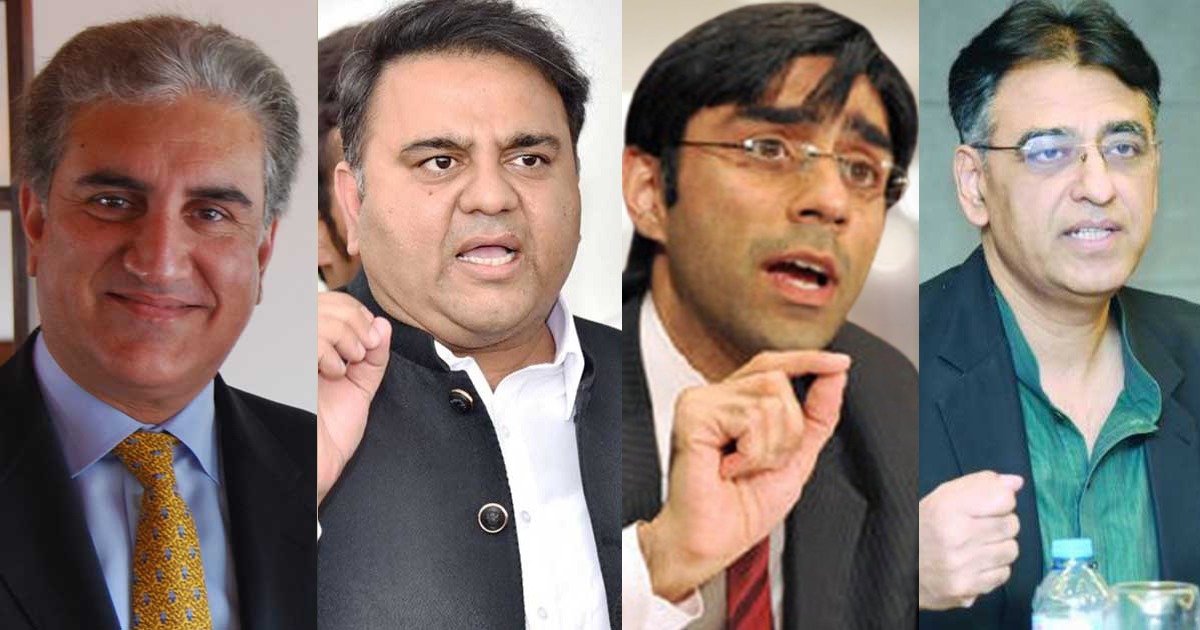
    Foreign Minister Shah Mahmood Qureshi pointed out how the Indian government’s decision indicated that the space for free speech and independent journalism was shrinking in India under a “dictatorial regime”. Qureshi said the five journalists were to travel to Pakistan and were also to visit the Azad Kashmir Assembly.

    Information Minister Fawad Chaudhry also condemned New Delhi for refusing permission to the international journalists to visit Azad Kashmir. 

    The minister took to Twitter and questioned India for its freedom of expression.

    National Security Adviser Moeed Yusuf said these “are the actions of an insecure government that has much to hide”.

    Federal Minister for Human Rights Shireen Mazari questioned whether the foreign journalists will expose the growing myth of Indian democracy under the fascist Modi regime.

    Federal Minister for Planning, Development and Special Initiatives Asad Umar tweeted, “We want the world to see what is happening in Azad Kashmir and they want to hide what is happening in Indian Occupied Kashmir. The difference between right and wrong cannot get more stark than this.”

    A request by Pakistan to allow a group of five India-based foreign journalists to travel to Islamabad through Wagah has been declined by Indian authorities as the border crossing is virtually closed due to the coronavirus pandemic, reported Times of India.

    The report stated that Pakistan planned to take the journalists for interactions with top political leadership and senior officials on the overall situation in Afghanistan.

    “One of the persons familiar with the development said the visit was planned from August 3 to 7,” read the report.


  • Journalists lash out at new PEMRA directives on how to cover natural calamities

    Journalists lash out at new PEMRA directives on how to cover natural calamities

    Pakistan Electronic Media and Regulatory Authority (PEMRA) issued new directives to news and current affairs television channels, on the recent coverage of torrential rain and urban flooding in the country.

    The notice issued by PEMRA says: “It has been observed with grave concern that while reporting/airing news/ footages on natural calamities, torrential rains, and flooding, news channels generally rely on videos which are widely circulated on digital platforms such a Facebook, Twitter, Instagram and WhatsApp instead of mobilising their own field teams for providing actual /real-time footages to the viewers, which is not only the responsibility of the channels but also mandated.”

    The statement further said that these “sloppy videos” create “unnecessary panic and fear” not only among the inhabitants of the cities being reported but for the loved ones living across the country or even abroad.

    The authority said, ” All satellite TV channels are once again directed to produce their own footages/packages and train their reporters/ news teams to be vigilant, responsive and active and cover each event/ occasion themselves so that viewers could get real-time factual information rather than relying on videos available on social media platforms.”

    Journalists lashed out at the new PEMRA directives.

    Jounailt Shahzad Iqbal tweeted, “Ruling party #PTI & Govt use social media for narratives but social media footages of rain in Islamabad that killed two people can’t be used?”

    Iqbal further wrote, “It will also mean media won’t be able to air any footage of atrocities in Indian Occupied Kashmir (IOK) or attacks on Palestinians by Israeli forces because we don’t have our reporters in the field.”

    Journalist Amber Rahim Shamsi wrote, ” Every channel in the world uses eyewitness footage from emergencies/disasters/conflict zones. It’s a bizarre directive until you realise the motive – keep TV channels on a tight leash when it makes the government look bad.”

    Journalist Zebunnisa Burki criticised the new directive and tweeted, “Pemra seems to have gone completely off the rails.”

    Journalist Benazir Shah questioned, “Guess PEMRA has not heard of ‘citizen journalism.’ If a video has been verified by channel why can it not be aired?”

  • EXCLUSIVE: ‘I did the speech knowing I would lose my job,’ Hamid Mir

    EXCLUSIVE: ‘I did the speech knowing I would lose my job,’ Hamid Mir

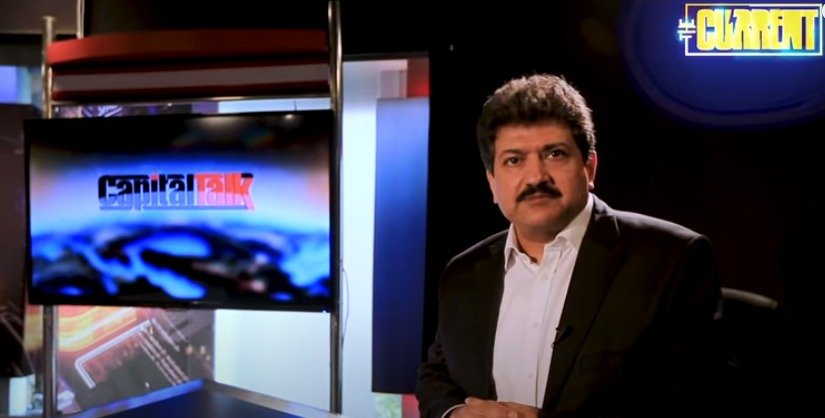
    Hamid Mir doesn’t sound like he’s down. On the contrary, the seasoned journalist sounds energised and alive. His phone was dead (or switched off) for the past two days, when The Current tried to reach out to him. Eventually when we got through, he didn’t pause for a second and gave us his version of the event that led to his removal from his flagship show, ‘Capital Talk’ on Geo News.

    “What will Geo probe?” he said when asked that Geo News had stated that they would “check for violation of policy and law” in a speech given by Hamid Mir “that resulted in backlash from different segments of society”.

    “My speech did not air on Geo News, it was not published in the newspaper,” Mir said categorically, “so how is Geo responsible when it never appeared on their television screens?”

    But Mir does admit that the pressure is intense on the management of his channel, which ultimately falls on him. “I am always prepared for pressure,” he says calmly, “I offered to leave the channel on Friday night when I was asked to clarify my statement. I told the management that when I never spoke on your channel, why do I need to issue a clarification? I was then told not to tweet on the issue and also that I should not take part in any other programmes,” Mir explained. “I was going to go on different news channels and said that I am not going to discuss my speech but to discuss the media ordinance. I was asked not to do so and therefore, I didn’t. I did tell them [management] that ‘they’ will ask you to remove me from the programme in a day or so and that’s exactly what happened.”

    When asked what it was about this particular case that drove Mir to give the speech, he said it was because of a man in a wheelchair.

    “When I was about to speak, if you notice in the video, there is a man on my right side sitting on a wheelchair. The man is an old journalist Qaiser Butt and he randomly said, ‘Larki ka bhai ho sakta hai‘ (it can be the girl’s brother) implying that Toor was part of an illicit relationship. That made me angry since Asad was standing right there as well. I got de-tracked and said, ‘larki ki maa bhi ho sakti hai jo General Rani hai‘. But it’s not just that.”

    Mir says the biggest reason for speaking out had been building up for the past three weeks. “In the past two, three weeks, some female colleagues were complaining that they were being threatened and one told me that ‘they’ came to her house. They didn’t cause her any harm but gave her a message.” He added that two female journalists also wanted to file a case but they have restrictions that are different. “Their husbands tell them not to report the cases; they face problems with their in-laws.”

    Mir is hopeful for change this time. “I did the speech knowing I would lose my job and I was prepared for that,” he says. “Right now, as I am speaking with you, I am at a meeting with the Human Rights Commission of Pakistan (HRCP). Hina Jilani is also here and the Pakistan Federal Union of Journalists (PFUJ) is going to be releasing a white paper on the new cases that have come up. I can’t tell you, I have been swamped with calls of people that are now finally coming forward with cases and want to raise their voice.”

    “Lots of people are taken off air, but there has never been such a big reaction,” Mir says, explaining that in this particular case, the local and international reaction is bigger than he expected. “I am getting a lot of calls from international networks wanting to cover the story and because of this interest, I believe that some pressure will be put on the political government for accountability.”

    “Lots of ministers are messaging me in private, lending their support,” Mir said. “Perhaps this time, we might see some actual change.”

    Hamid Mir was taken off air on Monday.

  • Hamid Mir will not be hosting ‘Captial Talk’ tonight

    Hamid Mir will not be hosting ‘Captial Talk’ tonight

    Senior Journalist and anchorperson Hamid Mir, who hosts prime time show ‘Capital Talk’ on Geo News, has been taken off air. Many believe Mir has been asked to go on leave because of this speech.

    Mir confirmed the news on Twitter. “Nothing new for me. I was banned twice in the past. Lost jobs twice. Survived assassination attempts but cannot stop raising voice for the rights given in the constitution. This time I’m ready for any consequences and ready to go to any extent because they are threatening my family.”

     Human rights bodies condemned the indefinite ban on Hamid Mir.

    Journalists tweeted in solidarity with Hamid Mir.

    Information Minister Fawad Chaudhry tweeted that it is up to the broadcasters to decide which programme to air. “We have nothing to do with the internal decisions of media organisations. All broadcasters are responsible for making their own policy under Article 19 of the Constitution.”

    Several politicians took to Twitter to condemn this ban.