Tag: journalist

  • PDM delegation visits Asad Ali Toor

    PDM delegation visits Asad Ali Toor

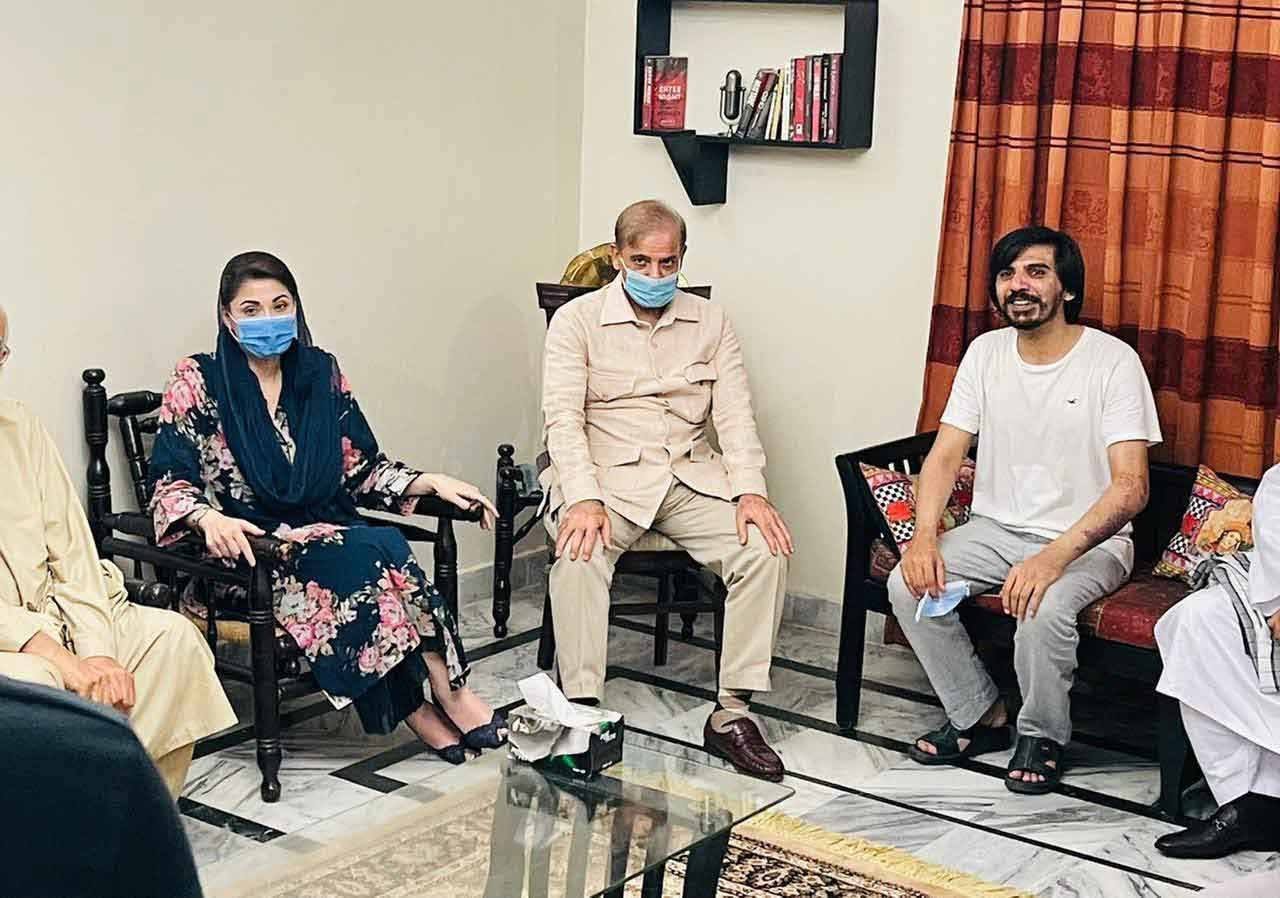
    A delegation of the Pakistan Democratic Movement (PDM) visited the house of journalist and Youtuber Asad Ali Toor on Saturday.

    https://twitter.com/pmln_org/status/1398685365007966215

    The delegation was led by the Jamiat Ulema-i- Islam Fazl (JUI-F) chief Maulana Fazlur Rehman. Pakistan Muslim League-Nawaz (PML-N) President Shehbaz Sharif, PML-N Vice President Maryam Nawaz, General Secretary PDM Shahid Khaqan Abbasi, Mehmood Khan Achakzai, Marriyum Aurangzeb, Usman Kakkar, Attaullah Tarar, Shah Awais Noorani, Maulana Abdul Ghafoor Haidari, and others from the PDM were also part of the delegation.

    Maryam Nawaz said, “It hurts my heart when journalists are punished for writing the truth and telling the truth.”

    https://twitter.com/pmln_org/status/1398658539220979718

    Asad Toor, was severely beaten up by unidentified assailants in his apartment in Islamabad on Tuesday night.

    Journalist bodies held countrywide protests and urged the authorities to investigate the issue and nab the culprits.

  • ‘No one can dare undermine me,’ Fawad Chaudhry burns BBC HARDTalk

    ‘No one can dare undermine me,’ Fawad Chaudhry burns BBC HARDTalk

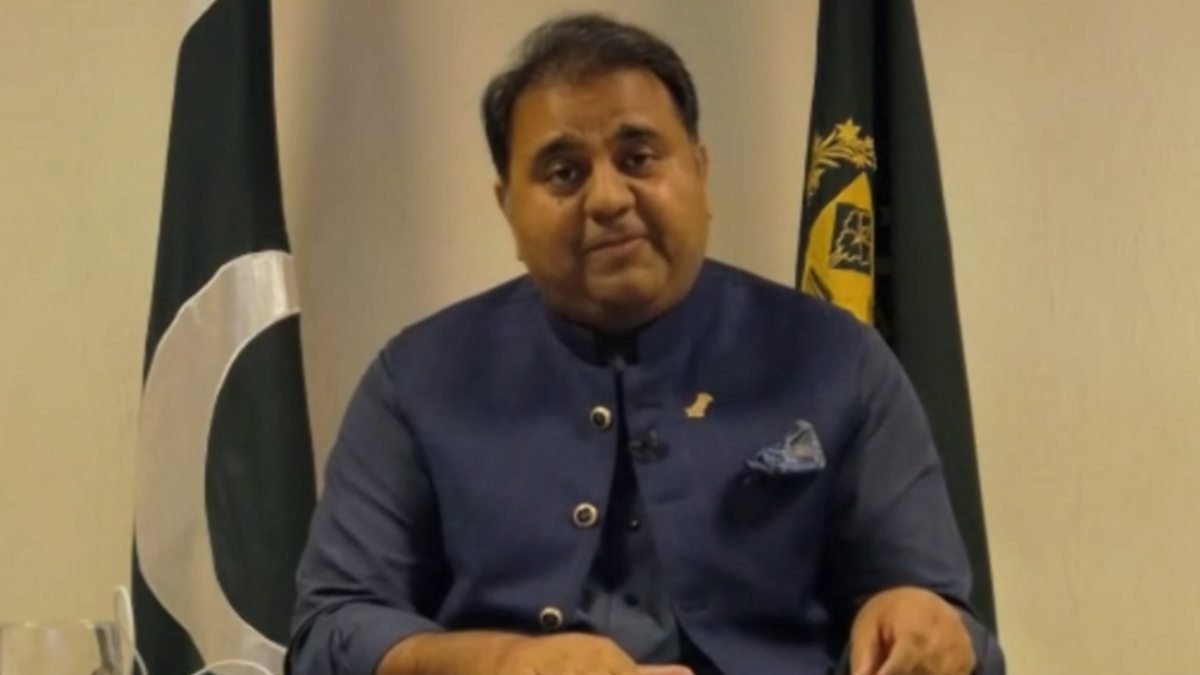
    Federal Minister for Information and Broadcasting Fawad Chaudhry talked on the protection of journalists, the involvement of the establishment within the state, the economy of Pakistan, missing persons, popularity of Prime Minister Imran Khan, Covid stituation and many other issues in an interview given to BBC host Stephen John Sackur on BBC HARDtalk.

    Journalists Protection

    The host opened the interview by asking what is the government and Fawad Chaudhry being the Information Minister doing to protect the journalists of the country. Sackur mentioned the recent attack on journalist Asad Ali Toor, who was severely beaten up by unidentified assailants in his apartment. Sackur further mentioned how a senior journalist and former Chairman of Pakistan Electronic Media Authority (Pemra), Absar Alam, was shot in Islamabad. To which Fawad Chaudhry replied, “Individual incidents do happen. The situation is not only dangerous for journalists but it has been for all the citizens of Pakistan. We have faced the worst terrorism. When we were fighting our war against terrorism, we lost a lot of field journalists and many civilians.”

    “Benazir Bhutto too got killed due to terrorism. We have been dealing with tough times,” replied Fawad.

    Stephen Sackur asked what the state was doing about the involvement of state agencies in such incidents.

    “It’s a bit fashionable for the western media to accuse ISI (Inter-Services Intelligence)
    when such incidents happen. When you name any organisation or Pakistani intelligence agency, you are bound to produce evidence of their involvement as well,” replied the minister. “The two specific incidents which you have mentioned, the investigation is still under process, I still don’t know under what pretext have you concluded that the state must be involved in any of this.”

    Direct State Interference

    BBC host asked Chaudhry about freedom of speech in Pakistan. He said that media censorship has increased during Imran Khan’s tenure. Chaudhry replied, “We have about 112 private channels, 43 international channels, with this kind of mass media we have, how do you expect the state to intimidate the media? How can the state be accused of intimidating the media?”

    Censorship

    “I am the Information Minister of the world’s fifth-largest state. I am the Information Minister of one of the world’s seven nuclear states of the world. No one can dare to undermine me. I am here with full authority and I decide in Pakistan what will and what is happening,” answered Fawad when told by Sackur that Chaudhry has no real power or control.

    PTI government’s comparison with previous government’s

    The host compared the working of the Pakistan Tehreek-e-Insaf (PTI) with previous governments.

    “This may be a perception of some Indian-influenced think tanks, not ours. This is not the perception of the people in general. Imran Khan is the most popular prime minister,” said Fawad.

    “As said, don’t undermine the elected government of Pakistan. Imran Khan has received nearly 200 million votes. This is not a joke. He is the prime minister of a nuclear state. He takes the decisions, the cabinet takes the decisions,” added Fawad.

    Relation with establishment

    Fawad Chaudhry said that we have a very good relationship with the ‘so-called establishment’ “as you term it so often. They are part and parcel of our system. We have huge respect for them, but the decision-making rests with the prime minister and the cabinet.”

    Missing Persons

    The BBC host asked about missing persons the security establishments, and the deep state?

    “ISI and army respect human rights just as any other civilian government will do. They are the most civilised army of the world, they are the most responsible army of the world. People in Pakistan respect them for their role,” said Fawad.

    “Least number of missing persons were reported in Imran Khan’s government. We are the only government that has just passed a law against disappearance. We are the only ones who have made illegal confinement a criminal offense. And now the bill has been passed and will go to the parliament,” added Fawad

    Imran Khan’s pledge to deliver

    The show host said that PM Khan’s promises have not been delivered to the people of Pakistan.

    “Unfortunately, I do not agree with your conclusion. Right now Pakistan’s growth rate is 3.94 per cent, which is one of the highest in the whole world despite all the Covid crises,” said Fawad.

    Fawad added, “People who have voted for Prime Minister Imran Khan and PTI are still ardent fans. In the next elections, PM Imran Khan will be elected again.”

    Covid situation

    Sackur asked why only one per cent of Pakistan’s population has been vaccinated.

    “As far as Covid is concerned Pakistan is a great success story. The partial lockdown story that Prime Minister Imran Khan implemented in Pakistan was a great success story,” replied Chaudhry.
  • Who is Bianna Golodryga?

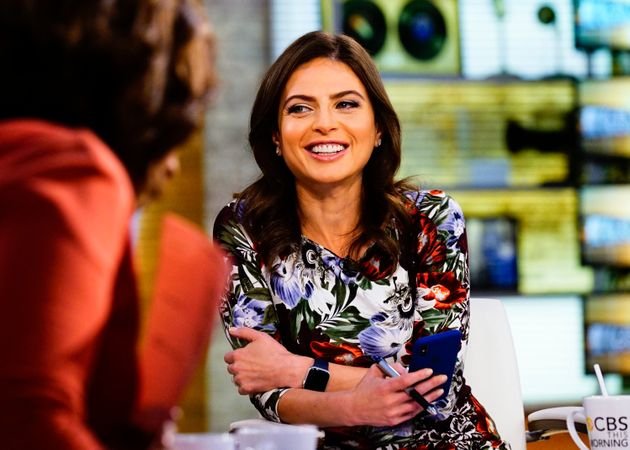
    Who is Bianna Golodryga?

    Foreign Minister Shah Mahmood Qureshi’s recent remarks on Israel got him under fire as CNN presenter Bianna Golodrya accused him of publicly expressing anti-Semitic remarks.

    Who is Bianna Golodrya?

    This image has an empty alt attribute; its file name is optimze-cnn-1-1024x1024.jpg

    Born in 1978, Bianna Vitalievna Golodryga is a senior global affairs analyst at CNN. She has previously served in Yahoo! News, ABC Network, CNBC, Wall Street Journal, and CBS.

    The forty-two-year-old anchor is the second wife of Peter R Orszag who is a former Director of Management and Budget for Obama Administration. The couple have two children together.

    Born to a Jewish family from the Soviet Republic of Moldova, Golodryga’s parents migrated to Houston as political refugees with no more than $150 in their pockets.

    The anchor often boasts about attending High School for Performing Visual Arts in Houston because of the fact that the music sensation Beyoncé Knowles also graduated from there.

    After completing her undergraduate degree in Russian/European affairs from the University of Texas, Golodryga began her as a producer for CNBC in 2001. One of her notable initial projects include live coverage of the aftermath of 9/11 terrorist attacks.

    In 2015, Golodryga was chosen by Hillary Clinton to conduct her first interview as a presidential candidate. Unfortunately, Clinton’s staff confused “Bianna” with “Brianna” which ended up with the golden opportunity being allocated to fellow CNN anchor Brianna Keilar instead of Golodryga.

    As Golodryga gained fame after being listed as one of the top journalists under 30 in 2004, she also went through various controversies. She was convicted of driving-under-influence in early 2000. Police records confirm that Golodryga was given a 30-day jail sentence which was later dismissed.

    Fluent in both Russian and English, the anchor serves as a member of Council on Foreign Relations and has a net worth of roughly $3 million.

  • Vaccination registration for ages 30 and above to start from Sunday

    Vaccination registration for ages 30 and above to start from Sunday

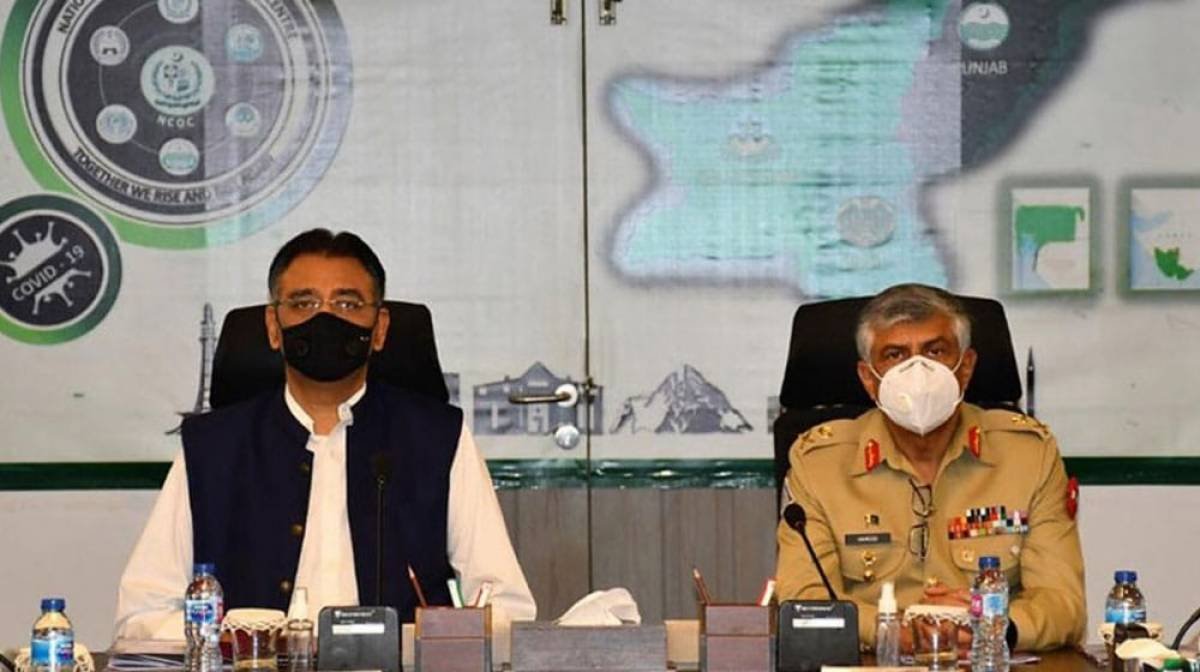
    The National Command and Operation Centre (NCOC) on Wednesday allowed citizens aged 30 and above to sign up for Covid-19 vaccination from Sunday (May 16).

    Federal Minister for Planning, Development and Special Initiatives Asad Umar tweeted, “As vaccine supply continues to improve and vaccination capacity gets enhanced in all Federating units, we continue to expand the categories of those who are eligible to get vaccinated.”

    Asad Umar announced that from Sunday, registration will be open to all 30 years and older citizens for Covid-19 vaccine.

    On May 3, Pakistan opened registration for the coronavirus vaccination for people aged between 40 to 49 years across the country.

    Special Assistant to CM Punjab for Information Dr Firdous Ashiq Awan tweeted that the corona vaccine will be given to the journalist community on a priority basis.

    “The process of vaccinating Punjab journalists will begin after the Eid holidays,” Firdous tweeted.

    A digital portal has been launched by the federal government for the registration through which a code is assigned to the person and then they can go to a designated vaccination centre and get a jab.

  • Politicians, journalists mark #WorldPressFreedomDay

    World Press Freedom Day is observed every year on May 3 and this year’s theme is ‘Information as a Public Good’. To mark the day, politicians, journalists and other key figures have stepped forward to call for freedom of press and media.

    United Nations Secretary-General António Guterres was also among those who marked this day. In his message, Guterres urged all governments to do everything in their power to support a free, independent and diverse media.

    Politicians and journalists from Pakistan including Federal Minister for Information and Broadcasting Fawad Chaudhry and Special Assistant to Chief Minister Punjab on Information and culture Firdous Ashiq Awan also shared messages to mark the day and paid rich tributes to journalists.

  • A hero for our times

    A hero for our times

    Just a few days before I. A. Rehman left us, we had been speaking about him at a journalism event – the second Razia Bhatti Memorial lecture at the IBA’s Centre for Excellence in Journalism (CEJ). Rehman sahab had been the very first speaker in this series – he spoke at the inaugural event, in 2019, and at this year’s lecture he was mentioned not just in that specific context but also as a beacon of hope in a country that is becoming increasingly intolerant and authoritarian. In his opening remarks, the IBA’s head Dr Akbar Zaidi called Rehman sahab “one of the greatest pillars of journalism, democracy, human rights that we have in Pakistan today.”

    And then, as Akbar Zaidi continued, he articulated the unspoken fear all of us had: the fear of Rehman sahab no longer being there – “One of the greatest pillars of journalism, democracy, human rights that we have in Pakistan today …and hopefully we’ll have for some years to go.”  Alas, that was not to be, because two days later Rehman sahab had exited with his usual quiet dignity.

    Two weeks later we are still having the memorial meetings and the tributes for him because, for so many people, the passing of I. A. Rehman is a devastating loss. This sense of immense bereavement is due to the fact that he was one of the sanest and bravest people working for the cause of democracy and social justice in Pakistan. 

    During his years as a journalist, he stood firm on principles and was part of the team of which set up and ran the Independent Azad in 1970-71. Then there was Viewpoint and then there was his support for Newsline — a journalist-owned publication, Newsline was headed by first Razia Bhatti and then Rehana Hakim and was founded by the team of journalists who left The Herald in 1988 when PHPL management asked Bhatti to leave. Rehman sahab was a staunch supporter and a regular contributor to the new magazine unlike some other contributors (unnamed here, but you know who you are) who didn’t want to risk the wrath of the Dawn group by writing for us. Mohammed Hanif who joined the magazine in 1989 summed it up succinctly in a recent tweet recalling: “When Razia Bhatti sent I.A. Rehman a cheque for his first contribution to Newsline, he mailed it back with a note: You can start paying me when you make your first million. Newline never made a million and Rehman sb never stopped writing.”

    At the Human Rights Commission of Pakistan (HRCP), he continued to fight against oppression and along with Asma Jahangir, Aziz Siddiqui and so many other lesser-known heroes, he was able to create a credible organisation that documented and raised awareness of human rights violations in the country.

    Much has been written about Rehman sahab over the past fortnight and the shared grieving has been somewhat cathartic yet the sense of loss persists. The void he leaves behind him is very great. Rehman sahab was a key part of the bulwark protecting rational and democratic thought in Pakistan – and indeed in South Asia. His passing has weakened the fortification that helped movements for social justice, human rights and constitutional reform to survive. He led the way in these efforts and he was so highly respected because he also walked the talk: he lived life simply and treated others, regardless of their social class or age, with consideration and generosity. He never wavered from the pursuit of peace and reason and his writings are truly remarkable for their clarity and intellectual depth. 

    He was one of the Titans who kept the flame of social justice movements alive, a flagbearer and a key leader in the fight against dictatorship and tyranny. Over the decades he stayed the course and continued the struggle despite all the tragedies and losses along the way, some of them very close to home. One that I remember was the murder of his nephew — the heroic lawyer and human rights activist Rashid Rehman in Multan in 2014; Rashid Rehman had been the defence lawyer for a young academic accused of blasphemy and he was shot and killed in his office after he had refused to give up the case despite receiving death threats from militant groups. 

    But despite all the losses, the injustices and the cruelty all around, Rehman sahab remained steadfast in his attempts to make the world a more just and compassionate place. 

    Truly he fought the good fight.

  • Pakistan Television’s first female anchor Kanwal Naseer passes way

    Pakistan Television’s first female anchor Kanwal Naseer passes way

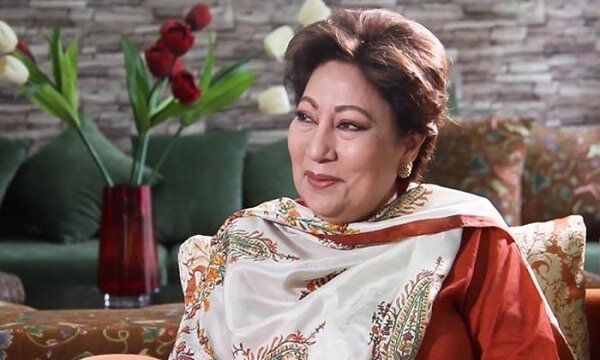
    Pakistan Television (PTV)’s first female anchor, newscaster and announcer Kanwal Naseer has passed away at the age of 73. The departed soul was hospitalised for the past couple of days, as reported by Radio Pakistan.

    Born in 1948 in Lahore, Naseer entered media at the young age of 17 and remained associated with PTV and Radio Pakistan for over five decades. Naseer made her first announcement at the PTV on November 26, 1964. 

    Naseer has been awarded the Pride of Performance and many other national awards in recognition of her services. She was the daughter of legendary actor Mohini Hameed.

    Meanwhile, several notable personalities including Fawad Chaudhry and Humayun Saeed expressed their condolences over her death on social media.

    https://twitter.com/RajaBasharatLAW/status/1375321768378916868
  • Priyanka Chopra wishes for harmony between India & Pakistan

    Priyanka Chopra wishes for harmony between India & Pakistan

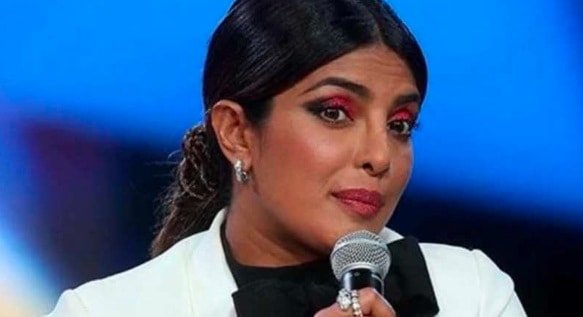
    Priyanka Chopra, in her memoir Unfinished, has reportedly talked about tense Indo-Pak relations and has hoped that things would improve between the two countries.

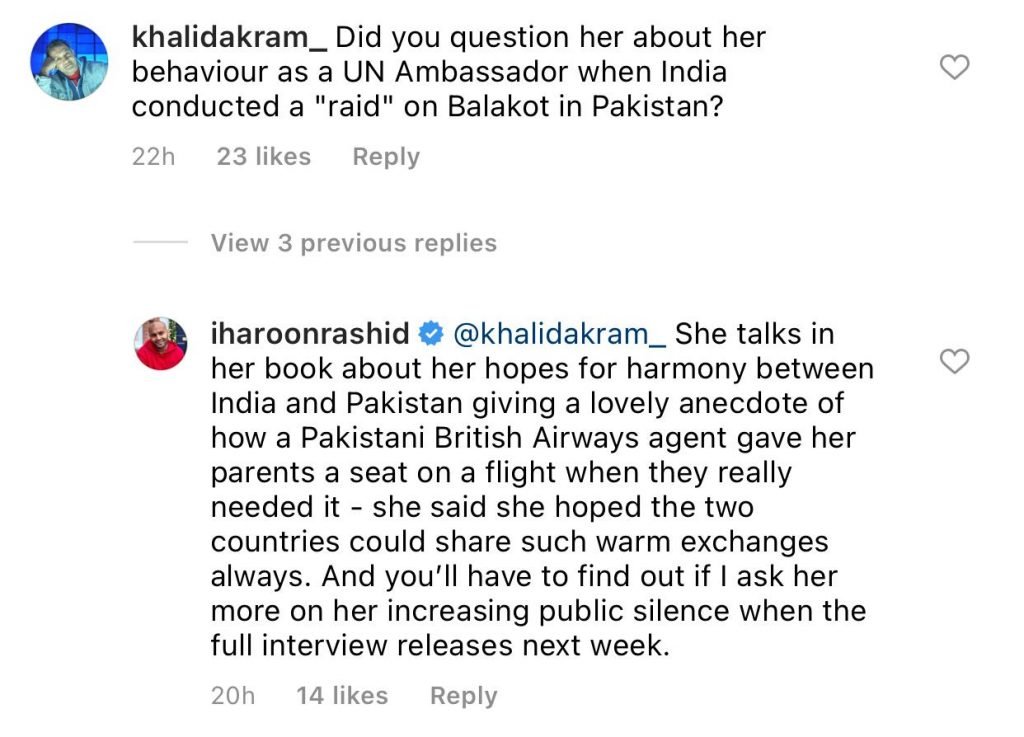
    BBC Asian Network journalist Haroon Rashid, who recently posted a teaser of his upcoming podcast with the actor, while responding to a social media user who asked if he asked Priyanka about her comments on the February 27 Balakot incident, said: “She talks in her book about her hopes for harmony between India and Pakistan giving a lovely anecdote of how a Pakistani British Airways agent gave her parents a seat on a flight when they really needed it.”

    “She said she hoped the countries could share such warm exchanges always.”

    “And you’ll have to find out if I ask her more on her increasing public silence when the full interview releases,” he added.

    Haroon further shared that Priyanka in the podcast talks about “lack of opportunities for South Asians in Hollywood” and “how important her humanitarian work is to her.”

    Earlier, in July 2019, Priyanka had sparked outrage with her response to a Pakistani woman Ayesha Malik, who had called her a hypocrite for “encouraging nuclear war against Pakistan”.

    “So it was kind of hard hearing you talk about humanity because as your neighbour, a Pakistani, I know you’re a bit of a hypocrite,” Malik can be heard saying in the video widely circulated on social media. “You tweeted on February 26, ‘Jai Hind #IndianArmedForces.’”

    Malik continued, “You are a UNICEF ambassador for peace and you’re encouraging nuclear war against Pakistan. There’s no winner in this. As a Pakistani, millions of people like me have supported you in your business of Bollywood and you wanted nuclear war.”

    However, the microphone was taken away from Malik before she could make any further comments.

    Priyanka had started off her response by saying “Whenever you’re done venting… got it, done? Okay, cool.”

    “So, I have many, many friends from Pakistan and I am from India, and war is not something that I am really fond of but I am patriotic. So, I’m sorry if I hurt sentiments to people who do love me and have loved me, but I think that all of us have a sort of middle ground that we all have to walk, just like you probably do as well,” she continued.

    “The way you came at me right now?” Chopra had remarked. “Girl, don’t yell. We’re all here for love. Don’t yell. Don’t embarrass yourself. But we all walk that middle ground, but thank you for your enthusiasm and your question and your voice.”

    Priyanka’s memoir Unfinished, which released on February 9, has become a bestseller, trending in both India and the United States.

  • Shaheena Shaheen’s murder

    Shaheena Shaheen’s murder

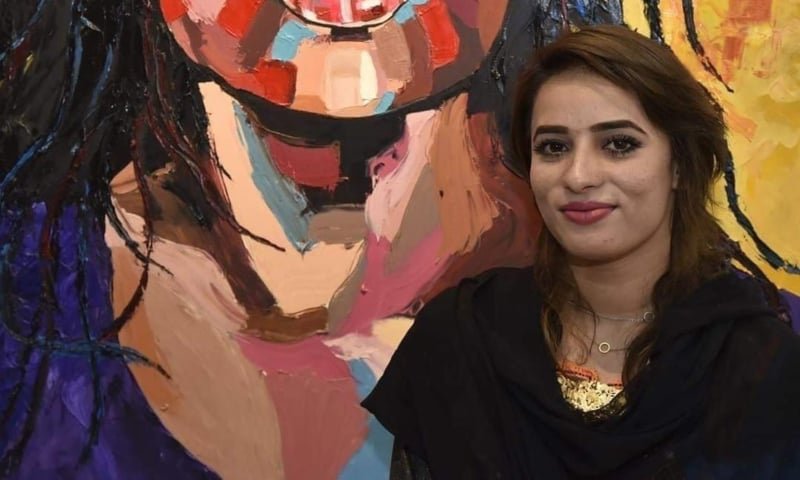
    Yesterday, a female journalist in Balochistan was shot dead. A social activist, an anchorperson at PTV and editor of a Balochi language magazine Dazgohar, Shaheena Shaheen was shot three times in Turbat on Saturday. She succumbed to her bullet injuries at the hospital. According to media reports, Kech Superintendent of Police Najeebullah Pandrani said the killing was the result of domestic violence. Shaheena’s family has nominated her husband in the First Information Report (FIR), whom she married just five months ago.

    Spokesperson of the Government of Balochistan Liaquat Shahwani tweeted that the murder seems to be due to a domestic issue and promised that justice would be served. Federal Minister for Information and Broadcasting Senator Shibli Faraz also condemned Shaheena’s murder. He said the government would fulfil its responsibility and bring the culprits to justice.

    Shaheena achieved a lot during her short but meaningful life. She was a talented artist, a brave social activist, and a talented journalist. Shaheena’s murder brings forth multiple issues plaguing our society, especially domestic abuse.

    Domestic violence is a serious issue in Pakistani context. According to a report released by SSDO in August and titled ‘Tracking Numbers: State of Violence Against Women and Children in Pakistan’, violence against women increased 10 times in just three months in Pakistan. A large number of women are victims of domestic abuse at the hands of their husbands but suffer silently due to multiple reasons, which include family ‘honour’, children’s future, lack of financial independence and the taboo attached to divorce. It is because of their silent suffering and lack of repercussions that these men continue to commit this crime. Some, like Shaheena’s husband, are emboldened enough to even commit murder. Apart from domestic violence, ‘honour killing’ by family members is not an uncommon practice in Pakistan. On Friday, the Supreme Court observed that the killing of women in the name of honour had never been an honourable practice and that such murders should not be categorised as honour killings. “It will help deter such killings if the term ‘Ghairat’ is not used to describe them,” observed Justice Qazi Faez Isa.

    Why is it that ‘honour’ is always attached to a woman’s actions and not that of any man in our society? Why is a woman expected to suffer at the hands of her abuser just to save family’s honour? Our lexicon is filled with phrases like, ‘Log kya kaheinge?’ [what will people say?], which make women think twice before leaving an abusive relationship. We wonder what these ‘people’ will say when a woman is murdered by her husband?

    The Ministry of Human Rights launched an awareness campaign about domestic abuse and violence in March this year, asking the victims to call their helpline. We have laws against domestic violence and honour killing in place but the major issue is under-reporting of these cases by the victims themselves who choose to stay silent due to societal pressures. It is time to raise awareness across the country and let these women know that they are not alone. The state as well as society stands with them. Shaheena, we hope your murderers are brought to justice. Rest in power, Shaheena!

  • VIDEO: Journalist Matiullah Jan goes missing

    VIDEO: Journalist Matiullah Jan goes missing

    Journalist Matiullah Jan, who is a vocal critic of the government among other quarters, has gone missing from Islamabad, his family said on Tuesday, according to the Human Rights Commission of Pakistan (HRCP).

    According to Jan’s wife, Kaneez Sughra, who was speaking to Independent Urdu, his car was found with keys still inside.

    Jan was due to appear in the Supreme Court (SC) this week after it took suo motu notice of a contemptuous tweet by the journalist.

    Amnesty International South Asia called for authorities to “establish [Jan’s] whereabouts immediately”.

    In a tweet, the organisation said it was “extremely concerned for the fate and wellbeing” of the journalist, who it said has been the subject of “physical attacks and harassment for his journalism”.

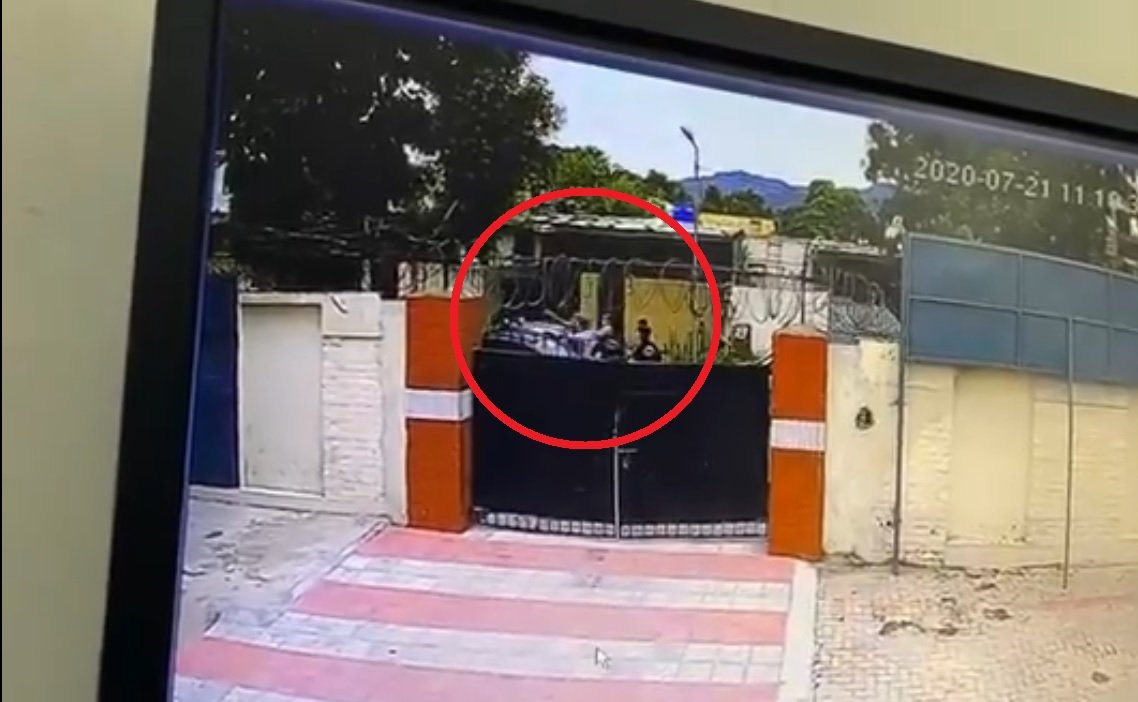
    Meanwhile, a CCTV footage showed Jan’s car being intercepted. It also showed a scuffle breaking out between the journalist and the reportedly armed men who took him away.

    He can also be shown throwing his phone away, which a woman was seen handing over to one of the unidentified men.

    Federal Minister for Information Shibli Faraz, later in the day, said the government was aware of the abduction and efforts were underway for the journalist’s safe return. The development was also confirmed by Human Rights Minister Shireen Mazari, who said that she was in contact with the capital city’s police in this regard.

    Chief justice of the Islamabad High Court (IHC), on the other hand, has reportedly taken notice of the abduction and directed authorities to present Jan before the court on Wednesday.