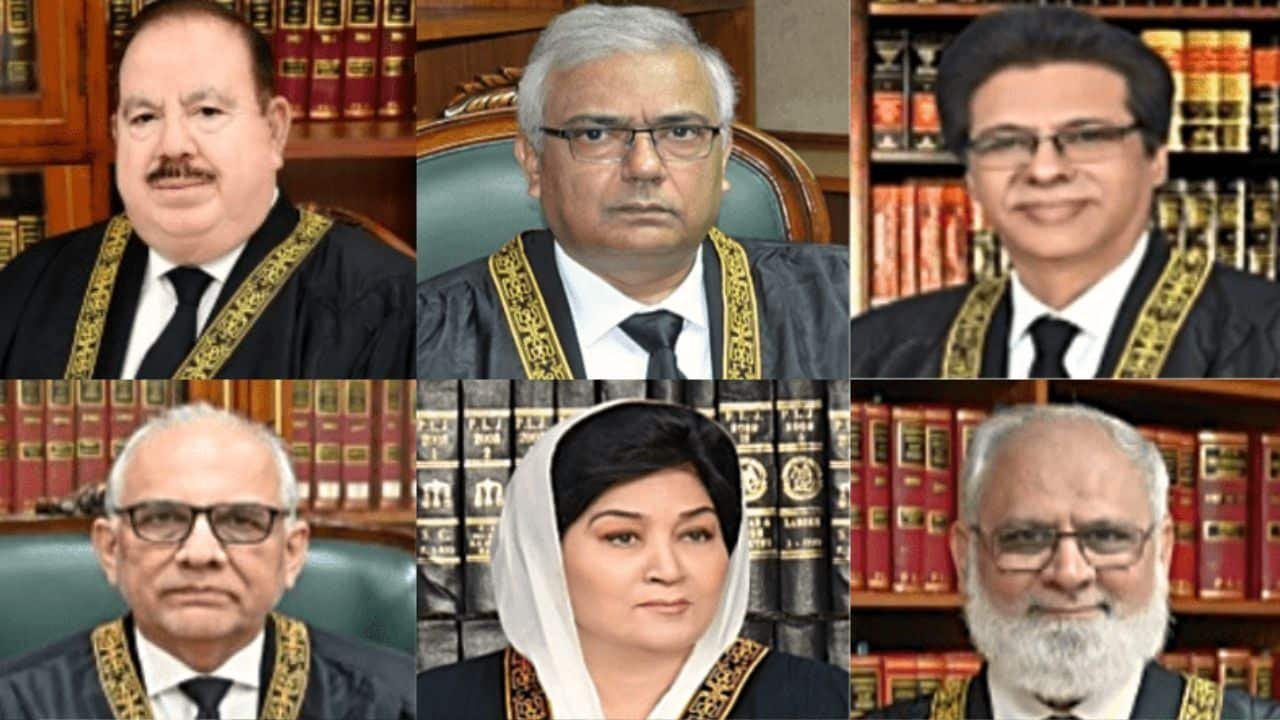
Tag: Justice Sardar Tariq Masood

  • Civilians to be tried in military court; Supreme Court decides

    Civilians to be tried in military court; Supreme Court decides

    The Supreme Court has, by a majority of 5-1, suspended its October 23 order that declared the trials of civilians in military courts null and void regarding the May 9 riots.

    The decision came in response to intra-court appeals (ICAs) filed by the federal and provincial governments, as well as the defense ministry, challenging the earlier verdict.

    A six-member bench of the Supreme Court, headed by Justice Sardar Tariq Masood and comprising Justice Aminuddin Khan, Justice Muhammad Ali Mazhar, Justice Syed Hasan Azhar Rizvi, Justice Musarrat Hilali, and Justice Irfan Saadat Khan heard the set of intra-court appeals.

    Justice Hilali differed with the majority decision.

    On October 23, a five-member apex court bench headed by Justice Ahsan unanimously admitted the pleas and nullified the government’s decision to try civilians in military courts in connection with the May 9 riots which erupted after the arrest of Pakistan Tehreek-e-Insaf (PTI)-then chairman Imran Khan.

    Four judges out of the five declared that Section 2(1)(d) of the Army Act and 59(4) (civil offences) are “ultra vires the Constitution and of no legal effect”.

    “Without prejudice to the generality of the foregoing the trials of civilians and accused persons, being around 103 persons […] shall be tried by criminal courts of competent jurisdiction established under the ordinary and/or special law of the land in relation to such offences of which they may stand accused,” the short order read.

    Following its verdict, the federal and the provincial governments along with the defence ministry filed intra-court appeals (ICAs). However, the caretaker government of Sindh refused to file any plea against the SC order.

    Justice Masood, who faced objections regarding his inclusion in the bench, refused to recuse himself.

    Former Chief Justice Jawwad S Khawaja and others had raised concerns about Justice Masood’s previous expressions on the matter, but the judge maintained his position.

    The Supreme Court’s recent decision to suspend the October 23 verdict means that the trials of 103 civilians will continue, with the final ruling conditional upon the Supreme Court’s subsequent orders.

  • Supreme Court uploads audio of JCP meeting on its website

    The Supreme Court of Pakistan (SCP) uploaded the audio of the Judicial Commission of Pakistan’s (JCP) meeting on its website.

    The recording was of the letters issued by two JCP members — senior puisne SC judge Justice Qazi Faez Isa and Justice Sardar Tariq Masood — both of whom claimed the meeting had disapproved the nominations of judges, proposed by the Chief Justice of Pakistan, for elevation to the top court.

    Justice Sardar Tariq Masood, in a letter, highlighted the need for putting out factual and correct minutes of the meeting, in which details of observations and discussions of each member should be mentioned.

    “The correct minutes of the meeting, if made publically, will stop needless rumours,” Justice Masood wrote in his two-page letter.

    In a similar letter written to other JCP members, Justice Qazi Faez Isa also highlighted that the acting secretary, who had attended the meeting in the absence of the JCP secretary, should immediately release this decision to the media, which would also stem unnecessary speculation and misreporting, as the meeting was held behind closed doors.

    “In these exceptional circumstances the Hon’ble chairman JCP has been pleased to relax the restriction under Rule 5(4) of the JCP Rules, 2010 and has directed for the audio recording of the JCP proceedings of 28.07.2022 to be made available on the official website of the SCP,” said a statement issued by the apex court.

    The audio recording from time slot 1:29:45 to 1:38:08 contains the statement by Attorney General for Pakistan (AGP) Ashtar Ausaf that the matters under discussion should be deferred to frame appropriate rules. He did not assess or reject the merits of any of the high court judges proposed for appointment to the apex court. As a result, five members of the JCP supported the deferment of the meeting as reported in the press note of Thursday,” the fresh statement said.

    In the audio tape, the AGP can be heard saying “when we talk of seniority, ability, integrity, and temperament, we should also consider whether the appellate courts have appreciated their judgements or overturned them”.

    “While nominating judges we should also consider how much time they will have in the Supreme Court to decide matters,” he said, pointing out that if they had only three years, then it would not be enough.

    Justice Isa, who spoke in the end after the CJP, expressed surprise that while the two senior-most CJs of the high courts could sit in the Supreme Judicial Council (SJC), they were not fit to be elevated to the Supreme Court. “What an irony?” he remarked.

    “What does a CJ of the high court bring to this court? [He] brings experience as a CJ. What I have learnt as CJ, I would never have learned as a judge. It is altogether a different ball game,” he emphasised.

    “We all are equal and can nominate and all of us carry one vote to decide. This is not about winning or losing but a question of the future. You are bypassing chief justices,” said Justice Isa.

    “We will be short of five judges next month and we have 50,000 cases,” the CJP pointed out.