Tag: Lahore

  • Zee Zindagi set to release ‘Mrs. & Mr. Shameem’ for Pakistani viewers

    Zee Zindagi set to release ‘Mrs. & Mr. Shameem’ for Pakistani viewers

    The Indian-owned Zindagi website’s ‘Mrs. & Mr. Shameem’ was previously not accessible for viewing in Pakistan. Now, after almost two years, the channel has decided to broadcast it on YouTube.


    ‘Mrs. & Mr. Shameem’ explores love and marriage beyond traditional roles, showcasing the bond between Shameem and Umaina as they navigate challenges together. With a rich music album featuring soulful tracks like ‘Dillagi’, the series blends drama, romance, and social commentary. Don’t miss out on this extraordinary journey of love and resilience, starting April 26th.


    The series, consisting of 20 episodes, airing every Tuesday and Friday at 7:30, promises an exceptional viewing experience. Saba Qamar plays Umaina, a character who challenges societal norms.


  • Governor Punjab has accepted Principal Aitchison College’s resignation

    Governor Punjab has accepted Principal Aitchison College’s resignation

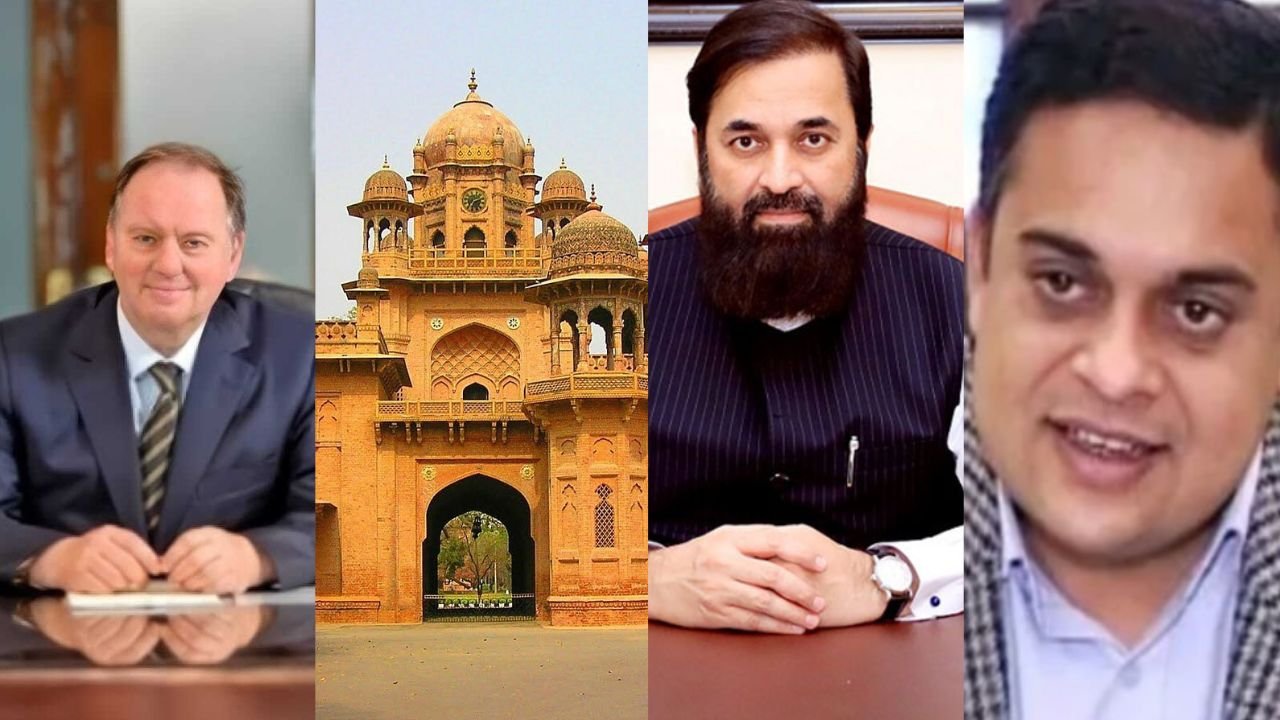
    Update: Governor Punjab Balighur Rehman has accepted the resignation of Michael A. Thomson, principal of Aitchison College Lahore.

    Geo’s sources at the Governor’s House say that Amina Imran has been appointed as the acting principal of Aitchison College in place of Michael A. Thompson.

    Governor of Punjab has also approved the fee waiver policy, according to which, if the student moves to another city for 3 years, he will get a fee waiver of up to 50%.

    Previously, the government of Punjab was not able to persuade Aitchison College Principal Michael A Thompson to change his mind and stick to his post.

    Thompson did not withdraw his resignation, contrary to an official claim.

    Even though the principal resigned, Punjab Governor Baligh ur Rehman granted him a paid leave for 28 days in hopes of negotiating the matter during that time.

    The government, in a statement to the media, claimed that Thompson withdrew his resignation. However, Mr Thompson has told Dawn that he had not withdrawn his resignation.

    Principal Thomson had resigned from his post a couple of days ago after developing differences with the Governor House over a change in the college’s fee waiver policy.

    He had earlier refused to accept the fee waiver application submitted by the wife of the ex-civil servant, Ahad Cheema. Cheema is now a senator and federal minister for finance ministry.

    Cheema’s two sons had to leave the college after the transfer of their mother, Saima Ahad Cheema, also a civil servant, to Islamabad. She had sought retention of the seats and fee waiver from the principal who, quoting the policy, rejected her request.

    However, Ahad Cheema approached Governor Balighur Rehman who sent the application to the college’s Board of Governors that changed the fee waiver policy, accepting the application.

    In his resignation, Thomson had cited interference in the management of the college.

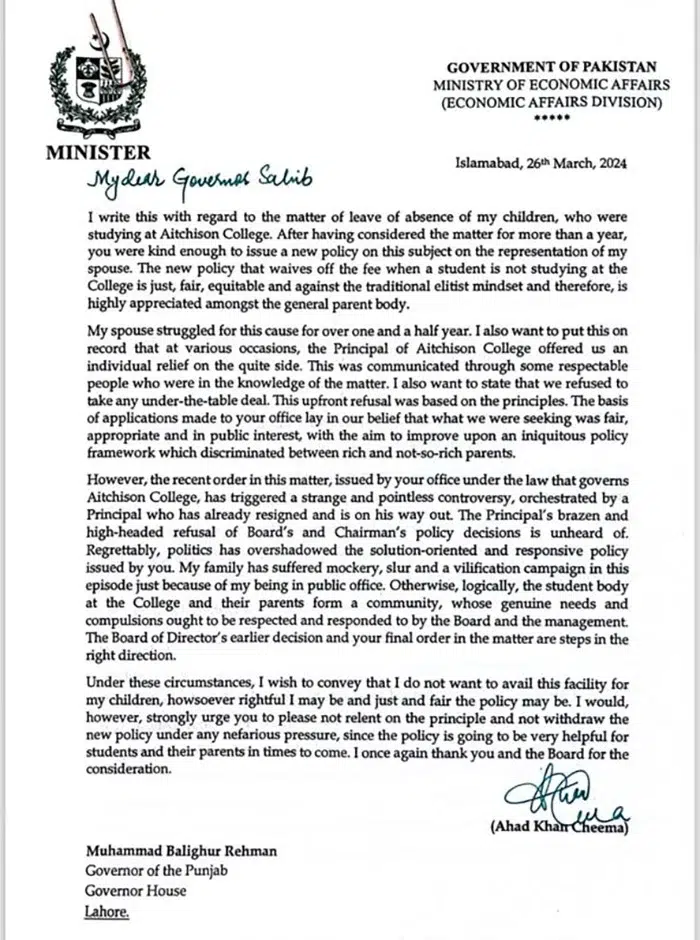
    A protest outside the Governor house and a severe backlash on mainstream and social media resulted in Ahad Cheema sending a letter to the Punjab governor, Balighur Rehman stating that he does not want to avail the fee waiver facility for his children anymore.

    Background

    Ahad Cheema the federal Minister for Economic Affairs, is currently a subject of backlash for using his position to get a fee waiver for his children at Aitchison College. The waiver was requested by his wife, Saima Ahad Cheema, who is also a bureaucrat, with the request that since their two children did not attend Aitchison college for three years, but kept their seats, they shouldn’t be required to pay. They made the request to the Governor of Punjab who forwarded it to the principal of Aitchison College. The principal resigned in protest.

    Ahad Cheema, in a letter to the Punjab governor, Balighur Rehman stated that he does not want to avail the fee waiver facility for his children anymore. He lambasted that politics has overshadowed the “solution-oriented and responsive policy” issued by the governor, which allowed a fee waiver for students under similar circumstances. Cheema said that his family has suffered “mockery, slur and a vilification campaign in this episode just because of my being in public office.”

    Cheema also blamed Principal Thomson for orchestrating a strange and pointless controversy, alleging that Thomson had already resigned and is on his way out. “The Principal’s brazen and high-headed refusal of the Board’s and Chairman’s policy decisions is unheard of.”

    As a continuation of his claim, Cheema, in Shahzeb Khanzada’s show, reasserted that Principal Thomson had offered him “an individual relief” and “was communicated through some respectable people who were in the knowledge of the matter”. However, Cheema said that his family refused to take any “under-the-table deal” based on principles.

    Cheema also urged the governor to “not relent on the principle and not withdraw the new policy under any nefarious pressure” because he believes it is going to be very helpful for students and parents in the future.

    Previously, Ahad Cheema, federal minister of economic affairs, has along with the newly elected government landed in a controversy as he is blamed for using his ties and position to influence the principal of Aitchison College Michael Thomson, to change the college’s policy and waive off his children’s fee.

    The minister appeared on Shahzeb Khanzada’s show to defend his stance where he described how the policy as totally unfair. “If you just take my name out of this controversy then what is wrong there in Governor Punjab’s orders,” he started off by asking. He asserted that Governor Baleegh ur Rehman has made a fair policy for all.

    Cheema laid out how his wife had requested for a leave because of her transfer yet wanted the fee to be waived off because paying fee in two schools was difficult. The principal declined the request and so she requested that the college policy be reviewed. The request was then presented to the Governor who referred it to the Board.

    Khanzada then said that the majority of the board had retained the current policy of the college, emphasizing that Governor Punjab was misinterpreting the board because they did not amend the policy. Additionally, he stated how the children were adjusted in a special manner going against college policy which has not been changed in years. To this Cheema responded that, “The principal approached me two times (indirectly) to get this matter resolved in my personal capacity and not agitate it on a policy level and I declined it both the times because we are not interested in gaining any personal favour and we want this to be changed on a policy level.” He further added that if the Principal wants, he can take the names of the interlocutors.

    During the course of the interview, Cheema professed he does not want “individual relief” but a decision taken principally. He refused to comment on the charge-sheet issued by the Governor and the comments made by Atta Tarar because that is not his mandate.

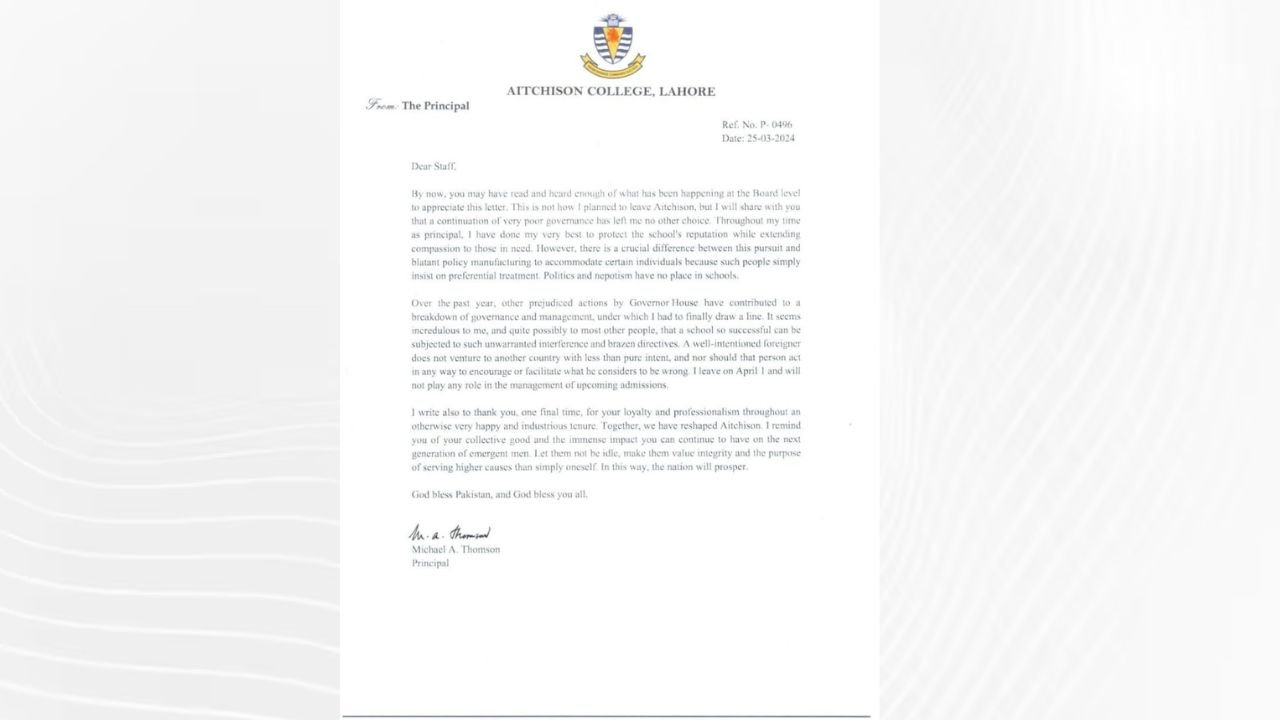
    The principal of Aitchison College, Michael Thomson announced his resignation in a letter to staff and board members, stating that the Punjab Governor Baligh ur Rehman’s ‘biased actions undermined the school’s governance and management’.

    Thomson’s decision came after the wife of Federal Minister for Economic Affairs and Establishment Ahad Cheema, asked for her two son’s school fees to be waived off for three years. She sent Governor Punjab Baligh ur Rehman the request. Following her request, the governor issued an order after which their fees was waived off for three years. But Principal Thomson refused to do so.

    Thomson said the decision taken by the governor to ‘extend a favour’ to Ahad Cheema’s family violates the policy of the school.

    The letter said that “politics and nepotism have no place in the schools”. He added further, “this is not how I planned to leave Atchison, but I will share with you that a continuation of very poor governance has left me no other choice.” He said that some “prejudiced actions by Governor House have contributed to a breakdown of governance and management, under which I had to finally draw a line.”

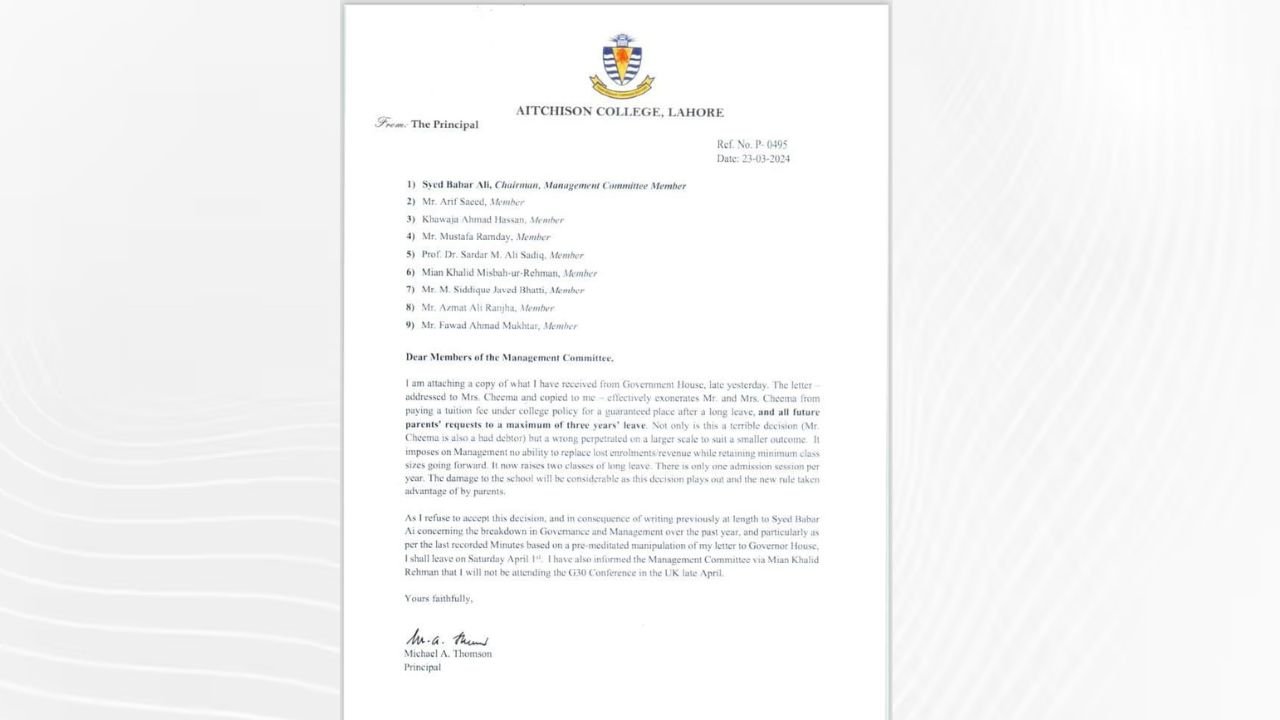
    In his letter to the members of the management committee, Principal Thomson laid out that paying a tuition fee for a guaranteed place comes under college policy. The policy is applicable for long leave to a maximum of three years leave. He stressed that this request by Mr. and Mrs. Cheema is a “wrong perpetrated on a large scale to suit a smaller outcome.” He closed the letter by saying that he refuses to abide by the order and has informed Syed Babar Ali who is the chairman of the Management Committee. He asserted that he will not play any role in management and admissions after April 1.

    Ahad Cheema’s wife who is a senior bureaucrat as per media reports, had applied to the Governor of Punjab for fee waiver and so at the request of the Governor of Punjab, the fee for three year for Ahad Cheema’s children was waived.

    Federal Information Minister Atta Tarar said that Ahad Cheema’s children have not been studying in Aitchison College for three years, so his wife applied for fee waiver according to the rules, which was approved by the Governor of Punjab, according to the law. He declared that the issue is being misrepresented.

    Governor Punjab Baligh ur Rehman has rejected the claims of the principal. He said that Ahad Cheema was posted in Islamabad for a year due to his job and Ahad Cheema’s children were not able to go to Aitchison. He emphasised that it was requested to waive the fee for the classes which these children had not taken.

    On the issue of resignation of the principal of Aitchison College, the governor of Punjab said that the resignation of the principal was already to become effective in August 2024. The principal of Aitchison College was receiving a salary of Rs. 40 lakhs and the audit of receiving this hefty amount has been started.

    The governor claimed that Principal of Aitchison College used to take more than 100 holidays in a year and he ‘adopted this tactic to avoid a probe’.

  • Tigress injures two near Multan as it escapes during transportation

    Tigress injures two near Multan as it escapes during transportation

    A Bengal tigress which was being transported from Lahore to Multan by an animal dealer, Muhammad Adnan, ran away from its cage into the fields near Multan in the early hours of Sunday, DAWN has reported.

    The age of Bengal tigress is reportedly about two years and its value is Rs5-6 million.

    Punjab Wildlife Department Multan Deputy Director Sheikh Zahid told Dawn’s Shoaib Ahmed that the tigress was being carried in a pick-up in a cage. The incident happened when the pick-up got stuck in a muddy track on Bosan Road behind the Multan Public High School.

    The cage got opened when the vehicle jerked to get out of the mud. The owner, Muhammad Adnan, called 15 but the police told him to contact the wildlife department.

    The furious tigress ran into the fields and reportedly injured two persons, including a wildlife official. However, the injuries were mild. The Punjab Wildlife Department officials and a DHA Multan Zoo vet were involved in the operation to catch the tigress. It was tranquilised by a DHA Multan Zoo vet.

    Animal dealer Adnan was fined Rs221,000 by the wildlife department under the Punjab Wildlife Act 1974. The tigress has been returned to the owner on payment of the fine, told Sheikh Zahid.

    Punjab Wildlife and Parks Department Director General Mudassar Riaz Malik talked to the media. To a question why tigers and lions had not yet been categorised in Schedule 3 of the Punjab Wildlife Department, the DG said he had called a meeting on Monday (today) to set standards and regulate the issue of keeping tigers and lions in breeding farms and houses only. “Such animals fall in Schedule 3 and it is prohibited to keep them domestically,” he added.

    Malik was asked if these animals were put in Schedule 3, what would happen to the private breeding farms having a huge number of lions and tigers. To this he responded it’s a crucial issue that would be discussed in the meeting besides all other aspects and possible licensing of such animals. To yet another question, Mr Malik said the meeting would also discuss either a new schedule or a new law.

    The wildlife DG said the Captive Wildlife Management Committee had got rules approved by the cabinet and new law would be introduced under these rules.

  • Behind closed wallets; The cycle of financial abuse of house help in Pakistan

    Behind closed wallets; The cycle of financial abuse of house help in Pakistan

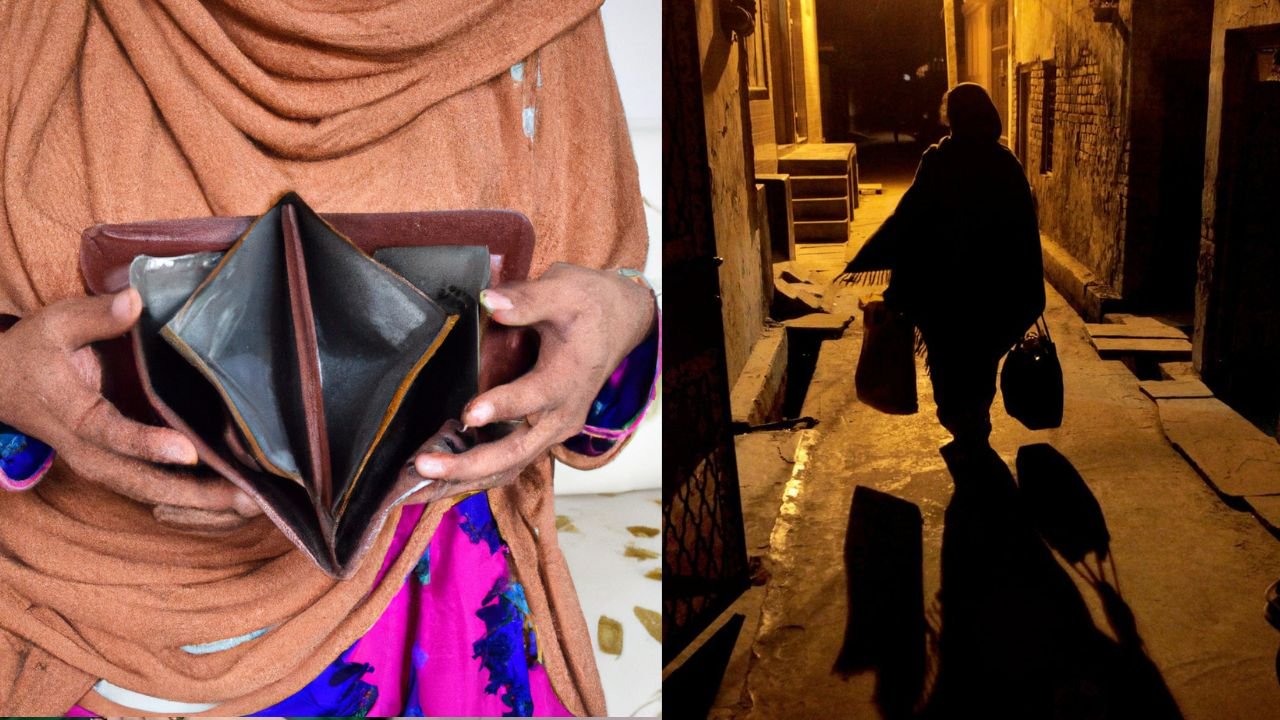
    Sonia, a 27-year-old woman, and mother of a 5-year-old daughter works as a house help. In eight years of married life, her husband has never had a stable job, nor does he bother to find work on a daily wage basis.

    Sonia has been paying off loans taken by her husband, Afzal, and her in-laws. In the initial months of her marriage, she sold whatever she had to buy a motor rickshaw for her husband so that they could have a source of daily income. Within no time Afzal sold the vehicle, taking additional loans to marry off Sonia’s sister-in-law.

    The debt piled up to 150,000 rupees. Sonia was working in two homes at that point, earning Rs20,000 from one for cooking food twice a day and Rs5,000 from the other for cleaning and washing the dishes. This was their sole family income in which they had to do grocery, pay the bills, feed their daughter and themselves, and look after the in-laws in addition to buying medicine for her mother-in-law.

    When she reminded her husband that he was supposed to work too if they wanted to get rid of the loans, she was beaten not only by Afzal but by his family too. From here started a never-ending cycle of financial exploitation and physical abuse. She endured two miscarriages due to the beatings and excessive work. She sometimes thinks that things would’ve been different if her father was alive.

    “I don’t blame my parents. This is what happens to people in our class. I just think that maybe if my father was alive, I would’ve had the option to tell him everything and he might have allowed me to take divorce and go back to my home. I don’t have that option anymore. I must live and survive here. I have a kid now. I can’t leave her,” she said while sobbing.

    Sonia is not the only one who goes through this cycle. I called up as many people as I could in different parts of Pakistan, family, friends, colleagues, acquaintances, and strangers to ask about their house help. Every woman had a similar story. A drug-addicted husband, an abusive husband, a husband who doesn’t work and keeps taking loans which the wife must pay. A never-ending circle of exploitation, harassment, and abuse.

    “There are very few people who respect us. It is not easy to clean someone’s dirt or wash their dishes with days-old rotten food. It is embarrassing to ask them for additional money to pay off loans. Sometimes I even have to take a loan from one person to pay off the previous one and the cycle goes on,” Sonia elaborated while talking about how draining her routine is as she does all the house chores and then works in the homes of other people too.

    She doesn’t want her daughter to end up like her. Instead she desires an education for her child, better career options. But whenever she brings the topic up, Afzal doesn’t take it seriously. He even spent the money they were given by different people to help finance their daughter’s education. Sometimes it was Eid gifts for sisters, other times it was a loan given to a friend. Sonia never got her money back.

    Doctor Ramish Fatima, who works in the periphery of Multan, details how such cases are quite normal and how these women suffer especially during their pregnancies. “These women keep working till the last month of their pregnancy and they must go back to work a few days after giving birth because they must pay off loans. If they fail to do so, they are beaten by their in-laws. In some cases, husbands work on minimum wages, but mostly don’t as they are drug addicts, and they physically abuse their wives after being intoxicated,” she explained.

    Ramish has been working in the periphery for over seven years now and most of the time she has dealt with such emergency cases. As a feminist and human rights activist, she believes that the solution to these problems is education and financial independence. She further emphasizes the importance of systemic upgrades and overall behavioral change in society towards women.

    Punjab Domestic Workers Act was enacted in 2019 throughout the province to regulate their terms of employment and working conditions of service, to provide them social protection and ensure their welfare, and to provide for the matters ancillary.
    The act states that “No child under the age of 15 years shall be allowed to work in a household in any capacity” while every other day we see cases of severe physical abuse and sexual exploitation against underage domestic workers.

    In the same manner, this act requires every employer to issue a letter of employment showing the terms and conditions of employment including nature of work and amount of wages.

    Regarding registration of Domestic Workers and Employers, this act states, “Every domestic worker, to benefit from the fund, shall make an application for registration in a manner as prescribed by the Governing Body, and every such domestic worker shall be provided by the Governing Body with a security number and identity card, which shall be renewable after completion of every three years. Provided that none of the domestic workers shall be eligible to get more than one security number and identity card. Every employer shall make an application for registration in a manner as prescribed by the Governing Body, and every such employer shall be provided with a registration number, which shall be renewable after completion of every three years.”

    Hiba Akbar, a lawyer who teaches at LMUS, believes that such laws are made to just get done with the binding of international treaties without any intention of implementing it.

    “Every time we see a shocking case of abuse of domestic workers we talk about laws but a law already exists. How many domestic workers are paid minimum wage? How many workers and employers are registered? Does anyone even know where they can register,” she questions. If the government was serious about implementation, she stresses, they would’ve made all the information public and ensured the safety and security of domestic workers.

    She further argues that financial abuse comes from employers too who believe that giving their house help food and clothes once in a while, that too of substandard quality, won’t help them in breaking the cycle of financial abuse and recurring loans.

    In 2023, Kashf Foundation, a registered Non-Banking Microfinance Company regulated by the Securities and Exchange Commission of Pakistan which started in 1996, gave 140,572 Easy Loans ranging from 10,000 to 35,000 rupees for short periods, as per their annual report.

    Their research in 2023 on low-income households highlighted that income spent on meeting food expenses has increased from 30% of their income in 2018 to 45% of their income in 2023 while earnings didn’t keep pace with the increase in food prices in real terms.

    Gender and Financial Inclusion expert Zainab Saeed explains that Pakistan has one of the lowest rates of financial inclusion in the world and only 7 percent of Pakistani women are financially included.

    She further says that most of the loans by microfinance institutions aren’t interest-free but have a service charge. Most microfinance institutions borrow money to lend money in addition to the cost of funds and running operations. Akhuwat, an interest-free loan program usually for small businesses, doesn’t solely focus on women but caters to women clients as well.

    “Turnaround times vary across institutions- for example Kashf is two days, you get the loan in two days. Other institutions have different turnarounds, like for Akhuwat, it is 10 to 30 days depending on what the set date for disbursement is in the month. Instant credit or nano loans like Jazz Cash have higher interest rates,” she says while emphasizing that a lot of women don’t even know how to use apps like Jazz Cash.

    As far as requirements are concerned, most of these institutions lend money to those who have their computerized national identity cards (CNIC), some require guarantors while others might demand post-dated cheques.

    When asked about how surety regarding on-time paybacks is made, Zainab said, “It is a trust-based environment so most people tend to pay back their loans on time. People don’t want to be blacklisted from Credit Information Bureau. Some institutions also go for appraisals like Kashf did a very detailed credit appraisal with household cash flows and that helped them to turn in the credibility of the loan.”

    For defaulters, there is legal recourse available but tending to civil courts given the judicial system of Pakistan is not the best solution. Generally, there are very few non-performing loans in the world of microfinance banks, as per Zainab. People end up paying back, some institutes take action to make an example out of it but they usually don’t end up taking that route.

    As these are not interest-free loans, ‘interest rate may vary from flat 25 to 30 percent’ which might seem high but, “the way the repayment is structured allows people to repay,” explains Zainab. “They Usually do monthly repayments. For instance, for a 10 thousand rupees loan, they are paying back 12 thousand 500 rupees. It is then 1000 to 1100 rupees a month. With microfinance institutions, there is a lot of transparency regarding installment dates and amounts which is lacking in other places,” she added.

    As a country with a low literacy rate and even lower financial inclusion of women in Pakistan, the path of loans, financial independence, and empowerment still seems like a far-fetched dream.


  • Ichra mob case: Three suspects get bail

    Ichra mob case: Three suspects get bail

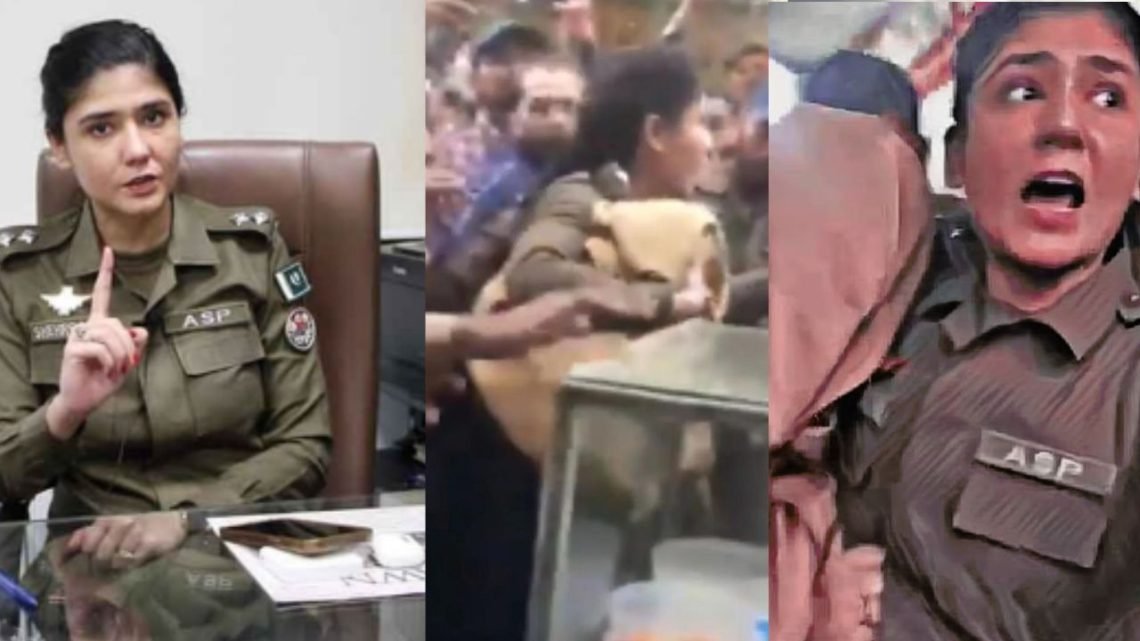
    An Anti-Terrorism Court on Monday has granted post-arrest bail to three suspects allegedly involved in the harassment of a woman in Ichra market for wearing a shirt with Arabic script printed on it, reports Dawn.

    The suspects, identified as Muhammad Nadeem, Adil Sarwar, and Altimash Saqlain, were arrested and sent to jail on judicial remand after the court denied further custody to the police on March 19.

    The lawyers for the suspects argued in the court that the police arrested their clients without any evidence, and only under pressure to show performance to the government.

    Judge Arshad Javed allowed bail petitions of the suspects subject to furnishing surety bonds of Rs100,000 each.

    The judge also disposed of pre-arrest bail petitions of two other suspects — Maulana Aleemuddin Shakir and Khalid Shehansha — as withdrawn in the light of a discharge report submitted by the police.

    In the FIR lodged a week after the incident it was stated that dozens of people accused a woman of blasphemy in Ichra bazaar as they confused the Arabic text printed on her shirt with Quranic verses. The mob threatened to kill the woman. A police team led by ASP Sheharbano Naqvi rescued the woman and shifted her to a police station.

  • Bushra Ansari wears shawl with urdu poetry on it

    Bushra Ansari wears shawl with urdu poetry on it

    Veteran actor Bushra Ansari caught attention on social media when she shared a photo of herself wearing a shawl with Allama Iqbal’s poetry written on it. She was getting ready for a Ramazan TV show.
    In her post, Ansari cleverly joked about the poetry on her shawl, saying, “If you can read Urdu, you’ll understand.”
    The choice of attire and her witty comment was in retort to the recent incident at Lahore’s Ichra Bazaar where a woman wearing a shirt with Arabic writing, was harassed by a fanatical mob.

    Thanks to quick action from the police, led by Assistant Superintendent Syeda Shehrbano Naqvi, the woman remained safe.
    Ansari’s comment is a reminder about violence and ignorance. While some might see her shawl gesture as bold, she’s known for her funny jokes and straight talk.

  • New restaurant timings, environmental awareness among youth: Lahore High Court

    New restaurant timings, environmental awareness among youth: Lahore High Court

    The Lahore High Court has approved the opening of restaurants in Punjab from iftar till sehr.

    The court has also ordered schools to introduce one period a week on the environment, including practical activities, as the goal for the court is to inculcate environmental awareness in the population from a young age.

    The court has asked for a detailed report on the revised curriculum to be tendered in the next hearing.

    It has also sought a plan from Lahore Waste Management Company (LWMC) for a cleanliness campaign which must include students so that they contribute in countering pollution and uncleanliness in the city.

    Moreover, the Court has also instructed Lahore Electric Supply Company (LESCO) officials to put an end to tree-cutting and to brief the Parks and Horticulture Authority (PHA) beforehand.

  • Lahore: Public holiday announced on March 2

    Lahore: Public holiday announced on March 2

    The local government has announced a public holiday in Lahore on March 2 (Saturday) to mark the annual urs of Hazrat Shah Hussain, popularly known as Madhu Lal Hussain.

    The 436th annual three-day urs celebrations of Madhu Lal Hussain will begin in Lahore on Saturday, reports The News.

    Secretary Auqaf Dr Tahir Raza will inaugurate the urs by performing traditional chador laying on the grave of the saint. Members of the Religious Committee and a large number of devotees will participate on the occasion as well.

    The Auqaf Department has allocated Rs459,000 for the Urs grant. Local police have made foolproof security arrangements for the visitors.

  • Pakistan mein kab aur kahan barish hogi?

    Pakistan mein kab aur kahan barish hogi?

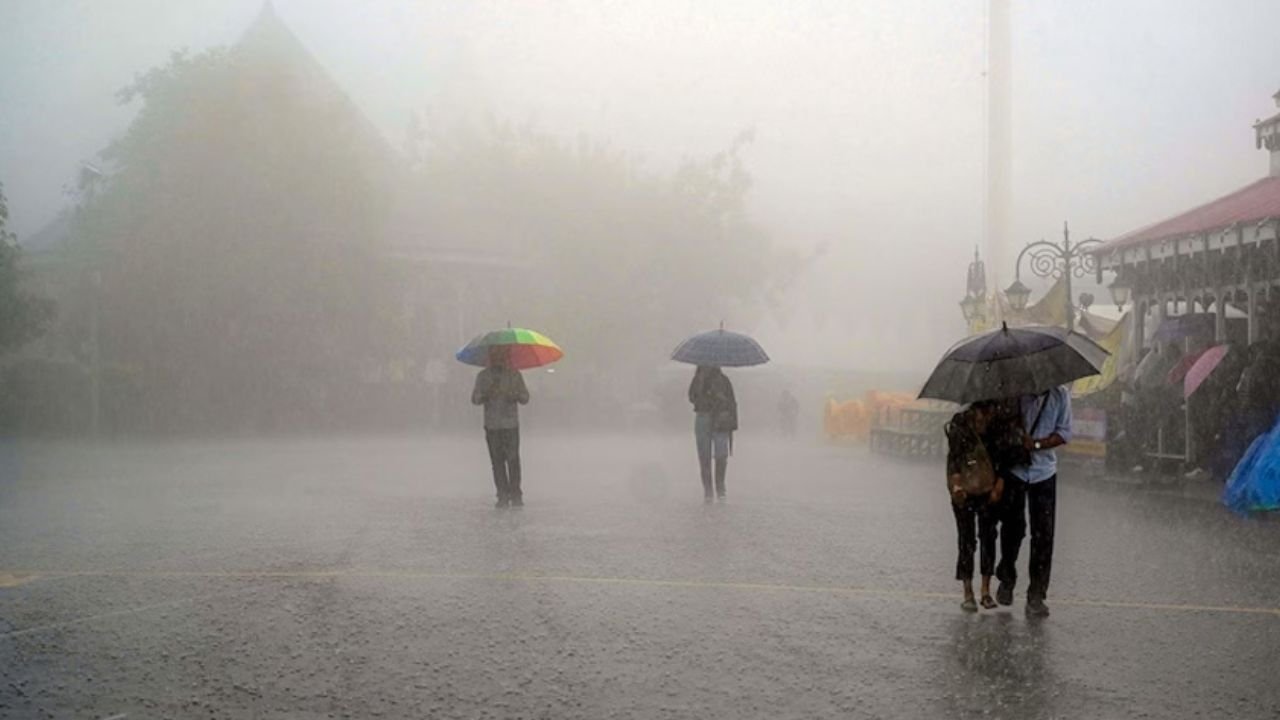
    As per the latest forecast from the Pakistan Meteorological Department (PMD), several regions across Pakistan are on high alert as they anticipate rainfall and heavy snowfall starting from Thursday.

    The Met Office has issued a weather advisory indicating that a strong westerly wave is set to approach western parts of the country by February 29, likely affecting most areas by March 1. This weather system is expected to persist for approximately two days, potentially leading to disruptive conditions.

    Areas including Karachi, Lahore, Islamabad, Peshawar, Gawadar, Quetta, Chitral, Abbottabad, GB, Kashmir, Multan, Faisalabad, and Sialkot are bracing for heavy rain accompanied by wind and thunderstorms.

    In Sindh, Kambar Shahdadkot, Jacobabad, Larkana, Shikarpur, Kashmore, Ghotki, Sukkur & Dadu, Jamshoro, Thatta, Tharparker, Badin, Umerkot, Mirpur Khas, Hyderabad, Tando Allahyar, Tando Muhammad Khan, Naushahro feroze, Shaheed Benazirabad, Sanghar districts & Karachi division are bracing for heavy rain accompanied by wind and thunderstorms on February 29 and March 1. PMD has also warned of the possibility of isolated hailstorms during this period.

    Similarly, Balochistan is expected to experience widespread heavy rain along with wind and thunderstorms in areas such as Nokkundi, Dalbandin, Chagi, Kalat, Khuzdar, Lasbella, Awaran, Turbat, Kech, Gwadar, Jiwani, Pasni, Ormara, Panjgur, Kharan, Noushki, Washuk, Mastung, Sibbi, Naseerabad, Zhob, Sherani, Barkhan, Musakhel, Kohlu, Jhal Magsi, Loralai, Ziarat, Quetta, Chaman, Pishin, Qila Abdullah and Qila Saifullah during the same timeframe.

    Meanwhile, Khyber Pakhtunkhwa (KP) is likely to witness heavy to extremely heavy rain coupled with thunderstorms from February 29 to March 3, affecting areas like Chitral (Lower & Upper), Dir (Lower & Upper), Malakand, Buner, Swat, Shangla, Kohistan, Torghar, Battagram, Mansehra, Abbottabad, Haripur, Swabi, Mardan, Nowshera, Peshawar, Charsadda, Bajaur, Mohmand, Khyber, Kurram, Orakzai, Hangu, Karak, Kohat, Bannu, Lakki Marwat, Tank, DI Khan, North & South Waziristan districts.

    Gilgit Baltistan (GB) and Kashmir are also expected to face heavy to extremely heavy widespread rain, along with windstorms and snowfall throughout the forecast period.

    In Punjab, cities including Murree, Galliyat, Islamabad/Rawalpindi, Attock, Chakwal, Jhelum, Mandi Bahauddin, Gujrat, Gujranwala, Hafizabad, Sialkot, Narowal, Lahore, Kasur, Okara, Faisalabad, Toba Tek Singh, Jhang, Khushab, Sargodha, Mianwali and Bhakkar on 01st & 02nd March. Heavy snowfall is also expected in Murree, Galliyat and surrounding during the period. Rain-wind/thunderstorm is expected in Multan, Kot Addu, Layyah, Rajanpur, Dera Ghazi Khan, Rahim Yar Khan, Sadiqabad, Khanpur, Sahiwal, Bahawalpur and Bahawalnagar are gearing up for widespread heavy rain accompanied by windstorms.

    The Met Office has issued warnings regarding the possibility of flash flooding in various regions. In Balochistan and Dera Ghazi Khan, heavy rainfall may lead to flash flooding in local nullahs on February 29 and March 1. Similarly, hill torrents in KP, Kashmir, Murree, and Galliyat, as well as local nullahs in Islamabad, could experience flash flooding on March 1 and 2.

    Moreover, the heavy rain and snowfall may result in road closures in popular tourist destinations such as Murree, Naran, Kaghan, and Swat, among others. Consequently, tourists are advised to avoid unnecessary travel during this period.

    The PMD has urged all relevant authorities to remain vigilant and take necessary precautions to mitigate any potential risks or untoward situations arising from the forecasted severe weather conditions.

  • Pakistani scientists introduce first calf born through IVF

    Pakistani scientists introduce first calf born through IVF

    University of Veterinary and Animal Sciences has announced the birth of the first Holstein Friesian (HF) calf by using In Vitro Embryo Production (IVEP) at the Training and Research Demonstration Farm, Ravi Campus, Pattoki, reports Dawn.

    Emeritus Professor and former UVAS VC Dr Naseem Ahmed announced the success at Pattoki campus on Tuesday, calling it the culmination of research and collaboration across departments. The process involved ovum pickup from pure Holstein Friesian specimens at the TRDF, followed by the UVAS embryology lab’s maturation, fertilisation, and culture of oocytes. Subsequently, the resulting embryo was transferred to a synchronised recipient, resulting in a successful pregnancy and the birth of a healthy calf.

    Department of Theriogenology and Embryology Chairman Dr Irfanur Rehman congratulated the embryology team, their guide Prof Dr Amjad Riaz, faculty members Dr Ali Husnain, Dr Talha Ashraf, and Dr Muhammad Yaseen, postgraduate students Dr Melaad and Muhammad Abdullah, researchers, technicians and staff.

    Prof Naseem Ahmad said that locally producing pure breed Holstein Friesian animals via IVEP not only lowers the expense of importing animals or embryos but also contributes to the nation’s sustainability while maintaining genetic integrity and milk production levels.