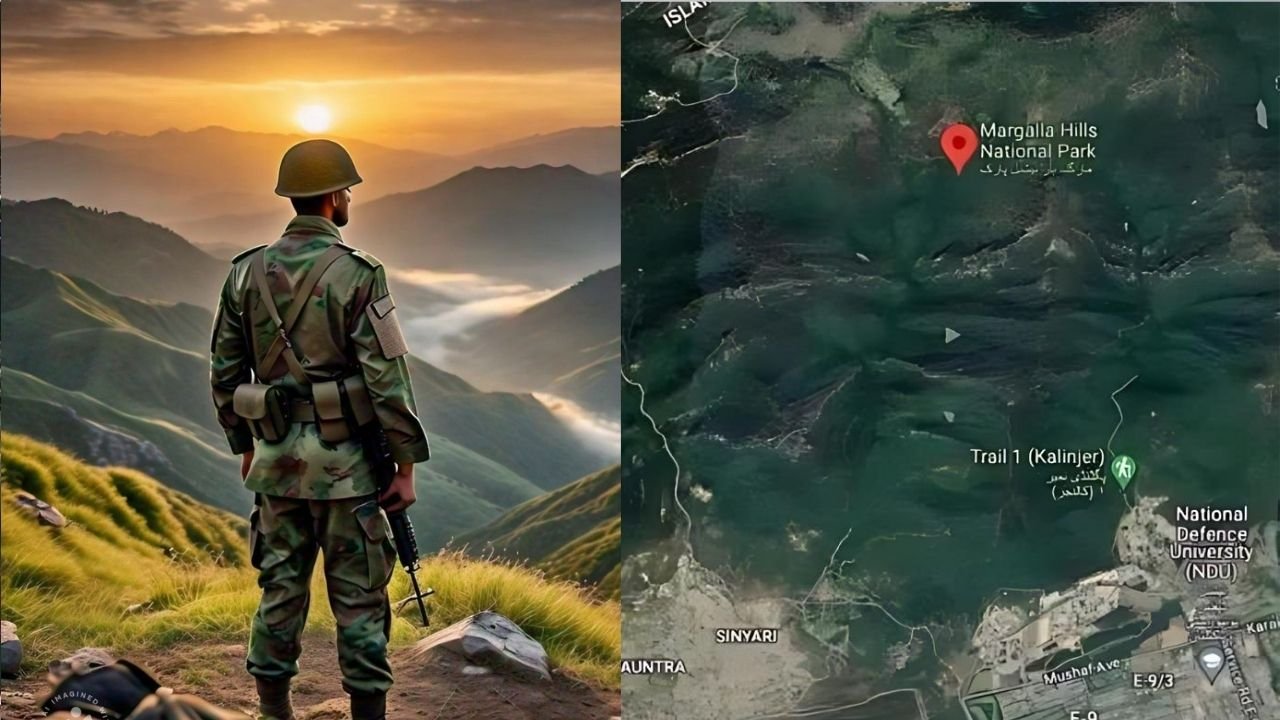
The Pakistan Army has written a letter to Deputy Commissioner (DC) Haripur to hand over more than thirty-four hundred kanals of land for defence purposes.
The letter revealed that the Pakistani army authorities are seeking 3,181 land kanals and 17 marlas from Haripur tehsil, Khanpur, for “defence purposes.” However, the defence purpose has not been defined, BBC Urdu reported.
Lately, the opposition leader of the National Assembly, Omar Ayub Khan, raised concerns about the Army’s intentions to acquire two villages’ land adjacent to the ShahAllah Ditta area near Islamabad.
“The Army will buy their land at a lower price. Where will the villagers migrate,” he questioned
He added, “Army should build Defence installation on Navy golf course and Airforce land.”
He suggested sending this matter to the Defence Committee to prevent the army from seizing the land.
However, DC Haripur, Shozab Abbasi, stated that all procedures must be carried out in compliance with the land acquisition law.
Zahid Hussain, a man hailing from Azad Jammu and Kashmir (AJK), handed down his land spread across thousands of kanals to Pakistan Muslim League-Nawaz (PML-N) Senior Vice President Maryam Nawaz via a legal procedure.
He said that Maryam can use the land for whatever purpose she sees fit.
On the legal deed, which has been shared on Twitter, the man stated, “I, Zahid Hussain, s/o Wilayat Hussain, hereby declare that I am of sound mind and have voluntarily decided to bequeath all the lands I possess, whether 50,000 kanals or 32,000 kanal, to Maryam Nawaz, d/o Nawaz Sharif, without any coercion or pressure from anyone”.
Moreover, the affidavit stated that the PML-N leader is now the owner of 50 per cent of the property, excluding approximately 50 kanals which is the inheritance of Hussain’s children and other heirs, in the life of Mazhar (possibly an heir of Hussain). According to the man, she will be the owner of 100 per cent of the property, excluding the same as above, after Mazhar’s death.
Reacting to the news, Maryam Nawaz said that it is “very touching”.
“OMG! Why would he do that! It is very touching though,” Maryam wrote on Twitter.
The Evacuee Trust Property Board (ETPB) has retrieved more than 3,500 acres of property worth Rs23 billion from illegal occupants, along with Rs650 million in rent arrears.
This was revealed during the press conference alongside the ETPB chairman by Dr Shoaib Suddle, the chairman of the One Man Commission, according to The News. He claimed that in accordance with the Supreme Court’s instructions, a forensic audit of the trust board was carried out. Based on the audit’s findings, a plan of action was decided with the help of the ETPB and FIA.
He said that the department’s revenue will increase as a result of the chairman board’s use of contemporary systems including the online billing system, complaints, geo-tagging, and e-office.
The department had disposed of valuable trust land/property worth billions of rupees with the aid of FIA, the biggest undertaking in the board’s history to date, the ETPB chairman told the media representatives.
In response to a query, he stated that various review sessions are held with the Trust Board and the FIA in accordance with the directives of the One-Man Commission, during which the action plan is formally implemented. Temples and Gurdwaras that are still in use have been renovated, and security measures have been improved.
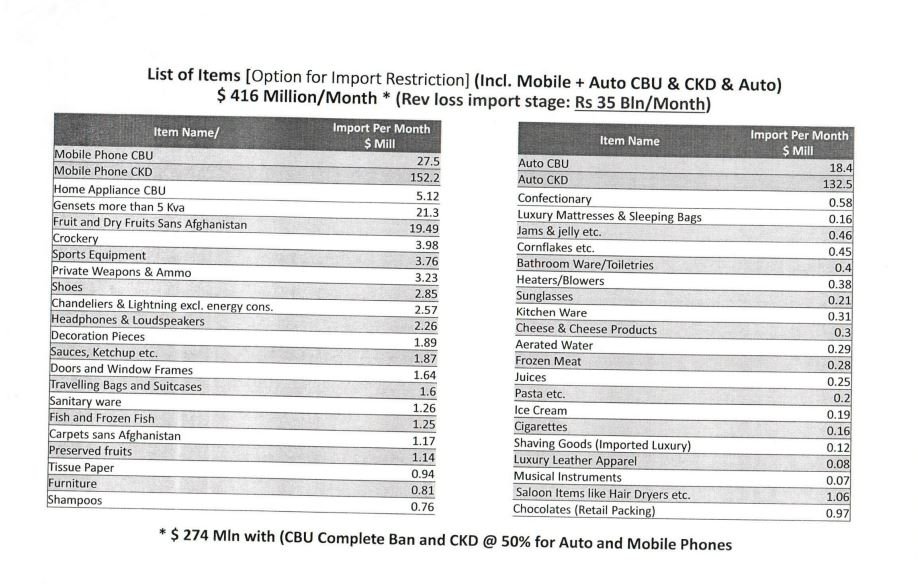
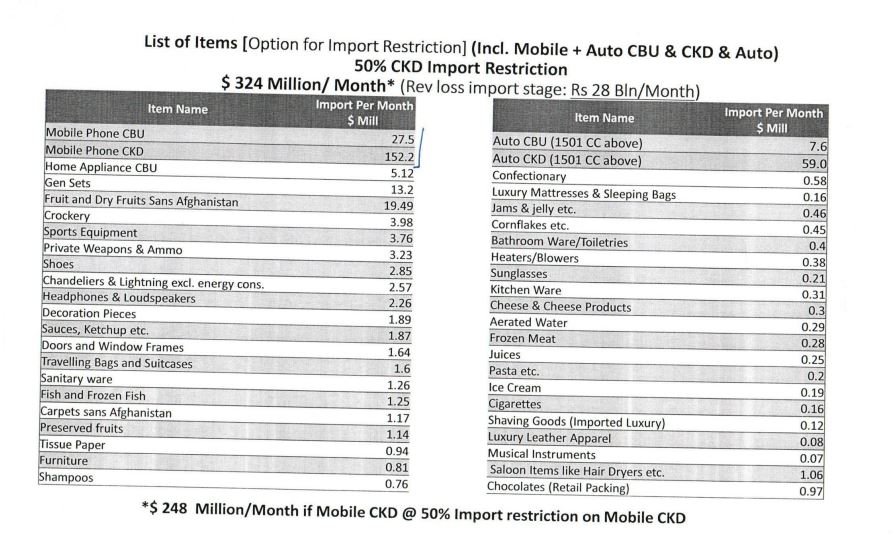
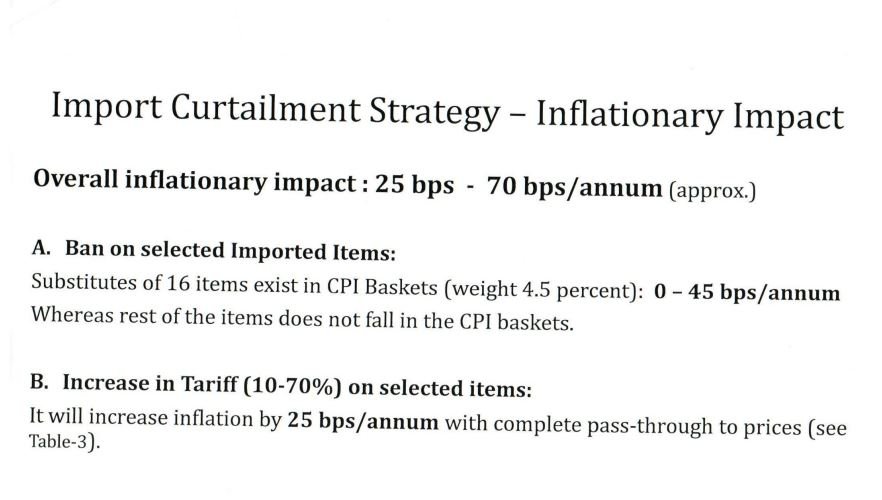
On Thursday, May 19th, 2022, the federal cabinet issued a list of 41 items which will be banned from being imported for two months. This is in an attempt to address the current account deficit. The list of products is banned from being imported into the country, which means that essentially any shops or restaurants which rely on using these products will be forced to find local alternatives.
These products will be banned regardless of what branding or packaging they use and only on the basis of whether the specific product is imported or not. Even products which are imported from abroad but packaged locally, will now be banned.
Officially released list of imported non-essential luxury items
Economists, university professors and business journalists took to Twitter to analyze and assess the merits and demerits of this decision. The discussion around luxury products and the fact that a lot of products which are labelled as “luxury items” are actually essential. Sanitary imports, valued at $16.4m are wrongly categorized as non-essential and although local alternatives also exist but it is definitions like these which disallow such decisions to be founded in research and expertise.
The valuation of these imports which was published by the Pakistan Bureau of Statistics, was being quoted to ridicule the decision by many. What’s interesting to note is that most brands which appear to be entirely local, import a major chunk of their supply and will now be forced to smuggle goods instead.
I don’t know who needs to hear this, but someone clubbed animal feed ($68m) with pet food ($5m) — and now suddenly we may have a feed crisis, b/c animal feed isn’t really a luxury and is used as a key agri input. Someone somewhere needs to amend the SRO.
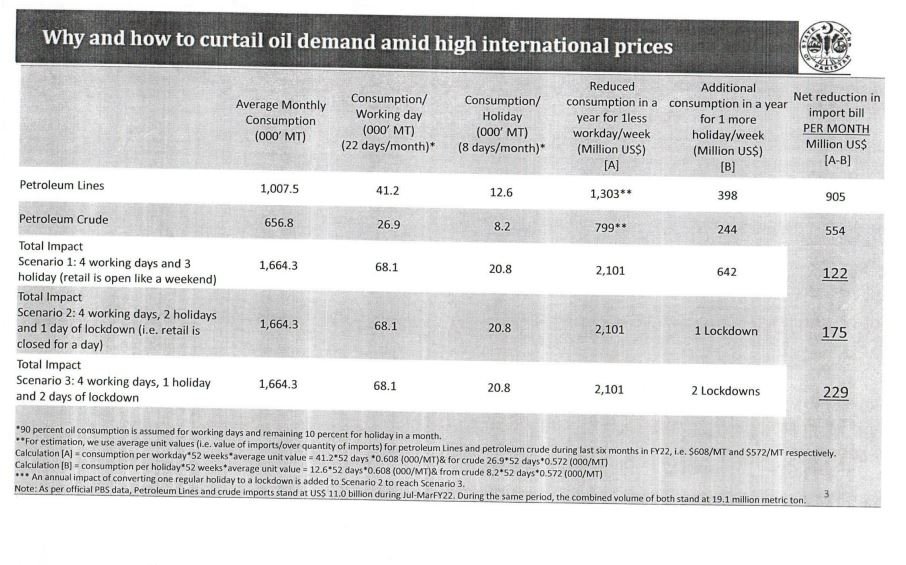
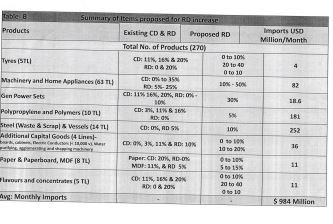
Only from the data shared by PBS it becomes clear that for the fiscal year 2022, June to March, the total value of petroleum imports was $11 billion, while the total value of banning all these non-essential “luxury” items is a total $984 million, which forms only about 8.9% of the total value of petroleum imports.
In conversation with Profit Magazine’s Ariba Shahid, she clarified that this would still prove to be a largely fruitless move since the most significant chunk of the import bill is still being used up to run the energy sector without any thought being given to the humongous fuel subsidies . “For a very long time the State Bank of Pakistan has been talking about how if we remove the oil component from it, the current account deficit is improving, which is true and basically means that people are not spending money to buy other items and most of the import bill is petrol and soy bean oil.”
This is patchwork economics, and unlikely to work
It is important to understand the deeper sources of structural imbalances
For example, one major source is unproductive sectors generating demand for foreign goods https://t.co/5bv5q2kKqS
Economists Ammar Khan and Atif R Mian also took to Twitter to analyze this decision of “patchwork economics”. Commenting on this unsustainable gap in Pakistan’s balance of payment, on April 15th, 2022 during a discussion on Pakistan’s economy at Princeton University, he explains that for Pakistan to grow it is a necessary condition for Pakistan to deal with this problem and digs deeper into the structure of the economy. He particularly takes apart urban land reforms, the necessity to levy a capital gains tax on speculative real estate transactions and analyzes how Pakistan is not even economically stable enough to grow at the rate of India and Bangladesh and it is primarily due to the elite capture of the economy that disallows the economy to attempt to fix its loopholes.
Echoing similar sentiments, Ariba Shahid explained that due to a weaker economy, the import bill is not as significantly high due to a reduced demand pull because of a lowered purchasign power and hence banning these products will be insignificant and might barely make a dent in the current account deficit. “The need of the hour is to reverse the fuel subsidy,” says Shahid, “This decision will swell up the grey market economy and smuggling will increase.”