Tag: LDO

  • International petrol, diesel prices drop, but no relief for Pakistanis

    The government has decided not to reduce the prices of diesel and petrol for local consumers, despite a significant decrease in their international prices. This decision is intended to offset previous exchange losses and raise taxation.

    On February 28, 2023, the average fortnightly prices of petrol and diesel in the global market will be used for the next price revision. According to industry sources, the average price of diesel for the next fortnightly review has dropped by $7 per barrel, which equates to a reduction of Rs30 per litre for domestic diesel prices.

    The global average price of diesel has fallen to approximately $100 per barrel compared to $107 per barrel in the previous fortnight. Similarly, the average price of petrol has dropped to $90 per barrel for the next review of prices compared to $93 per barrel in the last fortnightly review, which translates into a reduction of Rs10 per litre for consumers in the local market.

    According to Geo, the appreciation of the Pakistani rupee against the dollar in the last two weeks has also contributed to the reduction in import prices of diesel and petrol. However, industry sources do not expect any significant reduction in the prices of diesel and petrol for domestic consumers.

    The government is expected to adjust the exchange losses, which were not passed on fully to the oil sector in the last several reviews. For example, an exchange loss adjustment of Rs88 per litre was due on diesel, but the government only transferred Rs12 per litre on this head, leaving the remaining amount to be adjusted. The same is true for petrol, with an exchange loss adjustment of Rs34 per litre due, but only Rs12 per litre being given to the oil industry.

    Under the conditions set by the International Monetary Fund (IMF), the government may increase the petroleum levy (PL) on diesel to Rs50 per litre, as it now has room to do so. Currently, the PL on diesel is Rs40 per litre.

    If the government does not impose GST, sources expect a cut of Rs10 per litre in diesel prices, which would otherwise deprive local consumers of the drop in diesel prices in the global market.

    However, official industry sources do not anticipate any reduction in the price of petrol for local consumers, which would otherwise have been down by Rs10, as per the trends of its price in the global market.
  • Experts predict reduction in prices of petrol, diesel

    Experts predict reduction in prices of petrol, diesel

    According to oil price forecasts from energy experts, the price of petrol is likely to go down by Rs7.50 per litre, while the price of High-Speed Diesel (HSD) may be reduced by Rs12.37 per litre for the rest of this month.

    However, there won’t be a reduction in the price of petrol and high-speed diesel if the government increases the petroleum levy (PL) and corrects the backlog of exchange loss on a free-on-board (FOB) basis, according to Brecorder.

    Sources said that the price of petrol is likely to go down by Rs7.50, from Rs224.80 to Rs217.30 per litre, while the price of HSD is expected to slide by Rs12.37, from Rs235.30 to Rs222.93 per litre.

    The government is also poised to raise the tax on HSD, Superior Kerosene Oil (SKO), and Light Diesel Oil, according to sources in the Petroleum Division (LDO).

    It is also possible that the exchange loss arrears in fuel prices would be adjusted.

    There are lower prospects of the price of gasoline and HSD decreasing if the government raises the PL and corrects the exchange loss arrears. When petroleum goods reach the maximum level for PL, which is Rs50 per litre on each petroleum product, the government has promised the International Monetary Fund (IMF) that it will apply general sale tax (GST).

    Currently, the government is charging a petroleum levy of Rs50 per litre on petrol, Rs25 per litre on HSD, Rs7.01 per litre on SKO and Rs15.39 per litre on LDO.

    The government, however, has promised the international lender that it will hike the levy on diesel to Rs50 by April 2023.

  • Govt expected to increase petroleum levy on diesel

    Govt expected to increase petroleum levy on diesel

    The government is expected to raise the petroleum levy beginning tomorrow, implying that diesel customers are unlikely to receive any relief. 

    Finance Minister Ishaq Dar is also anticipated to maintain the oil prices for the first two weeks of December.

    The government now has the flexibility to raise the rate of PL on diesel, a crucial good that is extensively utilised in the transportation and agricultural sectors, thanks to the recent rise in PL on gasoline and High-Octane Blending Component (HOBC) to the budgeted level of Rs50 per litre.

    However, this change will directly affect how the majority of people live. High-speed diesel (HSD) is currently priced per litre at Rs12.59. However, according to sources, the price of diesel had decreased by Rs11.95 per litre during the past two weeks. Diesel prices could decrease to Rs223.35 per litre from Rs235.3 per litre if the government decides to pass along the savings.

    Despite the rupee losing Rs1.81 to reach Rs223.62, the cost of diesel, kerosene, and light diesel oil (LDO) fell significantly. The current rate of PL and GST is the basis for the variation in oil prices.

    The Inland Freight Equalization Margin has been set at Rs1.90 for HSD and Rs6.69 for gasoline per litre. The exchange loss for Pakistan State Oil was Rs3.01 for gasoline and Rs2.10 for HSD per litre.

    PSO imports goods, therefore it may experience exchange gains or losses depending on how much the local currency is worth. Kerosene oil prices also decreased by Rs9.91 per litre, and LDO prices decreased by Rs13.39 per litre.

    In isolated locations without access to LPG, kerosene oil is used for cooking. Kerosene oil’s price could decrease from Rs191.83 to Rs181.92 per litre and LDO’s price from Rs186.50 to Rs173.11 per litre if the government grants relief.

    Petrol prices have increased by Rs2.62 per litre, with a potential increase to Rs227.42 per litre from the current level of Rs224.80 per litre.

  • Forced stabilisation of oil prices causes oil industry to face over Rs7 billion in losses: OCAC

    Forced stabilisation of oil prices causes oil industry to face over Rs7 billion in losses: OCAC

    Maintaining oil prices for the second consecutive fortnight could harm the oil industry and disrupt petroleum products supply. The oil industry claims that it has suffered a loss of over Rs7 billion due to the government’s plan to keep oil prices artificially low.

    The nation’s oil industry protested against the government’s “manipulation” of the pricing system in its most recent fortnightly review to keep ex-depot petroleum product prices the same for the next 15 days.

    “This forced stabilisation of oil prices at the cost of the industry is not sustainable and will severely impact the already crippled oil industry,” wrote the Oil Companies Advisory Council (OCAC) — an umbrella organisation of more than three dozen oil marketing companies (OMCs) and refineries — to the Ministry of Energy on Wednesday.

    Following political pressure from the opposition Pakistan Tehreek-i-Insaf (PTI), the government declared on Tuesday that all product prices will remain unchanged. However, market participants, including Ogra, had predicted hikes in POL prices beginning on November 16.

    The oil sector claimed that the government was maintaining the rates in defiance of the long-standing pricing system. Over the next 15 days, the oil industry is expected to lose more than Rs7.6 billion as a result of the unilateral shift in pricing.

    According to the OCAC, the price freeze would result in losses for OMCs of Rs8.34 on each litre of petrol and Rs7.15 on each litre of high-speed diesel (HSD), totaling Rs7.55 billion.

    Even though the rates were rising in accordance with the pricing methodology set by the government itself, it claimed that the prices of motor fuels had remained the same for the second fortnight of November. Instead of passing on the increase or absorbing the increase by lowering the petroleum levy, it was claimed that the price components were “very forcefully and unjustly reduced.”

    “The industry is already facing a severe financial crunch due to high global prices, depreciation of the rupee, increased charges on confirmation of letters of credit, high premiums on import, etc and will not be able to survive if these unfair adjustments are not removed immediately”, the OCAC wrote to the Oil and Gas Regulatory Authority (Ogra) and the Petroleum Division.

    According to Dawn, inland freight equalisation margin (IFEM), a collection of transportation fees paid to OMCs, was decreased by Rs3.21 and Rs2.72 per litre on petrol and HSD, respectively, according to the OCAC. According to sources, the Ministry of Finance called the senior Ogra officials on Tuesday night to make these cuts.

    On gasoline and HSD, respectively, the exchange loss adjustment was also decreased by Rs3.01 and Rs2.11 per litre. Additionally, the long-awaited increase of OMC’s sales margins from Rs2.68 to Rs6 per litre was approved by the ECC on October 31. With another loss of Rs2.32 per litre on both products, the “revised margin for both products has not been incorporated in the prices.”

    Based on estimated sales volumes for the second fortnight of November from Ogra, the OCAC estimated a total loss of Rs7.55 billion, including Rs4.25 billion for petrol and Rs3.30 billion for HSD.

    The “forced price stabilization” could pose problems for the supply chain and jeopardise the industry’s survival, according to the OCAC, given the lower stock levels and higher import volume requirements.

  • Oil industry warns OGRA of looming petrol, diesel shortage

    Oil industry warns OGRA of looming petrol, diesel shortage

    Due to limited imports and constrained domestic supplies, the oil industry has warned the government that the country may witness a shortage of petrol and high-speed diesel (HSD) in the upcoming days.

    The Oil & Gas Regulatory Authority (OGRA) has been written about the shortfall by the Oil Companies Advisory Council (OCAC), an organisation that represents the oil industry.

    The Oil Marketing Companies (OMCs) were given permission to import motor spirit/petrol and HSD in accordance with their demand in the product availability review of products for the month of November 2022, the OCAC stated. This decision followed considerable consideration.

    A shortage of 210,000 MT of HSD and 147,000 MT of gasoline was calculated during the product review. Due to restricted supply on the global market and extremely expensive premiums, it was noted at the meeting that HSD imports in November would be difficult. As a result, only PSO has so far reserved supplies from Flow Petroleum of 220,000 MT and 10,000 MT.

    Alarmingly, though, fuel import that corresponds to the expected sales volume and the stock cover has also not been scheduled. According to the OCAC letter, the importers were supposed to finalise the import plan, but as of now, there is a gap in the import plan.

    The conference with representatives from the industry held on November 1 also brought up this crucial issue, but no clear guarantees have been obtained in writing from the importing OMCs, it stated.

    According to Geo, the OMCs, who were expected to bring imports for use in October, got their shipments in the final week of the month; hence, the product wasn’t ready for usage during the month it was intended for. Similar to how OMCs who were permitted to import goods the month before for usage the following month had already used the shipments, the letter observed.

  • Govt increases petrol price instead of decreasing, new rate stands at Rs237.43 per litre

    Govt increases petrol price instead of decreasing, new rate stands at Rs237.43 per litre

    The government officially announced the amended prices for petroleum products on Wednesday after a delay of almost a week, notifying consumers of an increase of Rs1.45 in the price of petrol.

    According to the notification, the price of gasoline has gone up from Rs235.98 to Rs237.43, while the price of high-speed diesel (HSD) has remained the same at Rs247.43.

    Light diesel oil’s price has dropped from Rs201.54 to Rs197.28 by Rs4.26, and kerosene’s price has dropped from Rs210.32 to Rs202.02 by Rs8.3.

    According to initial reports, the cost of petroleum products were expected to decrease from Rs235.98 per litre to Rs226.36 per litre on Friday, September 16, after a reduction of Rs9.62 per litre for the next two weeks.

    The new petroleum prices were expected to be revealed on September 16, but the administration postponed the announcement.

  • Govt raises petrol price by Rs2.07 to Rs235.98 per litre

    Govt raises petrol price by Rs2.07 to Rs235.98 per litre

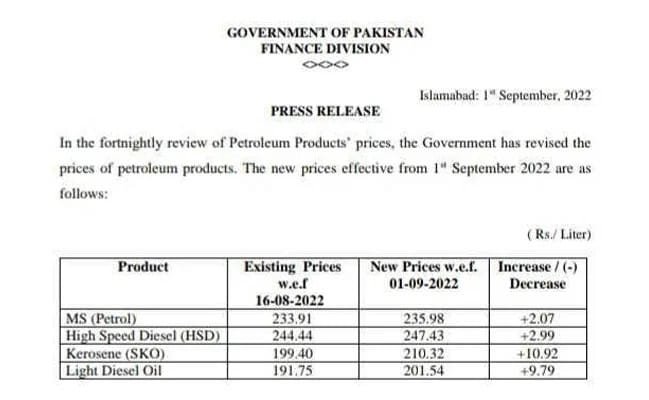
    The price of petrol was raised by the government on Wednesday by Rs2.07 per litre, making it Rs235.98 for the upcoming two weeks.

    Additionally, it announced a hike in the costs of kerosene oil by Rs9.79 per litre to Rs201.54, high-speed diesel by Rs2.99 per litre to Rs247.43, and light diesel oil by Rs10.92 per litre to Rs210.32.

    Contrary to what the market anticipated, the decision to raise gasoline prices, even more, was finally made. In the first half of September 2022, the market anticipated a price drop of up to Rs 20 per litre for the two main petroleum products—petrol and high-speed diesel.

    Expectations were sparked by a decline in the average exchange rate for the purchase of Pakistan State Oil (PSO), which fell from Rs227 in the first half of August to Rs217 in the next15 days.

    Similar to this, the premium paid on gasoline and HSD in the first half of August had decreased from $17 and $8.5 per barrel, respectively.

  • Govt raises petrol price by Rs6.72 to Rs233.91 per litre

    Govt raises petrol price by Rs6.72 to Rs233.91 per litre

    Despite several reports of an expected decrease in prices of petroleum products, the government increased the price of petrol by Rs6.72 per litre and decreased the price of high-speed diesel (HSD) by Rs0.51 and kerosene oil by Rs1.67 per litre.

    The price of light diesel oil (LDO) was raised by Rs0.43 per litre by the government.

    Prior to this, the coalition administration had decreased the cost of petrol and LDO starting on August 1 by Rs3.05 and Rs0.12, respectively.

    However, starting on August 1, 2022, the government had increased the price of HSD by Rs8.95 per litre and kerosene oil by Rs4.62 per litre.

    With the most recent announcement, the price of petrol has gone up from Rs227.19 per litre to Rs233.91 per litre, and that of LDO has gone up to Rs191.75 from Rs191.32 per litre; and that of HSD has gone up to Rs244.95 from Rs244.44.

    Kerosene oil is now available for Rs199.40 per litre as opposed to its earlier price of Rs201.07 per litre.

    The rapid depreciation of the rupee against the dollar had previously also been a significant determinant of oil prices.

    The standing of the rupee against the dollar had improved recently. In spite of this, the cost of gasoline had increased.

    Additionally, there had not been a significant decrease in the cost of diesel, which is widely used in the nation’s transportation and agricultural sectors.

  • Petrol price reduced by Rs18.50 per liter, Diesel by Rs40.54 per liter

    Petrol price reduced by Rs18.50 per liter, Diesel by Rs40.54 per liter

    In an attempt to provide relief to the masses and share the advantages of falling crude prices on the global market, the price of petrol has been slashed by Rs18.50 per liter.

    The price reductions for petroleum products were announced by the Prime Minister, Shehbaz Sharif, in an address to the nation.

    Diesel will now cost Rs236 per liter, while gasoline will now be sold at Rs230.24 per liter. The new prices for petroleum products, according to the Prime Minister, will take effect from midnight.

    He went on to explain why, after taking office, his government had to raise the price of gasoline. He continued, “We had raised fuel prices to meet the demands made by the International Monetary Fund (IMF), which were approved by the previous administration.

    “The government has decided to pass on the relief to the people and has therefore reduced the price of petrol and diesel by Rs18.50 and Rs40.54 per liter, respectively,” he continued.

  • Oil sales fell by 11 per cent as prices rose to highest levels

    Oil sales fell by 11 per cent as prices rose to highest levels

    In June 2022, overall sales of petroleum and lubricants were 1.93 million tonnes, down 11 per cent from the previous month but unchanged from the previous year.

    Petrol and high-speed diesel (HSD) sales both experienced significant monthly declines, falling by 12 and 16 per cent, respectively.

    Sales of all oil products rose by 16 per cent YoY to 22.595 million tonnes during FY22 from 19.45 million tonnes during the same period in FY21.

    Analyzing the data demonstrates that expansion was seen in all categories, with offtake increasing to 8.95 million tonnes, 8.87 million tonnes, and 4.04 million tonnes, respectively, up by 9 per cent, 15 per cent, and 35 per cent on YoY compared to the same period last year.

    Ismail Iqbal Securities analyst Abdullah Umer stated, “We believe that significant rise in both diesel and petrol prices are the main reason behind the decline in retail sales.”

    According to the brokerage house, “Healthy economic activity, robust agricultural activity, upbeat automobile sales, and curb of HSD smuggling remained major drivers behind such stupendous growth.”

    Although the current government has chosen to manage petroleum product prices by levying a Petroleum Development Levy (PDL) and sales tax even if international oil prices decline, the brokerage house anticipated a further slowdown in diesel and gasoline sales going forward.

    In the coming months, retail fuel demand is likely to be further impacted by an increase in carpooling, increased use of public transportation, a change in consumer behaviour (moving from passenger cars to two-wheelers), high inflation, and a general slowdown in economic activity.

    “We expect RFO sales to remain intact due to a likely decline in RLNG & imported coal-based power generation.”

    The government announced a late-night price increase for petroleum products on Thursday, raising the ex-depot price of gasoline to Rs248.74 per liter (after an increase of Rs14.85) and diesel to Rs276.54 (after a hike of Rs13.23).

    Diesel was previously priced at Rs263.31 per litre and petrol at Rs233.89.

    The pricing structure included a Rs10 petroleum levy on gasoline. The cost of high-speed diesel, kerosene, and light diesel oil has also increased by Rs5 per litre.

    Finance Minister Miftah Ismail announced the government’s decision, stating that these prices would go into effect at midnight in order to make up for the Rs-230 billion loss experienced during the fiscal year that ended on June 30th, 2022.

    According to him, the country’s budget deficit, which reached a historic high of Rs5 trillion, made the increase in these prices inevitable.