Tag: leak

  • Over 60 dead due to instant loan app scam blackmailing with nudes

    Over 60 dead due to instant loan app scam blackmailing with nudes

    A widespread blackmail scam, originating in instant loan apps, has ensnared victims in India and across Asia, Africa, and Latin America, with at least 60 Indians resorting to suicide after relentless abuse.

    The BBC conducted an undercover investigation that unveiled the culprits profiting from this pernicious scheme in India and China.

    Bhoomi Sinhaa, a Mumbai-based lawyer, fell victim to this ruthless scheme when she borrowed approximately INR 47,000 ($565; £463) from several loan apps.

    These apps, promising swift loans, often extract personal data and use it to extort users when repayments are delayed. Recovery agents, part of the gig economy, are then tasked with harassing individuals into paying back, resorting to insults and humiliation.

    Bhoomi’s debt spiralled, leading to relentless abuse, threats, and even the release of a manipulated, humiliating photo to her contacts.

    The BBC investigation revealed that at least 60 individuals have taken their own lives due to harassment by these loan apps, with most being young victims who suffered in silence.

    The culprits have managed to stay largely anonymous. However, the BBC did uncover a former debt recovery agent who exposed the system’s brutality.

    Rohan, an ex-employee, recorded over 100 incidents of harassment and abuse, capturing the extortion on camera.

    The most egregious behaviour was observed at Callflex Corporation, where agents were not going rogue but following directions from supervisors, including one named Vishal Chaurasia.

    The recovery process often involves painting victims as fraudsters and thieves and pressuring their contacts.

    The scheme’s sinister nature extends beyond India, involving a Chinese connection. Li Xiang, a Chinese businessman, operates in India through loan apps and recovery services, flouting local laws and resorting to shame to extract repayments.

    He emphasised that their approach is akin to exposing customers to their vulnerability, leaving them “naked” in front of the scammers.

    The emotional and psychological toll on victims like Bhoomi Sinhaa is profound. The shame and ostracization they experience have lasting consequences, with friends, family, and colleagues often distancing themselves from the victims.

    Despite the victims’ efforts to seek justice through police reports and media exposure, the culprits remain elusive, with denials and a lack of cooperation from the companies involved.

    Majesty Legal Services, another implicated company, refuted the allegations, while Li Xiang defended his operations, denying predatory practices.

    This investigation underscores the urgent need for authorities to address this alarming issue, protect vulnerable borrowers, and bring those responsible to justice, all while raising awareness to prevent further harm.
  • Feroze Khan sends public apology to fellow actors for leaking confidential information

    Feroze Khan sends public apology to fellow actors for leaking confidential information

    Feroze Khan has issued a public apology to the ten celebrities whose personal information was leaked to the internet when he posted their personal phone numbers and home addresses on Twitter in a screenshot.

    Khan had written in a statement: “As an actor, I know the importance of privacy and value it the most. I never intended that anyone’s peace be disturbed. If any one of my colleagues had to go through any inconvenience I’m deeply sorry for that.”

    Actor Muneeb Butt and his wife, Aiman, along with her sister Minal, were among the celebrities whose private info was leaked, but yesterday Butt shared a picture of him and Khan together, and revealed that they had settled their differences and decided to drop the charges against the “Habs” actor.

    His statement read:

    “..To give us pain and mental distress wasn’t FK’s intention it was a mistake I announce to drop all of the charges.”

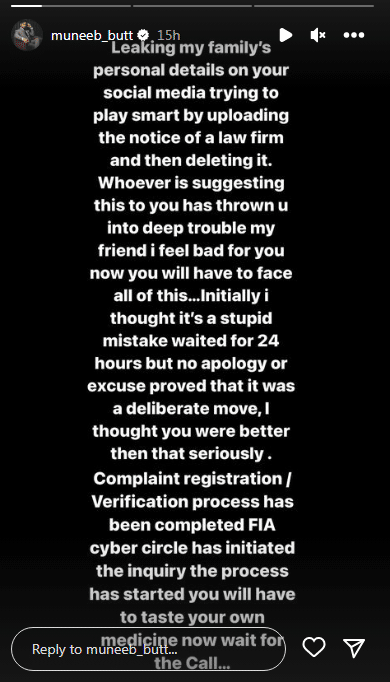
    Butt had previously filed a stalking report with the cyber crime department against Khan for leaking his and his family’s personal information.

    “Whoever is suggesting this to you has thrown you into deep trouble my friend I feel bad for you now you will have to face all of this… Initially I thought it’s a stupid mistake waited for 24 hours but no apology or excuse proved that it was a deliberate move, I thought you were better than that seriously. Complaint registration/ verification process has been completed FIA cyber circle has intiated the inquiry. The process has started, you will have to taste your own medicine now wait for the call,” he had written.

    Celebrities like Yasir Hussain had slammed Khan for being ‘stupid’ for first beating up his wife, and then leaking his number to the world.

    Actor Sarwat Gilani had shared a screenshot on her Instagram page of the numerous phone calls she had received since her number was leaked by Khan, and publicly announced that she was suing him along with the other celebrities.

    Gilani had written: “It is bizarre and despicable that private information, including phone numbers, of various famous individuals has been publicly shared on the absurd pretext of issuing legal notice to them by @ferozekhan Not only are such actions clearly illegal but also demonstrates the total lack of maturity to handle matters in a civilized way.”

  • ‘Affidavit was sealed, don’t know how it was leaked’: Rana Shamim’s response on Saqib Nisar

    ‘Affidavit was sealed, don’t know how it was leaked’: Rana Shamim’s response on Saqib Nisar

    The former chief judge of Gilgit-Baltistan Rana Shamim on Tuesday told the Islamabad High Court (IHC) that the affidavit he had signed accusing former Chief Justice of Pakistan (CJP) Saqib Nisar was leaked.

    “My affidavit was sealed and only [kept] with my family. I don’t know how it was leaked,” said Rana Shamim.

    Chief Justice IHC Justice Athar Minallah had previously taken notice of the story published in The News, in which Judge Shamim in a signed affidavit wrote that he was a witness to Nisar giving directions to a high court judge, not to release Pakistan Muslim League-Nawaz (PML-N) supremo Nawaz Sharif and Maryam Nawaz on bail at any cost before the 2018 general elections. The report was written by senior journalist Ansar Abbasi.

    IHC judge had directed the ex-judge to submit his response.

    Presiding over the hearing, Justice Minallah said the case was related to his court and its accountability, adding, that the judiciary’s freedom was dependent on the freedom of the press.

    Justice Minallah asked Shamim whether he had submitted his response as asked by the court earlier to which the latter replied that there had been a tragedy in his family and requested the court to give him time till December 12 and schedule the next hearing after that.

    The IHC chief justice gave Shamim five days to submit his written response.

    “I have not yet seen my affidavit,” the ex-GB judge informed the court.

    “You must have recorded the affidavit for some purpose. You will inform in the written response how the affidavit was revealed after three years,” pressed IHC judge, inquiring whether Shamim had given the affidavit or not.

    Attorney General of Pakistan (AGP) Khalid Jawed Khan, who was also present in today’s hearing, requested the court to direct Shamim to present the “original” affidavit in the IHC, stating, “This case is related to Article 19 and Article 19-A of the Constitution. The media’s role is secondary, responsibility lies on Rana Shamim.”

    “Maybe his son leaked the affidavit,” he contended, referring to Ahmed Hassan Rana, Shamim’s son and lawyer.

    Shamim said he had only one son, reiterating that he had not seen the affidavit himself.

    At this, Justice Minallah directed Shamim to submit his affidavit in court.

    When Shamim sought time to submit the affidavit, the AGP countered that the document was not 10 years old.

    The former GB chief judge repeated his statement that he had not seen the affidavit, and read it in the news report published.

    “Does he not remember [what happened on] November 10? If he has not written [the affidavit], who has?” the AGP questioned. “Every day is very important,” he added, referring to Shamim’s requests for more time.

    The IHC chief justice remarked that he does “not believe in contempt of court”, adding that judges should be held in higher regard.

    “Rana Shamim’s statement today has further complicated the case. Judges should not be used for political narratives,” said Minallah.

    The IHC adjourned proceedings of the case till December 7.

  • Sensitive personal information of Pakistanis leaked over the internet

    Sensitive personal information of Pakistanis leaked over the internet

    • NADRA, PTA spokespersons reject claims against their respective departments as data leak makes headlines

    In a massive breach of privacy, personal and sensitive data of millions — if not hundreds of millions of Pakistanis — has been leaked over the internet as blame game continues between the authorities concerned with none of them willing to take the fall for the divulgence.

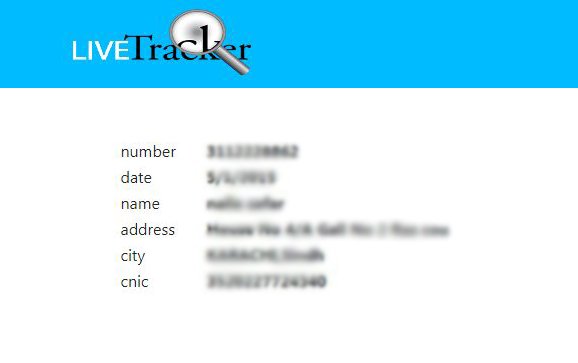
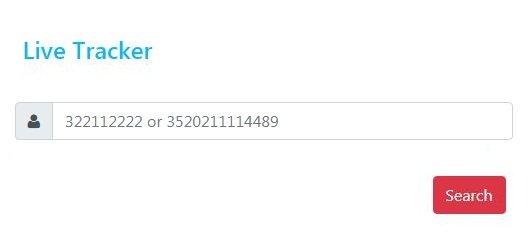
    According to the details, multiple smartphone applications and websites, one of which is Sim Database Online, are hosting millions of Pakistani telecom users’ sensitive data such as their Computerised National Identity Card (CNIC) numbers, names and even residential addresses, all of which can be accessed by simply entering the victim’s mobile number.

    Not only does the web-based application further goes on to reveal other mobile numbers registered in the name of the privacy breach victim, but also claims to be providing services such as mobile phone tracking.

    A screen grab of ‘Sim Database Online’

    “Such applications have been around for quite some time now and most probably are the reason behind the recent spike in number of identity theft incidents in Pakistan,” sources told The Current, adding that leaks of government-held databases remain the biggest contributor to identity theft-related crimes in the country, around 50,000 of which were reported in 2019 alone.

    Some groups on Facebook are also offering information regarding driving licences, current location, call details and even criminal records associated with any CNIC numbers if you pay them, sources claimed. “You can even dig out the National Database and Registration Authority (NADRA) family trees associated with a CNIC for a few hundred rupees.”

    They went on to claim it wasn’t just Pakistanis’ confidential data that was being hosted by such web applications. “Sensitive personal information of Afghans and Indians can also easily be accessed through these websites, but there appears to be no urgency among authorities of the three countries to protect their citizens,” they claimed.

    When asked if NADRA or the Pakistan Telecommunication Authority (PTA) were to be held responsible for the leak, they blamed the latter, saying the watchdog had failed to keep an eye on what the country’s telecommunication companies were doing with sensitive data of their customers.

    “How else do you the inboxes of so many people get flooded with text advertisements?” sources questioned, alleging that a data archive of registered telecom users was leaked online in August 2017.

    “The archive contains information about registered mobiles users of Pakistan categorised by their telecom companies. It is publicly available and contains personal information recorded to verify SIM cards. Despite the leaked information being brought to light by many, the data remains available.”

    Speaking to The Current, an information technology (IT) expert said that e-governance came with a set of standards across the world. “If you give access to someone, you have to follow these standards and maintain a certain security level. But unlike the rest of the world… where they have emergency response teams to investigate such issues, Pakistan has had no such probes I know of.”

    “Instead of having teams that react to such incidents, we need certain proactive measures,” the IT expert said, adding that privacy over the internet was a right of the users, and most identity theft-related crimes could be linked to data leaks associated with government bodies over the years.

    NADRA & PTA:

    When approached, NADRA spokesperson Faik Ali told The Current that there was no truth to the claims being made regarding the role of the authority in the data leak as it very carefully managed the sensitive registration database of all citizens.

    “NADRA has nothing to do with it,” he said and also rubbished claims regarding a data breach from two years ago.

    “We had in 2018 also denied accusations of leakage of voters’ data ahead of the general election,” he said, adding that it was also clarified by the authority in a letter to the Election Commission of Pakistan (ECP). “There has never been a data breach in the history of NADRA and we have never shared any citizen’s data with anyone.”

    Faik also reiterated NADRA’s commitment to protect sensitive data of all citizens come what may.

    PTA Public Relations Director Khurram Mehran, on the other hand, rejected all claims regarding the watchdog’s alleged inability to protect the data of telecom networks’ customers, saying that no telecommunication companies were involved in releasing confidential information of their customers.

    He, however, said that action would be taken against any company if evidence to support such claims is there.

    To a query, the PTA spokesperson further said if there were any such cases, they were to be dealt under the Prevention of Electronic Crimes Act (PECA) provisions by the agency concerned, as they were cybercrime cases.

    Repeated attempts were made to contact the chairperson of Senate Standing Committee on IT and Telecommunication, Rubina Khalid, but she was unavailable.