Tag: Local Assembling

  • Air Link partners with Xiaomi for assembling TVs in Pakistan

    Air Link partners with Xiaomi for assembling TVs in Pakistan

    Air Link Communication Ltd. will start assembling Xiaomi televisions in Pakistan in January 2024. This noteworthy development, reported by Bloomberg, marks a strategic move forward for the company.

    Muzzaffar Hayat Piracha, the Chief Executive Officer (CEO) of Air Link, shared insightful details with the publication. He highlighted the collaborative partnership formed two years ago between Air Link and Xiaomi, focused on distributing mobile phones across Pakistan.

    Importantly, both companies foresee a streamlined investment process, as the assembly lines for the two product lines exhibit notable similarities.

    Bloomberg’s analysis sheds light on Pakistan’s positive economic transformation following a pivotal deal with the International Monetary Fund. This consequential agreement effectively doubled the nation’s foreign exchange reserves, elevating them to an impressive $8 billion. A key requirement of this agreement was the removal of all restrictions on imports, a significant move that has provided relief and opportunities for companies, including Air Link.

    Notably, Air Link’s journey has been one of progress, transitioning from breaking even to achieving profitability over the past six months. This serves as a testament to their resilience and strategic acumen, according to Air Link’s CEO.

    Air Link, which commenced operations as a mobile phone distributor a little over a decade ago, etched its name in history by spearheading Pakistan’s largest private sector initial public offering in 2021.

    Piracha highlighted this milestone while also outlining the company’s ambitious goal to ramp up monthly mobile phone production to an impressive 500,000 units by the end of the year, surpassing the current rate of 300,000 units.

  • Inventory shortage forces Pak Suzuki to temporarily halt operations

    Inventory shortage forces Pak Suzuki to temporarily halt operations

    Pak Suzuki Motor Company (PSMC) announced on Wednesday that it will temporarily halt operations at its automobile plant from February 13th to 17th, due to an insufficient inventory.

    The management of Pak Suzuki, the local assembler, manufacturer, and marketer of Suzuki vehicles and related spare parts, has informed the Pakistan Stock Exchange (PSX) that it will temporarily cease operations at its automobile plant from February 13th to 17th, 2023, due to an ongoing shortage of inventory.

    The company’s motorcycle plant, however, will remain in operation. This decision follows a previous temporary shutdown of the automobile plant from January 2nd to 6th and January 16th to 20th, also due to inventory constraints.

    PSMC has reported that the recent introduction of a prior approval mechanism for imports by the State Bank of Pakistan (SBP) has negatively impacted the clearance of its import consignments, leading to a shortage of inventory.

    As a result, PSMC has suspended new bookings for its motorcycles starting January 20th, due to supply chain constraints and an uncertain production outlook. The company has stated that bookings will resume when the situation improves and it is able to serve fresh customers.

    Pakistan’s auto industry, which heavily relies on imports, is facing a crisis as the SBP has imposed restrictions on the opening of Letters of Credit (LCs) due to the persistent depreciation of the rupee. The country’s depleted reserves have resulted in operational challenges for various industries.

  • Kia increases car prices by up to Rs1.3 million ‘due to significant devaluation of Pakistani rupee’

    Kia increases car prices by up to Rs1.3 million ‘due to significant devaluation of Pakistani rupee’

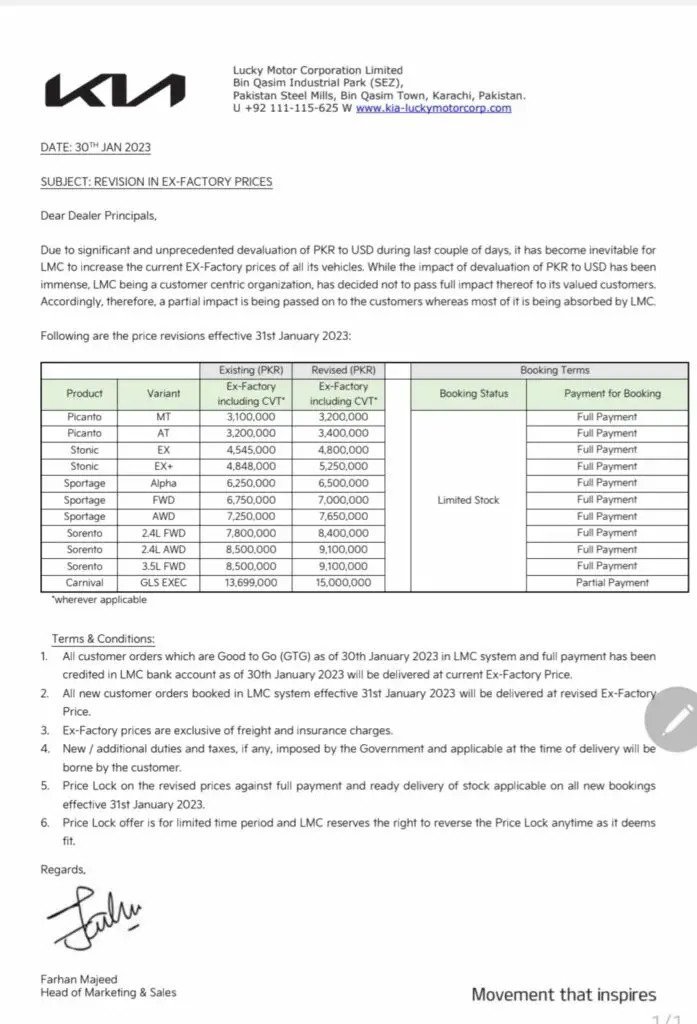
    As the value of the Pakistani rupee (PKR) against the US dollar falls to an all-time low, Kia Lucky Motors Corporation (KLMC) has announced a significant hike in their car prices in Pakistan.

    Details indicate that, depending on the model, the manufacturer has increased the price of the Kia Picanto, Kia Sportage, Kia Stonic, Kia Sorento, and Kia Carnival in Pakistan by up to Rs1.3 million.

    “Due to the significant and unprecedented devaluation of PKR to USD during the last couple of days, it has become inevitable for LMC to increase the current ex-factory prices of all its vehicles,” the company announced in its notification to dealers.

    The new rates will go into effect on January 31, 2023.

    “While the impact of the devaluation of PKR to USD has been immense, LMC, being a customer-centric organization, has decided not to pass the full impact thereof to its valued customers,” it said, adding that only a partial impact is being passed on to the customer and the rest has been absorbed by LMC.

    It is important to note that on January 30, 2023, the interbank market closed with the Pakistan rupee at an all-time record low of Rs269.63 versus the US dollar.

    The price of the Kia Picanto in Pakistan has been increased by a massive Rs100,000 for both variants, bringing the new price of the M/T variant to Rs3,200,000 and the A/T variant to Rs3,400,000, compared to the old prices of Rs3,100,000 and Rs3,400,000, respectively.

    Here are the new prices for all Kia cars:

  • Pak Suzuki increases motorcycle prices by up to Rs25,000

    Pak Suzuki increases motorcycle prices by up to Rs25,000

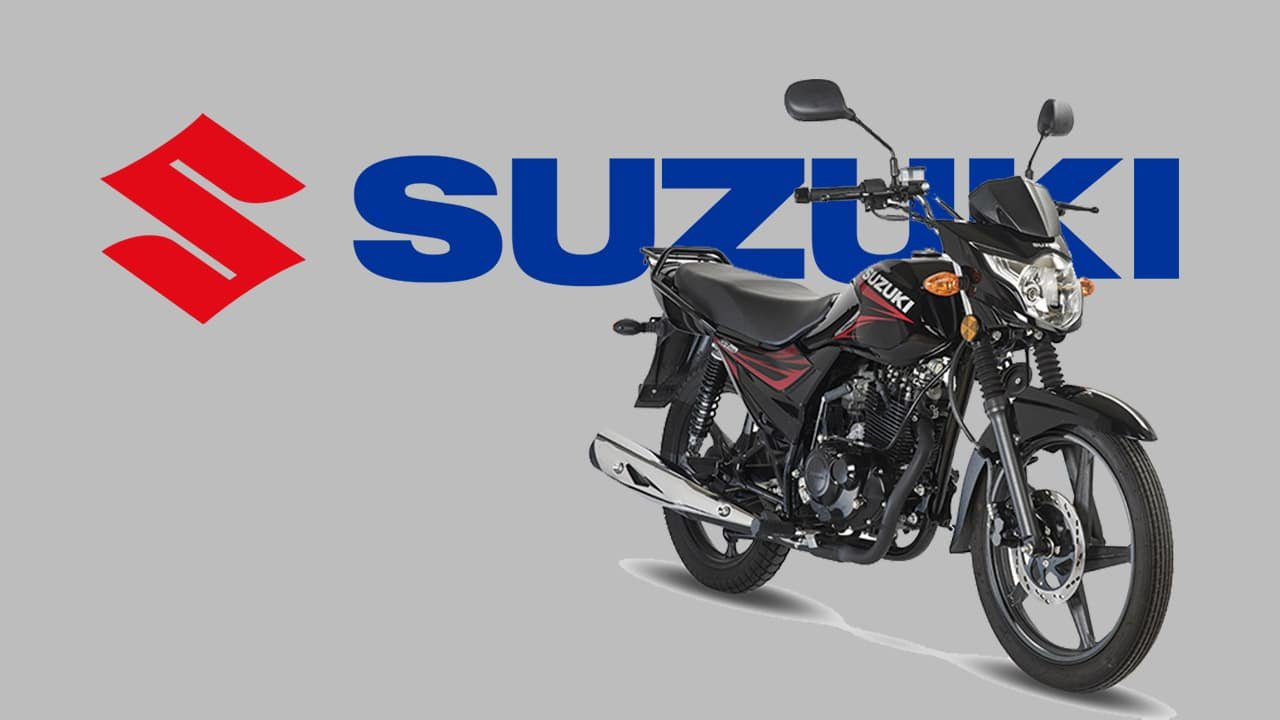
    Pak Suzuki Motor Company Ltd. (PSMCL) has increased motorcycle prices by Rs20,000-25,000, effective February 1st.

    The new rate for GD110 S, GS150, GSX125, and GR150 is Rs264,000, Rs286,000, Rs384,000, and Rs410,000.

    However, the company’s communication to authorised dealers lacked any explanation for the price increase.

    PSMCL had temporarily ceased taking new bike orders as of January 20 due to supply chain constraints based on imports and unpredictable production capacity in the current economic climate.

    Read more: Latest Suzuki car prices

    Pak Suzuki has been enjoying a smooth journey, recording sales of 20,762 units in FY23 compared to 18,030 at the same time last fiscal year, as sales of all two-wheeler assemblers have remained flat due to rising prices, quality problems, and affordability difficulties.

    The assembler of Hi-Speed motorcycles has also increased the rate by Rs25,000 of 150cc Infinity and 200cc Freedom followed by a Rs2,500-Rs3,500 hike in 70cc-125cc motorcycles.

  • Yamaha Pakistan increases bike prices by up to Rs13,500 due to an increase in production costs

    Yamaha Pakistan increases bike prices by up to Rs13,500 due to an increase in production costs

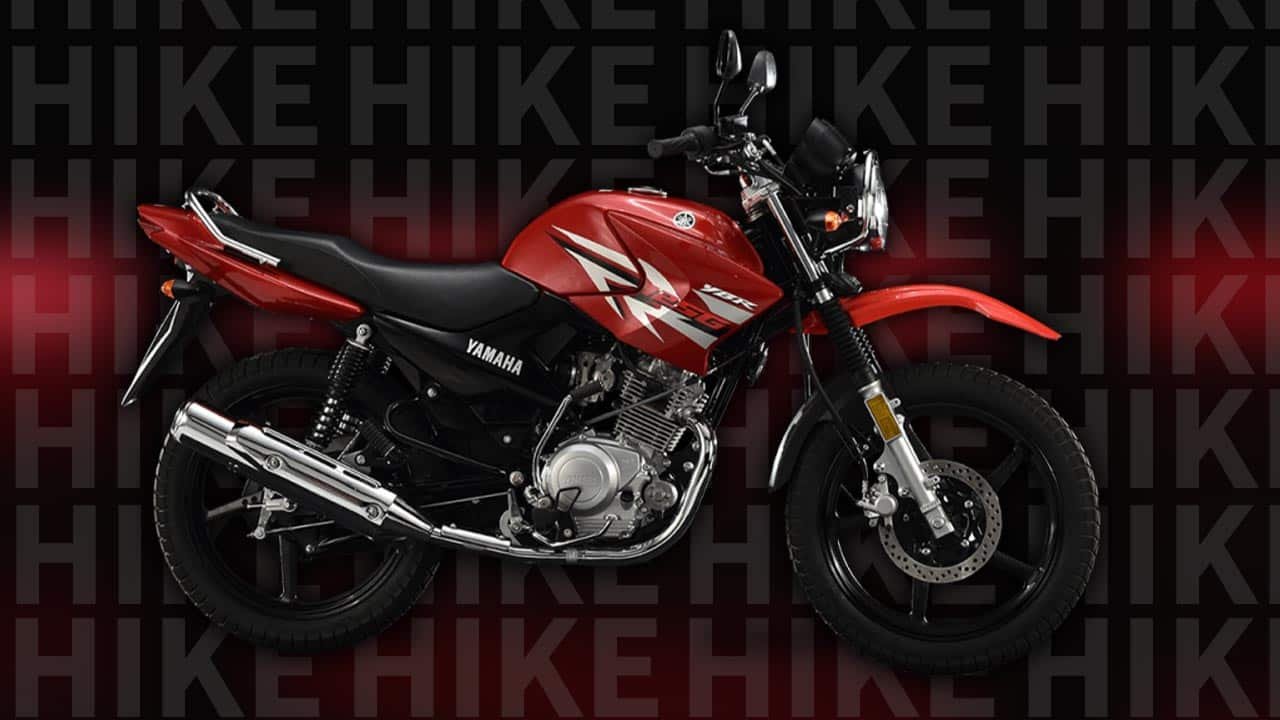
    Yamaha Motor Pakistan on Tuesday announced an increase in the prices of its overall motorcycle lineup owing to an increase in production costs.

    According to a notification made in this respect, the Japanese bike manufacturer raised the price of its five models by up to Rs13,500, with the new rates taking effect on January 4, 2023.

    The price of the YB125 Z model has been increased by Rs12,000 to Rs305,500. The price of the YB125 Z DX model has also been increased to Rs327,000 from Rs314,500, according to Geo.

    Model Old price Retail price excluding tax Sales tax 17 per cent New price Increase
    YB 125Z Rs293,500 Rs261,111 Rs44,389 Rs305,500 Rs12,000
    YB 125Z DX Rs314,500 Rs279.487 Rs47,513 Rs327,000 Rs12,500
    YBR 125 Rs322,500 Rs287,179 Rs48,821 Rs336,000 Rs13,500
    YBR125G Rs336,000 Rs298,718 Rs50,782 Rs349,000 Rs13,500
    YBR 125G
    Matte dark grey
    Rs339,000 Rs301,282 Rs51,218 Rs352,000 Rs13,500
  • Pak Suzuki extends plant closure due to low inventory

    Pak Suzuki extends plant closure due to low inventory

    The State Bank of Pakistan (SBP) has imposed import restrictions that have negatively impacted the clearance of import consignments, which has in turn affected the inventory levels, according to Pak Suzuki Motor Company (PSMC), which announced on Monday that the shutdown of its auto production plant has been further extended from August 29 to August 31.

    The SBP has instituted a procedure for prior permission for imports within the HS code 8703 category (including CKDs), according to a notice given to the Pakistan Stock Exchange (PSX) by PSMC on May 20, 2022, according to pkrevenue.

    According to PSMC, these restrictions had a negative influence on the import consignment’s clearance, which in turn had an impact on inventory levels.

    PSMC said that it is experiencing a scarcity of inventory. As a result, the company’s management has decided to further extend the auto plant’s shutdown time from August 29, 2022, to August 31, 2022.

    As a result of a decline in inventory levels, PSMC informed the PSX earlier this week that it will halt production of automobiles from August 22 through August 26, 2022.

    However, PSMC stated on both occasions that its motorcycle plant will continue to operate.

    Due to Pakistan’s auto industry’s reliance on imports and the SBP’s limits on Letters of Credit opening as a result of the persistent rupee devaluation, the country is currently experiencing an exchange rate crisis.

    In order to prevent delays in car delivery and future price increases, the manufacturers requested the central bank’s involvement back in July for opening LCs for the import of CKD kits.

    PSMC stated earlier this month that it would lower the pricing of its cars by between Rs75,000 and Rs199,000, citing the strengthening of the rupee versus the US currency. Due to the weakening of the rupee, prices had already climbed significantly in early August.

  • Pak Suzuki suffers losses of Rs17.23 million due to rising production costs

    Pak Suzuki suffers losses of Rs17.23 million due to rising production costs

    Pak Suzuki Motor Company Ltd. (PSMC) reported its half-yearly results, which were completed on June 30, 2022. The company reported a net loss of Rs17.23 million against a net profit of Rs1.19 billion, according to the automaker’s latest filing on the Pakistan Stock Exchange (PSX).

    According to Mettis Global, the company’s sales revenue climbed 30 per cent YoY, from Rs66 billion to Rs112, 62 billion, mostly due to volumetric growth and pricing increases.

    As a result of growing input costs and the significant depreciation of the local currency, the gross margins during 1HFY22 decreased from 5.98 per cent to 3.74 per cent.

    Regarding the company’s primary expense heads, distribution and marketing costs came in at Rs1.64 billion, up 30 per cent YoY, while administration costs dipped to Rs1.48 billion, up 11 per cent YoY.

    In contrast to Rs866 millionn in 1HFY21, the company additionally received Rs1.56 billion in other income.

    Furthermore, as a result of rising interest rates, finance costs increased by 6.2x YoY, from Rs292 million to Rs1.8 billion.

    The company also paid Rs767.84 million in taxes, which represents an increase of 57 per cent YoY because of the impact of super taxes.

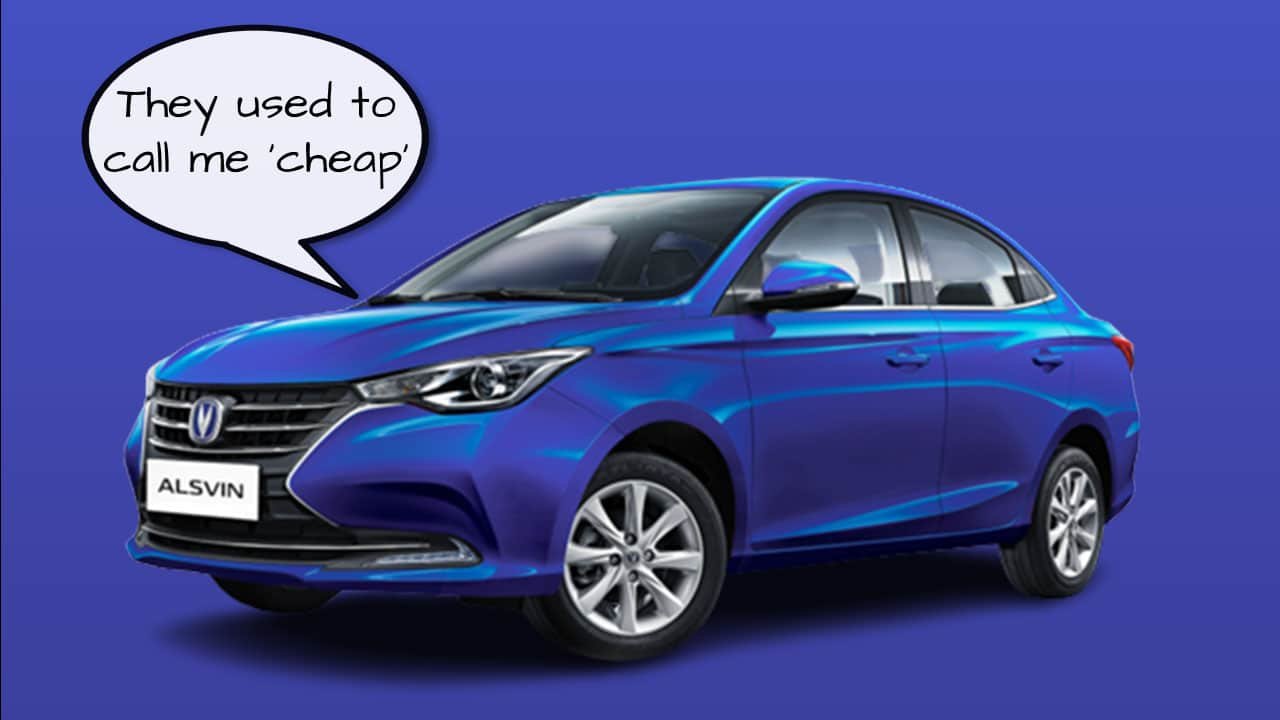
  • Changan is not reducing the price of Alsvin variants

    Changan is not reducing the price of Alsvin variants

    With the exception of Alsvin, Changan has announced price reductions for all locally assembled vehicles.

    While Changan and every other brand in Pakistan increased the price of automobiles to an all-time high, it appears that the Chinese manufacturer has noted that Alsvin variants were far less expensive and still seemed like a good option for local car buyers as compared to other sedans from top brands.

    Here are the new prices for Changan vehicles:

    Model Old invoice New price Reduction
    Oshan X7 Comfort Rs7,449,000 Rs7,049,000 Rs400,000
    Oshan X7 FutureSense Rs7,749,000 Rs7,549,000 Rs200,000
    Karvaan Standard Rs2,469,000 Rs2,419,000 Rs50,000
    Karvaan Plus Rs2,619,000 Rs2,569,000 Rs50,000
    Alsvin Comfort Rs3,394,000    
    Alsvin DCT  Rs3,649,000    
    Alsvin Lumiere DCT  Rs3,844,000    
    Changan New Car Prices in Pakistan – 19 August 2022

    Oshan X7 Comfort’s price has been significantly reduced by Changan and is currently available for Rs7,049,000 as opposed to its earlier invoice of Rs7,449,000. This indicates a price reduction of Rs400,000.

  • Govt lifts import ban on luxury goods with heavy duties

    Govt lifts import ban on luxury goods with heavy duties

    On the recommendation of the International Monetary Fund (IMF), the Federal Minister for Finance and Revenue, Miftah Ismail, announced lifting of the ban on the import of luxury and non-essential goods on Thursday. He added, however, that the Regulatory Duties (RDs) would be increased significantly to deter the import of such items.

    “It is requirement of the international community that there should be no ban so we are lifting ban on all products. But simultaneously the duties I am going to impose would not let these commodities to enter into Pakistan as finished goods,” according to Finance Minister.

    According to the minister, RDs would be increased three times, or to the highest degree conceivable, and may potentially increase by up to 400 to 600 per cent or more.

    Keeping in view his duty to offer basic and vital goods to the nation’s citizens, he said that the prime minister was against the importation of luxury goods, according to APP.

    To comply with the IMF, international agreements, and World Trade Organization, he claimed the restriction had been lifted. Although import taxes would be applied on expensive food, clothing, and other items, anyone still wishing to import is free to do so.

    He said that the available resources will be used to give the people of the country grain, wheat, cotton, and edible oil rather than iPhones or fancy cars. He claimed that Pakistan did not have a lot of money to spend on the import of opulent things.

    The finance minister stated in response to a question that the levies on completely built-up (CBU) automobiles, appliances, imported meat and salmon, as well as other luxuries, would increase. He explained that the government’s goal was to limit imports while adhering to the requirements of the International Monetary Fund (IMF) and other international accords, not to promote the import of such goods.

    On the other hand, since the Completely Knocked Down (CKD) kits are not considered luxury items, their import will resume without any caveats. However, its positive impact on the sales figures will be seen after a few months.

    According to the finance minister, Pakistan and the fund have been in lengthy negotiations. The IMF board is due to convene on August 29 and will decide whether to accept Pakistan’s programme because it has already complied with all requirements and performed all necessary preliminary steps.

    He said that friendly nations like Saudi Arabia, Qatar, and the United Arab Emirates helped arrange the $4 billion cash for strengthening the nation’s foreign exchange reserves. China also agreed to roll over $2 billion in loans, and Saudi Arabia agreed to roll over its own assets. According to him, the finance need has been satisfied.

    According to the minister, the requirement for the electricity tariff has also been met, thus there won’t be any non-funding subsidies.

    In addition, he said that the government was expected to get Rs42 billion from retail tax, but when the decision was reversed, the objective was cut to Rs27 billion, and the Rs15 billion shortfall will be filled by increasing the tax on tobacco and cigarettes.

    Moreover, taxes on tobacco and cigarettes will bring in Rs36 billion. Tier-2 cigarettes’ tax will rise from Rs1,850 to Rs2,050 per 1,000 cigarettes, while Tier-1 cigarettes’ tax would rise from Rs5,900 to Rs6,500 per 1,000 cigarettes. The green leaf Cess has also been raised from Rs10 per kg to Rs380.

    According to Bloomberg’s report, the Pakistani Rupee was the best performing currency in the world during August, and the Pakistan Stock Exchange continued to be the top performing stock market in the world, therefore the minister believed that the country’s economy was strengthening.

    The minister stated that the government was implementing a policy of self-reliance in order to stay within its means, reduce the fiscal deficit, and raise imports to a level equal to exports plus remittance in order to control the current account deficit.

  • Hyundai-Nishat announces a hefty price hike following KIA

    Hyundai-Nishat announces a hefty price hike following KIA

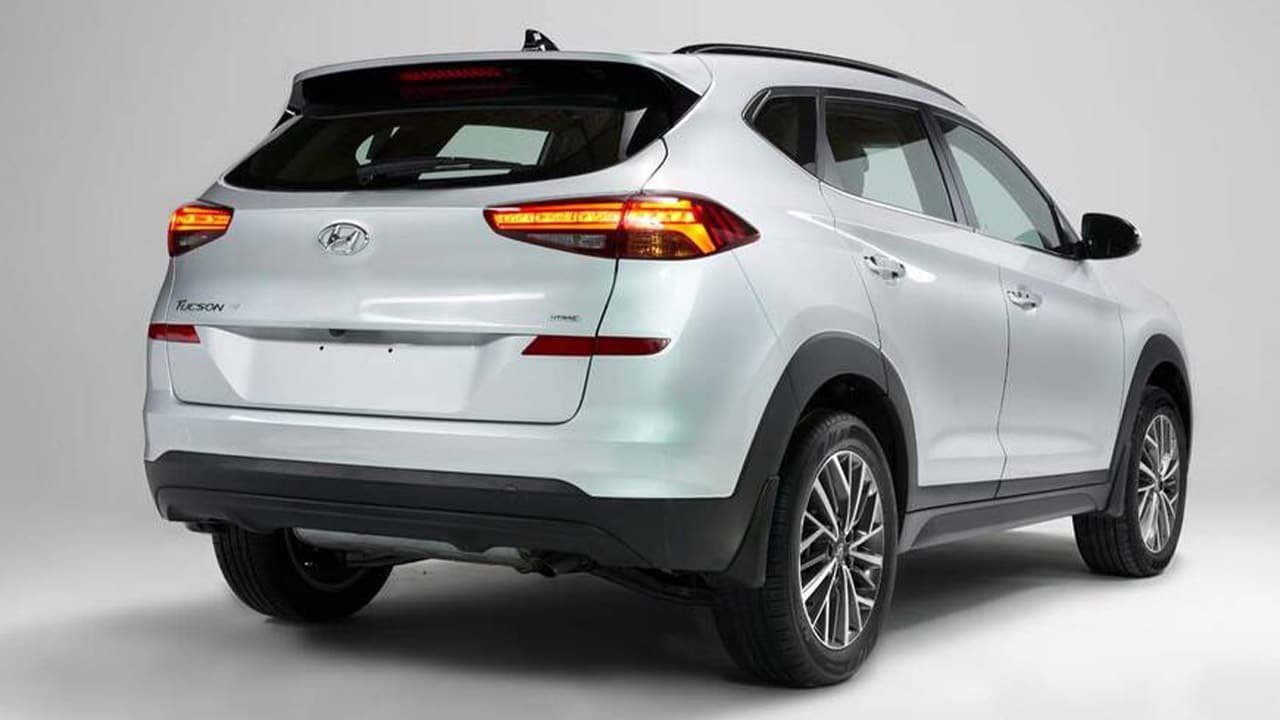
    Hyundai-Nishat Motors raised the pricing of its Tucson variants by Rs1.1 million, citing the decline in the currency as the primary cause, following Lucky Motor Corporation’s price increases for its KIA-brand vehicles.

    After an increase of Rs1.1 million price increase for the c, the Hyundai Tucson FWD model is now offered for Rs6.89 million. The price of the AWD version has increased by Rs1.1 million to Rs7.39 million.

    According to a sales representative, the company would accept reservations upon full payment, and delivery is anticipated to occur in August and not take longer than 60 days.

    Prior to that, Lucky Motor announced an increase in the prices of its KIA-brand vehicles starting on July 19, with the rise reaching as high as Rs1.1 million.

    The corporation said that the ongoing depreciation of the rupee versus the dollar was to blame for their need to raise pricing.

    “Kia and Hyundai have taken the initiative to increase car prices but the rest of the automakers will follow too,” said Sunny Kumar, Research Analyst at Topline Securities.

    “The last pricing most of the carmakers did was when the dollar stood at Rs185. It has now crossed Rs225. The price hike was imminent and announcements from other automakers could be expected anytime now.”

    According to Brecorder, the CEO of Lucky Motor Corp, Asif Rizvi, acknowledged that the auto sector primarily employs imported materials and that localised parts also contain a large percentage of foreign components while speaking on the sidelines of the Peugeot 2008 launch in March.