Tag: local unit

  • Pakistani rupee closes at Rs277.41 as US dollar recovers by nearly Rs2 in interbank trade

    Pakistani rupee closes at Rs277.41 as US dollar recovers by nearly Rs2 in interbank trade

    The US dollar appears to have bounced back on Wednesday at the opening of interbank trade, as it gained 31 paisas. The American currency closed at Rs277.41 after gaining Rs1.97 against the local unit. The dollar was exchanged for Rs275.75 at the start of the trading session on Wednesday.

    However, later the greenback gained even more value with Rs1.31 in interbank trade and was being traded at Rs276.75. In just a short while, the currency gained even more strength with Rs1.56 and was traded at Rs277.

    Owing to the strengthening of the dollar in the interbank trade, the currency’s value stopped falling in the open market also. Its value remained stable at Rs280 in the open market. On Tuesday, the greenback had lost a massive Rs10 in the interbank market.

    On the other hand, the Pakistan Stock Exchange continued its bullish trend. The shares of energy, oil and gas, and refinery companies were shared in the market.

    The stock exchange retained its limit of 44,000 points on Wednesday morning. The KSE-100 index rose with 472 points to 44,030 points. At the start of the trading session, the index gained 200 points to reach 43,770 points.
  • Pakistani rupee drops by more than Rs18 against US dollar due to delay in IMF deal

    Pakistani rupee drops by more than Rs18 against US dollar due to delay in IMF deal

    Pakistani rupee (PKR) experienced a significant decline of over Rs18.8 against the US dollar in the interbank market during intra-day trade, ahead of the monetary policy review and delay in the International Monetary Fund (IMF) deal.

    At approximately 11:40 am, the greenback was being traded at Rs285 against the local currency, compared to its previous day’s closing of Rs266.11.

    Zafar Paracha, the General Secretary of ECAP, expressed concern over the delay in the agreement with IMF and the lender’s demand to peg the currency rate with that of the grey market, which has resulted in market uncertainty.

    In his opinion, the current rate is too high and should not have risen to this extent. He also noted that the greenback was being traded at Rs290 in the grey market a day earlier.

    Adnan Asghar, a currency market expert, stated that the delay in the deal between Pakistan and the IMF has contributed to the depreciation of the rupee.

    He added that the uncertain political situation has also been a factor in the decline of the rupee’s value. Asghar warned that the country is approaching a default situation due to this delay.

  • Pakistani rupee drops by 0.35% to close at Rs221.43 versus dollar

    Pakistani rupee drops by 0.35% to close at Rs221.43 versus dollar

    As investors await the US Federal Reserve’s decision on the policy rate, the Pakistani rupee (PKR) depreciated by 0.35 per cent against the greenback on Wednesday.

    According to the State Bank of Pakistan (SBP), the local unit appreciated by Rs0.78 and ended the day at Rs221.43.

    The Pakistani rupee enjoyed gains against the US dollar on Tuesday, and it ended the day at Rs220.65 after rising by Rs0.24 (or 0.11 per cent) in the interbank market.

    Gains were recorded when market confidence improved as a result of discussions held by Finance Minister Ishaq Dar with senior bank and exchange company executives.

    However, in a significant development, according to the most recent data released by the Pakistan Bureau of Statistics (PBS) on Tuesday, consumer price index (CPI)-based inflation increased to 26.6 per cent on an annual basis in October 2022 as opposed to an increase of 23.2 per cent in the previous month and 9.2 per cent in October 2021.

    Globally, the US dollar slipped on Wednesday as investors awaited the US Federal Reserve’s policy decision amid speculation it might indicate a slowdown in future rate hikes. The central bank will soon release its policy statement with investors widely expecting a 75 basis points (bps) rate hike, the fourth such increase in a row.

    The dollar index – which gauges the greenback against a basket of six counterparts that includes the yen, euro and sterling – eased 0.2 per cent to 111.28, but was not far below Tuesday’s high of 111.78, the strongest level since October 25. The index has fluctuated widely around the 112 level since its retreat from a two-decade high of 114.78 at the end of September.

    Oil prices, a crucial gauge of currency parity, increased on Wednesday after data from the sector revealed a surprising decline in US oil supplies, indicating that demand is still strong despite sharp interest rate increases that are slowing down global development.

  • Pakistani rupee becomes best performing currency after recording impressive gains

    Pakistani rupee becomes best performing currency after recording impressive gains

    The unpredictable Pakistani rupee, which made the highest rise of 3.9 per cent over five working days to Rs219.92 against the dollar on anticipation of sizable inflows of foreign cash, was dubbed the “world’s best-performing currency” in the week that concluded on Friday.

    According to analysts monitoring currency movements, the rupee proved to be the best-performing currency throughout the week.

    Friday marked the rupee’s 11th straight successful working day since the current finance minister, Ishaq Dar, announced his return to Pakistan by ending a five-year self-exile last month, according to the Express Tribune.

    Clearly, Dar continued his previous strategy of defending the rupee from the assault of the US currency after assuming power. He thought the rupee was undervalued at its all-time low of roughly Rs240 to the dollar in July and suspected commercial banks of manipulating the rupee’s value to advance their own interests.

    In a swift move, Pakistani officials notified Moody’s that during recent meetings with multilateral creditors, the government had received an additional funding commitment of more than $2.5 billion from the Asian Development Bank.

    This was done while strongly responding to Moody’s downgrading Pakistan’s credit rating to Caa1. The World Bank has also committed to providing an additional $1.3 billion in finance for infrastructure improvement and other projects during the current fiscal year.

  • Yamaha increases motorcycle prices for the 5th time in 2022

    Yamaha increases motorcycle prices for the 5th time in 2022

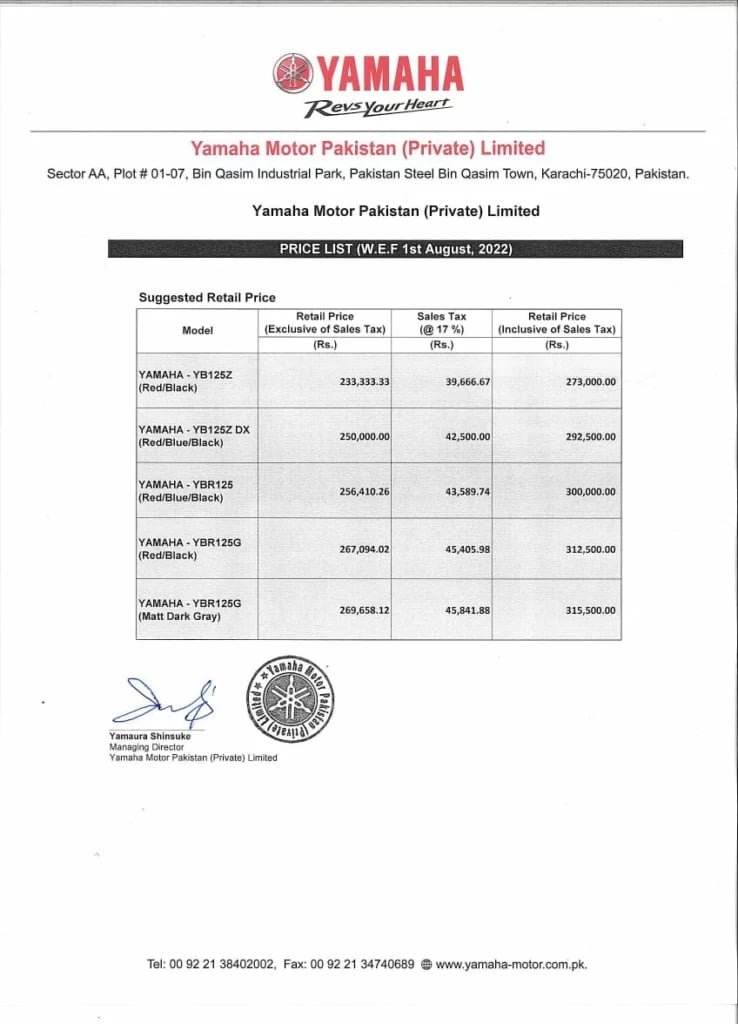
    Yamaha has announced a significant price increase for motorcycles effective from August 1, 2022. All variants from the manufacturer, including the YB 125Z, YB 125Z DX, YBR 125, and YBR 125G, have seen price increases.

    It is important to note that this is the fifth price rise for Yamaha motorcycles in Pakistan since the year 2022 started, with the previous increase occurring in June 2022 and costing more than Rs20,000 for each model.

    The Yamaha YB 125Z will now cost Rs273,000 after an increase of Rs18,000, and the Yamaha YB 125Z DX will cost Rs292,000 after a hike of Rs18,000.

    Similarly, the Yamaha YBR 125’s price has increased by Rs19,500 to Rs300,000. After an increase of Rs20,500 for both models, the price of the Yamaha YBR 125G (Black/Red) is now Rs312,500, and the Yamaha YBR 125G (Gray) is now priced at Rs315,500.

    Nevertheless, this was to be expected, and over the course of 2022, Yamaha Motorcycle prices are predicted to rise by several factors, especially in light of the depreciation of the Pakistani Rupee (PKR) against the US dollar and the implementation of the Super Tax on the automotive industry.

    There is little justification for motorcycle manufacturers to raise prices so frequently and by such significant margins as bike manufacturing has been localised by up to 94 per cent in Pakistan.

    The depreciation of the local currency caused price hikes across the board in Pakistan’s auto industry, whether it be for cars or two-wheelers, pushing prices out of reach for an average person.