Tag: LSD

  • Top driving techniques for reducing fuel consumption

    Top driving techniques for reducing fuel consumption

    The price of petrol in Pakistan is unforgivably high and motorists have no recourse since fuel is the basic and continuous expense for gasoline-powered vehicles. Still, the vast majority of auto owners want to lower their monthly fuel costs.

    Fuel economy may not be a huge concern if an individual rarely drives a car for short trips, but regular commuting and lengthy excursions make it challenging to save fuel.

    Here are a few tried-and-true tips that are well-known to increase mileage:

    Go easy on the accelerator

    This entails just accelerating the car when necessary. Frequent braking and engine revving increase fuel consumption whereas keeping the speed of the vehicle steady reduces fuel consumption. This is why you get greater mileage on long routes or motorways.

    It is strongly advised to maintain a low RPM (preferably less than 2,500), and if your automobile has an eco-mode, it would be helpful to frequently use it. Depending on the vehicle, this mode is especially made to improve fuel efficiency and can reduce fuel consumption by up to 15%.

    Watch your speed

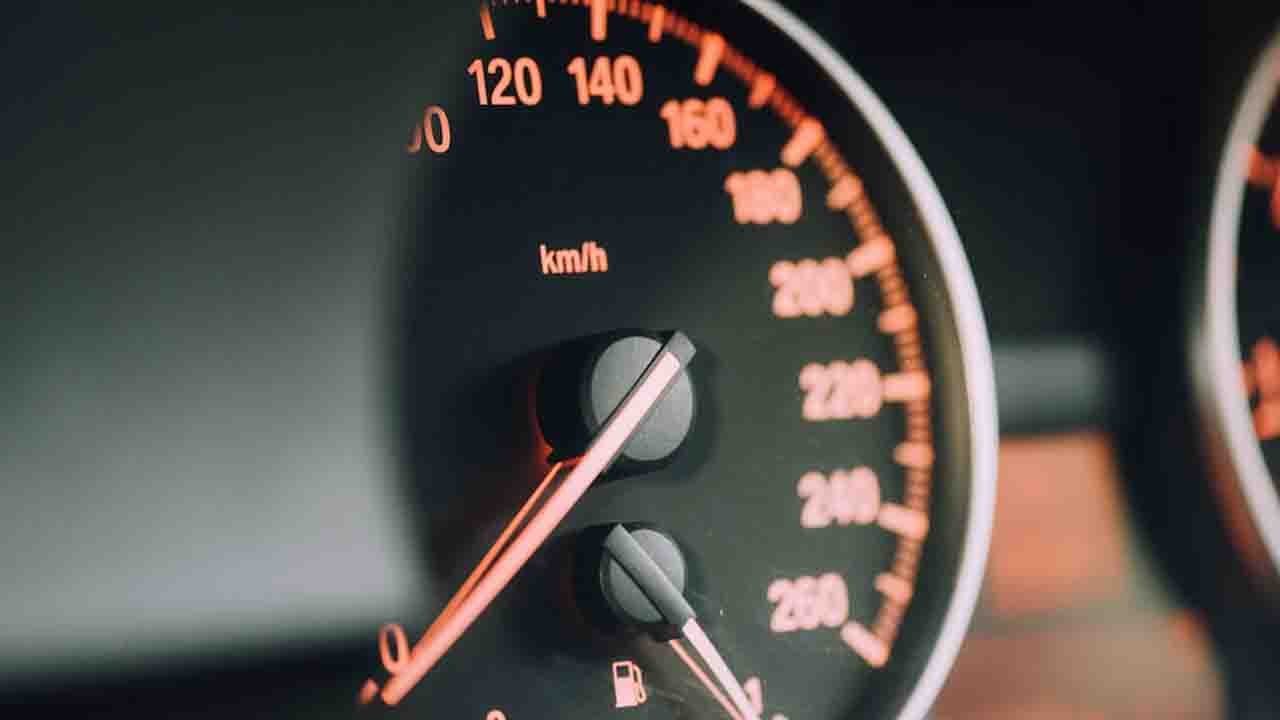
    If your car has a small engine (under 1300cc), it will use more gasoline when travelling at speeds of 100 km/h or greater. To provide higher output, the engine must push harder, which raises the RPM and petrol usage.

    Bigger engines may generate greater power at lower RPMs, hence they are often unaffected by higher speeds as they require less power and repeated flooring.

    Be aware that hybrid engines are less affected by this as they may employ electric motors to maintain a high power output while consuming little fuel.

    Drive smartly

    A motorist may handle traffic more effectively by keeping an eye on the surroundings, maintaining safe distances, and analysing the driving habits of other drivers. By doing this, the motorist may prepare for obstacles including roadblocks, red lights, road closures, and bumps.

    Additionally, it aids in intelligent acceleration and deceleration. Ultimately, smart driving is one of the best ways to increase safety and reduce fuel consumption.

    Avoid idling

    This is the most basic fuel-saving advice offered by automotive specialists. It is clear that idling for an extended period of time wastes fuel. In addition, warming up a car shouldn’t take more than 60 seconds.

    Use AC when needed

    When the air conditioner (AC) is on, cars use more petrol. More fuel is saved by just using the AC when necessary.

    Still, driving with your windows down in the summer only to save on fuel is not advised, especially on highways. The automobile experiences higher drag when the windows are rolled down, especially at high speeds. As a result, the automobile encounters higher air resistance and requires more engine power to maintain the same speed.

    This is why while driving at faster speeds, such as on a highway, the driver would be wise to put on the AC rather than rolling down the windows.

    Remove excess weight

    Many automobile owners ignore this underrated advice. If your trunk is empty, it might not make much of a difference, but if you have heavy items within your car, this could be the cause of your excessive fuel usage.

    The engine is put under more stress as the automobile gets heavier because it requires more power to move ahead, which increases fuel consumption.

    Perform regular maintenance

    Every automobile owner’s primary priority should be maintenance. Regularly having your automobile serviced is crucial since there may be many underlying problems and components under the hood that you are unable to inspect or maintain.

  • ANF confiscates more than one tonne of drugs during an operation in Islamabad

    ANF confiscates more than one tonne of drugs during an operation in Islamabad

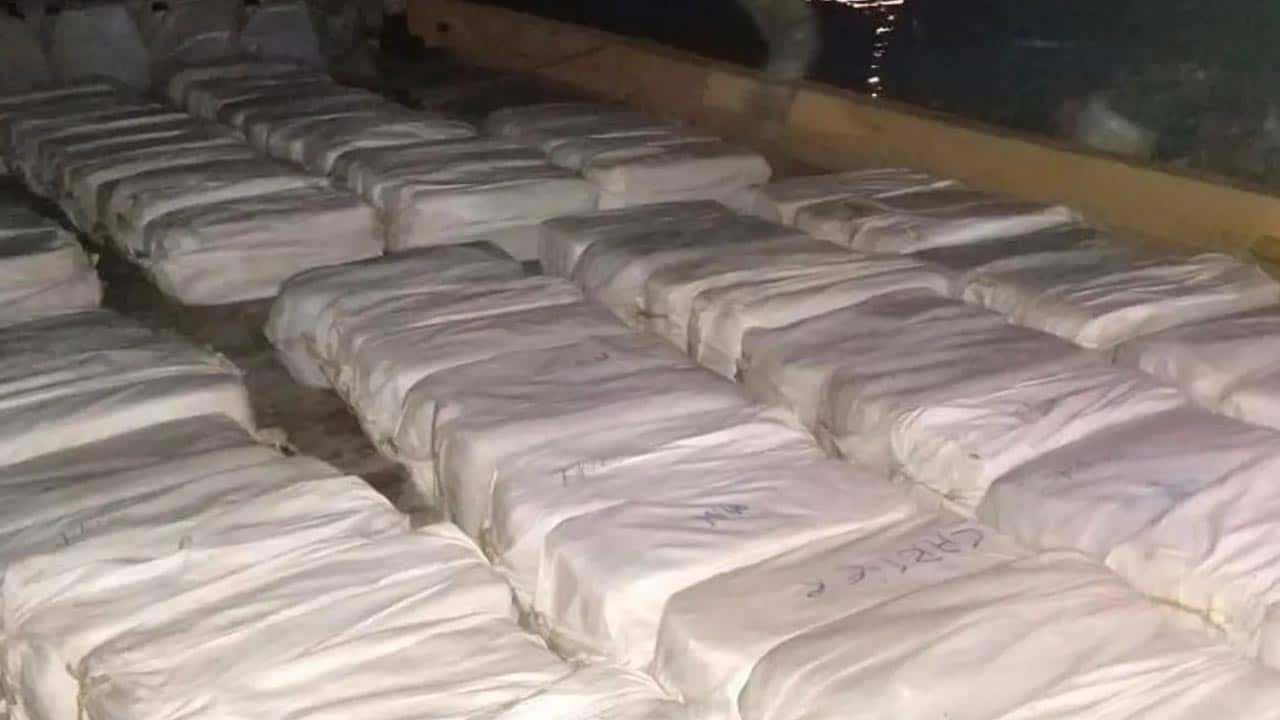
    During an operation on Sunday, the Anti-Narcotics Force (ANF) was able to recover more than a tonne of drugs and take two suspects into custody.

    According to a spokesman for the ANF headquarters, the ANF carried out a raid in the Islamabad area after receiving a tip, seizing nearly one tonne of drugs, including 1,020 kg of hash and 28.8 kg of heroin, as well as two members of an inter-provincial drug smuggling ring.

    The refrigerated container contained medicines that were being transported out of Balochistan. After filing a case against the accused, ANF began a new investigation to find other gang members, he continued.

    In other news, the Airports Security Force (ASF) recovered 7 kg of heroin on Sunday as a result of two separate raids at the airports in Lahore and Karachi.

    Asif Ali, a passenger travelling from Lahore to Bangkok, had 5.12 kg of heroin hidden in his hand luggage, according to Anti Narcotic Force (ANF) officers. The accused had expertly concealed the heroin in his hand luggage.

    In the second operation, which was carried out at the Karachi Airport, 1.47 kg of heroin was found in Ahmed Sher’s suitcase, who was travelling from Karachi to Medina.

    While ASF representatives said that the accused had been given to ANF for additional legal proceedings, including drug charges.

  • Anti-Narcotics Force recovers ice-infused bed sheets, 102 kg  drugs

    Anti-Narcotics Force recovers ice-infused bed sheets, 102 kg drugs

    The Anti-Narcotics Force (ANF) seized ice drug-infused bed sheets that were being smuggled to Australia during a raid at a courier service office in Lahore. Muhammad Asad, a Muzaffarabad resident, placed the order for the package.

    Along with detaining one accused person, ANF was able to recover over 102 kg of drugs in two other operations.

    ANF Intelligence carried out a raid on GT Road in Akora Khattak, according to a spokesman for the ANF Headquarters, and confiscated 102 kg of drugs, including 84 kg of hashish and 18 kg of opium, from a truck’s hidden compartments.

    A suspect named Zaib Gul, resident of Mansehra, was also detained by the ANF. The accused’s accomplices would also face imprisonment, according to ANF official.

    The suspects have been charged in separate cases, and additional inquiries are being conducted.

    in the wake of rising drug cases, the ANF has been quite active in recent months, carrying out several operations around the nation and making it nearly impossible to smuggle drugs.

  • PM Shehbaz to announce relief package for the poor

    PM Shehbaz to announce relief package for the poor

    Prime Minister (PM) Shehbaz Sharif will announce a relief package soon for those who are unable to afford fuel after a massive hike imposed by the government.

    This is undoubtedly an excellent news for the lower-income strata, as the recent petrol hike has weighed heavily on the inflation-stricken masses.

    Finance Minister Miftah Ismail announced last night a gigantic increase in the price of oil products in an attempt to reestablish the International Monetary Fund (IMF) plans to assist the country’s fragile economy.

    The decision was made in light of IMF guidelines, which required the removal of oil subsidies in order to restart Pakistan’s much-needed programme. On a talk show, Miftah Ismail slammed former Prime Minister Imran Khan for his contract with the IMF.

    “Imran Khan promised the IMF a Rs30 levy and a 17.5% sales tax on petroleum products,” he explained.

    The government is losing Rs120 billion per month as a result of Imran Khan’s unilateral decision to provide petrol subsidies, according to the finance minister.

    “Prime Minister Shehbaz Sharif had to make a difficult choice. However, he will announce a relief package for those who cannot afford high fuel prices in his address to the nation today,” Ismail added.

    According to Miftah, the government has already stated that the IMF programme will not begin unless petroleum subsidies are eliminated.

    Miftah Ismail voiced concerns about losing political capital as a result of the current decision to raise fuel prices, saying, “honestly telling you, we have admitted that by deciding on hiking fuel prices, we will suffer politically, but this is our country, and we will sacrifice to fix its issues”.

    Ismail acknowledged that the current increase in gasoline prices will shift the burden to the masses and increase inflation.

    Miftah dismissed the possibility of a default, saying, “I’m guaranteeing two things: the IMF programme will be restored, and Pakistan will not go bankrupt”.

  • OCAC warns of petrol supply shortages due to roadblocks

    OCAC warns of petrol supply shortages due to roadblocks

    Oil Companies Advisory Council (OCAC) said that oil marketing companies are supplying fuel to retailers but the deliveries are being slowed owing to road blockages in Punjab’s major cities, which could affect deliveries to filling stations.

    It warned provincial authorities in Punjab that the road blockades have severed connectivity between major cities and neighboring areas, affecting fuel supplies inside the province.

    The Oil Companies Advisory Council affirmed that there are sufficient stockpiles of gasoline products throughout the country, including depots in Punjab.

    It also highlighted fears about the current scenario of roadblocks and the rumoured assumption of minimal stocks spreading on numerous platforms and asked the public to refrain from panic buying. Despite the roadblocks, there are enough stockpiles of petrol and high-speed diesel (HSD) in Punjab, and OMCs are constantly working to restock retail outlets on time.

    OCAC expressed its concerns to the Chief Secretary of Punjab, requesting the local administration’s assistance in ensuring the safe and secure transit of tankers from different depots to different petrol outlets across the province till the scenario stabilizes.

  • Another hike of Rs4.9 per unit approved in power tariff

    Another hike of Rs4.9 per unit approved in power tariff

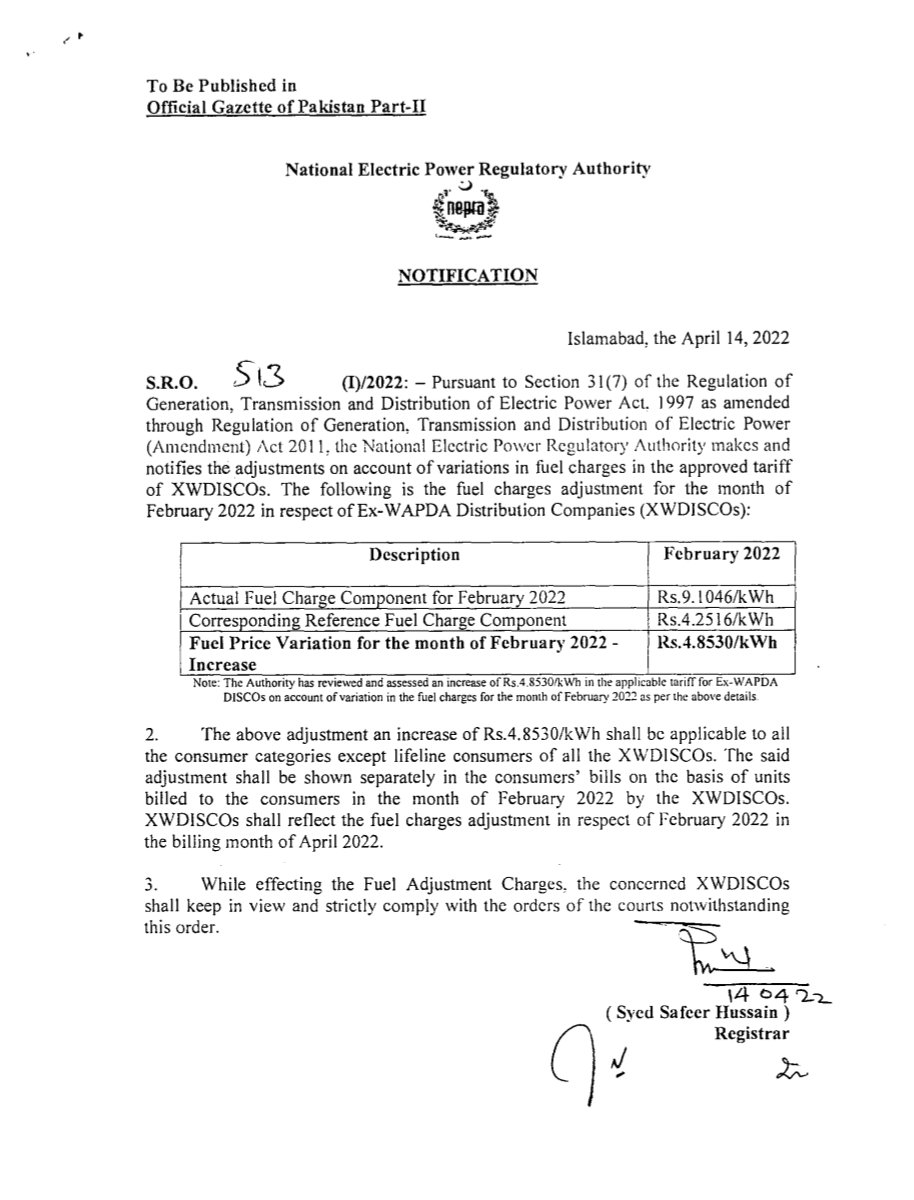
    Owing to the monthly Fuel Cost Adjustment (FCA) for February, the National Electric Power Regulatory Authority (NEPRA) on April 15 increased the price of electricity by Rs4.85 per unit.

    It has also announced an increase in the price of power, stating that the power output in February was more expensive than the previously set fuel price.

    According to the notice, the power distribution companies (DISCOs) will collect the amount from electricity consumers in the April bill. In addition, consumers will be hit with a charge of Rs37.7 billion, excluding general sales tax (GST). However, K-Electric and lifeline customers will be exempt from the hike.

    On March 31, the NEPRA held a hearing to determine the FCA but did not make a decision. The Central Power Purchasing Agency (CPPA) requested that the cost per unit be increased to Rs4.94 by the NEPRA.

    Following the monthly FCA, which only operates for one month, the administration had already hiked the power price to Rs5.95 per unit for the month of January.

    As per NEPRA’s data, the most expensive energy production sources, including High-Speed Diesel (HSD) and Residual Fuel Oil (RFO), were used more than average in the prior months, raising the overall cost of production.

  • PM Shehbaz rejects OGRA’s proposal, petrol price to remain unchanged till April 30

    PM Shehbaz rejects OGRA’s proposal, petrol price to remain unchanged till April 30

    Pakistan’s new Prime Minister (PM) Shehbaz Sharif on Friday dismissed the proposal from the Oil and Gas Regulatory Authority (OGRA) to raise the price of petroleum products for the fortnight. The recent decision is aimed at providing relief to the public affected by inflation.

    It is worth noting that the present government’s choice to maintain the same prices will oblige it to provide another substantial subsidy till the end of April 2022.

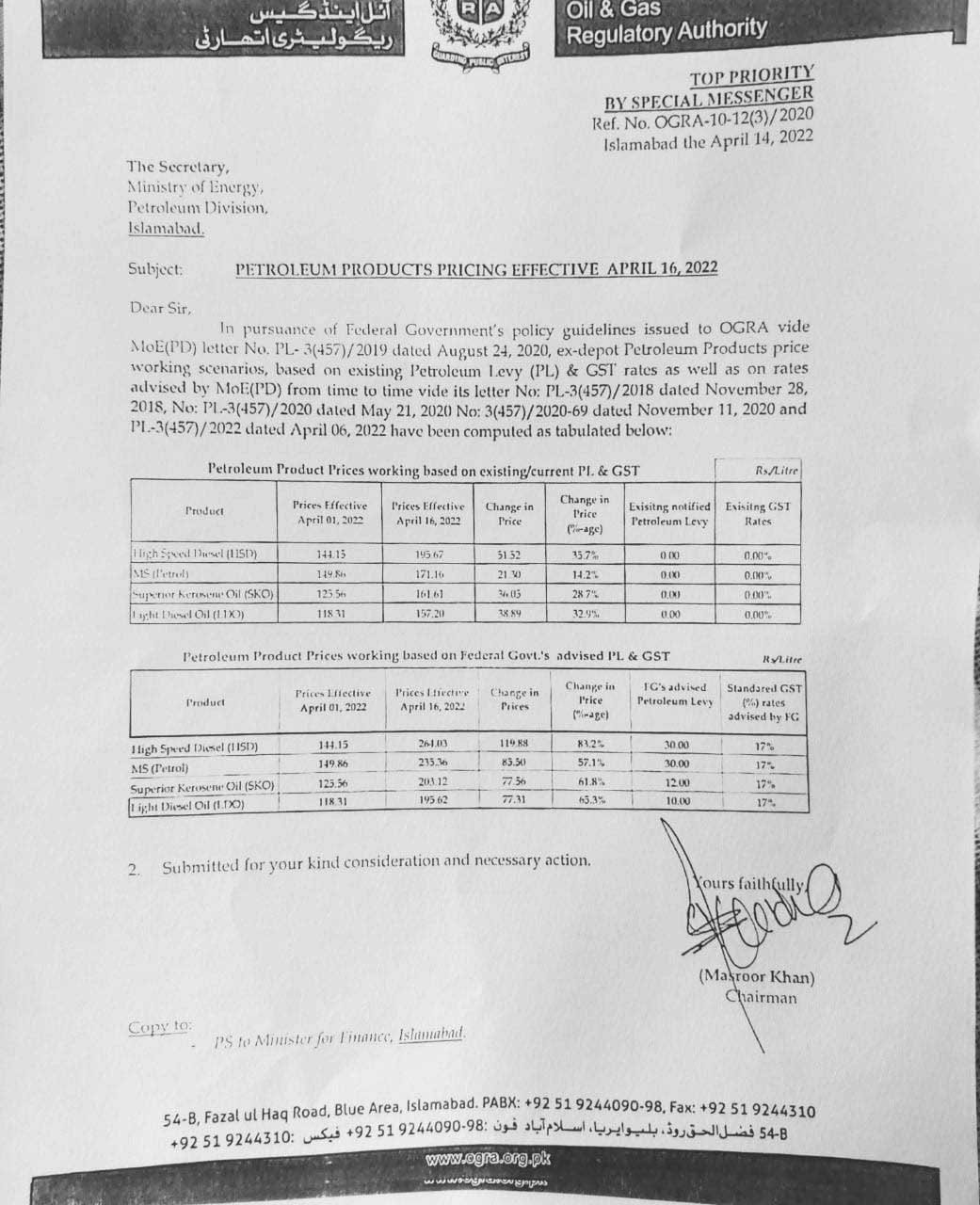
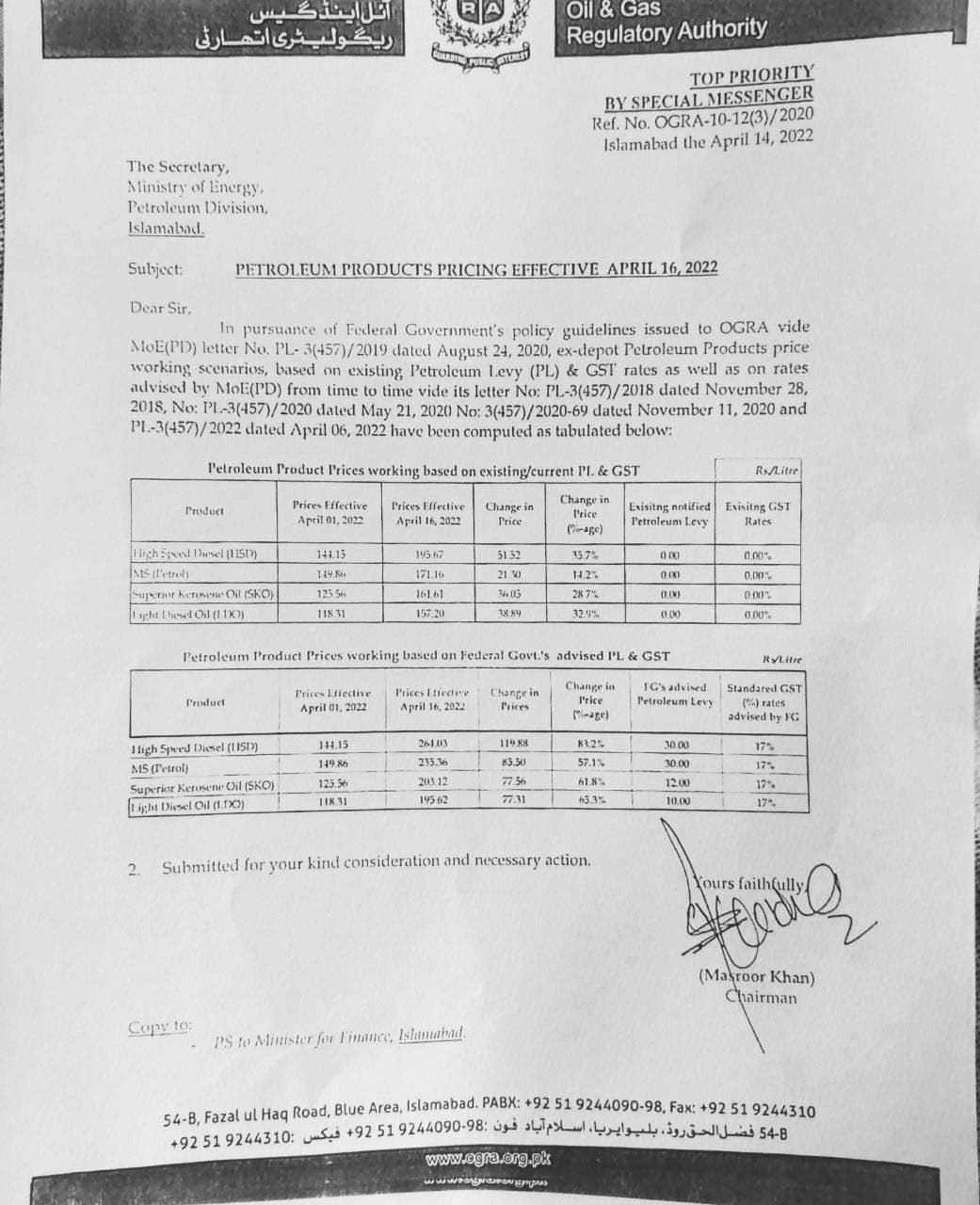
    Earlier, OGRA suggested to the Finance Division that the price of petrol be increased by Rs21.50 and that of diesel be hiked by Rs51.30 in view of the current petroleum levy and general sales tax (GST).

    Read more: Massive hike of Rs83.5 for petrol, Rs119 for diesel proposed by OGRA

    The authority also proposed a hike of Rs83.50 per liter of petrol and Rs119.88 per liter of diesel considering the federal government’s recommended petroleum levy of Rs30 and 17 per cent GST, as per the official statement.

  • Massive hike of Rs83.5 for petrol, Rs119 for diesel proposed by OGRA

    Massive hike of Rs83.5 for petrol, Rs119 for diesel proposed by OGRA

    The Oil and Gas Regulatory Authority (OGRA) suggested the federal government elevate fuel prices by up to Rs83.5 per liter for petrol and Rs119 for diesel.

    A summary to the petroleum division was presented by OGRA for the huge increase in petroleum rates to come into effect on April 16 in Pakistan.

    The proposed raise was calculated using a 70 per cent GST rate plus a Rs30 per liter levy. It is worth noting that the current duty on fuel and diesel is Rs30 per liter, plus 17 per cent GST.

    On the basis of complete levy and taxes, the body has recommended raising petrol prices by Rs83.5 per liter, while diesel prices should be raised by Rs119 per liter.

    According to reports, the OGRA proposed raising the petrol price to Rs21.53 per liter in line with the current tax rate, Rs51.3 for diesel, and Rs77.56 for kerosine oil on the grounds of full tax and levy.

    Read more: Gold prices go up by Rs350 per tola to Rs130,300

    Concerning other oil products, a full tax rate and levy hike of Rs77.31 was suggested for light diesel, Rs36.5 for kerosine oil, and Rs38.89 for light diesel. According to sources, the finance ministry would make the final decision on the OGRA summary after briefing Prime Minister Shehbaz Sharif.

  • International oil prices declined by 4%, crashing below $100 per barrel

    International oil prices declined by 4%, crashing below $100 per barrel

    Brent crude slid below $100 for the first time since March 16 amid plans to release huge amounts of petroleum and oil products from strategic storage, and also China’s prolonged coronavirus closure.

    Crude oil was down $4.1, or 3.99 per cent, at $98.68 per barrel. The price of US West Texas Intermediate (WTI) crude fell $4.28 a barrel, or 4.28 per cent, to $94.07 per barrel.

    The International Energy Agency (IEA) recently announced that member countries will release 60 million barrels over the next six months, with the United States matching that amount as part of its 180-million-barrel release announced in March.

    The actions are meant to make up for a shortfall of Russian crude after Moscow was extensively sanctioned for what it claims was a “special military operation” in Ukraine.

    As per JP Morgan analysts, the release of Strategic Petroleum Reserve (SPR) volumes will amount to 1.3 million barrels per day (BPD) over the next six months, enough to cover a 1 million BPD shortfall in Russian oil supplies.

    The release of strategic government oil reserves is projected to relieve some market tightness in the coming months, reducing the likelihood of oil prices rising and re-enforcing near-term supply constraints.

    While this is the largest release since the IEA stockpile was established in 1980, market participants believe it will fail to affect the principles of the oil market and will just delay further increases in production from crucial suppliers.

  • Petroleum sales increase by 23% in March, despite hefty oil prices

    Petroleum product sales rebounded in the last month after a dismal February with Oil marketing companies (OMC) witnessing an increase of 23 per cent in sales of petroleum products on a year-over-year (YoY) basis in March 2022.

    Overall petroleum sales in March 2022, increased to 1.82 million tonnes compared to 1.54 million tonnes in March 2021, as per the data released by Arif Habib Limited.

    The stability comeback shows a 19 per cent increase in overall OMC sales on a month-over-month (MoM) basis.

    OMC volume growth was driven by furnace oil, which climbed by 34 per cent on a YoY basis, followed by HSD volume growth of 29 per cent and MS volume growth of 13 per cent. MoM growth in OMC volumes followed a similar pattern, with FO taking the lead.

    Although the increase in furnace oil volumes was driven by increased furnace oil usage in the power sector due to low gas and Re-Gasified Liquefied Natural Gas (RLNG) availability.

    The increase in HSD volumes was driven by increased demand from the transportation and agriculture sectors and increased usage in generators and the power sector.

    Moreover, the government’s price caps and the additional number of days in March compared to February were the main contributors to MoM growth in diesel and gasoline sales.

    Consequently, petroleum sales increased by 19 per cent on a YOY basis in 9MFY22, with double-digit increases for petroleum products.

    Diesel sales grew by 17 per cent, followed by 16 per cent increase for furnace oil and a 10 per cent growth for motor oil.

    While some are expecting a drop in petroleum sales due to the political turmoil and rising commodity prices, others say that higher oil consumption cannot be overturned as the summer is already here and people are likely to consume more electricity, also that the power sector may switch to furnace oil due to RLNG commitment defaults.