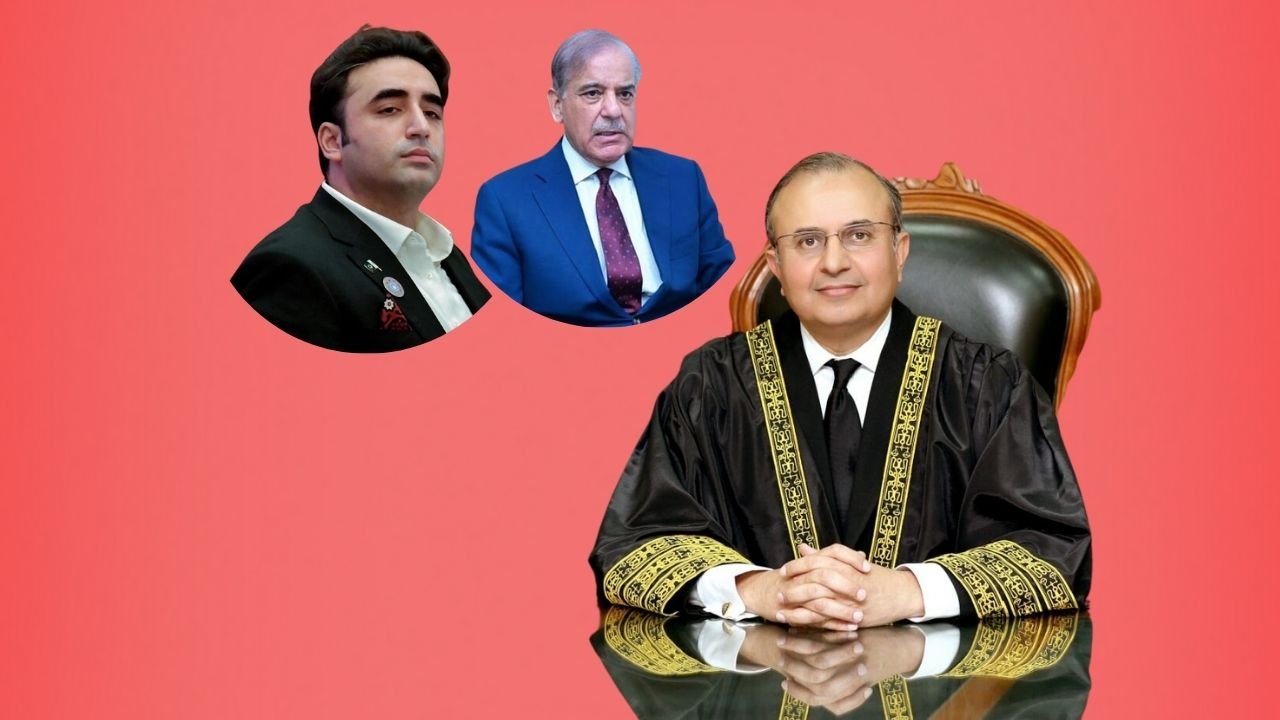
Tag: Mansoor ali Shah

  • Justice Mansoor Ali Shah on claims of ‘scheme to oust PML-N govt’

    Justice Mansoor Ali Shah on claims of ‘scheme to oust PML-N govt’

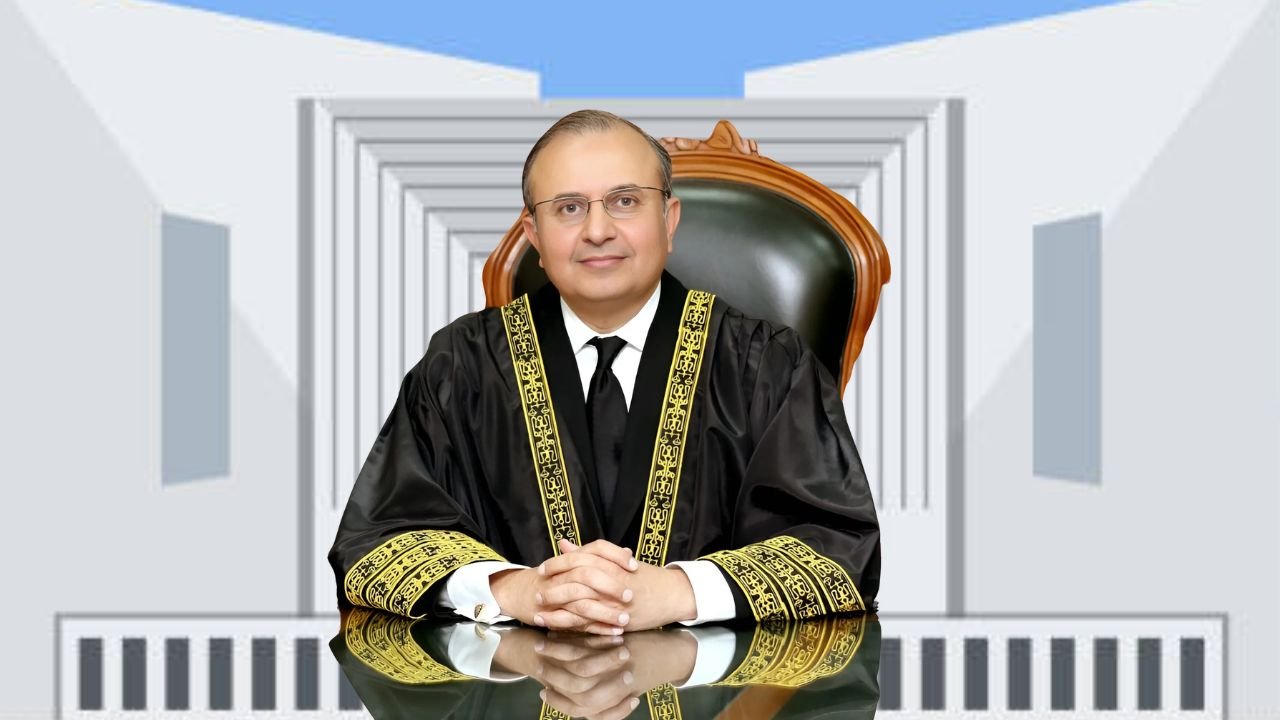
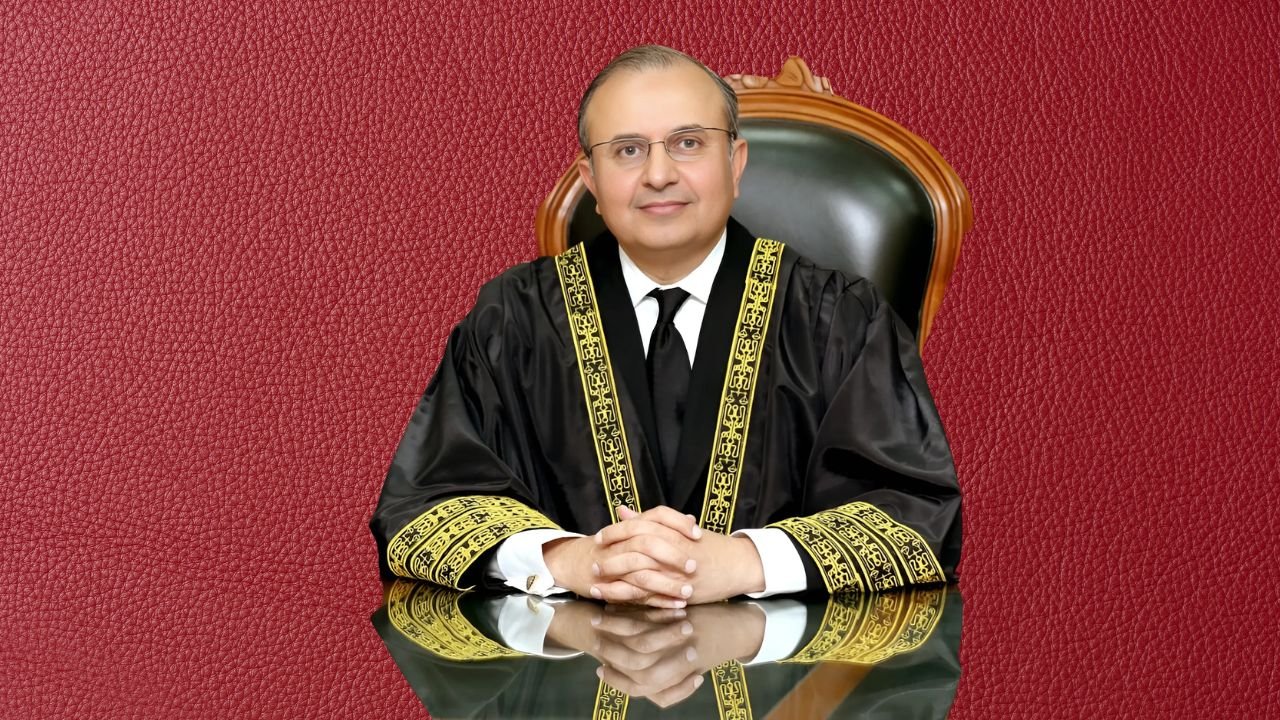
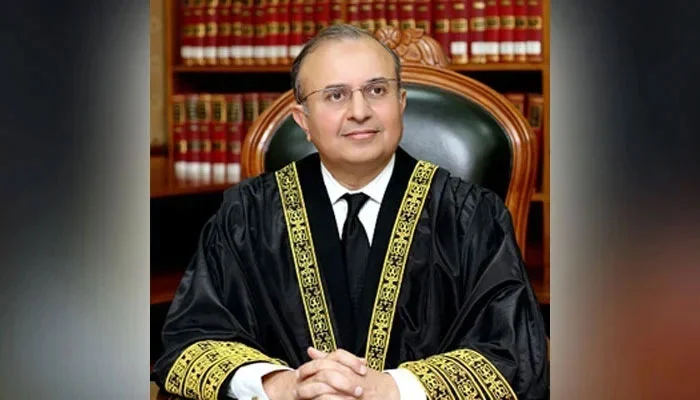
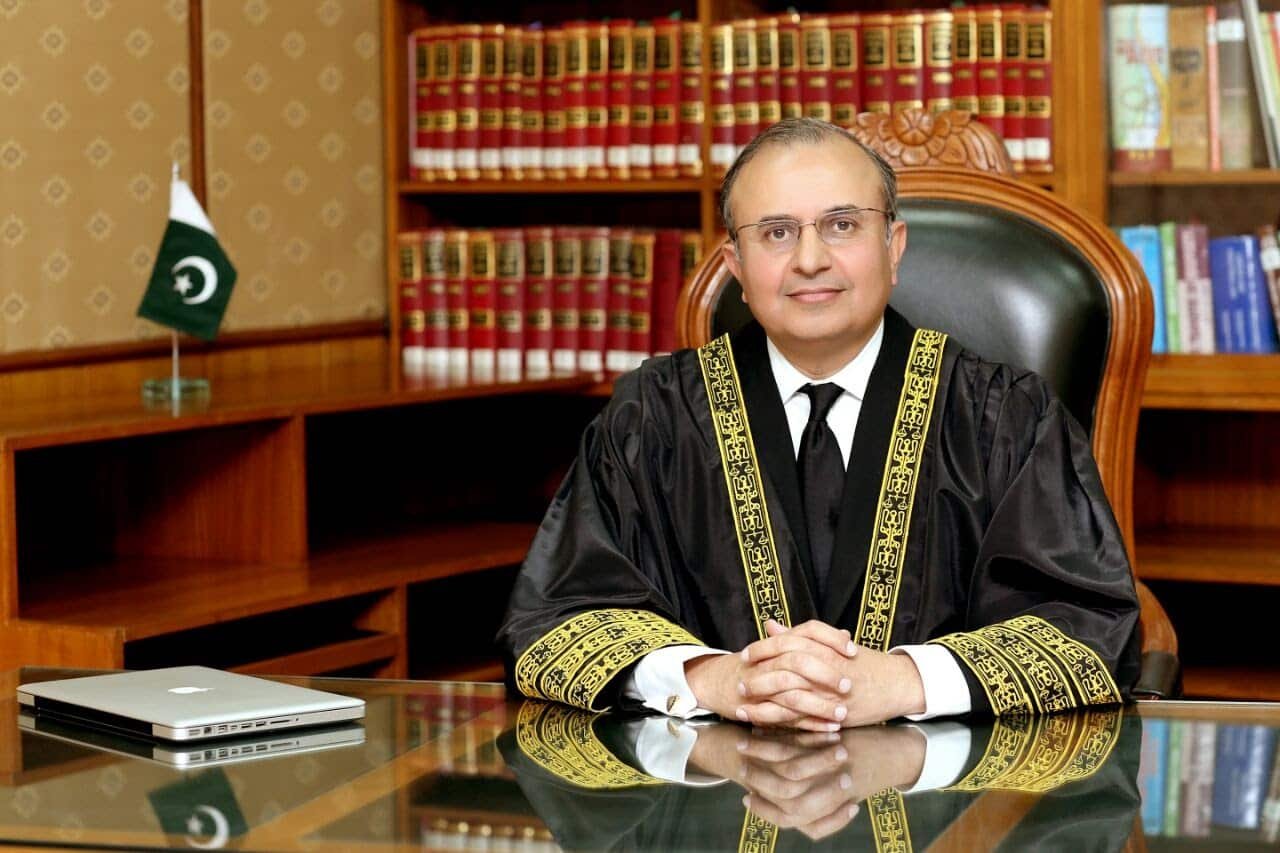
    Justice Mansoor Ali Shah has responded to the allegations and conspiracies against him regarding the possible ouster of the Pakistan Muslim League-Nawaz (PML-N) government had he been appointed as the next chief justice of Pakistan (CJP).

    Reports quoted a source close to Justice Shah as “categorically denying” any intentions or plans to remove the incumbent government if he had become the top judge.

    It may be noted that Justice Mansoor Ali Shah was the senior-most judge in the Supreme Court (SC) and next in line to become the CJP after the retirement of then-CJP Qazi Faez Isa.

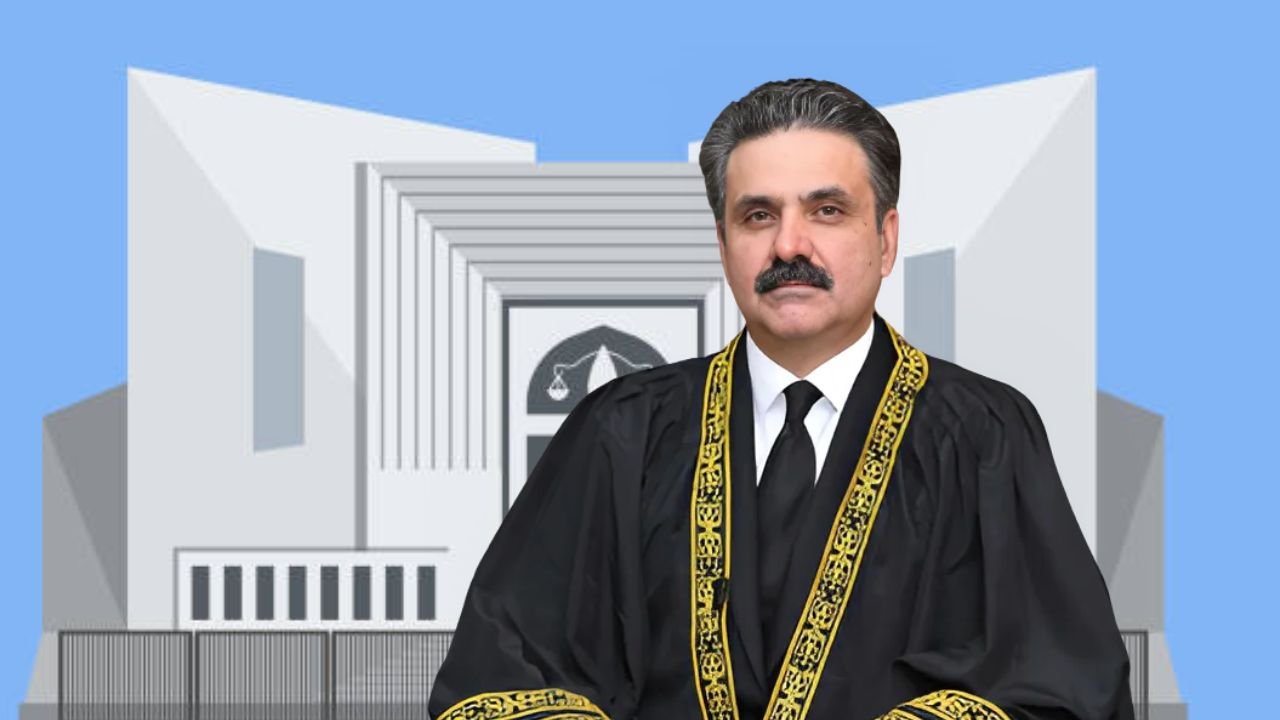
    However, with the passage of the 26th Constitutional Amendment, the scenario for the appointment of the senior-most judge as the CJP was scratched, paving the way for the nomination and subsequent appointment of the third senior-most judge, Yahya Afridi, as the top judge.

    The News also quoted the source as saying that a federal minister’s recent claims regarding the possible ouster of the government and Justice Shah bringing Imran Khan back to power was a “pack of lies”.

    “Justice Mansoor Ali Shah wants everyone to understand that he is totally apolitical. His interest is in promoting the constitution, rule of law and democracy, and nothing comes in the way of him in achieving this.”

    They also said that Justice Shah was not responsible for the actions of previous chief justices and he did not approve of their conduct.

    “He has even written against them. It’s unfair to generalise all judges this way. His judgments stand as his record. Read them,” the source added in response to Punjab Assembly Speaker Malik Ahmad Khan’s recent remarks on “judicial monarchy”.

    According to the report, the source skipped a question regarding Justice Mansoor Ali Shah’s stern letter to former CJP Qazi Faez Isa during the latter’s farewell reference. “Let’s discuss that another time,” they said.

    Justice Mansoor Ali Shah on October 25 had refused to attend Friday’s full court reference in honor of the outgoing Chief Justice of Pakistan Qazi Faez Isa.

    “To stand a Reference and celebrate such a tenure would send a message that a Chief Justice can betray his institution, erode its strength, act petty and low and still be celebrated as an honorable servant of justice. I am sorry, I in good conscious, cannot stand at a reference for such a Chief Justice,” opined Puisne judge Mansoor Ali Shah in a in a letter of refusal on the record of the reference proceedings,
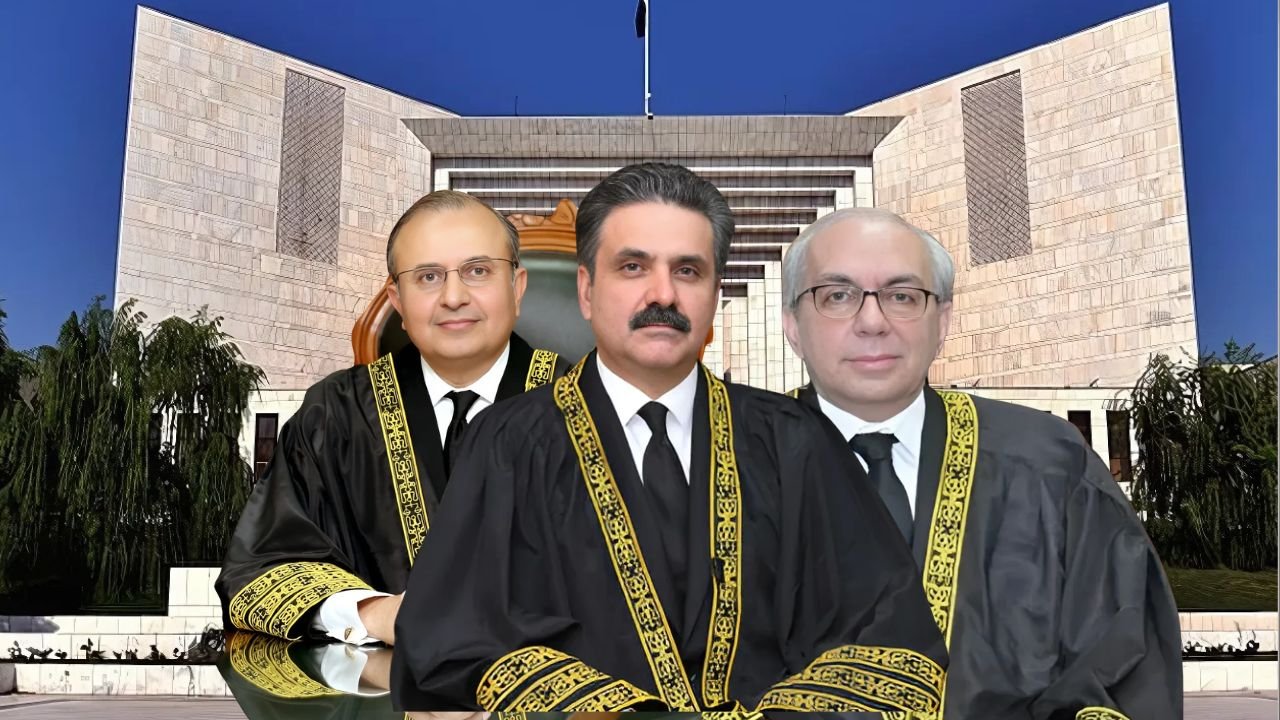

  • CJP brings back Justice Mansoor Ali Shah, Munib Akhtar to bench-formation committee

    CJP brings back Justice Mansoor Ali Shah, Munib Akhtar to bench-formation committee

    In an interesting development, newly-sworn Chief Justice of Pakistan (CJP) Yahya Afridi has reconstituted the Practice and Procedure Committee of the Supreme Court (SC).

    As per the details, CJP Afridi, on his first day as the top judge, brought back Justice Mansoor Ali Shah and Justice Munib Akhtar to the apex court committee that decides on bench formation and case fixation.

    This means that no bench can be formed, or cases can be heard without their assent.

    “In supersession of this court’s office order of even number dated 20-09-2024 and in the exercise of powers under section 2 (1) of the Supreme Court (Practice and Procedure Act) 2023 as amended by the Ordinance eight of 2024, the Hon’ble Chief Justice of Pakistan has been pleased to reconstitute the requisite committee,” read a notification issued by the SC on Saturday.

    “The committee stands constituted as under: Justice Yahya Afridi, chief justice of Pakistan, Justice Mansoor Ali Shah, senior puisne judge and Justice Munib Akhtar,” it added.

    Originally, the committee was supposed to consist of the three senior-most SC judges to deal with cases under Article 184(3) of the Constitution — often referred to as the apex court’s suo motu jurisdiction.

    Following an ordinance last month to amend the Supreme Court (Practice and Procedure) Act 2023 — a law that aimed to curtail the chief justice’s powers — the top judge could now pick any SC judge to be the third member of the body.

    Subsequently, Justice Isa had removed Justice Akhtar, the second in the line of seniority after the CJP, from the committee and made Justice Aminuddin Khan a part of it.

    At the time, Justice Khan was fourth in the line of seniority after the CJP, while Justice Afridi was the third senior-most judge.

    Speaking at the full court reference Friday, CJP Yahya had stressed that the “rule of law shall rule” and the principles of trichotomy of power shall prevail during the time ahead.

    He indicated that the immediate focus would be on districts furthest away, on improving the justice delivery system and facilitating the cases of women, children, and the disabled.

    During a hearing earlier this week, Justice Afridi said a separate category would be created for cases where any law had been challenged or needed constitutional interpretation — in line with the 26th Amendment that entailed the formation of constitutional benches.

  • History never forgives: Justice Mansoor Ali Shah

    History never forgives: Justice Mansoor Ali Shah

    Supreme Court senior judge Syed Mansoor Ali Shah has refused to sit at special or larger benches formed by the committee after Supreme Court Practice and Procedure Act 2023 amendments passed through a Presidential Ordinance last month.

    In a letter addressed to the committee, led by Chief Justice Qazi Faez Isa, Justice Shah expressed his concerns about the formation of benches, writing: “I will not participate in special benches formed by the new committee and will only attend sittings of regular benches to hear the cases of ordinary litigants in the larger public interest.”

    “We often forget, when in power, that people of this country are watching our actions and that history never forgives,” he remarked.

    He quoted Sir Thomas More from A Man for All Seasons: “I think that when statesmen forsake their own private conscience for the sake of their public duties, they lead their country by a short route to chaos.”

    There has been significant controversy over the appointment of the next CJP after the coalition government successfully passed the 26th amendment, which gave more power to the Special Parliamentary Committee to appoint the next Chief Justice.

    Before the amendments, Justice Shah, being the senior judge, would have become the next CJP after Justice Isa. The committee, however, nominated Justice Yahya Afridi as the next CJP, bypassing the other two senior judges, Justice Mansoor Ali Shah and Justice Munib Akhtar.

  • Here’s why govt didn’t want Mansoor Ali Shah as next chief justice

    Here’s why govt didn’t want Mansoor Ali Shah as next chief justice

    In an interesting development, prominent journalist Fakhar Durrani revealed why the government didn’t want Justice Mansoor Ali Shah as the next chief justice of Pakistan.

    Speaking on ‘Fact Check Pakistan,’ he disclosed that things started turning against Justice Shah after he announced the reserved seats verdict on 12 July.

    On July 12, the Supreme Court of Pakistan declared Pakistan Tehreek-e-Insaf eligible for reserved seats of Women and non-muslims.

    Chaired by Chief Justice Pakistan Qazi Faez Isa, the 13-member larger bench was hearing the appeal filed by the Sunni Ittehad Council party against the Peshawar High Court’s (PHCs) recent reserved seat verdict.

    Justice Mansoor Ali Shah, a second senior judge in the top court (counting Qazi Faez Isa as the first), had announced the majority eight-member verdict on reserved seats and ordered the Election Commission of Pakistan (ECP) for the allotment of Women and non-muslim seats to PTI.

    The other eight member judges, along with Justice Mansoor Ali Shah, were Justice Shahid Waheed, Justice Ayesha Malik, Justice Irfan Saadat, Justice Athar Minallah, Justice Munib Akhtar, Justice Hasan Azhar Rizvi, and Justice Muhammad.

    Fakhar Durrani stated that following the verdict on reserved seats, Justice Shah reportedly sent a WhatsApp message to one of his wives, which the country’s agencies intercepted and informed the government about it.

    “Main ne tumhary leader kay liye ye kar diya hai,” Fakhar Durrani quotes the message.

    He also said that Justice Mansoor Ali Shah’s further conversation was collected, which was reportedly biased towards Pakistan Tehreek-e-Insaf (PTI).

    Based on Shah’s tilt toward PTI and the fear that Shah Could give the government a tough time, the ruling government decided to pass the 26th Constitutional Amendment before October 25, the date when Chief Justice of Pakistan (CJP) Qazi Faez Isa would retire as CJP, Durrani added.

    Durrani also claimed that Chairman Pakistan Peoples Party (PPP) Bilawal Bhutto Zardari, while giving the reason for the judiciary’s past controversial verdict and citing the top court verdict on the disqualification of former prime minister Nawaz Sharif, convinced Jamiat Ulema-e-Islam Fazl (JUI-F)

    “There should be a process of accountability for judges, and parliament should have a role in the appointment of judges,” Bhutto had said.

    Clarifying why Justice Mansoor Ali Shah’s message was not made public, the journalist claimed that the message was not public by the government amid fear of being disgraced internationally.

    Justice Mansoor Ali Shah has not responded to this latest development that journalist Fakhar Durrani claimed.

  • Will Justice Yahya Afridi accept his nomination as chief justice?

    Will Justice Yahya Afridi accept his nomination as chief justice?

    With Justice Yahya Afridi’s name being finalized as the next chief justice of Pakistan (CJP), opposition leader and netizens are speculating whether Justice Afridi will be accepting the post or not.

    President Asif Ali Zardari on Wednesday appointed Justice Yahya Afridi as the next CJP, who will take over the reins from incumbent CJP Qazi Faez Isa later this week. Justice Afridi has been appointed for a fixed three-year term starting on October 26, said a statement from Aiwan-e-Sadr.

    Soon after Justice Afridi’s nomination by a special parliamentary committee, formed under the 26th Amendment, PTI leader Hamid Khan, in conversation with a private media outlet on Tuesday night, expressed hope that Justice Afridi “would decline the position”.

    The statement left the internet divided, with people speculating whether Justice Afridi will be accepting the position of the country’s 30th CJP.

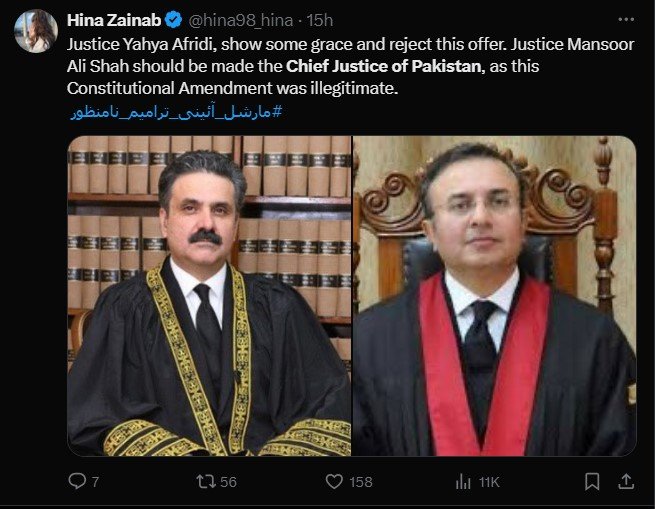
    Some social media users went on to suggest that Justice Afridi should not accept the position owing to the changes in process of appointment of the country’s top judge under the 26th Amendment.

    “Justice Yahya Afridi, show some grace and reject this offer. Justice Mansoor Ali Shah should be made the Chief Justice of Pakistan, as this Constitutional Amendment was illegitimate,” wrote one user, calling out the ruling coalition.

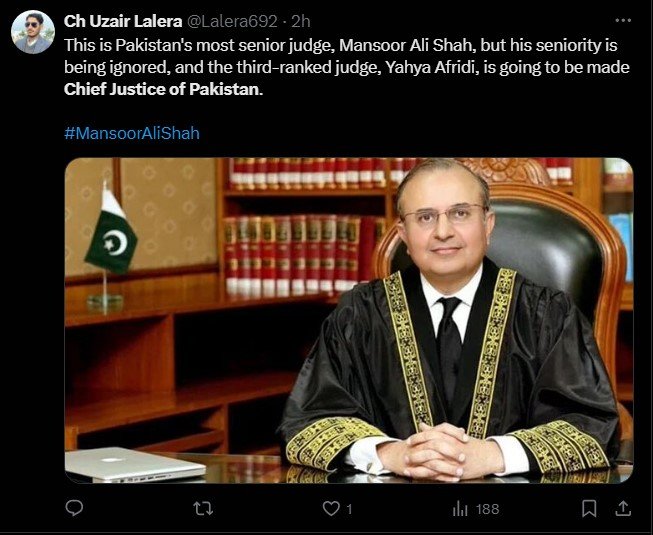
    Showing concern over the appointment of the third senior-most judge instead of senior-most Justice Mansoor Ali Shah after CJP Qazi Faez Isa, another user wrote, “This is Pakistan’s most senior judge, Mansoor Ali Shah, but his seniority is being ignored, and the third-ranked judge, Yahya Afridi, is going to be made Chief Justice of Pakistan.”

    It may be noted that neither Justice Afridi himself, any Supreme Court (SC) judges nor other relevant authorities have so far hinted at the possibility of Justice Afridi refusing to take charge as the country’s top judge. Instead, media reports on Wednesday afternoon claimed that the incumbent chief judge among other members of the judicial community had already congratulated Justice Afridi.

    On late Sunday night, the Parliament passed the 26th Amendment, ruling out the scenario of the senior-most SC judge’s appointment as the CJP. Under the changes, the appointment of the CJP shall now be made from among the three senior-most judges of the apex court on the recommendation of a special parliamentary committee.

    Justice Mansoor Ali Shah, Justice Munib Akhtar and Justice Yahya Afridi were in the race for the slot of the country’s top judge till a special parliamentary committee nominated Justice Yahya Afridi.

  • Here’s how Justice Mansoor Ali Shah reacted to Yahya Afridi’s appointment as CJP

    Here’s how Justice Mansoor Ali Shah reacted to Yahya Afridi’s appointment as CJP

    A claim regarding Justice Mansoor Ali Shah’s reaction to Justice Yahya Afridi’s appointment as the next chief justice of Pakistan (CJP), has taken the internet by storm.


    Justice Shah, who was next in line to be the CJP on the basis of seniority, was on Tuesday sidelined for the appointment of Justice Yahya Afridi, as a Special Parliamentary Committee, formed under the 26th Amendment, nominated the latter instead.


    The committee, with a two-thirds majority, referred Justice Afridi’s name to Prime Minister Shehbaz Sharif, who later forwarded it to President Asif Ali Zardari for a final nod.


    With the Law Minister Azam Nazeer Tarar announcing the decision of the parliamentary committee last night, senior journalist Meher Bokhari shared on X (formerly Twitter) a claim regarding Justice Shah’s reaction to the news.


    “Just spoke to a close family member of Justice Mansoor Ali Shah. He said, ‘I am fine and going off to sleep and need to go early to SC [sic],” she claimed

    It wasn’t later when social media was flooded with commentary on Justice Shah’s reaction.


    One user trolled Meher Bokhari and said, “It was quite a revelation indeed. I also talked to a family member of Justice Mansoor Ali Shah, and he said, ‘I’ll wake up and brush my teeth.”


    “Sanu ki paway lambi taan kay sawy ya choti,” another user posted.


    Optimistically, one X user wrote, “Justice Mansoor Ali Shah’s commitment to his duty speaks volumes. Let’s hope his integrity remains intact amidst all the political pressure.”


    Justice Yahya Afridi’s Early Life

    Justice Yahya Afridi was born in Dera Ismail Khan on Jan 23, 1965. Justice Afridi belongs to the Adam Khel clan of the Afridi tribe and is a resident of Kohat’s Babari Banda village. He comes from a family steeped in the tradition of public service, as per Dawn News.


    Justice Afridi attended Aitchison College and Government College, Lahore, for his schooling and undergraduate degree. He later secured an MA degree in Economics from Punjab University.


    After being awarded a Commonwealth Scholarship, Justice Afridi completed his LLM from Jesus College at the University of Cambridge. He was subsequently selected for a scholarship programme for Young Commonwealth Lawyers at the Institute of Legal Studies in London.


    He was enrolled as a high court advocate in 1990 and a Supreme Court lawyer in 2004. He served as an assistant advocate general for Khyber Pakhtunkhwa and as federal counsel for the federal government while in practice.


    Justice Afridi was elevated to the Peshawar High Court (PHC) as an additional judge in 2010, and confirmed as a PHC judge on March 15th, 2012.


    He was elevated to the Supreme Court on June 29, 2018.


    Justice Yahya Afridi will take oath as CJP on October 26.

  • Justice Mansoor Ali Shah urges women to be part of judiciary

    Justice Mansoor Ali Shah urges women to be part of judiciary

    Justice Mansoor Ali Shah of the Supreme Court of Pakistan has stressed the need for women’s participation in the country’s judiciary.  

    Justice Mansoor Ali Shah pointed out the gap between population demographics and the representation of women within the country’s judicial system.

    “Article 34 of our Constitution mandates full participation of women in all spheres of life,” said Justice Shah. He also said that 50 percent of the country’s population is women, but only 16 percent are connected with the judiciary.

  • Court fails to recognise legislative authority of parliament: Justice Mansoor Ali Shah

    Court fails to recognise legislative authority of parliament: Justice Mansoor Ali Shah

    In a 2-1 majority decision, the Supreme Court (SC) invalidated changes made by parliament to the National Accountability Bureau (NAB) regulations. Justice Mansoor Ali Shah commented that the decision failed to recognise the legislative authority of parliament.

    Imran Khan, the leader of the Pakistan Tehreek-e-Insaf (PTI), received approval on Friday from a three-member SC panel for his appeal challenging amendments made to the country’s accountability legislation under the previous administration, which was led by the Pakistan Democratic Movement (PDM).

    The majority decision, according to the verdict, found the petition against the NAB changes valid, reopening all closed inquiries submitted to the anti-graft body.

    “The majority judgement has also fallen short to appreciate that what Parliament has done, Parliament can undo; the legislative power of the Parliament is never exhausted,” Justice Shah said in his dissenting note.

  • ‘Another lie of Faisal Vawda has been exposed’: PTI leader used expired passport to prove single nationality

    ‘Another lie of Faisal Vawda has been exposed’: PTI leader used expired passport to prove single nationality

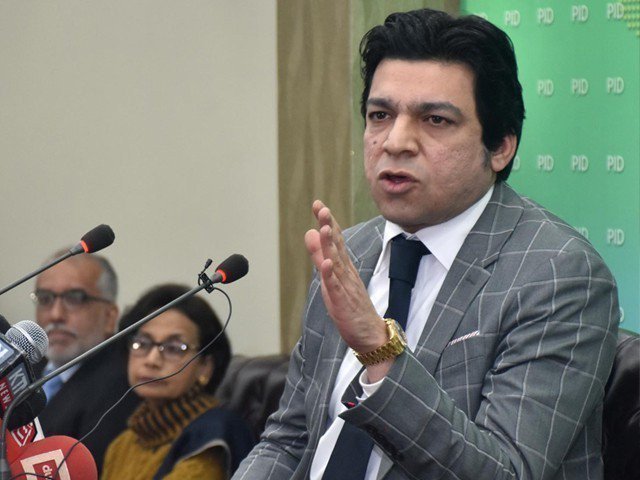
    Justice Mansoor Ali Shah of the Supreme Court (SC) Wednesday remarked that another lie of Pakistan Tehreek-e-Insaf (PTI) leader Faisal Vawda has been caught as the court took up the former federal minister’s petition against a lifetime ban imposed on him by the Election Commission of Pakistan (ECP).

    A three member-bench headed by Chief Justice Umar Ata Bandial, Justice Mansoor Ali Shah and Justice Ayesha Malik heard the petition.

    Justice Ayesha Malik remarked that the cancelled passport which the counsel was relying upon expired in 2015 but was shown to the RO in 2018.

    “When you get the new passport, the older one is stamped cancelled. How can a cancelled passport be evidence of renouncing the nationality,” she asked.

    To this, CJP Bandial said that the issue has become very serious.

    Justice Mansoor Ali Shah then said, “Another lie of Faisal Vawda has been exposed”.

    The hearing was adjourned for two weeks after Faisal Vawda’s counsel, Wasim Sajjad asked for more time for preparation.

    At this, Justice Mansoor Ali Shah said, “You will not get answers of these queries even after a week.